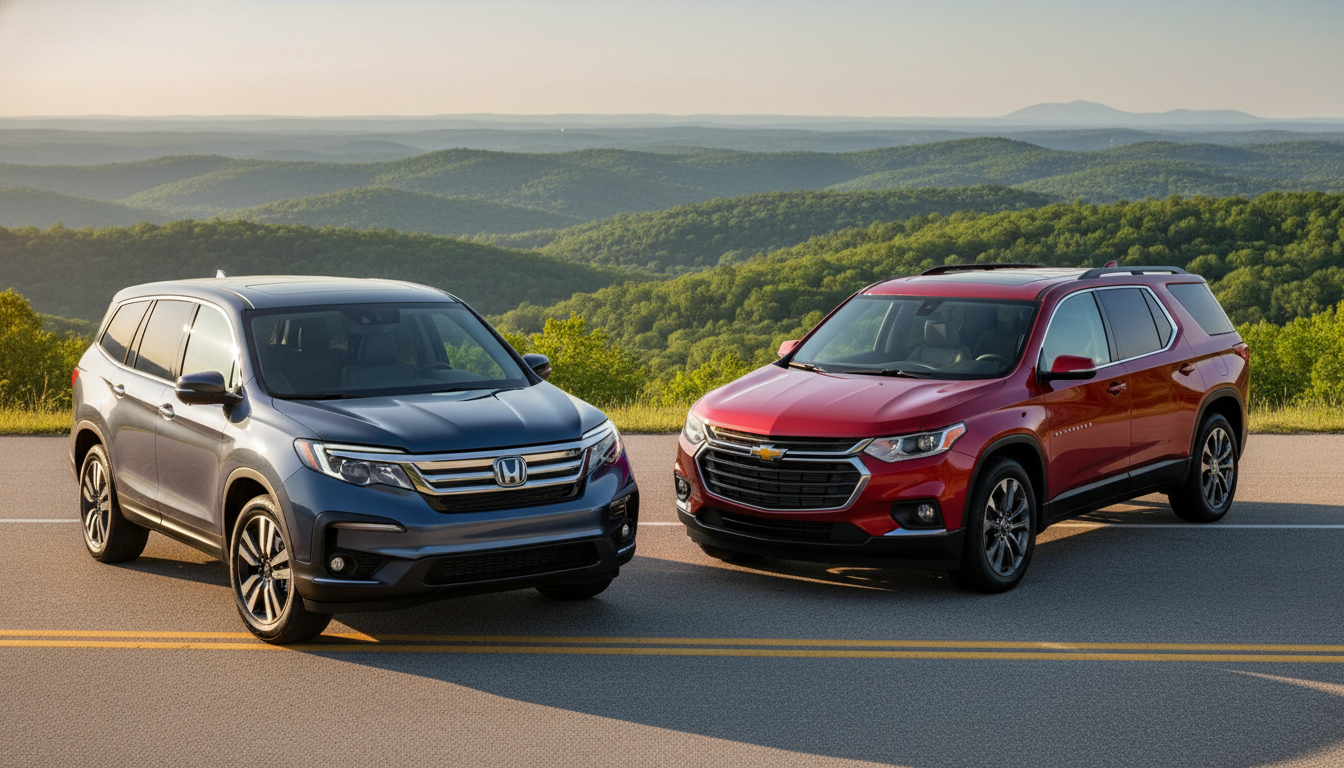
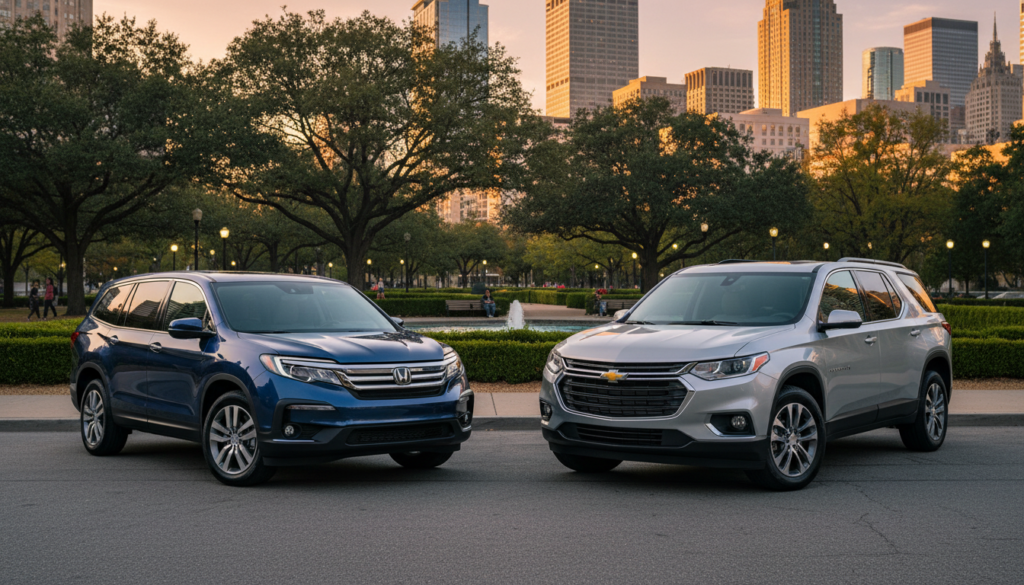
Honda Pilot vs Chevy Traverse 2020: Which Midsize SUV is Right for You?
The choice between these two midsize crossovers starts with numbers and ends with real life. To decide, buyers need clear facts on performance, cabin space, and price.
The 2020 chevrolet traverse opens at $36,198, while the 2020 honda pilot begins around $41,290 for its base trim. Those entry prices set different expectations for features and value.
This guide compares engines, seating, and interior dimensions side-by-side. It also breaks down available trim levels so you know what each car gives you at each price point.
Families will find practical advice on how each suv fits daily routines and long trips. The goal is simple: make the decision process easier with clear, useful data.
Introduction to the 2020 Midsize SUV Market
Shoppers in the midsize SUV market balance seating, cargo and cost when comparing large three-row options. The segment mixes true family haulers with more compact crossovers, so buyers must match needs to size and budget.
The 2020 chevrolet traverse starts at $36,198 and offers 7 or 8 seats. The 2020 honda pilot begins near $41,290 and also seats seven or eight, which keeps both models central to family buying decisions.
Competitors range from value-focused models like the honda cr-v and nissan rogue to premium alternatives such as the acura mdx and buick enclave. Shoppers may also contrast these with compact choices like the volvo xc40 or the volkswagen tiguan.
Every vehicle in this class must balance passenger capacity and cargo versatility to stay relevant. Understanding that balance helps buyers decide if a large 3-row SUV or a smaller crossover better fits daily life.
| Model | Starting Price | Seating | Positioning |
|---|---|---|---|
| Chevrolet Traverse | $36,198 | 7–8 | Value-focused 3-row SUV |
| Honda Pilot | $41,290 | 7–8 | Comfort and family utility |
| Acura MDX / Buick Enclave | $43,000–$45,000* | 7 | Premium alternatives |
| Honda CR-V / Nissan Rogue | $25,000–$30,000* | 5 | Smaller crossover options |
Honda Pilot vs Chevy Traverse 2020: A Direct Comparison
Comparing access and cabin calm reveals practical strengths that affect daily use. This section focuses on how each model handles back-seat access and in-cabin noise so buyers can pick what suits family life.
Third Row Accessibility
The 2020 honda pilot provides a third row that is widely praised for adult-sized space. Seats fold and slide with straightforward motions, making entry easier for grown passengers.
By contrast, the 2020 chevrolet traverse has a tighter rear area. Access often requires more effort, especially when folding second-row seats to reach the back row.
| Feature | Honda Pilot | Chevrolet Traverse |
|---|---|---|
| Third row space | Adult comfortable | Best for children or short trips |
| Access method | Easy slide-and-tilt second row | Requires larger seat movement |
| Trim focus | Comfort for all rows | Modern front cabin emphasis |
Cabin Quietness
The Pilot emphasizes a quiet cabin that reduces road and wind noise on long drives. That calm helps conversations and makes long trips less tiring.
The Traverse features a modern front layout and tech-first cockpit. Both models prioritize driver comfort, but the Pilot’s layout and insulation often earn higher marks for overall serenity.
Engine Performance and Powertrain Specs
Under the hood, power delivery and gearing determine how each midsize SUV performs on daily drives and long hauls.
The chevrolet traverse uses a 3.6L V-6 that produces 310 horsepower and 266 lb-ft of torque. That extra horsepower gives the traverse stronger acceleration for highway passing and loaded driving.
By comparison, the honda pilot pairs a 3.5L V-6 with 280 horsepower and 262 lb-ft of torque. The pilot’s output favors smooth, predictable power delivery that helps with steady cruising and city driving.
Both models employ advanced automatic transmissions tuned to manage torque and improve efficiency. Drivers who tow or carry heavy loads should note the traverse’s higher peak power, while those who prefer calm, linear throttle feel may lean toward the pilot.
| Spec | Chevrolet Traverse | Honda Pilot |
|---|---|---|
| Engine | 3.6L V-6 | 3.5L V-6 |
| Horsepower | 310 hp | 280 hp |
| Torque | 266 lb-ft | 262 lb-ft |
| Transmission | Advanced automatic | Advanced automatic |
Fuel Efficiency and Driving Range
Small differences in consumption can mean big savings across a year of commuting and errands. This section reviews real-world fuel numbers and how tank size affects range for both models.
City vs Highway Consumption
The 2020 honda pilot posts 13.0 L/100 km in the city and 9.3 L/100 km on the highway. That yields a combined rating of 11.3 L/100 km.
The 2020 chevrolet traverse rates 13.6 L/100 km in the city and 9.6 L/100 km on the highway, with a combined 11.8 L/100 km.
Families who do a lot of city driving will notice the Pilot’s slight edge in efficiency. For long highway trips, both models are similar, but tank capacity shifts the practical range.
| Metric | Honda Pilot | Chevrolet Traverse |
|---|---|---|
| City (L/100 km) | 13.0 | 13.6 |
| Highway (L/100 km) | 9.3 | 9.6 |
| Combined (L/100 km) | 11.3 | 11.8 |
| Fuel tank (L) | 74 | 82 |
| Practical note | Better economy for frequent city driving | Longer range between stops on mixed routes |
Interior Dimensions and Passenger Comfort
Legroom and seating layout shape the day-to-day usability of a three-row crossover.
The 2020 honda pilot emphasizes rear passenger comfort with 1004 mm of front legroom and 1040 mm in the second row. That extra second-row room helps adults sit more comfortably on long trips.
The 2020 chevrolet traverse offers 1049 mm up front and 1016 mm in the second row. Its front-seat space favors drivers and front passengers who want a stretch-out feel.
Both models prioritize passenger comfort, but the Pilot’s layout is often praised for making the most of second- and third-row space. Families should test-seat both to feel which room suits car seats, tall passengers, or frequent long drives.
| Metric | Honda Pilot | Chevrolet Traverse |
|---|---|---|
| Front legroom (mm) | 1004 | 1049 |
| Second-row legroom (mm) | 1040 | 1016 |
| Best for | Rear passenger room | Front stretch-out space |
Cargo Space and Storage Versatility
How much you can haul and how easily it stows shapes the real usefulness of a three-row SUV.
Maximum Cargo Capacity
The 2020 honda pilot excels in maximum cargo, offering up to 3092 L with all rear seats folded flat. That makes it a top pick for large loads, moving day items, or roof gear.
Trunk Space Behind Rear Seats
The 2020 chevrolet traverse provides 651 L of trunk space behind the third row. The Pilot has 524 L behind the rear seats, so the Traverse gives more immediate cargo room with all seats in place.
Storage versatility favors each model in different use cases. The Pilot offers greater max volume for bulk hauling. The Traverse balances trunk space and passenger room for families who keep the third row in use more often.
| Metric | Honda Pilot | Chevrolet Traverse |
|---|---|---|
| Trunk behind rear seats | 524 L | 651 L |
| Max cargo capacity | 3092 L | 2781 L |
| Best for | Maximum cargo and fold-flat utility | Immediate trunk space with passengers aboard |
Safety Ratings and Crash Test Results
Safety ratings give clear, independent insight into crash protection and rollover risk for family SUVs.
The 2020 honda pilot and the 2020 chevrolet traverse each earned an NHTSA overall rating of 5 stars. That top score signals strong occupant protection in combined testing and helps buyers assess real-world safety at a glance.
In frontal crash testing both models recorded 4 stars, showing consistent protection for the driver and front passenger. These results reflect restraint systems and engineered crush zones that reduce forward injury risk.
Both vehicles also earned 4 stars in rollover assessments, which improves confidence when matching a family vehicle to daily needs. Manufacturers invested in structural integrity and safety design to reach these marks.
| Model | Overall (NHTSA) | Frontal | Rollover |
|---|---|---|---|
| 2020 honda pilot | 5 stars | 4 stars | 4 stars |
| 2020 chevrolet traverse | 5 stars | 4 stars | 4 stars |
Standard Safety Equipment and Driver Assistance
Active driver aids and visible alerts shape how families trust a three-row SUV day to day.
The honda pilot arrives with the Honda Sensing suite as standard. That package includes Collision Mitigation Braking and Lane Keeping Assist to help the driver avoid or reduce impact during critical moments.
By contrast, the chevrolet traverse provides a practical baseline with a rear seat reminder and a rearview camera. Those systems focus on occupant awareness and close-range safety for loading and parking.
Key differences:
| Feature | Honda Pilot | Chevrolet Traverse |
|---|---|---|
| Standard suite | Honda Sensing (collision braking, lane assist) | Rear seat reminder, rearview camera |
| Sensing & sensors | Front-facing sensors monitor the road | Essential alerts focus on occupant checks |
| Trim coverage | Comprehensive across trims | Requires options to match Pilot tech |
Families should test these systems in real driving. Confirm the alerts cover every seat and feel intuitive for daily use.
Infotainment Systems and Connectivity
Infotainment choices can shape how families connect, navigate, and enjoy every trip.
The 2020 honda pilot ships with a 7.0-inch touchscreen that pairs natively with Apple CarPlay and Android Auto. That larger display makes menus easier to read and touch targets simpler to hit while driving.
The 2020 chevrolet traverse uses a 4.2-inch screen that still supports CarPlay and Android Auto. It provides essential connectivity for navigation and audio streaming, but the smaller panel feels more basic next to the Pilot’s layout.
| Model | Screen | Speakers | Key connectivity |
|---|---|---|---|
| Honda Pilot | 7.0-inch touchscreen | 7-speaker audio | Apple CarPlay, Android Auto, navigation |
| Chevrolet Traverse | 4.2-inch touchscreen | 6-speaker audio | Apple CarPlay, Android Auto, navigation |
Bottom line: both systems keep smartphones and streaming at the center of the in-car experience. The Pilot leans toward a richer tech feel, while the Traverse focuses on straightforward, reliable features for everyday use.
Exterior Design and Wheel Options
A vehicle’s profile and wheel design set expectations before anyone opens a door. The two midsize crossovers present different design priorities that show up from the front fascia to the rear tailgate.
The honda pilot features a refined, understated exterior with a length of 4991 mm. It rides on standard 18-inch alloy wheels that aim for a classic, balanced look.
The chevrolet traverse takes a bolder approach with a longer 5189 mm length and the same standard 18-inch alloy wheels. Its stance reads more aggressive, with sharper lines at the front and a sculpted rear.
Each wheel design complements the overall aesthetic. The Pilot’s wheel faces emphasize neat, timeless styling. The Traverse’s wheel choices lean toward a modern, sporty appearance.
| Feature | Model | Notes |
|---|---|---|
| Length | 4991 mm | Refined proportions |
| Length | 5189 mm | Longer, aggressive profile |
| Standard wheel | 18-inch alloy | Balanced fit for both designs |
Choosing between them often comes down to taste. If you prefer a classic, restrained look choose the Pilot. If you favor a larger, more assertive presence pick the Traverse.
Warranty Coverage and Roadside Assistance
A clear warranty and dependable roadside plan turn unexpected breakdowns into manageable events.
The 2020 honda pilot and the 2020 chevrolet traverse share the same baseline for factory protection. Both models come with a 36 months / 60,000 km comprehensive warranty that covers defects and many repairs during early ownership.
Powertrain protection is also identical: each vehicle offers a 60 months / 100,000 km powertrain warranty to cover engine and transmission items that matter most over time.
Roadside assistance differs. Chevrolet pairs the vehicle with 60 months / 100,000 km of roadside coverage. The other program provides 36 months of unlimited km assistance, giving a different support model for owners.
Understanding these limits helps buyers weigh long-term value beyond sticker price. For families who travel far, the longer roadside term may matter. For urban owners, unlimited-km assistance can be attractive.
| Coverage | honda pilot | chevrolet traverse |
|---|---|---|
| Comprehensive | 36 months / 60,000 km | 36 months / 60,000 km |
| Powertrain | 60 months / 100,000 km | 60 months / 100,000 km |
| Roadside Assistance | 36 months (unlimited km) | 60 months / 100,000 km |
Towing Capacity and Utility
Rated tow figures tell you what each SUV can safely pull and how useful it will be outside daily drives.
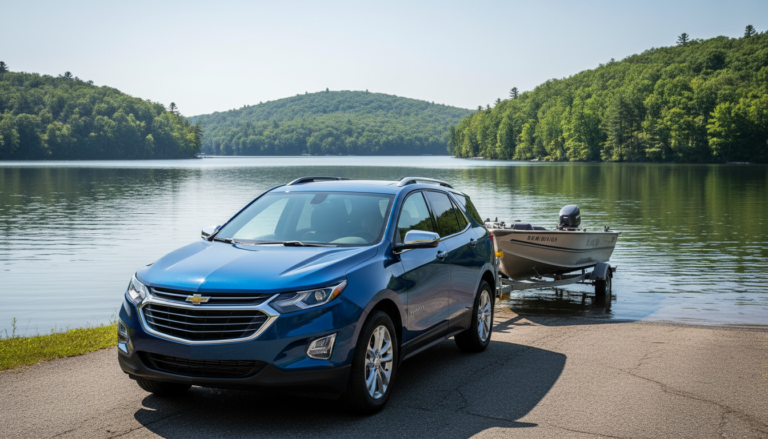
Both the 2020 honda pilot and the 2020 chevrolet traverse are rated to tow up to 2268 kg (5000 lbs) when properly equipped. That capacity covers common family loads like medium trailers, small boats, and utility haulers.
Robust engineering in both models helps maintain stable handling under load. Owners report steady performance during highway towing and when climbing grades with a trailer attached.
For weekend recreation or light work, these SUVs provide dependable utility without needing a dedicated truck. Buyers should confirm tow packages and cooling enhancements when ordering or inspecting a vehicle.
| Feature | Rated Capacity | Practical Benefit |
|---|---|---|
| Maximum towing | 2268 kg (5000 lbs) | Trailers, boats, small campers |
| Suitability | Family and light-duty work | Weekend hauling and trips |
| Owner advice | Confirm equipment | Check hitch rating and cooling |
To see a side-by-side look at how towing and utility fit into each model’s broader strengths, compare towing and utility for more detail.
Pricing and Trim Level Variety
Trim choices and pricing shape how a family SUV fits both budget and lifestyle.
The 2020 chevrolet traverse arrives in eight distinct trims. Prices span from $36,198 to $60,398, giving wide scope for customization of tech, comfort, and towing options.
The 2020 honda pilot offers six trims. Its range goes from $41,290 up to $55,190, focusing trims on specific comfort and convenience bundles.
Selecting the right trim determines which luxury touches and driver aids come standard. It also sets how many optional packages you may need to reach desired features.
Most buyers can find a configuration that meets budget and needs. Below is a quick comparison to highlight the core differences in variety and pricing.
| Model | Number of Trims | Price Range | Trim Focus |
|---|---|---|---|
| Chevrolet Traverse | 8 | $36,198 – $60,398 | Wide customization, tech & towing options |
| Honda Pilot | 6 | $41,290 – $55,190 | Comfort-oriented packages, streamlined lines |
| Buyer tip | Match trim to daily needs—choose higher trims for advanced safety and premium interiors; pick lower trims for value and core utility. | ||
Driving Experience and Handling
A well-tuned suspension can turn a bulky family transporter into a confident, composed car on the road.
Modern midsize suvs aim to balance ride comfort with responsive control. Engineers tune springs, dampers, and bushings so the body stays calm over rough pavement while corners feel steady.
Each seat benefits from that focus. Rear passengers feel fewer bumps and the cabin stays composed on highways. That comfort helps during long trips and daily errands.
Drivers value intuitive steering and braking that make a large vehicle feel manageable in town. Electronic aids and chassis damping are part of the features that simplify maneuvers and add confidence.
A positive driving experience leads to higher owner satisfaction over time. When handling and comfort work together, every trip feels less tiring and more enjoyable.
| Aspect | Focus | Best for |
|---|---|---|
| Ride comfort | Suspension tuning, seat support | Long trips, family use |
| Handling | Steering response, body control | City driving, highway confidence |
| Driver aids | Stability control, adaptive dampers | Everyday safety and ease |
Comparing Brand Reliability and Value
Trust in a manufacturer’s track record shapes decisions as much as price or features.
Reliability is a core value for makers known for durable designs. Brands that make the Honda CR-V and Honda Passport score well for long-term ownership and routine maintenance costs.
Chevrolet competes with other mainstream options. Shoppers commonly compare it to the Nissan Rogue and cross-shop against premium names like the Acura MDX or Buick Enclave when value and resale matter.
Practical note: buyers often consider smaller models such as the Buick Encore and Volvo XC40 for lower running costs. Larger family choices like the Volvo XC90 or Volkswagen Tiguan appeal when safety and space are priorities.
Weigh brand track record against the features you need. A reliable service network and strong resale value can offset a higher initial price for the right car.
| Attribute | Brand Examples | Strength |
|---|---|---|
| Reliability | Honda CR-V, Honda Passport | Low maintenance, proven engines |
| Value & Resale | Nissan Rogue, Buick Encore | Affordable ownership, steady resale |
| Luxury & Safety | Acura MDX, Volvo XC90 | Advanced features, higher retention |
| Compact Utility | Volvo XC40, Volkswagen Tiguan | Efficient space, modern tech |
Conclusion
Your ideal midsize choice depends on what you pack, who rides, and how far you drive. For many buyers, a well‑equipped 3-row SUV that balances space and features wins the day. Consider mainstream alternatives like the honda cr-v and the nissan rogue if you need different size or fuel tradeoffs.
For more premium or comfort-focused buyers, the acura mdx and buick enclave offer higher-end touches. If you want rugged versatility or compact options, check the honda passport, the buick encore, or other popular models.
Test-drive both contenders and compare them to models such as the volvo xc40, volvo xc90, and volkswagen tiguan. That hands-on check will show which SUV and which features best match your family’s needs.
FAQ
Which midsize SUV has more usable third-row space?
Both models offer three-row seating, but the Traverse provides noticeably more legroom in the rear row for adults, while the Pilot’s third row suits children or shorter trips better. Consider seat layout and folding methods when you need regular third-row use.
How do cargo capacities compare when all seats are up and folded?
The Traverse gives larger maximum cargo volume with the rear seats folded, making it the stronger choice for hauling gear. The Pilot still performs well for everyday needs and benefits from flexible storage cubbies and a low liftover height for loading.
Which vehicle feels quieter and more refined on the highway?
Cabin quietness favors models with better sound insulation and chassis tuning. The Traverse leans toward a smoother, quieter highway ride in higher trims, while the Pilot offers a balanced mix of comfort and road feedback across its lineup.
What are the key engine and powertrain differences?
The Traverse typically uses a V6 with more low-end torque, aiding towing and passing. The Pilot’s V6 emphasizes a balanced blend of power and everyday refinement. Both can be paired with all-wheel-drive systems for improved traction.
How do city and highway fuel economy compare?
Expect slightly better highway fuel economy from the Pilot in similar configurations, while the Traverse’s larger cargo and towing capability can lower mpg in mixed driving. Actual consumption depends on drivetrain, trim, and driving habits.
Are advanced driver-assist systems standard?
Both brands offer comprehensive crash-avoidance tech. One model includes a full suite as standard on most trims; the other provides comparable features across key packages. Look for adaptive cruise, lane-keeping assist, and automatic emergency braking when comparing trims.
How easy is it to connect phones and use infotainment features?
Each vehicle supports Apple CarPlay and Android Auto on most trims, with touchscreen interfaces, Bluetooth, and USB ports. Higher trims add larger displays, better sound systems, and wireless charging for a more seamless experience.
Which SUV to pick for towing and utility needs?
If maximum towing capacity matters, the Traverse’s torque-rich V6 and chassis tuning give it an edge. The Pilot still tows respectably for light trailers and boats; confirm trailering packages and cooling upgrades for heavier loads.
What about warranty coverage and roadside assistance?
Warranty terms vary by manufacturer; check powertrain and bumper-to-bumper limits and whether roadside assistance is included. Certified pre-owned programs and dealer plans can extend coverage and add peace of mind.
How do reliability and long-term ownership costs compare?
Both models come from brands with solid reputations. Ownership costs depend on maintenance schedules, fuel, insurance, and repair history. Researched reliability reports and local dealer service experiences help predict long-term value.
Which trim offers the best balance of tech, comfort, and price?
Mid-level trims often strike the best balance, adding key tech like advanced infotainment and driver aids without the premium for top-tier leather and luxury extras. Evaluate required features such as all-wheel drive, towing prep, and upgraded audio when choosing.
Are there notable differences in ride handling and driver engagement?
The Traverse prioritizes composed highway stability and cargo-hauling duty, while the Pilot delivers more responsive steering and composed cornering for everyday driving. Test drives on varied roads reveal which driving experience suits your needs.