GMC Terrain vs Chevy Equinox: Which Compact SUV Reigns Supreme?
The compact crossover debate is best summed up as one family with different personalities. This comparison examines how two closely related models split on price, trim strategy, driving feel, and upscale options.
This short guide is meant to help buyers choose the better-fit vehicle based on budget, comfort, tech, and real-world driving. Readers will get clear decision points: price and value, size and space, engine and transmission, fuel economy, ride quality, and features.
Key idea: which model “reigns supreme” depends on priorities some want maximum value, others want a more premium feel with Denali or AT4-style touches. The piece will include concrete numbers where they matter and plain-English explanations for tricky specs.
Note that model year and trim level affect what’s standard. Compare the exact models you’re shopping, not just the nameplate, to make the best choice among these popular US suvs.
GMC Terrain vs Chevy Equinox: Quick Snapshot for US SUV Shoppers
Two compact crossovers share much of their engineering, but they aim at different buyers.
Shared roots. These models are mechanical cousins built on the same GM platform. That means similar packaging, comparable maintenance expectations, and close everyday usability.
- FWD vs AWD: Front-wheel drive is more efficient; all-wheel drive adds traction for poor weather.
- Trim levels: Names mark feature bundles and price tiers.
- Turbocharged engine: More power from a smaller displacement, common in this class.
- Driver-assistance: Suite of safety aids like lane keep and automatic braking.
Who should consider which? The chevrolet equinox often wins on lower entry price. The gmc terrain aims for a more premium cabin and specialty trims.
| Aspect | Typical Winner | Why it matters |
|---|---|---|
| Price | chevrolet equinox | Lower starting MSRP for budget buyers |
| Cabin feel | gmc terrain | Upscale materials and trim options |
| Everyday usability | Tie | Shared platform gives similar cargo and seating |
The rest of the article breaks down price, space, powertrain, and tech so you can shortlist the right model year and trim.
Pricing and Value in the United States: MSRP, Features-for-the-Money, Resale
Starting price tells only part of the story when choosing between two closely related compact SUVs.
Recent 2025 figures show a close gap. The chevrolet equinox lists at about $30,495 and the gmc terrain at $31,395. Dealer quotes can shift those numbers; some dealers report $28,600 for Equinox and $30,000 for Terrain.
Prices change by state because of destination fees, regional incentives, dealer add-ons, and local inventory. Always check out-the-door pricing for similar equipment, not just base MSRP.
- Value equation: A lower starting price can win, but compare standard features and what costs extra at each trim.
- Positioning: The gmc terrain leans premium in materials and options, while the chevy equinox targets mainstream value.
- Resale: Both hold value reasonably, but the Terrain’s premium image can bring slightly stronger returns in some markets.
| Item | Equinox (example) | Terrain (example) |
|---|---|---|
| Typical 2025 MSRP | $30,495 (dealer range $28,600) | $31,395 (dealer range $30,000) |
| Buyer focus | Lower entry price, budget trims | Upscale trims, more standard features |
| Shopping tip | Compare similarly equipped models | Factor incentives, financing, trade-in |
Size, Seating Comfort, and Cargo Space: Interior Room Where It Counts?
Small differences in inches make big differences in how you use an SUV every day. Length, legroom, and cargo numbers tell a practical story about parking, passenger comfort, and hauling.
Exterior dimensions and city maneuverability
The shorter 181.0-inch footprint versus 183.2 inches gives the Terrain a slight edge in tight drives and curbside parking. In dense city streets that few inches translate to easier turns and less overhang at the curb.
Legroom and headroom comparisons
Front legroom is close: 40.9 in for the chevrolet equinox and 40.6 in for the gmc terrain. That few tenths feels minor on short trips but tall drivers may notice on long hauls.
Rear legroom follows the same pattern: 39.9 in vs 39.2 in. Families who seat adults or install large child seats should prioritize a test sit in both models.
Cargo capacity and rear seat versatility
Both models offer 29.8 cu ft with seats up and 63.5 cu ft with the second row folded. Practically, that means day-to-day cargo capacity is a tie.
Folding the rear seat changes the cargo shape and load floor height. Bring a stroller, cooler, or bike during a test to confirm fit, not just the cubic feet number.
Quick takeaways
- The slightly shorter length helps city parking.
- Front and rear seat differences are subtle; tall passengers should test both.
- Cargo volume ties the pair, but real items determine usability.
| Measure | chevrolet equinox | gmc terrain |
|---|---|---|
| Overall length (in) | 183.2 | 181.0 |
| Front legroom (in) | 40.9 | 40.6 |
| Rear legroom (in) | 39.9 | 39.2 |
| Cargo (seats up / folded, cu ft) | 29.8 / 63.5 | 29.8 / 63.5 |
Performance, Transmission, and Driving Feel: Engine, Ride Quality, and AWD
Performance differences show up when you push these compact crossovers on real roads, not on paper. This section focuses on what the shared 1.5L turbo powerplant and available drivetrains mean for day-to-day use.
Base power and real-world pull
The 1.5L turbo produces about 175 hp and 203 lb-ft. That output gives solid low-end torque for merging and passing. It is not a sport SUV, but it handles commuter duties and highway merges comfortably.
Transmission and responsiveness
More gears can help keep the engine in its sweet spot. A nine-speed automatic can smooth acceleration and improve efficiency when tuned well. Some model years may use a six-speed automatic instead. Shoppers should confirm the exact transmission on the window sticker.
Fuel economy and drivetrain trade-offs
Expect roughly FWD ~26 city / 28 highway and AWD ~24 city / 28–29 highway. All-wheel drive adds traction but usually costs a small MPG penalty.
Ride, suspension, and light off-road ability
Higher trims often have slightly more refined suspension tuning and better cabin isolation. The AT4-style package adds standard AWD, Off-Road Mode, Hill Descent Control, skid plate protection, and tougher tires for gravel and snow.
- Test-drive tips: try a parking-lot loop, a highway merge, and a rough patch of road.
- Feel: note shift logic, throttle response, and how the ride soaks up bumps.
| Item | Common Spec | What to expect |
|---|---|---|
| Engine | 1.5L turbo — 175 hp / 203 lb-ft | Good low-end pull for daily driving |
| Transmission | 9-speed or 6-speed automatic | More gears = smoother acceleration if calibrated well |
| Fuel economy (FWD/AWD) | ~26/28 mpg city/hwy (FWD); ~24/28–29 (AWD) | AWD adds traction at a small MPG cost |
| Light off-road | AT4: AWD, Off-Road Mode, HDC, skid plate | Useful on gravel, snow, and muddy paths — not a rock crawler |
Quick take: Drivers seeking a slightly more refined ride in upper trims may favor the gmc terrain for its tuning and AT4 hardware. The chevrolet equinox remains a solid, efficient choice for buyers prioritizing everyday economy and lower cost.
Interior Features, Tech, and Safety Systems: Touchscreens, Cameras, and Driver Assistance
For many buyers, interior tech and safety systems decide which small SUV makes the cut. The infotainment experience varies by trim and year. Some models offer a larger modern display while base trims stick to 7–8 inch units.
Touch and usability: Verify screen size, menu responsiveness, and whether audio, climate, and phone controls are easy to reach while driving. Wireless Apple CarPlay and Android Auto are common on higher trims.
Convenience: Power liftgate and hands-free programmable liftgate come on SLT and up in some packages. These options make daily tasks groceries, car seats, gear much easier.
Premium tech and camera systems
Upper trims can add a Denali head-up display, Bose audio, and multi-camera views (useful in tight garages and school drop-off lanes). A 10-camera style system gives wide views for parking and close-quarters driving.
Core safety systems
What they do: Automatic Emergency Braking, Lane Keep Assist, and Forward Collision Alert help avoid or soften crashes. They assist the driver but do not replace attention behind the wheel.
| Feature | Availability | Why it matters |
|---|---|---|
| Automatic Emergency Braking | Standard/available | Can reduce crash severity or avoid low-speed impacts |
| Lane Keep Assist | Standard/available | Steers gently to keep you centered in the lane |
| Safety Alert Seat | Higher trims (where equipped) | Tactile warnings for drivers who prefer seat-based alerts |
Quick tip: Confirm the exact infotainment and safety package on the window sticker, since screen size and camera suites change by model year and trim.
Trims, Design, and Best-Fit Recommendations: Which Model Matches Your Lifestyle?
A model’s trim list is where value, convenience, and personality meet. Treat trims as feature bundles that answer real-life needs — commuting, family hauling, snowy seasons, or weekend trails.
Terrain trim breakdown
SLE is the value entry with core safety and basic comfort. It suits buyers who want reliable daily transport without extras.
SLT adds convenience items like a hands-free programmable power liftgate and nicer upholstery. It’s the comfort step-up for frequent grocery runs and car-seat swaps.
AT4 brings off-road hardware — skid plate, Off-Road Mode, and tougher tires — plus a rugged look for light trails and winter roads.
Denali is the flagship with premium upgrades such as Bose audio and a head-up display for a more refined cabin experience.
Equinox trim overview
LS covers budget basics and efficient packaging. LT is the mainstream sweet spot for most buyers, balancing price and upgrades.
RS emphasizes sporty design cues and unique styling. Premier targets tech and luxury, adding top-tier comfort and features.
Exterior design and buyer fit
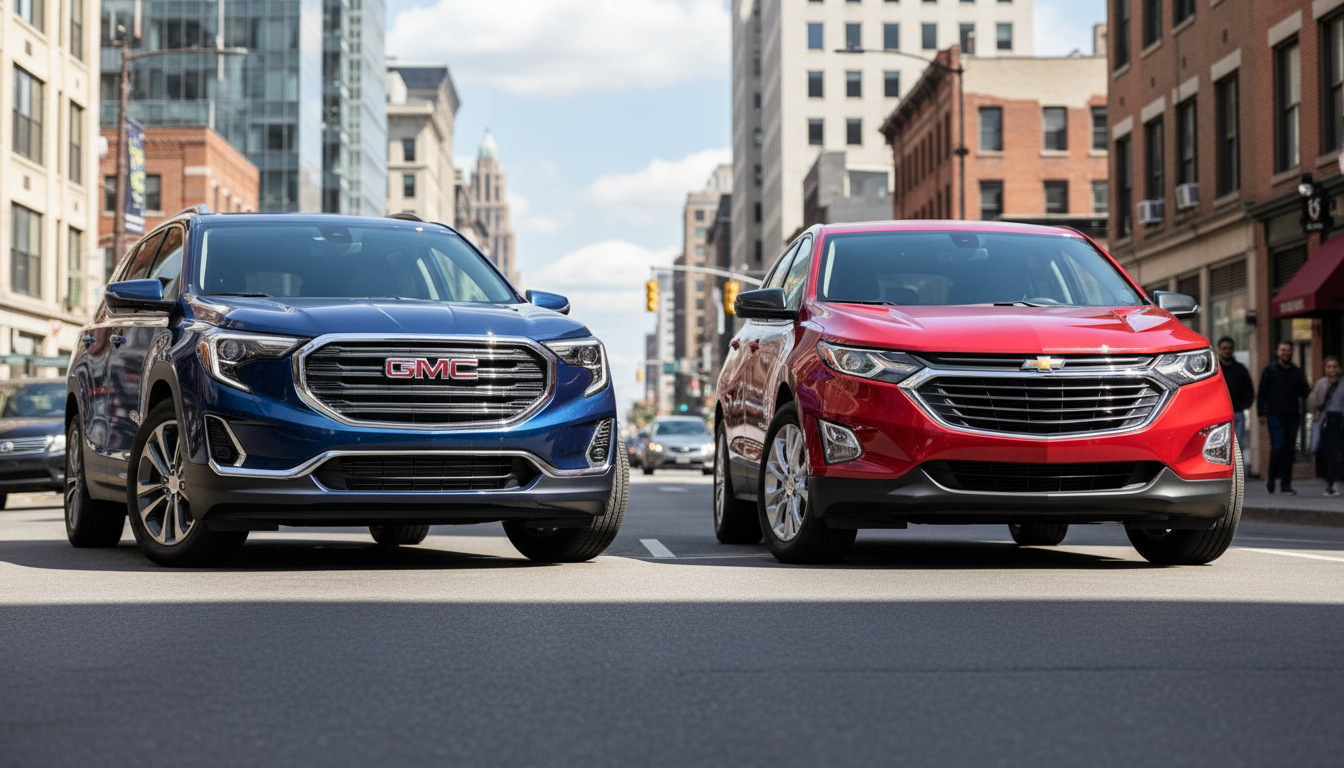
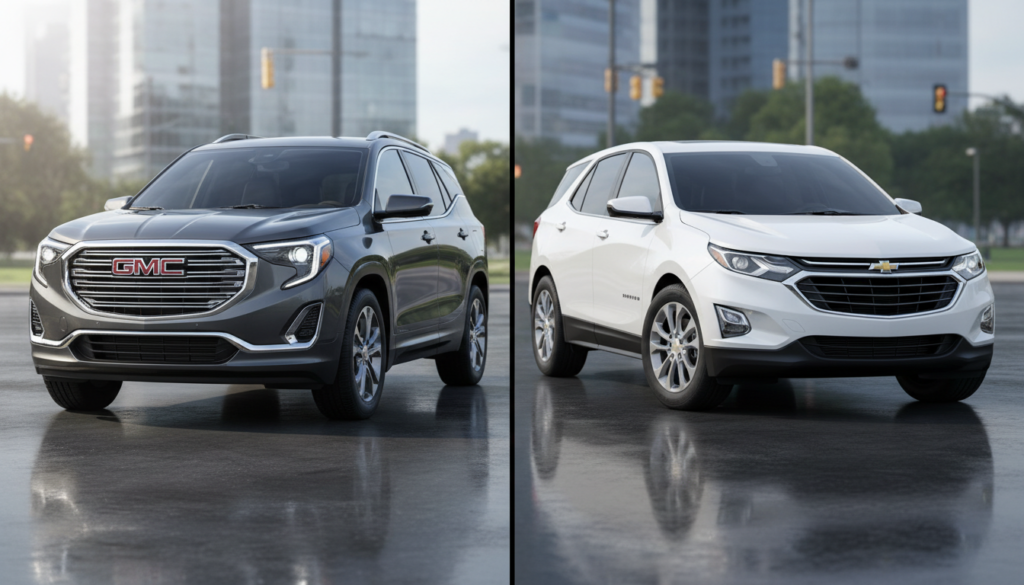
The Terrain favors a bold, truck-inspired stance that appeals to buyers wanting a more rugged aesthetic and higher perceived presence on the road.
The sleeker Equinox leans sportier and more car-like, which helps visibility for city driving and fits buyers who prefer a subtle profile.
- Pick the SLT/Premier for daily comfort and extra convenience features like a heated steering wheel.
- Choose AT4 if light off-road capability and tougher suspension matter.
- Opt for LS/ SLE when budget and straightforward utility matter most.
| Trim Role | Best for | Signature features |
|---|---|---|
| Value (LS / SLE) | Budget buyers | Essential safety, basic infotainment |
| Mainstream (LT / SLT) | Everyday comfort | Liftgate, upgraded seats, heated steering |
| Rugged (RS / AT4) | Style or light trails | Sport/rugged styling, off-road hardware on AT4 |
| Flagship (Premier / Denali) | Luxury seekers | Bose, HUD, premium trim |
Quick recommendation: choose the chevy equinox if price sensitivity and rear space are top priorities. Choose the gmc terrain if a premium vibe, AT4 capability, or Denali-level luxury better matches your lifestyle. Always test drive the exact trim to feel transmission tuning, ride quality, and real-world space before you buy.
Conclusion
When choosing a compact SUV, the right pick often comes down to lifestyle, budget, and the features you actually use.
Quick decision: both models share core utility, so the winner is the one aligned with your priorities. The chevrolet equinox tends to lead on entry price and slightly more rear legroom, while the gmc terrain emphasizes premium trim choices like AT4 and Denali and a more upscale interior feel.
Before you buy, compare the exact model year and equipment list. Infotainment size, transmission tuning, and driver-assist systems vary by trim and year.
Final checklist: verify MSRP and incentives, confirm FWD or AWD, test cargo volume with seats folded, and try key tech in person. Do the same commute, park in a tight spot, and test a highway merge to judge performance and ride quality side by side.
Either choice can be a smart purchase when price, seats, space, and fuel economy meet your needs. Make the comparison work for your drive and buy with confidence.
FAQ
How do these two compact SUVs relate mechanically and in ownership expectations?
Both models share General Motors underpinnings, so they use many of the same engines, transmissions, and safety systems. That means similar reliability profiles, parts availability, and service networks. Differences arise in tuning, trim content, and materials — one brand positions its model toward a more premium feel while the other emphasizes value and lower entry pricing.
Which model typically costs more and why?
The premium-branded model generally carries higher MSRPs and offers more upscale standard equipment at each trim level. Dealers and regional incentives can narrow the gap, but buyers can expect the premium-badged SUV to retain slightly higher resale value due to perceived refinement and available luxury options.
Are there major differences in interior space and cargo capacity?
Exterior footprints differ slightly, with one model often being a bit shorter for easier city parking while the other stretches a little more for rear legroom. Cargo numbers are close and many configurations yield near-identical luggage volumes with seats up or folded. Practical differences come down to seat cushioning, trim choices, and how well rear seats fold flat.
What are the typical engine and transmission setups and how do they affect driving?
Both use a 1.5L turbocharged four-cylinder as the base option, tuned to similar horsepower and torque for everyday driving. Transmission choices include a nine-speed automatic in one and a six-speed automatic in the other on some trims; the nine-speed aims for better highway efficiency but can feel different under light throttle. AWD availability affects traction and slightly lowers fuel economy.
How do fuel economy and drivetrain choices compare for city and highway driving?
Front-wheel-drive versions yield the best EPA numbers, especially on highway runs. Adding AWD typically lowers those figures by a couple of MPG in combined use. Expect real-world city/highway differences to track EPA ratings closely, with drivers seeing slightly better economy in lighter trims and when using the newer multi-gear transmission for cruising.
Which model offers better ride quality and light off-road ability?
Ride tuning varies by trim. Higher-end trims from the premium-badged model often feature firmer suspension tuning and better sound insulation for a more refined ride. For light off-road use, the off-road–oriented trim includes AWD calibration, off-road driving modes, hill descent control, and tougher underbody cladding, giving it a clear advantage on gravel and dirt roads.
What tech, convenience, and safety features should buyers expect and which stand out?
Both offer modern infotainment with touchscreen displays, smartphone integration, and driver information clusters. Premium trims add features like head-up displays, upgraded Bose audio, multi-camera views, and hands-free liftgate options. Standard and available safety systems include automatic emergency braking, lane-keeping assist, forward collision alerts, and optional haptic or seat-based safety alerts depending on trim.