Are Chevy Malibus Good Cars? Find Out Now
Is the Chevrolet Malibu a practical choice for U.S. driving today? This intro sets expectations for a buyer-focused review, not hype.
Long-term reliability, ownership costs, mpg, driving feel, interior livability, and which model years matter when buying used.
The modern chevy malibu aims to be steady, useful transport for daily commutes and long trips. A wide Chevrolet dealer network makes service accessible across the U.S.
Who benefits most? Shoppers wanting simple commuting comfort, predictable controls, and low drama in a mid-size sedan. Expect trade-offs: the interior is useful but not premium, and rivals like Honda and Toyota often lead in long-term reputation and ratings.
It will separate the Malibu model from specific years. You will get a quick verdict, a shortlist of safer used years, red-flag years to avoid, and a short test-drive checklist you can use at the dealer.
Quick verdict on the Chevrolet Malibu as a good car for U.S. drivers
Think of the Chevrolet Malibu as a sensible mid-size choice for everyday life. It favors comfort, simple controls, and a quiet highway ride over sporty thrills. For buyers prioritizing steady value, it often checks the right boxes.
Who it fits best?
Commuters, small families, and frequent highway drivers benefit most. The tuned suspension soaks up long miles and the cabin stays quiet at speed.
What it is not?
This is not the pick for buyers chasing sharp handling, aggressive power, or luxury-grade interiors. Shoppers wanting performance should cross-shop sportier models.
Value versus competitors
- Price and service availability give the Malibu an edge for tight budgets.
- Maintenance, fuel economy, and depreciation matter as part of overall value.
- Compare efficiency and reliability later against rivals like the honda accord and toyota camry to decide if the trade-offs fit your needs.
Are chevy malibus good cars for reliability and long-term ownership?
When buyers ask about reliability, they mean fewer surprises and steady repair bills. Reliability here means predictable service, low repeat failures, and clearer ownership costs—not flawless operation.
Reliability snapshot and ratings
J.D. Power places recent reliability roughly at 80/100, with the 2022 model year scoring about 82/100. Use that rating as a benchmark, then check complaint trends for specific years and trims.
Common trouble areas
- Engine: the costliest failures reported across several years.
- Transmission: occasional complaints, including shifting issues and the continuously variable setups on some trims.
- Electrical and interior accessories: switches, modules, and convenience features can fail more often than expected.
Longevity and maintenance
With regular oil changes, transmission service, and prompt fixes, expect roughly 150,000 miles of useful life. A clear service history often matters as much as the odometer when planning ownership costs and economy.
Note: Driver-assist and infotainment system components can be costly if neglected. Ultimately, reliability depends more on model year and care than the nameplate alone.
Chevy Malibu model years to buy used vs years to avoid
A model year can change long-term ownership costs more than mileage. Start by separating an avoid list from safer picks. That saves time and money when shopping the used market.
Years to avoid
- High-complaint span: 1999–2011 — frequent engine and powertrain problems.
- Problem spikes: 2013 and 2016 — reported transmission and electrical faults.
- Worst single year: 2010 — heavy engine-related complaint volume and coolant leaks.
Safer used picks
- 2015, 2017–2021 — fewer recurring complaint clusters and better owner sentiment.
- Select older low-complaint years: 1979–1983, 1996–1997 — notable for low complaint records.
Why year matters more than mileage?
A lower-mileage example from a high-complaint year can cost more in repairs than a well-documented higher-mileage example from a safer year.
Validation and test-drive checklist
- Review recalls and NHTSA complaint history for the specific vehicle.
- Verify service records and clean title history.
- On the test drive: listen for drivetrain hesitation, check transmission shift feel, test all electrics, and watch for warning lights after a short drive.
| Category | Years | Primary Issues |
|---|---|---|
| Avoid list | 1999–2011, 2013, 2016 | Engine failures, transmission, electrical faults |
| Safer picks | 2015, 2017–2021, select older years | Lower complaint rates, better reliability trends |
| Buying tip | Any year | Check recalls, service history, and perform focused test drive |
Price, trims, and what you get for the money?
Knowing MSRP lanes and used-market swings helps pick the right year and trim. The Malibu sits in the mid-size sedan lane with a starting price just over the high-$20Ks and top trims in the low-$30Ks.
New MSRP positioning: Expect a typical starting price around $28,100 for the base LS and about $32,595 for loaded 2LT trims. That positions the model as a lower-cost alternative to premium rivals.
Used market value by year
A 2010 example averages about $7,521, while a 2020 averages roughly $20,960. Year, supply, and demand drive that gap: remaining inventory, condition, and popular trims push values up or down.
Trim breakdown
- LS (base): basic seats, essential infotainment, best for tight budgets.
- RS: sport styling, minor suspension tweaks, visual upgrades.
- LT: mainstream comfort and tech—phone integration and driver aids.
- 2LT: feature-heavy option with advanced safety and nicer materials.
Best value: For most buyers the LT balances price and must-have features. It delivers comfort, infotainment, and safety without the top-trim price premium.
| Aspect | LS | 2LT |
|---|---|---|
| Typical price range | Entry | Top |
| Main benefit | Base value | Feature set |
| Who it’s for | Budget buyers | Comfort-focused buyers |
Buyer note: with production winding down, searches for 2025 chevrolet malibu or 2025 chevrolet inventory can reveal incentives and remaining vehicle choices. Remember, purchase price is only part of ownership—mpg and range follow next.
Fuel economy, mpg, and driving range for everyday efficiency
Fuel costs and real-world mpg shape daily ownership more than sticker horsepower.
The EPA rates the recent model at 29 mpg city, 36 mpg highway, and 32 mpg combined. Combined mpg is the best single metric for most U.S. drivers because it blends typical city and highway use.
Real-world fuel economy varies with speed, weather, tire condition, and driving style. Driving 75–80 mph on long runs can cut highway numbers and lower the effective miles per gallon.
The fuel tank holds 15.8 gallons. At the EPA combined figure that works out to roughly 474 miles per tank. Under light-load, conservative driving some owners report closer to ~506 miles to empty in certain tests.
Why miles per tank matters: fewer stops on family trips, simpler trip planning, and less time hunting for stations during long road runs. For high-mileage commuters, even a few mpg difference changes annual fuel spend noticeably.
- Compare trims and engines when shopping—efficiency shifts with turbo tuning and transmission programming.
- Competitors like the Honda Accord and Toyota Camry often post slightly better mpg in similar trims, but results depend on engine choice.
| Metric | EPA / Tank | Real-world note |
|---|---|---|
| City / Highway / Combined | 29 / 36 / 32 mpg | Combined is best for mixed driving |
| Tank size | 15.8 gallons | ~474 miles per tank (EPA) |
| Comparative note | Competitors | Accord and Camry may edge efficiency in matched trims |
Next, driving dynamics explain how turbo engines and transmission maps affect both mpg and daily feel on the road. That links fuel economy to the driving section ahead.
Driving experience, engine, and transmission performance
Behind the wheel, the sedan shows a clear focus on comfort and usable performance. This section summarizes how the powertrain and ride feel in daily use.
Turbo four-cylinder character
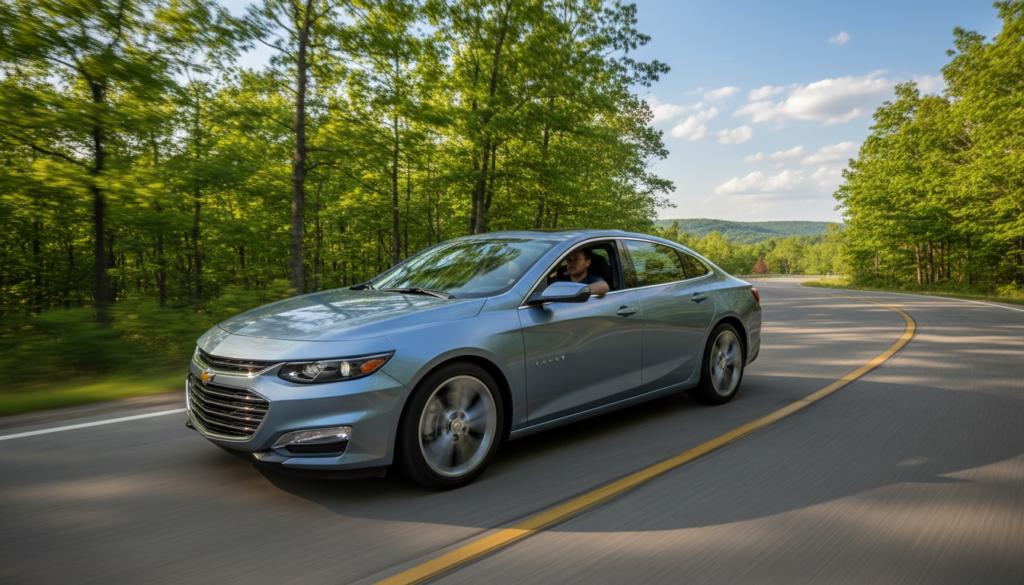
The 1.5L turbo engine delivers about 160 hp and 184 lb-ft. It feels spunky for merges and passing, not a performance specialist.
Practical note: the base powertrain has enough punch for on-ramps and two-lane passing, and it helps economy when driven smoothly.
Ride comfort and suspension
Suspension tuning favors stability and a soft ride at highway speeds. Long trips feel less fatiguing thanks to steady damping and calm responses.
Steering and handling
A small-diameter steering wheel gives a sharper feel at the helm. That makes the vehicle feel more responsive without changing its true chassis limits.
Cabin noise and road manners
Highway quietness is a strong suit. Reduced wind and tire roar keep the cabin calm on interstates and cut driver fatigue.
- Seat comfort over two hours
- Straight-line tracking at highway speeds
- Smooth transmission behavior during steady cruise
| Aspect | Impression | Why it matters |
|---|---|---|
| Engine/Transmission | Spunky, smooth shifts | Enough power for daily driving and passing |
| Ride | Calm, highway-focused | Better comfort on long road trips |
| Steering | Responsive feel | Driver confidence without sporty limits |
A quiet, comfortable drive often feels like an upgrade even when materials and outright performance are modest.
Interior, seats, and infotainment system: what it’s like to live with?
Step inside and the cabin makes its priorities clear: comfort and utility over flash. Front seats sit at a comfortable range for average-height drivers, with decent fore-aft space and reasonable lumbar support on higher trims.
Rear-seat headroom can feel tight for anyone over six feet. Families with teens or car seats will find the bench usable, but taller adults may notice headliner contact on longer rides.
Materials and durability
The interior uses lots of hard plastic. That lowers a premium feel but keeps cleaning and daily wear simple. Check stitching, switchgear wear, and door-panel scuffs when inspecting a used example.
Infotainment and safety tech
Chevrolet Infotainment 3 is straightforward. Navigation helps on long trips, and Bose audio on higher trims noticeably improves sound for road-trip listening.
Confirm driver-assist features like automatic emergency braking and front pedestrian braking function without warning messages.
Climate-control test-drive plan
- Set temperature below 74°F and note whether vents blast very cold air.
- Cycle fan speeds to check modulation and listen for odd noises.
- Verify every vent delivers steady flow at different settings.
| Check | What to look for | Why it matters |
|---|---|---|
| Front seats | Support, lumbar, adjustment range | Comfort on commutes and long trips |
| Rear cabin space | Headroom, legroom, seat contour | Suits family passengers and car seats |
| Infotainment system | Response, navigation, audio quality | Ease of use and media enjoyment |
Conclusion
Overall, this model fits buyers who value comfort, predictable costs, and solid mpg.
Recent ratings put reliability near 80/100 (2022 at 82/100). EPA figures are 29/36/32 mpg and a 15.8‑gallon tank for roughly a 474‑mile range, which helps on long commutes and trips.
Buy vs pass checklist: prefer safer model years (2015, 2017–2021), avoid 1999–2011, 2013, 2016. Verify service records, confirm no major recalls, and factor price gaps (2010 ≈ $7,521 vs 2020 ≈ $20,960).
Recommendation: prioritize the right year, balance features against cost, and use focused checks during the test drive. When hunting online, filter 2025 chevrolet malibu and 2025 chevrolet listings for CPO or warranty details rather than chasing low photos.
FAQ
Are Chevrolet Malibu vehicles a good choice for U.S. drivers?
The Malibu is a sensible midsize sedan for many Americans. It suits commuters and small families who want a comfortable, fuel-efficient daily driver with a roomy cabin and modern infotainment. It’s not aimed at buyers seeking sports-car performance or luxury-level materials.
Who does the Malibu fit best and who should look elsewhere?
Best for commuters, families, and road-trip drivers who value comfort, predictable handling, and decent fuel economy. Shoppers after performance sedans or premium interiors should consider alternatives like the Honda Accord or Toyota Camry, which offer sharper driving dynamics or upscale cabins in some trims.
How reliable is the Malibu for long-term ownership?
Recent model-year reliability is mixed but generally acceptable. J.D. Power ratings around the low 80s (for example, 82/100 in 2022) indicate average dependability. Long-term reliability depends heavily on maintenance: regular service, timely repairs, and attention to known trouble spots improve outcomes.
What common problems have owners reported across model years?
Reported issues include engine and transmission concerns, electrical faults, and accessory or interior wear. Frequency varies by year and trim, so check specific vehicle histories and recall records before buying.
Which Malibu model years should buyers avoid and which are safer used picks?
Years with higher complaint rates include many from 1999–2011, plus problem-heavy model years like 2013 and 2016. Better-used picks include 2015, 2017–2021, and select older years with clean histories. Always verify service records and vehicle inspections regardless of year.
Why does model year matter more than mileage when shopping used?
Engineering changes, recalls, and recurring defects often correspond to specific model years. A low-mileage example from a problem year can still be costly to maintain, while a higher-mileage car from a solid year with good service history can be more reliable long-term.
How should a buyer validate a specific Malibu before purchase?
Review complaint history and recalls, examine service records, get a vehicle history report, and perform a thorough test drive. Have a trusted mechanic inspect the engine, transmission, electrical systems, and suspension for hidden issues.
What is the price range and typical trim structure for recent Malibus?
New MSRPs usually start in the high-,000s and top out in the low-,000s for well-equipped trims. Common trims include LS, RS, LT, and 2LT. Used prices vary widely by year and condition; older models from 2010 are markedly less expensive than 2020 examples.
Which trim offers the best value for most buyers?
Mid-level trims such as the LT or 2LT often balance features and cost. They typically include upgraded infotainment, safety aids, and nicer materials without the premium price of top trims, making them the sweet spot for many buyers.
What fuel economy and driving range can drivers expect?
EPA ratings depend on engine and year but recent four-cylinder Malibus commonly achieve competitive city/highway/combined mpg for the class. With a typical fuel tank size, real-world range is adequate for long commutes and road trips, though rivals like the Honda Accord and Toyota Camry sometimes post slightly better numbers.
How does the Malibu drive — engine, transmission, and comfort?
Most Malibus use turbocharged four-cylinder engines that deliver “fast enough” acceleration for daily use. Transmissions are generally smooth; some model years used continuously variable or conventional automatics. Suspension tuning favors comfort, making the car well-suited to highway cruising and long trips.
What is the interior like — seats, materials, and infotainment?
The cabin offers roomy front and rear seats with reasonable tall-driver headroom. Materials trend toward durable plastics rather than premium soft-touch surfaces, but they hold up well under daily use. Chevrolet Infotainment 3 is common, with available navigation and Bose audio on higher trims. Check climate-control operation during a test drive, as some owners note quirks.
How does the Malibu compare to competitors such as the Honda Accord and Toyota Camry?
The Malibu competes on value, comfort, and infotainment features. The Accord and Camry often beat it in driving dynamics, perceived refinement, and sometimes long-term reliability ratings. For buyers prioritizing price and a comfortable ride, the Malibu remains a reasonable choice.