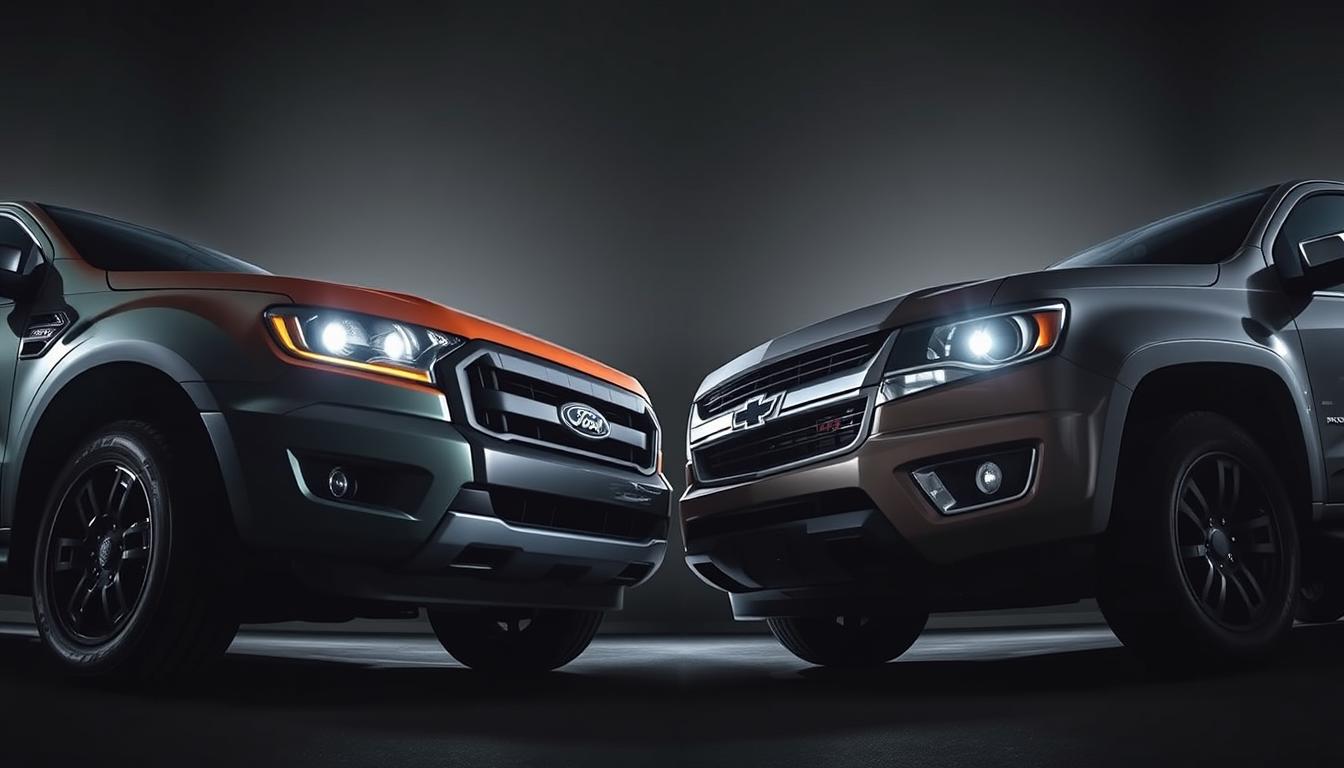
Ford Ranger vs Chevy Colorado: Pickup Truck Showdown
This showdown helps U.S. buyers pick the best midsize truck. It compares the 2024–2025 Ford Ranger and Chevrolet Colorado. We look at specs, real-world use, and tech.
The article covers important details like size, engine, towing, and fuel economy. We also talk about off-road trims, interior tech, and owning costs. Terms like EcoBoost are explained simply for easy understanding.
For those wanting a detailed comparison, this article is for you. It uses manufacturer specs, dealership notes, and expert reviews. Our aim is to help you choose the right truck for your needs.
Overview of the Ford Ranger vs Chevy Colorado market position
Midsize trucks are a middle ground between small and large pickups. They offer a good mix of towing, payload, and daily driving. This makes them a top choice for many buyers.
Here are some key points about why midsize trucks are important. They show how Ford and Chevrolet make their trucks stand out.
Segment landscape and why midsize trucks matter
Midsize trucks are perfect for those who need utility but don’t want a full-size truck. They’re great for towing trailers, carrying tools, and fitting in tight spaces. Buyers look for a balance of towing, comfort, and fuel efficiency.
How Ford and Chevrolet position the Ranger and Colorado?
Ford focuses on the Ranger’s tech and powertrain options. It offers everything from a 2.3L EcoBoost four-cylinder to a 3.0L Raptor V6. Ford highlights SYNC infotainment and off-road features for a modern truck.
Chevrolet emphasizes the Colorado’s ruggedness and power. The 2.7L TurboMax engine is at the heart of its lineup. Chevy offers trims like ZR2 and Trail Boss for those who need towing and off-road capabilities.
Key buyer priorities in the United States: capability, tech, and efficiency
In the U.S., buyers value towing and payload highly. They need these for work and play. Off-road readiness is also important for outdoor enthusiasts.
Buyers also care about in-cab tech. They want easy smartphone integration, clear displays, and driver assists. Fuel economy is key for commuters and long-distance drivers.
| Priority | What Buyers Want | How Ford Responds | How Chevrolet Responds |
|---|---|---|---|
| Towing & Payload | Strong ratings, hitch features, trailer aids | Varied engines, towing aids, Ranger Raptor option | Competitive towing max, simplified powertrain focus |
| Off-road Ability | Skid plates, suspension, tires, locking diffs | Trail-capable hardware, Raptor-grade components | Z71, ZR2 and Trail Boss packages for serious terrain |
| In-cab Tech | Large displays, connectivity, driver assists | SYNC with up to 12-inch screen, fast updates | Modern infotainment, focus on usability and ruggedness |
| Fuel Economy | Efficient engines, real-world range for trips | Smaller turbocharged options and tuned powertrains | Turbocharged 2.7L focused on torque and efficiency |
| Shopping Focus | Value, capability, and personal style | Positions Ranger as a tech-forward contender in truck comparison | Asserts Colorado as a rugged alternative for the best midsize truck buyers |
Those reading Ford Ranger reviews will see praise for its tech and versatility. Chevrolet’s straightforward approach to towing and ruggedness is noted by those comparing trucks. This competition gives buyers clear choices based on their priorities.
Design and exterior comparison with styling and ground clearance details
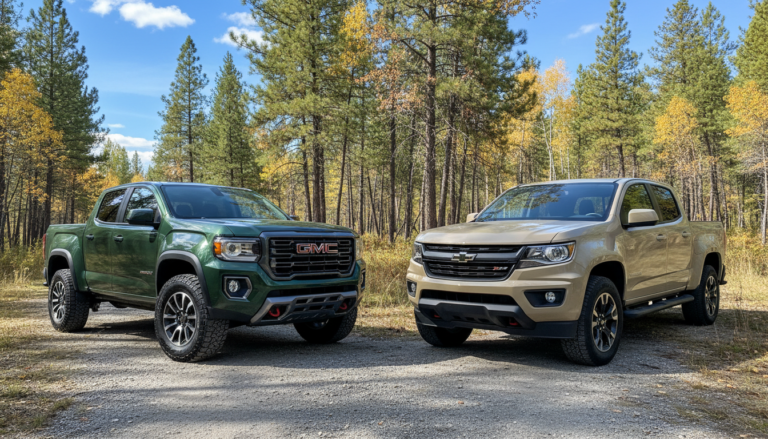
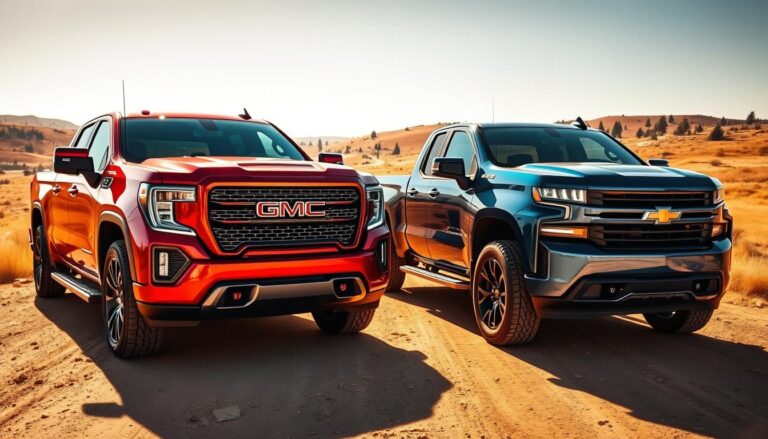
The look of a midsize truck tells you what it’s for. Ford goes for bold lines and a practical look. Chevrolet takes a sharp, angular path with a strong face and edges.
Exterior styling: Ford’s rugged lines vs Chevy’s sharp, angular stance
Ford Ranger focuses on being tough and useful. It has LED lights and a STX Package for a look that’s both functional and cool. It’s ready for trails but also looks good on the street.
Chevy Colorado has a modern, sharp look. Its strong lines and big grille show it’s ready for off-road adventures. It looks tough and capable.
Size and maneuverability: Ranger’s 210.6-in. length vs Colorado’s 213.02-in. length
Length matters for parking and changing lanes. The Ranger is a bit shorter than the Colorado. This makes it easier to handle in tight spots.
The Colorado is bigger, which makes it look more powerful. If you need more space for cargo or passengers, the Colorado might be better. Try both in tight spaces to see which is easier.
Ground clearance and off-road readiness: Ranger’s minimum 9.3 inches vs Colorado’s 7.9 inches
Ground clearance is key for off-road adventures. The Ranger has 9.3 inches, giving it an edge on rough trails. This makes it great for weekend off-roading.
The Colorado has 7.9 inches, which is good for many trails. But off-road trims can make it even better. When looking at specs, remember how clearance affects real-world use.
Design choices affect how a truck handles and looks. Ranger balances style and size for everyday use. Colorado goes for a bolder look and bigger size for a more aggressive feel. Each design choice impacts how the truck performs.
Powertrains and performance breakdown using engine specs
The powertrain choices affect how each truck performs on the road and off. This section compares engine options, transmissions, drivetrain choices, and how they handle on the road. It helps readers decide between the ford ranger and chevy colorado based on what matters most to them.
Ford Ranger engine options: 2.3L EcoBoost, 2.7L EcoBoost, 3.0L Raptor V6
Ford offers engines for different needs. The standard 2.3L EcoBoost four-cylinder has 270 hp and 310 lb-ft of torque. It’s good for everyday driving and fuel economy.
The 2.7L EcoBoost V6 makes about 315 hp and 400 lb-ft. It’s available in Lariat or XLT trims for more power when towing or carrying heavy loads.
The Ranger Raptor has a 3.0L EcoBoost V6 with 405 hp and 430 lb-ft. It’s designed for off-road adventures, as noted in recent reviews.
Chevy Colorado engine: 2.7L Turbo (TurboMax) and off-road variants
Chevrolet uses a single 2.7L TurboMax four-cylinder for 2025. It has about 310 hp and 430 lb-ft of torque. This helps with starting on trails and towing.
Off-road trims like ZR2 and Z71 have special suspension and drivetrain settings. Choosing one engine makes it easier for shoppers who want a simple performance choice.
Transmission, drivetrain choices, and on-road responsiveness
The Ranger comes with a 10-speed automatic. You can choose rear-wheel drive or 4WD for base XL, XLT, and Lariat. The Raptor is 4WD only, ready for tough terrain. This lets buyers pick between fuel economy and power.
The Colorado has an eight-speed automatic with the TurboMax engine. WT and LT trims offer RWD or 4WD. Trail Boss, Z71, and ZR2 trims have 4WD and off-road settings.
On the road, the Ranger offers more options. The 2.3L is lighter and more fuel-efficient for daily driving. The 2.7L is faster for towing or passing. The Raptor focuses on performance and comfort off-road.
The Colorado’s single engine provides consistent power for towing and heavy loads. Its eight-speed transmission keeps the engine steady under load. It’s great for those who want simple power and maintenance.
Choosing between the Ranger and Colorado comes down to personal preference. The Ranger offers variety for different needs. The Colorado provides one strong engine package for most trims. Reviews often praise the Ranger’s variety, while the Colorado’s specs highlight its torque and off-road readiness.
Towing capacity and payload: real-world capability comparison
The Ranger and Colorado are top choices for those who need to haul and tow. This section looks at their towing and payload claims, useful features, and safety tech for heavy loads.
Each truck has its own strengths. One might tow a bit more. The other offers more payload and trailer tech for work and play.
Ranger figures
The Ranger can tow up to 7,500 pounds with the right package. It can carry about 1,805 pounds in the bed. This is great for hauling heavy stuff without a trailer.
Colorado figures
The Colorado can tow up to 7,700 pounds, a bit more than the Ranger. It has a payload of about 1,685 pounds. This is good for many users.
Towing tech and trailer features
Ford’s Ranger comes with Pro Trailer Backup Assist and blind-spot warnings for trailers. It also has adaptive cruise control on higher trims. Chevrolet’s Colorado has a safety suite with lane-keeping and automatic emergency braking. It also has trailer stability controls on many trims.
Practical advice
Go for the Colorado if you need the highest tow rating. Choose the Ranger for more payload, trailer assist, and extended trailer detection.
| Category | Ford Ranger | Chevy Colorado |
|---|---|---|
| Max towing capacity | Up to 7,500 lbs | Up to 7,700 lbs |
| Payload capacity | ~1,805 lbs | ~1,685 lbs |
| Trailer steering assist | Pro Trailer Backup Assist | Not offered |
| Blind-spot with trailer coverage | Available | Some trims offer extended detection |
| Adaptive cruise with stop-and-go | Available on higher trims | Adaptive cruise available on select trims |
| Best use case | Work trucks needing higher payload and towing aids | Owners needing the highest towing capacity |
When comparing the Ford Ranger and Chevy Colorado, think about towing and payload. Also, consider the features that make towing easier. These factors help decide which truck is best for work, play, or both.
Fuel efficiency and range for commuting and long trips
When choosing between the Ford Ranger and Chevy Colorado, you’re looking at real-world economy versus capability. EPA estimates give a quick baseline. Tank range and drivetrain choices show how each truck performs on daily commutes and long drives. Practical checks help buyers match powertrain choice to driving needs.
EPA-estimated combined MPG
The Ranger leads in combined figures, with certain 2.3L EcoBoost configurations rated up to about 23 mpg combined. This is roughly 21 city / 26 highway. The Colorado’s best combined estimate reaches about 20 mpg, or around 19 city / 23 highway. These figures are a starting point for comparing the Ranger and Colorado for buyers focused on fuel efficiency.
Real-world range examples
The Ranger can approach roughly 460 miles on a full tank, given typical tank sizes and favorable highway driving. The Colorado can yield about 428 miles under similar conditions. Real drivers should expect variation based on load, speed, and climate when assessing commute fuel economy and trip planning.
How engine choice and drivetrain affect economy?
Engine selection clearly changes outcomes. The Ranger’s 2.3L EcoBoost is the most efficient option. Choosing the Ranger’s 2.7L or the Raptor 3.0L V6 lowers mpg noticeably. Colorado’s single 2.7L Turbo offers strong torque but fewer paths to improved fuel economy.
Drivetrain choice matters. Four-wheel-drive setups typically reduce fuel efficiency on both trucks. Lighter payloads and highway cruising favor higher mpg. Buyers who prioritize commute fuel economy should pick the most efficient engine and a two-wheel-drive layout when available.
For shoppers debating the best midsize truck, these trade-offs clarify use cases. Those who want better everyday economy lean toward the Ranger with the 2.3L. Buyers who need extra torque or towing capacity may accept slightly lower numbers from the Colorado.
| Metric | Ford Ranger (efficient config) | Chevy Colorado (efficient config) |
|---|---|---|
| EPA combined MPG | Up to 23 mpg | Up to 20 mpg |
| EPA city / highway | 21 city / 26 highway | 19 city / 23 highway |
| Real-world range per tank | About 460 miles | About 428 miles |
| Most fuel-efficient engine | 2.3L EcoBoost | 2.7L Turbo (only option) |
| Effect of 4WD | Reduces mpg noticeably | Reduces mpg noticeably |
| Best fit for commute fuel economy | Daily highway commuters and light loads | Drivers needing torque who accept lower economy |
Off-road capabilities and available trail-ready trims
The midsize segment offers real off-road capability in dedicated trims. Buyers choosing between ford ranger vs chevy colorado will find each brand has a clear approach to trail performance. This section outlines what the Ranger Raptor brings and how Chevrolet equips the Colorado for rough terrain.
Raptor hardware and intended uses
The Ranger Raptor focuses on high-speed off-roading. It has a turbocharged 3.0L EcoBoost V6 engine for strong midrange power. Fox internal-bypass shocks provide controlled damping at speed.
Locking differentials and a reinforced frame increase durability on aggressive runs. This setup suits desert runs, high-speed dirt work, and recreational drivers who want to push pace over varied terrain. Standard four-wheel drive and performance tuning separate the ranger raptor from other Ranger trims.
Chevrolet trail trims and suspension
Chevrolet offers the colorado zr2 as the flagship for hardcore trails. The ZR2 includes specialized suspension, Multimatic DSSV dampers on some models, skid plates, and a wider track for stability. Z71 and Trail Boss trims add terrain-tuned springs, protective plates, and off-road hardware for more moderate to challenging trails.
The colorado zr2 emphasizes controlled articulation and chassis resilience for technical obstacles and slower, deliberate trail driving. It balances capability with daily drivability for owners who split duty between street and trail.
Clearance, approach angles, and practical choices
Ground clearance matters on rocks and ruts. Ranger’s higher minimum ground clearance around 9.3 inches helps clear obstacles and improves departure angles. Colorado’s roughly 7.9-inch figure remains capable but limits extreme lines.
Approach, breakover, and departure angles change by trim to protect bumpers and maximize travel. Buyers should pick based on intended use: choose Ranger Raptor for speed-focused adventures, choose Colorado ZR2, Z71, or Trail Boss for balanced trail competence and everyday comfort.
Interior comfort, cargo practicality, and technology features
The Ranger and Colorado have cabins that mix work needs with comfort. They feel different, whether for short trips or long drives. This is due to their design, materials, and tech options.
Infotainment and connectivity
The Ranger comes with a 12-inch SYNC 4A touchscreen. It also has wireless Apple CarPlay and Android Auto, plus FordPass Connect. The Colorado has an 11.3-inch system on higher trims and Google Built-In on some models.
Both offer an 8-inch digital gauge cluster for easy data reading. The Ranger has bigger screens and more integration. The Colorado has a clean interface and reliable phone connectivity.
Those looking at ford ranger reviews or chevy colorado specs will see how tech impacts daily life.
Driver aids and safety tech
Ford focuses on trailer features like blind-spot warning and Pro Trailer Backup Assist. The Ranger also has adaptive cruise control with stop-and-go on many trims.
Chevrolet emphasizes basic safety features like automatic emergency braking and lane-keeping assist. The Colorado has a solid safety foundation but lacks some of Ford’s trailer tools. For those who tow often, these features are key to compare.
Cabin ergonomics, storage, and urban-friendly design
The Ranger has smart storage and easy controls. It has cupholders, under-seat bins, and power outlets for urban and job-site use. Optional premium materials add comfort without cluttering the space.
The Colorado has straightforward ergonomics and practical storage. Its seats are comfy for long drives, and trim choices affect surface quality and storage. Both crew-cab layouts are great for families and work crews.
Key takeaway: ford ranger reviews often praise its advanced tech and trailer aids. Chevy colorado specs highlight its solid infotainment and safety features. Comfort is key for daily use.
Pricing, trims, and value proposition for buyers
Choosing a midsize pickup involves many factors that affect costs. Prices change based on trim, engine, and where you buy it. A detailed comparison helps understand where your money goes and what you get in return.
Trim levels set expectations. Ford Ranger starts with XL, then XLT, Lariat, and ends with Raptor. Chevrolet Colorado starts with WT, then LT, Trail Boss, Z71, and ZR2 for off-road enthusiasts. Each level adds features like better infotainment, tow assists, and heavy-duty suspension.
Key features quickly increase costs. Larger screens, towing packages, and upgraded brakes raise the price. Ranger’s 2.3L or 2.7L EcoBoost affects fuel and insurance. The Raptor’s V6 boosts power but adds maintenance costs. Colorado’s single 2.7L Turbo simplifies but limits trim pricing differences.
Features impact ownership costs directly. Better towing tech saves time and stress. Bigger engines increase fuel costs. Payload and tow hardware can change insurance and maintenance costs.
Watch for dealer incentives and regional pricing. Freight and destination costs are fixed in the U.S. but dealer packages vary. Coastal and off-road areas may see more protection or promotions. Local incentives can lower the initial cost. Additional fees like documentary and surface care can increase the final price.
Value depends on what matters most. Ranger’s efficiency is great for daily use. Colorado’s lineup offers clear off-road choices. A balanced comparison considers upfront costs and long-term expenses.
Practical steps when shopping:
- List must-have equipment and match it to trim levels.
- Compare MSRP plus freight and dealer fees for final pricing.
- Calculate fuel and insurance estimates for chosen engines and trims.
- Ask dealers about regional incentives and packaged services.
Small differences in options shape long-term value. Match tow needs, tech wish lists, and budget limits to the right trim for the best value from this Ford Ranger vs Chevy Colorado comparison.
Consumer ratings, reliability impressions, and ownership considerations
Feedback from buyers and experts shows how these trucks do in daily life. Ratings talk about how happy people are with the drive, tech, and how long they last. This helps decide between the Ford Ranger and Chevrolet Colorado.
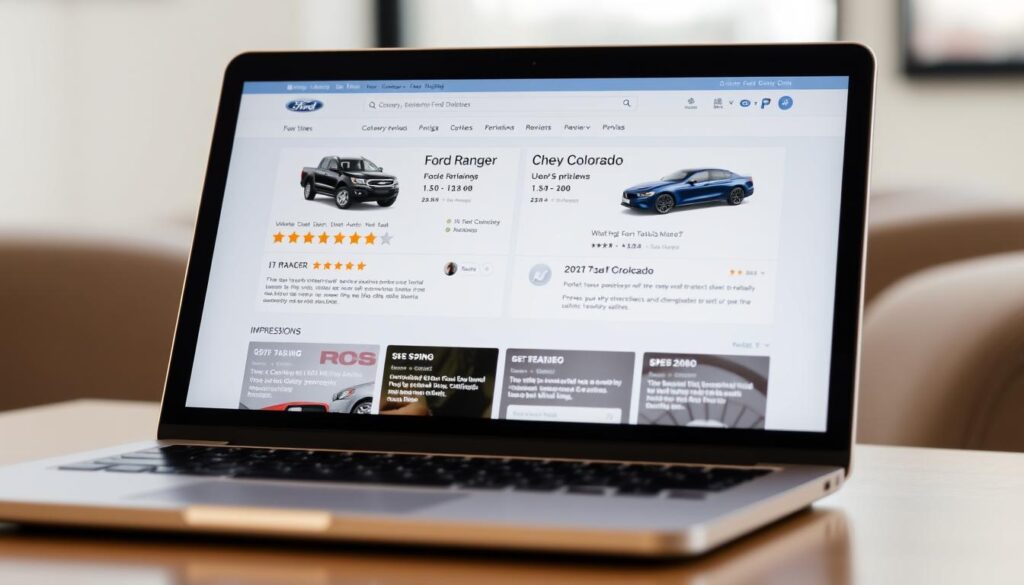
Many say Ford’s tech and driver aids are top-notch. Ford Ranger reviews often praise the 12-inch SYNC screen and the Raptor V6 for fun driving. People like the Ranger for its tech and how it saves gas.
Experts say the Colorado is great for towing and off-roading. They like its strong towing and off-road trims like ZR2. Chevrolet gets credit for making it good for hauling and off-road adventures.
How often you need to service your truck depends on the engine and features. Ford and Chevrolet offer similar warranties for new trucks. So, the cost over time depends on the engine and how you use the truck.
Warranty and service packages add value to owning a truck. Plans for extended coverage, maintenance, and support from local dealers are key. This is important for those who tow a lot or go off-road often.
Here’s what to consider based on your needs:
- Commuters looking for good gas mileage and tech: Ranger with the 2.3L EcoBoost.
- Those who tow a lot: Colorado for its 7,700-pound capacity.
- Off-road enthusiasts: Ranger Raptor for its turbo V6 and suspension.
- Trail-goers who want rugged looks: Colorado ZR2 or Z71 for off-road features.
Make sure to check the exact specs and reviews for the trim you want. Test drives and warranty details at local dealerships are essential. They help match the truck to your needs.
Ford Ranger vs Chevy Colorado
This comparison highlights the strengths and compromises of each truck. It’s a guide to help you choose the best truck for your needs. Whether it’s for daily driving or weekend adventures, this comparison will help you decide.
Head-to-head summary of strengths and compromises
The Ford Ranger offers a wide range of engines, including the 2.3L and 2.7L EcoBoost, and the 3.0L Raptor V6. It also has advanced towing features like Pro Trailer Backup Assist. The Ranger has better fuel economy and can carry up to 1,805 lbs. It also has a ground clearance of about 9.3 inches, making it great for rough terrain.
The Chevy Colorado, on the other hand, has a higher maximum tow rating of up to 7,700 lbs. It also has strong torque from the 2.7L Turbo. The Colorado’s exterior is bold, and its off-road trims, like ZR2 and Z71, offer tuned suspensions and heavy-duty hardware. The Colorado is slightly longer than the Ranger, which can affect parking and maneuverability.
Which truck wins for specific drivers?
For tech-focused commuters, the Ranger is the better choice. Its SYNC 4A system and adaptive features are perfect for daily driving and long commutes.
For those who need to tow heavy loads, the Colorado is the better option. Its 7,700-lb towing capacity and strong torque make it ideal for heavy trailers and large loads.
Enthuasiasts who want high-speed trail capability will prefer the Ranger Raptor. It has a turbo V6, Fox shocks, and performance tuning. Drivers who prefer balanced off-road hardware and a variety of factory trail trims may choose the Colorado ZR2 or Z71.
Test-drive checklist: what to evaluate in person
- Ride quality on city streets and highway; try both 2WD and 4WD where possible.
- Steering feel and maneuverability in parking lots; note how the shorter Ranger length affects tight turns.
- Acceleration and passing power for your chosen engine: compare 2.3L, 2.7L, and 3.0L responses.
- Towing setup if relevant: attach a trailer, test hitching, Pro Trailer Backup Assist, and trailer coverage systems.
- Infotainment responsiveness, smartphone integration, and clarity of the gauge cluster.
- Cabin ergonomics: storage solutions, visibility, and seat comfort during a longer drive.
- For off-road trims: check ground clearance, skid plates, suspension travel, and damping behavior over rough surfaces.
Below is a compact comparison highlighting the main contrasts to guide in-person checks and final choices.
| Category | Ford Ranger | Chevy Colorado |
|---|---|---|
| Engine options | 2.3L, 2.7L EcoBoost, 3.0L Raptor V6 | 2.7L Turbo (TurboMax), off-road variants |
| Towing / Payload | Up to 7,500 lbs tow, ~1,805 lbs payload | Up to 7,700 lbs tow, ~1,685 lbs payload |
| Ground clearance | ~9.3 in. (higher off-road trims) | ~7.9 in.; ZR2 offers increased clearance |
| Infotainment & Tech | 12-in. SYNC 4A, advanced trailer aids | 11.3-in. system, strong off-road tuning |
| Best for | Tech seekers, commuters, high-speed off-road with Raptor | Tow-focused buyers, balanced off-road with ZR2/Z71 |
| Notable compromise | Shorter length than Colorado; fewer max tow pounds | No Ranger V6 option; fewer trailer-focused tech features |
Conclusion
In this comparison of the Ford Ranger and the Chevy Colorado, each truck has its own strengths. The Ford Ranger focuses on tech, flexibility in its lineup, and better fuel economy for daily driving. It also has higher payload numbers and a wide range of engines for those who need both work and comfort.
The Chevy Colorado, on the other hand, excels in towing. It has the highest towing rating, bold looks, and off-road trims like ZR2. This makes it perfect for those who often tow heavy trailers or prefer Chevrolet’s suspension.
When choosing the best midsize truck, consider what you really need. If you want tech, payload, and efficiency, go for the Ranger. But if you need maximum towing and a rugged ride, the Colorado is your best bet. Visit local dealerships, test-drive the exact trims you’re interested in, and check the towing and payload on the window sticker for your needs.
With clear priorities like commute efficiency, towing needs, or off-road thrills, you can choose the right truck for your lifestyle. This guide helps turn specs into practical expectations. So, you can find the best midsize truck for your plans.
FAQ
Which truck has the higher maximum towing capacity, the Ford Ranger or the Chevrolet Colorado?
The Chevrolet Colorado can tow up to about 7,700 pounds when equipped right. The Ford Ranger can tow up to 7,500 pounds with the Trailer Tow Package.
Which truck gets better fuel economy and longer real-world range?
The Ford Ranger is more fuel-efficient, with up to 23 mpg combined. It can go about 460 miles on a full tank. The Colorado gets about 20 mpg combined and can go up to 428 miles.
How do off-road models compare between Ranger and Colorado?
The Ranger Raptor is made for fast, rough off-roading. It has a 3.0L EcoBoost V6, Fox shocks, and more. The Colorado ZR2 is for tough trails, with special suspension and skid plates.
Which truck offers more engine choices and why does that matter?
The Ranger has more engine options: a 2.3L EcoBoost, a 2.7L EcoBoost V6, and a 3.0L EcoBoost V6 for the Raptor. The Colorado has just one engine, a 2.7L Turbo. More choices let Ranger buyers pick what they need, while Colorado’s single engine is great for towing.
Which truck has better towing technology and trailer aids?
The Ford Ranger has Pro Trailer Backup Assist and other trailer aids. The Colorado has basic safety features but lacks some of Ranger’s trailer aids.
How do ground clearance and maneuverability compare?
The Ranger has more ground clearance (about 9.3 inches) than the Colorado (7.9 inches). This helps with trails. The Ranger is also shorter, making it easier to park.
Which truck should I choose if I mainly commute but sometimes tow or go off-road?
The Ford Ranger is great for commuting with occasional towing or off-roading. It has better fuel economy and advanced tech. If you need to tow a lot, the Colorado is a good choice.