Chevy 6 Lug Bolt Pattern Guide: Silverado 1500, Tahoe & Colorado Specs
Upgrading the wheels on your half-ton Chevy is the fastest way to completely transform its stance and off-road capability. But if you assume that “all 6-lug wheels are the same” and blindly click buy on a set of rims, you might end up with a very expensive garage ornament.
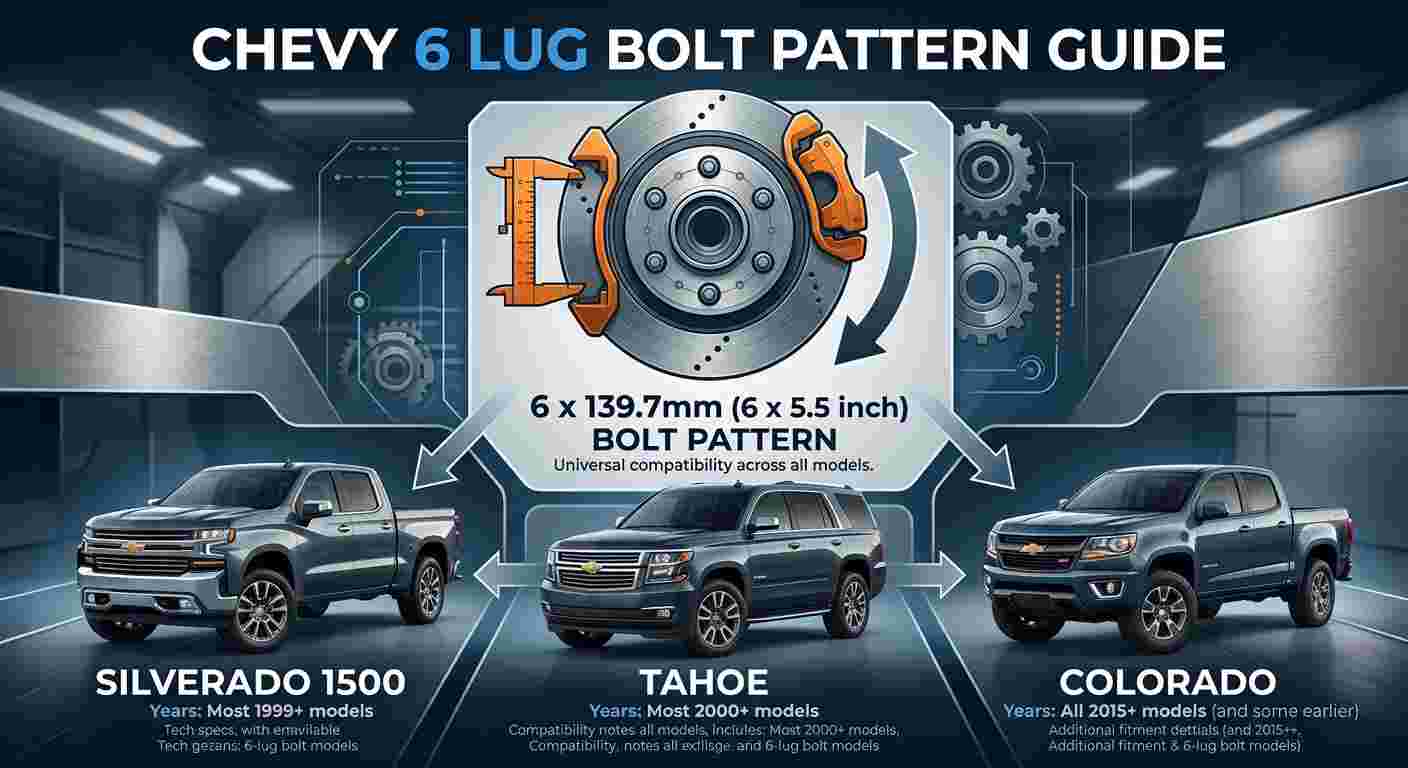
The undisputed king of GM half-ton hubs is the Chevy 6 lug bolt pattern—specifically, the legendary 6×5.5″ (6×139.7mm) layout. This setup has been the backbone of the Silverado 1500, Tahoe, and Suburban for decades.
But matching the bolt circle is only one piece of the fitment puzzle. In this guide, we are breaking down exactly which Chevy models use this standard, how to measure your hub to be 100% sure, and the hidden center bore and lug nut thread sizes you absolutely must verify before mounting aftermarket wheels.
What is the Standard Chevy 6 Lug Bolt Pattern?
The golden rule of half-ton GM trucks is simple: 6×5.5 inches is exactly the same as 6×139.7 millimeters.
Whether you are shopping for a classic 90s K1500, a 2008 Tahoe, or a brand-new Silverado 1500 bolt pattern, you are going to see these two numbers used interchangeably by wheel manufacturers. If an aftermarket rim says it fits a 6×5.5 bolt pattern, it will slide onto a 6×139.7 hub perfectly.
This classic 6-lug layout provides the ideal balance of load-bearing strength for standard towing while keeping rotational mass down for daily driving.
How to Measure a 6-Lug Hub (The Right Way)
Unlike 5-lug hubs (which require you to skip a lug to measure accurately), figuring out your Chevy’s 6-lug layout is incredibly straightforward because it’s an even-numbered pattern.
Here is the exact step-by-step method:
- Pick your starting point: Choose any lug stud on your wheel hub.
- Measure straight across: Take your tape measure or digital caliper and measure from the exact center of that first lug, directly across the middle of the hub, to the exact center of the lug directly opposite it.
- Check the reading: If the distance is exactly 5.5 inches (or roughly 139.7mm), you have the standard Chevy half-ton pattern.
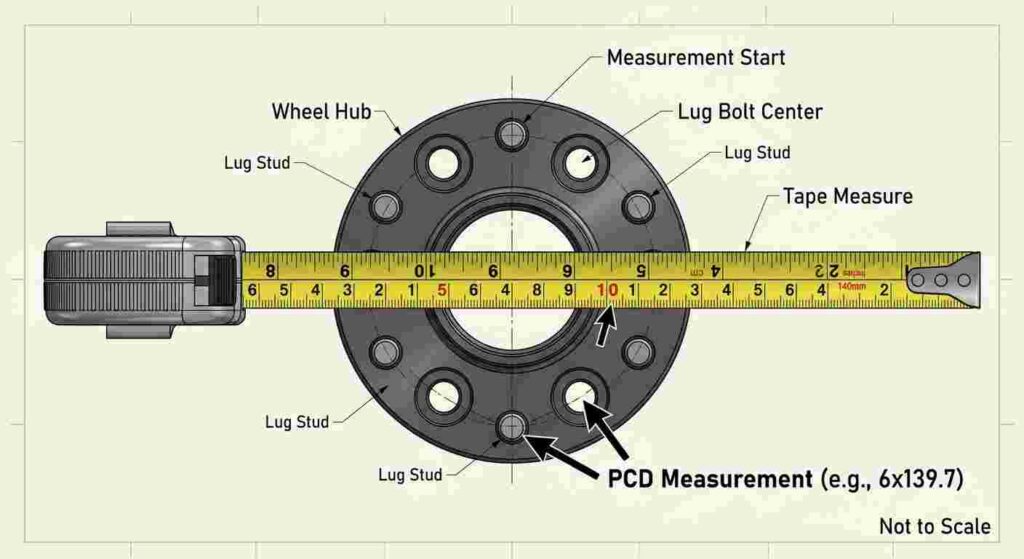
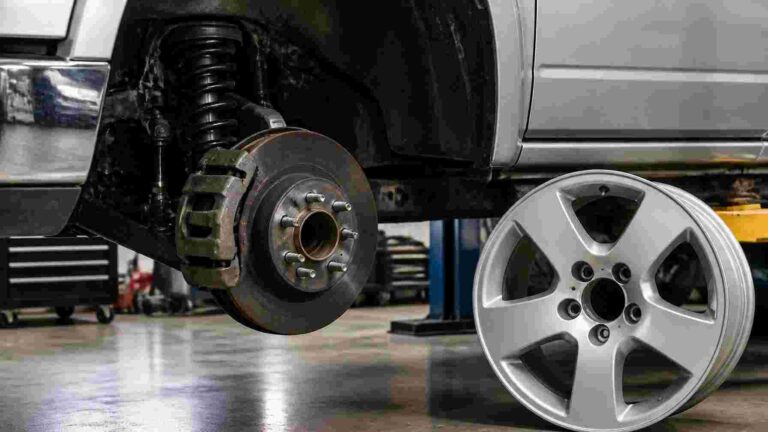
To find the bolt pattern of a wheel with an even number of lugs, simply measure the distance between the center points of two opposite holes. As shown here, measuring straight across a 6-lug hub from one stud center to its direct counterpart gives you the accurate pattern diameter.
Safety Warning: Don’t just measure the bolt circle and call it a day! The biggest mistake Chevy owners make is ignoring the center bore—the large hole in the middle of the wheel that rests on the axle hub.
Chevy 6 Lug Fitment Chart by Model & Year
While the 6×5.5″ (139.7mm) bolt pattern is the undisputed standard for full-size GM trucks, you cannot blindly assume every 6-lug Chevy uses it. Hub diameters and stud sizes have evolved, and a few specific models deviate from the standard entirely.
Use this quick-reference table to find your exact factory specs before shopping for aftermarket rims.
| Chevy / GMC Model | Years | Bolt Pattern | Center Bore | Factory Stud Size |
| Silverado / Sierra 1500 | 1999 – Present | 6 x 5.5″ (139.7mm) | 78.1mm | M14 x 1.5 |
| Tahoe / Suburban 1500 | 2000 – Present | 6 x 5.5″ (139.7mm) | 78.1mm | M14 x 1.5 |
| Colorado / Canyon (1st Gen) | 2004 – 2012 | 6 x 5.5″ (139.7mm) | 100.3mm | M12 x 1.5 |
| Colorado / Canyon (2nd/3rd Gen) | 2015 – Present | 6 x 120mm | 66.9mm | M14 x 1.5 |
| Trailblazer / Envoy | 2002 – 2009 | 6 x 5.0″ (127mm) | 78.1mm | M12 x 1.5 |
🚨 The “Fitment Traps” You Need to Avoid:
- The Trailblazer Trap: A classic mistake. The mid-2000s Trailblazer uses a completely unique 6×5.0″ (6x127mm) pattern. Standard Silverado wheels will not fit a Trailblazer without heavy-duty wheel adapters.
- The Colorado Shift: Notice the Colorado specs in the table above. First-generation Colorados share the 6×5.5 bolt pattern, but have a massive 100.3mm center bore (meaning standard Silverado wheels won’t clear the hub). Modern Colorados (2015+) abandoned the classic pattern entirely for a smaller 6x120mm bolt circle.
Center Bores and Stud Sizes: The Hidden Fitment Killers
If your bolt pattern matches, the wheel will slide onto the studs. But if your center bore and stud threads are wrong, your truck is going to be a nightmare to drive.
1. The 78.1mm Center Bore Rule
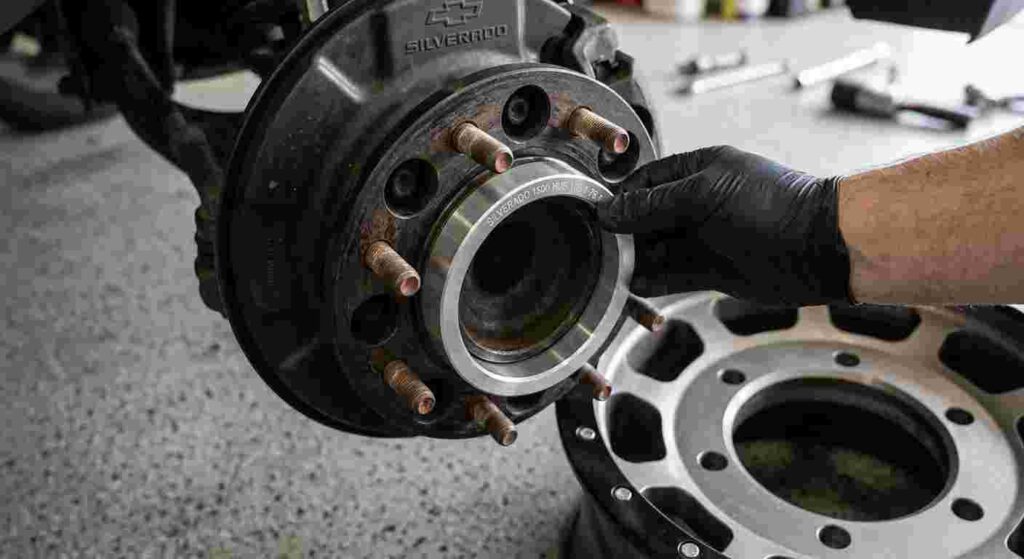
The center bore is the large hole perfectly machined into the middle of the wheel. It is designed to seat snugly on the lip of your vehicle’s axle hub. This is called a hub-centric fit, and it means the massive weight of your truck is resting securely on the axle, not shearing against your wheel studs.
The modern full-size Chevy 1500 utilizes a 78.1mm center bore.
Many aftermarket off-road wheels (and Toyota 6-lug wheels) are manufactured with a larger 106mm or 108mm center bore to fit a wider variety of trucks. If you buy these wheels, you must purchase 106mm-to-78.1mm hub-centric rings. These inexpensive aluminum or polycarbonate rings bridge the gap, physically centering the wheel and eliminating the violent highway steering wheel shake that plagues so many lifted trucks.
2. Matching Your Stud Thread Size
You cannot reuse your old lug nuts if you are upgrading from factory wheels to aftermarket alloys, as the seat types are usually different (requiring a 60-degree conical “acorn” nut instead of a flat flange).
To buy the right aftermarket lug nuts, you need to know your stud thread pitch:
- 1999 to Present (Full-Size): Nearly all modern Silverado 1500s and Tahoes use a thick M14 x 1.5 wheel stud.
- Pre-1999 (Classic Trucks): Older OBS (Old Body Style) GM trucks often utilized a smaller M12 x 1.5 or 1/2-inch stud.
Always double-check your thread pitch before forcing a lug nut on with an impact gun, or you will cross-thread the stud and face a costly repair.
Will Toyota or Ford 6-Lug Wheels Fit a Chevy?
If you find a killer deal on Facebook Marketplace for a set of Take-Off wheels from a different truck brand, you need to know exactly what will—and won’t—bolt up to your Chevy hub.
Toyota to Chevy Fitment (Yes, but with a catch)
Many Toyota trucks, specifically the Tacoma, 4Runner, and older Tundras, share the exact same 6×139.7mm (6×5.5″) bolt pattern as your Silverado or Tahoe. The lugs will line up perfectly.
The Catch: Toyota manufactures their wheels with a much larger center bore (typically 106mm). If you bolt a Toyota wheel directly to a Chevy’s 78.1mm hub, the wheel will be entirely lug-centric. Without a set of 106mm-to-78.1mm hub-centric rings, you will experience severe steering wheel vibrations at highway speeds.
Ford to Chevy Fitment (No, stay away)
Do not buy 6-lug Ford F-150 wheels for your Chevy. While they might look similar to the naked eye, modern 6-lug Fords utilize a tighter 6x135mm bolt pattern.
They will not fit over your Chevy’s studs. The only way to mount F-150 wheels on a Silverado is by using thick, bolt-on wheel adapters (converting 6×5.5 to 6×135). For half-ton trucks that tow or go off-road, adding adapters just to fit a different brand’s factory wheels is rarely worth the added stress on your suspension.
Proper Torque Specs for Chevy 6-Lug Wheels
Never let a tire shop blast your new wheels on with an air impact gun and call it a day. Over-torquing stretches the wheel studs, warps brake rotors, and ruins the aluminum seating surface of expensive aftermarket rims.
For modern (1999+) Silverado 1500s and Tahoes equipped with the thicker M14 x 1.5 studs, the factory recommended torque spec is a hefty 140 lb-ft.
(Note: Older GM trucks utilizing the thinner M12 studs generally call for a lower torque spec, around 100 lb-ft. Always verify your specific model year in the owner’s manual).
The Tightening Sequence: Grab a calibrated torque wrench and tighten your lugs using the 6-lug star pattern (skipping one lug, straight across, then adjacent). This ensures the wheel is pulled perfectly flat against the hub face.
[Image Placeholder: Diagram showing a 1-to-6 numbered star tightening sequence on a 6-lug wheel]
Safety Rule: Always re-torque your wheels after the first 50 miles of driving. As the aluminum heats up and settles, lug nuts can easily back off.
Frequently Asked Questions (FAQ)
What is the 6×139.7 bolt pattern in standard inches? The metric 6×139.7mm bolt pattern translates exactly to the standard 6×5.5″ layout. Wheel manufacturers and tire shops use these two designations interchangeably.
Do all Chevy 1500s have a 6-lug pattern? All modern (1999 and newer) Silverado and Sierra 1500s use a 6-lug pattern. However, if you are restoring a classic 1980s or 1990s 2WD C1500 (OBS truck), it likely features a 5-lug hub. Only the 4WD (K1500) models from that era consistently used the 6-lug setup.
What size are the lug nuts on a Chevy Silverado 1500? From 1999 to the present day, the standard wheel stud size for a Silverado 1500 is M14 x 1.5. When buying aftermarket wheels, ensure you purchase 60-degree conical “acorn” style lug nuts with this exact thread pitch to seat properly.