Chevy 6.6 Gas MPG: Real-World Highway & Towing Numbers
The Chevy 6.6L Gas V8 (L8T) is a legendary torque monster, delivering 464 lb-ft of pulling power. But let’s be honest: it has a bit of a ‘drinking problem.’
Since the EPA doesn’t rate Heavy Duty trucks (2500/3500 series), finding honest Chevy 6.6 gas MPG numbers is like finding a needle in a haystack.
The Real-World Numbers (2024+ 10-Speed Allison):
- Highway (Unladen): 14–16 MPG (Cruising at 65-70 MPH).
- City/Mixed: 10–13 MPG.
- Heavy Towing: 8–9 MPG.
The Million Dollar Question: Choosing the 6.6L Gas engine saves you nearly $9,500 upfront compared to the Duramax Diesel. But will those savings vanish at the gas station?
In this guide, we strip away the marketing fluff and crunch the real numbers. Whether you are a weekend warrior towing a boat or a hotshot driver hauling daily, here is the truth about what the 6.6L Gas V8 will actually cost you to run.
Overview of the 6.6L Chevy Gas Engine (L8T): Specs & Purpose
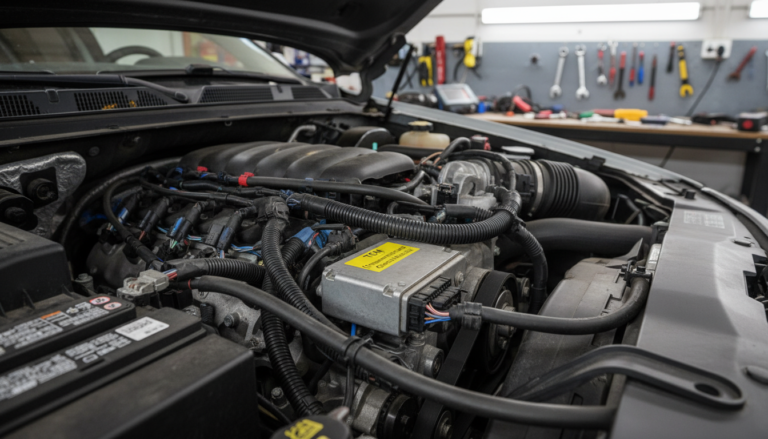
The 6.6L V8 L8T is Chevrolet’s dedicated heavy-duty gasoline engine. Unlike the light-duty engines found in the Silverado 1500, this iron-block workhorse prioritizes durability over fuel saving.
Quick 6.6 Gas Engine Specs:
- Displacement: 6.6 Liters (Exactly 400 cubic inches)
- Horsepower: 401 hp @ 5200 rpm
- Torque: 464 lb-ft @ 4000 rpm
- Block Material: Cast Iron (Built for extreme heat and stress)
- Oil Capacity: Holds exactly 8 quarts (with filter change)
- Fuel Type: Regular Unleaded (87 Octane) or E85 FlexFuel
The Reliability Advantage: No AFM/DFM
This is the biggest selling point for long-term owners. Unlike the 5.3L and 6.2L engines, the 6.6L Gas does NOT use Active Fuel Management (AFM) or Dynamic Fuel Management (DFM).
- What this means: It runs on all 8 cylinders, 100% of the time. While this hurts MPG slightly, it eliminates the notorious lifter failures associated with cylinder deactivation. It is a simple, brute-force engine designed to last.
Transmission Evolution: 6-Speed vs. 10-Speed
Your fuel economy and towing experience depend heavily on the model year:
- 2020–2023 Models (6-Speed 6L90): These trucks feel strong but rev high on the highway, leading to lower MPG (12-14 mpg highway).
- 2024+ Models (10-Speed Allison): The game changer. The new Allison transmission keeps RPMs lower at cruising speeds, improving highway MPG and offering much smoother towing performance on steep grades.

Intended Use: Who is this for?
This setup is the “Sweet Spot” for drivers who need a 2500HD/3500HD but want to avoid the $9,500 premium and complex emissions systems (DEF fluid) of the Duramax Diesel. It is perfect for:
- Towing trailers under 12,000 lbs occasionally.
- Daily driving and light commercial work.
- Hauling slide-in truck campers.
Here’s a quick look at the key specs and drivetrain options that affect fuel use and performance.
| Attribute | Typical Value | Effect on Chevrolet 6.6 Gas Engine MPG |
|---|---|---|
| Displacement / Configuration | 6.6L L8T V8 gasoline | Strong midrange power; moderate fuel use under load |
| Power / Torque | ≈401 hp / 464 lb‑ft | Good towing without diesel torque; MPG drops under heavy towing |
| Primary Transmission | 10‑speed Allison automatic | Smoother shifts and better highway mpg compared to older boxes |
| Driveline Options | RWD or 4WD; multiple axle ratios | 4WD and lower gear ratios reduce chevy 6.6 gas mpg; taller gears help highway mileage |
| Typical Models | Silverado 2500HD, Silverado 3500HD | Silverado 2500HD specs tend to favor slightly better fuel efficiency than 3500HD under like loads |
Real-World MPG Expectations: What Owners Actually See
The 6.6L L8T V8 strikes a deliberate balance between brute force and acceptable fuel efficiency. But because fuel economy swings wildly based on load, terrain, and how heavy your right foot is, relying on a single estimated number is a mistake. Let’s look at what actual owners and independent tests are seeing on the pavement.
Average Mixed & Highway MPG
Scour the owner forums and dealer road tests, and a clear consensus emerges: expect somewhere between 13 and 17 MPG in mixed driving. If you’re running a 2500HD unladen on a steady highway cruise, hitting 16–18 MPG is absolutely doable—especially with the 2024+ 10-speed Allison keeping RPMs low.
However, throw it in 4WD, add a heavy payload, or get stuck in gridlock, and those numbers will quickly drop into the low teens. Stop-and-go traffic is the natural enemy of a heavy iron-block V8.
Why Are There No Official EPA Ratings?
You might be wondering why there isn’t an official MPG sticker on the window at the dealership. The EPA simply doesn’t mandate standard fuel economy ratings for heavy-duty (Class 2b and Class 3) trucks. Their test cycles are built for light-duty commuters, not 7,000-pound workhorses. This means buyers have to rely entirely on crowdsourced owner data and independent road tests to figure out their true running costs.
How to interpret real-world data?
- Use ranges instead of one figure; report mixed, highway, and towing numbers.
- Adjust expectations for payload, trailer drag, and 4WD operation.
- Look for consistent patterns across owner reports and dealer tests before changing driving habits or upgrades aimed at improving Chevy 6.6 mpg.
6.6L Gas vs. 6.6L Duramax Diesel: The True Cost of Towing
The ultimate heavy-duty dilemma: Gas or Diesel? While the gas L8T holds its own at 13–17 MPG in everyday driving, the 6.6L Duramax diesel effortlessly stretches out to 18–21+ MPG on the highway. For unladen city driving, the efficiency gap narrows. But once you hook up a trailer, the game changes entirely.
Towing Efficiency Under Load
Diesel is king when the payload gets heavy. Thanks to massive low-end torque, the Duramax chugs along at incredibly low RPMs even while dragging 15,000 pounds up a steep grade. By contrast, the gas V8 has to rev much higher to find its power band, which aggressively drains the tank. If you are regularly hauling heavy loads over long distances, the diesel will consume significantly less fuel.
Long-Term Economics: Is the Diesel Worth It?
Here is where the math gets interesting. The Duramax comes with a nearly $9,500 upfront premium, higher routine maintenance costs (think DEF fluid and expensive oil changes), and diesel fuel often costs more at the pump.
However, diesel trucks depreciate slower and command much higher resale values. If you only tow a boat on the weekends, the gas engine is the smarter financial play. If you are a hotshot driver logging 50,000 miles a year, the diesel pays for itself.
| Aspect | 6.6L Gas V8 | 6.6L Duramax Diesel |
| Real‑World Mixed MPG | 13–17 mpg | 18–21+ mpg |
| Towing Efficiency | Great for light to moderate towing | Superior for heavy, sustained towing |
| Torque Profile | High peak torque, requires higher RPMs | Massive low‑end torque, low RPMs under load |
| Upfront Cost | Lower purchase price | ~$9,500 premium |
| Long‑Term Value | Best for light/moderate users and weekend warriors | Best for high‑mileage and heavy‑towing owners |
How Truck Configuration Impacts Your MPG
Not all 6.6L HD trucks are created equal when it comes to fuel economy. The exact configuration of your Silverado 2500HD or 3500HD plays a massive role in what you’ll see at the pump.
- Silverado 2500 vs. Chevy 3500 6.6 Gas MPG: A 3500HD typically carries heavier spring packs and beefier rear-end components. This added unsprung weight can shave a fraction of an MPG off your daily average compared to a lighter Chevy 2500. Furthermore, if you are looking at GM 6.6 gas MPG across sister brands (like the GMC Sierra), expect identical numbers, as they share the exact same powertrain and weight profiles.
- Cab and Bed Length: Pushing a Crew Cab Long Bed through the air requires more energy than a Regular Cab. The added mass and longer aerodynamic profile can easily cut your highway numbers by a point or two.
- 4WD vs. RWD: Opting for four-wheel drive adds the mechanical drag of a transfer case and front differential. Even in 2WD mode, this parasitic drag drops your MPG slightly compared to a strictly RWD setup—especially in stop-and-go city traffic.
The Towing Penalty: What Happens When You Hook Up?
The L8T was built to pull, but towing a heavy load absolutely tanks fuel efficiency. When you ask this 401-hp engine to drag serious weight, it demands fuel to match.
While an unladen truck might see 15 MPG on the highway, hooking up a trailer easily cuts that number in half. However, aerodynamics often matter more than raw weight. Pulling a flatbed with a 7,000-lb skid steer is much easier on your fuel tank than dragging a 7,000-lb enclosed travel trailer, which acts like a giant parachute.
Here is what you can realistically expect when putting the 6.6L Gas V8 to work:
| Towing Scenario | Unladen MPG | Expected Towing MPG | Pro Tip |
| Light Utility Trailer (Highway) | 13–16 MPG | 9–13 MPG | Keep it under 65 MPH to minimize aerodynamic drag. |
| Enclosed Camper (Mixed Driving) | 13–16 MPG | 8–12 MPG | Ensure trailer tires are at max cold PSI. |
| Open Car Hauler / Equipment | 13–16 MPG | 7–11 MPG | Use a weight-distribution hitch to keep the rig level. |
| Heavy Fifth-Wheel (Long Haul) | 13–16 MPG | 6–10 MPG | If this is your daily life, consider trading for the Duramax. |
Note: Use your Allison transmission’s Tow/Haul mode. It holds gears longer and prevents the transmission from constantly “hunting” on inclines, which saves your drivetrain and optimizes fuel delivery.
5 Proven Ways to Maximize Your 6.6L Gas MPG
You can’t turn a heavy-duty V8 into a Prius, but a few strategic tweaks to your driving habits and truck setup can easily claw back 1 to 3 MPG.
- Manage Your Speed: Aerodynamic drag increases exponentially after 60 MPH. Cruising at 65 MPH instead of 75 MPH is the single fastest way to see an immediate bump in fuel economy.
- Cover the Bed: An open truck bed creates a vortex of turbulent air that creates drag. Installing a hard, flush tonneau cover smooths out the airflow and can add +0.5 to 1.5 MPG at highway speeds.
- Ditch the Aggressive Rubber: Massive, heavy mud-terrain tires look great, but their high rolling resistance and added rotational mass destroy fuel economy. Stick to a high-quality all-terrain or highway rib tire if MPG is a priority.
- Shed Unnecessary Weight: Don’t carry 400 lbs of tools, sandbags, or unneeded hitches in the bed unless you are actually using them. Dead weight equals burned gas.
- Be Careful with ECU Tunes: A mild, reputable tow-tune can sometimes optimize shift points and slightly improve MPG under load. However, aggressive aftermarket tunes designed for peak horsepower will almost always send your fuel economy into the dirt. Proceed with caution.
The Bottom Line
The Chevy 6.6L Gas V8 (L8T) is a remarkably reliable, naturally aspirated powerhouse. By ditching complex cylinder deactivation (AFM/DFM), Chevy prioritized brute durability over strictly saving gas. Expect roughly 13–17 MPG in mixed driving and brace for single digits when towing heavy.
If you haul occasionally or use your truck for lighter daily commercial work, the $9,500 upfront savings over the diesel make the 6.6L Gas a phenomenal, low-maintenance investment.
FAQs
Is the Chevy 6.6 gas engine reliable?
Yes, the GM 6.6L Gas V8 (L8T) is widely considered one of the most reliable modern heavy-duty engines available. Because it utilizes a heavy cast-iron block and completely omits complex cylinder deactivation tech (AFM/DFM), it avoids the notorious lifter failures that plague the smaller 5.3L and 6.2L GM engines.
What are the most common Chevy 6.6 gas engine problems or issues?
The 6.6 gas engine has proven incredibly durable with very few widespread issues. Some owners of earlier 2020-2022 models reported slightly higher-than-average oil consumption when towing heavy loads, but GM considers up to 1 quart per 1,000 miles within acceptable commercial limits. For the most part, major mechanical problems are exceptionally rare.
What real-world MPG can I expect from the Chevy 6.6L gas V8?
Most drivers average 13–17 MPG in mixed driving. Highway cruising unladen can reach 15–18 MPG, while heavy towing will drop you down to 8–11 MPG.
Why doesn’t the EPA provide official MPG ratings for heavy-duty 2500/3500 trucks?
The EPA exempts vehicles with a Gross Vehicle Weight Rating (GVWR) over 8,500 lbs from standard fuel economy testing, as these trucks are classified for commercial work and their fuel use varies wildly based on payload.
Is it worth upgrading to the Duramax diesel for better fuel economy?
Yes, but only if you tow frequently or drive high annual mileage. The diesel gets better MPG (18-21+) and tows heavy loads much more efficiently, but it comes with a massive ~$9,500 upfront cost and higher routine maintenance bills.
What truck setup choices hurt gas mileage the most?
Choosing a 4WD Crew Cab Long Bed with an aggressive axle ratio and aftermarket mud-terrain tires will yield the worst possible fuel economy.