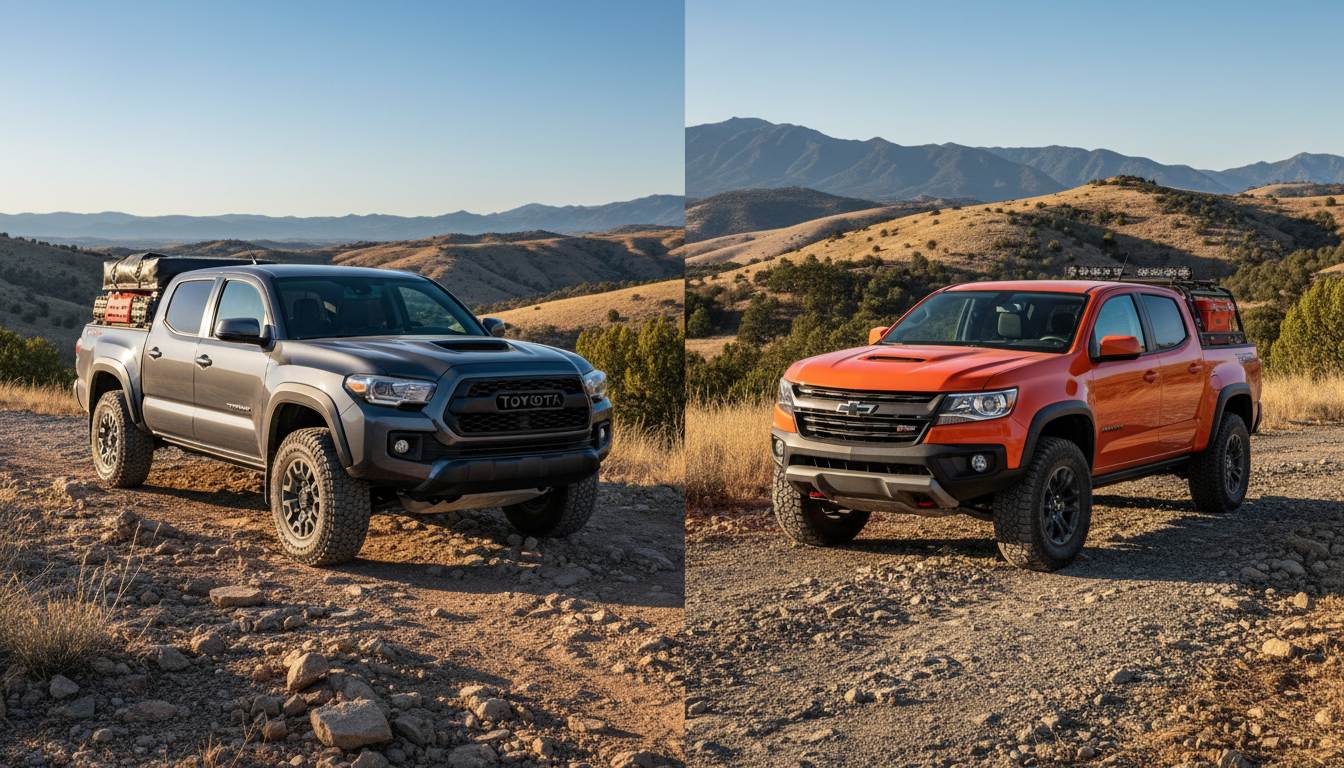
Toyota Tacoma vs Chevy Colorado: Which Midsize Truck Reigns Supreme?
The redesigned 2024 Tacoma and the new-generation 2023 Colorado headline a practical fight for U.S. shoppers who want real capability without full-size bulk. This introduction sets a buyer-focused tone and explains what “reigns supreme” means here: not just peak numbers, but the full ownership picture—performance, daily usability, efficiency, comfort, and cost.
Car and Driver framed this as a head-to-head using instrumented testing and measured specs. The comparison stays grounded in towing and payload, off-road hardware, and cabin tech. It highlights how midsize trucks fit parking lots, drive-throughs, and weekend trails more easily than full-size rigs.
Readers will get clear guidance on which pickup fits their priorities, which compromises matter most, and consistent terminology for trims and packages. This section primes practical decisions with concise, useful information for shoppers weighing the toyota tacoma vs chevy colorado matchup.
Quick Snapshot for US Truck Shoppers
Recent updates pushed both models into clearer roles for buyers. The redesigns change how each midsize pickup feels day to day, so choose based on your routine and priorities.
What’s new right now?
Toyota tacoma moved to a new turbo four and an updated chassis that aim for better ride and sharper steering. The chevrolet colorado arrives as a full new generation with revised suspension and available hardcore off-road bits.
Who each truck is built for?
One model trends toward everyday livability and easier city parking. The other leans into factory off-road swagger and aggressive hardware that helps on trails.
- City commuters: Prefer a softer ride, lower step-in, and responsive power in stop-and-go traffic.
- Mixed-use owners: Need towing ability and a comfortable cabin for long drives.
- Trail-focused buyers: Want lockers, tougher dampers, and a package that feels like a purpose-built off-roader.
| Focus | Everyday livability | Off-road intent | Trim impact |
|---|---|---|---|
| Ride & comfort | Softer tuning, lower step-in | Stiffer suspension, higher clearance | Base vs off-road changes feel like different vehicles |
| Powertrain feel | Smoother throttle in traffic | Quicker response under load, tuned for trails | Turbo choices and gearing alter daily drive |
| Cabin & tech | More usable storage, friendlier ergonomics | Durable surfaces, utility-first layout | Screens and switches vary widely by trim |
Bottom line: If your week is mostly urban drives, favor the model tuned for comfort. If weekends mean deep trails, pick the one with factory off-road hardware. Trim choice will change that balance a bit, so test the specific configuration you plan to buy.
Toyota Tacoma vs Chevy Colorado: Core Specs That Matter
Start with the hardware: the tested toyota tacoma uses a 2.4L turbo I‑4 with 278 horsepower and 317 lb‑ft of torque at 1,700 rpm. The chevrolet colorado ZR2 has a 2.7L turbo I‑4 with 310 hp and 430 lb‑ft at 3,000 rpm.
What that feels like: torque arriving at 1,700 rpm in the smaller engine gives earlier pull in traffic. The Colorado’s larger peak torque number helps under load, but it comes higher in the rev range.
- Transmission reality: both offer an eight-speed automatic; the tacoma also offers a six-speed manual for buyers who want more control.
- Towing capacity: Tacoma TRD Off‑Road 6,300–6,400 pounds; Colorado ZR2 5,500–6,000 pounds depending on packages.
- Payload: Tacoma about 1,200 pounds; Colorado ZR2 tested at 1,084 pounds.
- Bed, cab, seating: tacoma offers multiple bed/cab layouts for family or cargo flexibility; the colorado typically has a single configuration.
| Spec | Tacoma (tested) | Colorado ZR2 (tested) |
|---|---|---|
| Engine | 2.4L turbo I‑4 | 2.7L turbo I‑4 |
| Horsepower / Torque | 278 hp / 317 lb‑ft @ 1,700 rpm | 310 hp / 430 lb‑ft @ 3,000 rpm |
| Towing capacity (pounds) | 6,300–6,400 | 5,500–6,000 |
| Payload (pounds) | ~1,200 | 1,084 (as tested) |
| Bed & cab options | Multiple layouts, manual option | Single common configuration |
Spec sanity check: always confirm door‑jamb payload stickers and tow ratings on the exact vehicle and options you plan to buy. Options and drivetrain change final capacity and towing numbers.
Powertrain Performance in Real Testing
Measured runs and everyday driving paint a clearer picture than spec sheets alone. Both trucks hit 0–60 mph in 6.8 seconds and ran the quarter-mile in 15.2 seconds, but the details tell the rest of the story.
Horsepower, torque, and turbo response
The raw numbers show different peaks: one engine makes higher peak torque on paper while the other delivers earlier boost. Turbo tuning and transmission logic change how that power arrives.
Acceleration and passing times
Trap speeds diverged: one truck reached 92 mph while the other topped out at 89 mph. More telling is the 50–70 mph passing test—4.7 seconds for the more eager setup versus 5.4 seconds for the other. That gap matters for merging and overtakes.
On-road drivability and downshift behavior
Editors found the first truck more willing to downshift and respond instantly under light throttle. The other, despite higher peak horsepower and numbers, felt less eager in everyday driving.
- Read beyond specs: check throttle mapping, boost onset, and automatic shift logic.
- Use rolling tests: try 50–70 mph pulls, light uphill accelerations, and quick lane-change bursts during a test drive.
- Trust feel: subjective readiness of the powertrain often matters more than peak figures in daily use.
| Metric | Result A | Result B |
|---|---|---|
| 0–60 mph | 6.8 s | 6.8 s |
| Quarter-mile | 15.2 s | 15.2 s |
| Trap speed | 92 mph | 89 mph |
| 50–70 mph pass | 4.7 s | 5.4 s |
Fuel Economy, Range, and Running Costs
Fuel costs and upkeep often decide the real winner for daily drivers. For buyers weighing a toyota tacoma against a chevrolet colorado, EPA and real-world numbers make the budget picture clear.
The EPA rates the tested Tacoma at 19 city / 23 highway / 21 combined. The ZR2 reads a flat 16 mpg across the board. Off-road trims lose efficiency because of wider tires, lower gearing, and extra weight.
- Observed trip: 19 mpg (Tacoma) vs 14 mpg (ZR2) — that gap leads to more stops and higher spend.
- Range matters: a larger tank can be negated by higher consumption; capacity alone doesn’t win.
- Maintenance signal: RepairPal estimates ~ $478/yr for the Tacoma and ~$599/yr for the Colorado. Use this as a budgeting guide, not a guarantee.
| Metric | Tacoma (EPA) | Colorado ZR2 (EPA) |
|---|---|---|
| City mpg | 19 | 16 |
| Observed trip mpg | 19 | 14 |
| Estimated annual maintenance | $478 | $599 |
Quick decision lens: if this vehicle will be a daily commuter or long-distance runner, prioritize better mpg and range. If trail hardware matters more, expect to pay a bit for fuel and upkeep.
Interior, Infotainment, and Everyday Features
A roomy, practical cabin can decide a midsize truck purchase as much as power or towing. Interior design matters because these trucks double as commuter cars and weekend haulers. Good storage and easy controls reduce daily friction.
Cabin layout and materials
The tested toyota tacoma includes multi-level storage: a phone shelf, large door pockets, and an enclosed under‑seat box. The chevrolet colorado has a simpler layout with fewer useful nooks and criticized materials.
Infotainment and controls
Infotainment use matters for navigation and phone mirroring. Tacoma offers an available 14.0‑inch screen that makes menus easier to read. Colorado buries some functions in menus, forcing drivers to hunt for fog lights or downhill assist.
Rear comfort and loading
Colorado gains about 1 inch more rear legroom. Tacoma returns practical wins: bigger under‑seat storage and 60/40 fold‑flat seatbacks for gear.
| Metric | Tacoma (tested) | Colorado (tested) |
|---|---|---|
| Step-in height | 23.8 in | 26.5 in |
| Tailgate/bed loading | 34.2 in | 37.1 in |
| Rear legroom | Measured | +1 in vs competitor |
| Rear storage | Large under-seat box | Limited under-seat space |
Buyer tip: Sit in the rear seats during a test drive and lift a heavy item into the bed by hand. That quick check reveals real-world comfort and bed access better than specs alone.
Driving Experience and Off-Road Capability
Real-world trail tests reveal how each midsize pickup handles corners, brakes, and rough ground. Skidpad grip and 70–0 stopping distance act as quick proxies for cornering confidence and emergency braking performance.
Handling & braking: Measured results show the tacoma trd at 0.77 g and a 70–0 stop in 179 ft. The chevrolet colorado recorded 0.72 g and 186 ft. That gap means the tacoma trd feels more composed entering twisty roads and shorter in panic stops on highway runs.

Suspension tech
Multimatic spool‑valve dampers on the colorado favor repeatable control under big hits. The tacoma trd’s 46‑mm Bilstein shocks with external reservoirs deliver tuned rebound and better composure over washboard sections.
Articulation and trail composure
Ramp travel index numbers explain wheel contact: colorado 461, tacoma 411 with the bar connected, and 489 when its anti‑roll bar is disconnected. More travel helps keep tires planted and reduces reliance on lockers to pull a truck over obstacles.
Off‑road hardware and real use
- Tires: 33‑inch Goodyears on the colorado suit boulder and mud; 32‑inch BFGoodrich on the tacoma trd balance traction and road manners.
- Lockers & systems: Colorado has front and rear lockers; tacoma trd offers a lockable rear, plus multi‑terrain and crawl systems for slow technical moves.
- Clearance: Tacoma 11.0 in vs Colorado 10.7 in—small differences that matter on big rocks.
Which feels better?
On pavement the tacoma trd feels sharper and more engaging. The chevrolet colorado feels stable at speed but is less eager in tight corners and showed longer brake distances in testing. Off road, the colorado’s articulation and dual lockers excel on rough, technical lines, while the tacoma trd trades a bit of travel for livelier steering and easier on‑road manners.
| Metric | Tacoma TRD | Chevrolet Colorado |
|---|---|---|
| Skidpad (g) | 0.77 | 0.72 |
| 70–0 stop (ft) | 179 | 186 |
| Ramp travel index | 411 / 489 (bar disconnect) | 461 |
Price, Trims, and Options to Consider Before You Buy
A loaded midsize build can look very different from its base price. A careful shopper reads option sheets, not just MSRPs, to avoid sticker shock. The as‑tested examples make that clear: one tested tacoma trd came in at $47,480 while the tested chevrolet colorado ZR2 Desert Boss reached $61,530.
As‑tested pricing in plain terms
The Tacoma TRD Off‑Road started at $43,295 and added about $4,185 in options (disconnectable anti‑roll bar, eight‑speed automatic, JBL audio, heated seats, paint) to reach $47,480.
The Colorado ZR2 began at $48,295 and ballooned with the Desert Boss package and comfort/tech bundles to $61,530. Big off‑road packages and luxury items drive the gap.
Trim strategy: pick a path
- Broad lineup (value to overland): the tacoma’s many trims help buyers match needs—base SR through off‑road and Pro levels.
- Simpler range: the chevrolet colorado uses five trims to streamline choices but offers fewer bed/cab permutations.
Feature dealbreakers to check first
- Manual transmission or hybrid availability—if these matter, rule out trims without them early.
- Tow hooks, LED lighting, and practical bed hardware—these are functional items that affect capability more than a luxury package.
- Remember: towing capacity and payload shift with options and configuration; the priciest build isn’t always the most useful for your pounds or towing needs.
Quick shopping checklist
- Decide cab and bed needs first.
- Choose the trim that already includes core hardware you want.
- Add options last so the final price stays on budget.
| Item | Tacoma TRD (as tested) | Colorado ZR2 (as tested) |
|---|---|---|
| Base price | $43,295 | $48,295 |
| As‑tested price | $47,480 | $61,530 |
| Major option drivers | Anti‑roll bar, eight‑speed automatic, audio, heated seats | Desert Boss package, comfort/tech bundles |
Conclusion
Measured results and everyday impressions point to a clear front‑runner for most drivers.
Car and Driver names the 2024 toyota tacoma TRD Off‑Road the winner because its powertrain feels more responsive, braking and handling were sharper in test, and interior usability beats the competition. Fuel economy and passing response also leaned in its favor.
Choose the chevrolet colorado if you prioritize hardcore off‑road hardware like dual lockers, greater articulation, or a setup tuned for rough terrain despite interior tradeoffs.
Choose the Tacoma if you want a more engaging daily drive, better fuel numbers, and a smarter cabin and bed layout for real‑world capacity and payload use.
Do this: test drive both on the same route—include a highway stretch and a rough road—and compare window stickers for exact towing capacity, payload, and options before you buy.
FAQ
Which midsize truck is better for daily driving and occasional off-road use?
Choice depends on priorities. The redesigned 2024 Tacoma emphasizes ruggedness, higher payload and trail-ready hardware for weekend adventures, while the new‑gen 2023 Colorado focuses on a more refined on-road ride and advanced dampers for mixed use. For daily comfort with occasional trails, the Colorado’s tuned suspension and cabin may feel more civil. For tougher off-road work and a higher factory payload, the Tacoma’s setup wins.
How do the engines compare in real-world performance?
Both models use modern turbo four‑cylinder engines—the Tacoma’s 2.4L and the Colorado’s 2.7L—paired mainly to eight‑speed automatics. The larger‑displacement unit makes slightly different torque characteristics; measured acceleration and passing times show close results, but turbo response, gearing and transmission tuning influence how each truck feels in everyday driving.
What are the towing and payload differences I should know?
Maximum towing varies by trim and equipment. Trail-focused Tacoma TRD Off‑Road models can approach the mid‑6,000‑pound range, while ZR2‑equipped Colorado examples are typically in the mid‑5,000s to 6,000 range depending on packages. Payload numbers favor the Tacoma in many configurations—around 1,200 pounds versus tested Colorado ZR2 figures near 1,084 pounds—so hauling heavy gear in the bed often points to the Tacoma.
Are there manual transmission options and how do they matter?
The more rugged model still offers an available six‑speed manual in select trims, which appeals to purists and gives direct control off‑road. The competitor relies mostly on its eight‑speed automatic, tuned for smooth shifts and efficiency. For buyers who value gear selection and engine braking on trails, the manual remains a differentiator.
How do fuel economy and running costs stack up?
EPA and observed fuel figures show a gap: the Tacoma typically posts better highway numbers, while high‑trail Colorado trims like the ZR2 can rate as low as the mid‑teens. Real‑world testing has recorded around 19 mpg for the Tacoma versus roughly 14 mpg for the Colorado on identical routes. Long‑term ownership should also weigh reliability histories and maintenance cost estimates when comparing total cost of ownership.
What should buyers expect from the interior and infotainment?
Interior design differs by intent. One truck emphasizes durable storage, simple ergonomics and an available 14‑inch touchscreen for easier visibility, while the other offers a cleaner, more conventional layout with large standard displays and user‑friendly controls. Rear‑seat room and under‑seat storage vary by cab configuration, so test the specific cab and bed combo you plan to buy.
Which truck performs better off-road and on paved roads?
Off‑road performance depends on suspension components and hardware: Bilstein shocks and traditional setup favor the Tacoma’s composed trail manners, while Multimatic dampers on the Colorado ZR2 deliver exceptional articulation and high‑speed composure. On pavement, the Colorado often feels more refined and stable at speed; on dirt, the Tacoma’s setup and available locking differentials give drivers more confidence in technical terrain.