
P0300 Code Chevy Silverado: How to Fix Random Misfires (5.3L & 6.2L)
The P0300 code on a Chevy Silverado represents a “Random/Multiple Cylinder Misfire,” and it is often harder to diagnose than a specific cylinder code like P0301. It means your engine computer knows misfires are happening, but they are jumping around randomly, leaving you to hunt for the root cause.
⚠️ URGENT WARNING: If your Check Engine Light is flashing, pull over immediately. A flashing light indicates active misfiring that is dumping raw fuel into the exhaust. Driving in this state can melt your catalytic converters in minutes, turning a $50 repair into a $2,000 disaster.
The Usual Suspects (Silverado Specifics)
While a P0300 can be caused by spark plugs or bad gas, on a Silverado (especially the 5.3L and 6.2L V8s), the culprits are often more specific:
- AFM/DOD Lifter Failure: Stuck lifters on Active Fuel Management engines are a notorious cause of random misfires.
- Intake Manifold Gaskets: On older Vortec engines, plastic gaskets dry out and create vacuum leaks that confuse the sensors.
- Carbon Buildup: On newer Gen V Direct Injection engines (EcoTec3), carbon on the intake valves disrupts airflow.
Whether you are driving a classic 4.3L V6 or a modern 2.7L Turbo, this guide breaks down the diagnostic path to isolate the issue—starting with fuel pressure and ending with ignition coils.
Common P0300 Causes by Silverado Generation
Unlike other vehicles where P0300 is usually just old spark plugs, the Chevy Silverado has specific failures depending on which engine generation you have.
Generation 1: GMT800 (1999–2006)
- Engine: Vortec 4.8L, 5.3L, 6.0L
- Top Cause:Intake Manifold Gasket Failure.
- The Issue: The factory intake gaskets on these years were plastic/rubber composite that degraded over time, causing massive vacuum leaks.
- The Fix: Check your Long Term Fuel Trims (LTFT). If they are high (+15% or more) at idle but drop to normal when you rev the engine to 2500 RPM, your intake gaskets are leaking. Replace them with the updated Fel-Pro “Teal Green” gaskets (avoid the orange ones).
Generation 2: GMT900 (2007–2013)
- Engine: 5.3L (LC9, LY5) with AFM
- Top Cause:AFM Lifter Collapse.
- The Issue: These engines use Active Fuel Management (dropping to 4 cylinders to save gas). The special AFM lifters (cylinders 1, 4, 6, and 7) are prone to mechanical collapse or getting stuck.
- Symptoms: You will often hear a “chirping” or ticking noise from the engine, and the P0300 will be accompanied by a rough idle.
Generation 3: K2XX (2014–2019)
- Engine: EcoTec3 5.3L / 6.2L (L83/L86)
- Top Cause:Direct Injection (DI) Injector Failure.
- The Issue: Unlike older Silverados, these engines inject fuel directly into the cylinder. These injectors are prone to clogging or electrical failure, causing a specific cylinder misfire that registers as P0300.
Official Chevy TSBs for Misfires
Before you start replacing parts, check if your Silverado is covered by one of these known Technical Service Bulletins.
| TSB Number | Model Years | Problem Description |
| 15-06-01-002 | 2007–2014 | AFM Lifter collapse causing misfire and ticking noise. |
| PIP5029 | 2010–2014 | Carbon buildup on valves due to PCV design (Direct Injection models). |
| PIP3232C | 1999–2006 | Cold start rough idle due to leaking intake manifold gaskets. |
Real P0300 Diagnosis on a Silverado!
This video diagnoses a rough-running 2005 Chevy Silverado with a P0300 code, black smoke, and a check engine light. A scan tool reveals misfires on specific cylinders, prompting investigation of the upstream O2 sensors. The mechanic systematically checks sensor voltage and physically inspects the sensors for potential issues.
Symptoms and driving risks of a P0300 Chevy Silverado code
The check engine light will turn on when a Silverado P0300 code shows up. Drivers should check for related fault codes like P0301–P0308, P0335, P0340, and oxygen sensor codes. Freeze-frame data and misfire counts help figure out if it’s one cylinder, a bank, or many cylinders.
Look for a steady CEL or flashing CEL. A flashing light often means severe misfires that risk catalytic converter damage. Note accompanying codes, time stamps, and engine load in the scan tool to build a diagnostic pattern for the P0300 code Chevy.
Performance signs to watch
Typical symptoms include a rough idle, hesitation under acceleration, stalling, and reduced fuel economy. You may detect a fuel smell at the tailpipe from unburned gasoline. These signs point to misfires that the PCM logs as a Chevy P0300 code.
Noise clues and AFM lifter warnings
Tapping or ticking noises can indicate lifter wear, specially on AFM-equipped GM engines. That sound may come before a stored misfire code. Distinct mechanical noises call for compression or leak-down testing to check valves and lifters.
Driving risks and why prompt repair matters
Continuing to drive with a P0300 code Chevy risks overheating and destroying catalytic converters. Long-term misfires can damage pistons, valves, and the exhaust system. Sudden power loss creates safety hazards in traffic. Repairing misfires quickly limits repair costs and reduces the chance of secondary failures.
How to diagnose P0300 on a Silverado: step-by-step inspection workflow?
Diagnosing a Chevy Silverado with a P0300 code starts with simple steps. First, use an OBD-II scan to find P0300 and related codes. Note the freeze-frame data, misfire counters, and if misfires point to a specific bank or cylinder.
Next, do a detailed visual check. Examine spark plugs for wear, fouling, and correct gap. Also, check coils, coil boots, and connectors for damage. Look at wiring harnesses, vacuum lines, PCV hoses, fuel lines, and intake gaskets for any issues.
For coil-on-plug systems, use the swap-and-test method. Move a suspect coil to a known-good cylinder and re-scan. If the misfire follows the coil, replace it. If it stays on the same cylinder, check wiring, connector pins, and the plug for that cylinder.
Then, check the fuel system. Measure static and running fuel rail pressure against GM specs. Run an injector balance or flow test to find weak or clogged injectors. Consider ultrasonic cleaning for deposits. Test the fuel pump and change the fuel filter if needed.
Focus on CKP and cam sensors next. Use a scope or scanner to verify signal integrity. Intermittent CKP faults can cause false misfire reports. Also, check MAF and oxygen/air-fuel ratio sensors for proper readings. An AFR sensor issue can trigger a bank-specific misfire and set the Silverado engine code P0300.
Perform compression and leak-down tests to check mechanical health. Low or uneven compression suggests problems with rings, valves, or a head gasket. Record values and compare them to factory tolerances to decide on repairs.
End with a smoke test to find hidden leaks. Introduce smoke into the intake and look for leaks at intake gaskets, vacuum fittings, and PCV connections. Fix and retest until no smoke appears in suspect areas.
Start with simple steps like scans and visual checks. Then, move to coils and injectors, sensors, and lastly, compression and leak-down tests. This order helps avoid more invasive repairs when possible.
| Step | Tool/Test | What to look for | When to advance |
|---|---|---|---|
| Scan | OBD-II scanner | P0300, P030x, freeze-frame, misfire counts | Any misfire codes or odd freeze-frame data |
| Visual inspection | Basic tools, flashlight | Plugs, coils, boots, wiring, vacuum lines | Signs of wear, oil, cracks, loose clamps |
| Ignition swap test | Hand tools | Misfire follows coil or stays on cylinder | Isolation of faulty coil or wiring |
| Fuel checks | Fuel pressure gauge, flow tester | Rail pressure, injector balance, pump operation | Low pressure or imbalanced injector flow |
| Sensor verification | Scope or advanced scanner | CKP/cam signals, MAF, AFR/O2 readings | Intermittent or incorrect sensor signals |
| Compression/leak-down | Compression gauge, leak-down tester | Uneven or low compression percentages | Suspected mechanical fault |
| Smoke test | Smoke machine | Smoke ingress at intake, PCV, vacuum lines | Hard-to-see leaks that affect air metering |
Cost estimates and time to repair P0300 on a Chevy Silverado
The cost to fix a misfire on a Chevy Silverado varies. Simple fixes like spark plugs or sensor swaps are affordable and quick. But, complex jobs like AFM lifter replacement or fuel pump service take more time and cost more.
Before getting a quote, owners should budget for diagnostic time. This helps in understanding the total cost.
Common part and labor ranges
Spark plugs for a Silverado cost $80–$140. DIY owners save on labor, but a shop job can add $0–$200. Ignition coils are about $100–$160 each, helping to find the source of a Silverado P0300 code.
Air/fuel ratio sensors cost $80–$260. The total cost for replacement is around $280–$320. Fuel injector cleaning is about $150, while full replacement costs vary widely.
AFM lifter replacement: why labor dominates
AFM lifter kits cost $300–$750. Labor can take 7–15 hours. This makes the total cost $1,500–$2,000 or more, including gaskets and parts.
Trucks under GM warranty or covered by a TSB may have lower costs. Always check VIN coverage before scheduling work.
Fuel pump and injector service estimates
Fuel pump assembly jobs cost $500 to $1,500 for parts. Some estimates reach $1,500–$1,800 for full replacement. Injector cleaning is about $150, while replacement costs more per unit.
Escalation risks from misdiagnosis or delay
Ignoring a Silverado P0300 code can damage the catalytic converter. This increases repair costs. Continued operation can also cause internal wear or head gasket issues, leading to engine replacement. Reports show final bills can be much higher than expected if diagnosis and repair are delayed.
Quick cost checklist
- Spark plugs: $80–$140 parts; labor varies.
- Ignition coils: $100–$160 each; testing recommended.
- Air/fuel sensor: $80–$260 parts; $280–$320 typical total.
- Injector cleaning: ~$150; replacements much higher per injector.
- AFM lifter job: $300–$750 parts; 7–15 hours labor, $1,500+ total common.
- Fuel pump: $500–$1,500 parts; $1,500–$1,800 total in some estimates.
When facing a P0300 Chevy fault, get a detailed diagnostic. Ask for an itemized estimate. Knowing the exact problem helps avoid repeat visits and keeps costs in check.
Preventive maintenance to avoid future misfires on Silverados
Regular care keeps your Chevy running smoothly and lowers the risk of a P0300 code. Small checks at regular times catch wear before it causes problems. The steps below follow Chevrolet’s advice and common practices for Silverado owners.
Ignition checks
Change spark plugs as Chevrolet recommends. At each change, check coils for damage or wear. Replace any faulty coils to avoid a P0300 code.
Fuel system care
Change fuel filters on time and use quality gasoline. Plan for professional injector cleaning every 30k–60k miles. Clean injectors help avoid a P0300 code caused by uneven fuel delivery.
Oil and AFM lifter practice
Use the right oil viscosity and change it as recommended. Keep oil levels correct and change it before it gets too old. Clean oil reduces aeration and lowers AFM lifter wear, which can cause misfires.
Sensor maintenance
Watch for rising fuel trims or slow engine response. Replace MAF and O2 sensors when needed. Early replacement prevents poor combustion that can trigger a P0300 code.
Vacuum, PCV and intake health
Check vacuum hoses, PCV valves, and intake gaskets during service. Replace any damaged parts quickly. A smoke test at service intervals finds leaks before they cause problems.
Quick preventive routine
- At each oil change: visually check spark plugs, coils, fuel lines, and for oil or coolant leaks.
- Every 30k–60k miles: injector cleaning and fuel filter replacement as needed.
- Replace sensors as symptoms or scan data indicate, not when they fail completely.
By following these steps, you can reduce random misfires and keep your Silverado reliable. Regular maintenance is the best way to avoid a P0300 code or other trouble codes.
Troubleshooting tips, tools, and when to call a pro?
When a Chevy Silverado P0300 code shows up, start calmly and methodically. First, gather live data and do some quick checks you can safely do. Then, decide if you need a professional’s help.
Recommended scan tools and live data to watch
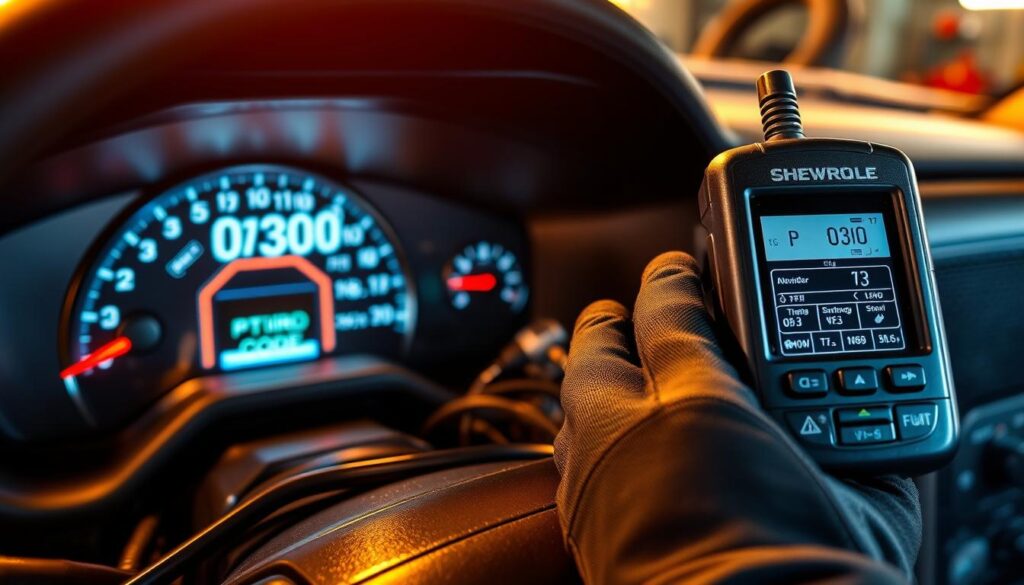
Use a good OBD-II scanner from Autel, Snap-on, ANCEL, or a reliable Bluetooth tool. These tools show real-time misfire counts per cylinder. Watch misfire counters, RPM, and fuel trims. Also, check oxygen/AFR sensor voltages and CKP and cam signals for dropped pulses.
Quick DIY checks you can try!
- Swap coils between cylinders, then re-scan. If the fault follows the coil, replace it.
- Inspect spark plugs for fouling and correct gap. Replace plugs out of spec (common gap 0.037–0.043 in.).
- Measure fuel pressure at the rail to verify pump and regulator operation.
When to use a smoke machine or compression tester?
Use a smoke machine if visual checks and hoses don’t find leaks. A compression tester or leak-down tester is good for mechanical problems. Low or varied compression points to valves, rings, or head gasket issues.
Red flags that require professional diagnostics
- Persistent misfires after swapping coils, plugs, or injectors.
- Bank-specific AFR or O2 sensor faults that affect one side of the engine.
- AFM lifter ticking, strong oil aeration, or symptoms noted in GM TSBs.
- Signs of internal damage such as metal in oil, severe loss of power, or repeated low compression.
- Vehicle under GM warranty or a TSB that recommends dealer service.
Mobile mechanic and repair-shop options
Mobile mechanics can do coil and plug changes, injector cleaning, and fuel pressure checks. For more complex repairs like AFM lifter service or head work, go to a full-service shop or dealer. Start with a free local OBD scan, then get detailed diagnostics.
| Task | DIY Possible? | Tools Recommended | When to Escalate |
|---|---|---|---|
| Read live misfire counts | Yes | Autel/Snap-on/ANCEL scanner or Bluetooth OBD-II | If misfires persist after basic checks |
| Swap ignition coils | Yes | Socket set, torque wrench, scanner | If misfire does not follow coil |
| Spark plug inspection/replacement | Yes | Gap tool, torque wrench, proper-spec plugs | If plugs foul repeatedly |
| Fuel pressure test | Yes | Fuel pressure gauge, safety equipment | Low or inconsistent pressure |
| Smoke test for vacuum leaks | No (specialized) | Smoke machine, intake adapters | If visual checks fail to find leaks |
| Compression or leak-down test | Maybe (experience needed) | Compression tester, leak-down kit | Uneven or low compression readings |
| AFM lifter service or internal engine work | No | Dealer tooling or full shop equipment | AFM ticking, TSB symptoms, internal damage |
Keep detailed records of your tests and results when dealing with a P0300 Chevy problem. Good documentation helps a technician if you need more help. If the silverado P0300 code keeps coming back after you’ve swapped parts, stop and get professional help to avoid bigger engine or emissions problems.
Conclusion
The P0300 code on a Chevy Silverado means there are random or multiple cylinder misfires. These misfires need to be fixed quickly to avoid damage. The first thing to do is an OBD-II scan to find out more about the problem.
After the scan, start by checking the engine visually. Then, do coil-swap tests and check the fuel pressure and injectors. Make sure the sensors are working right and do mechanical tests if needed.
Common fixes include replacing spark plugs and ignition coils. You might also need to swap out AFR/O2 sensors, clean injectors, or service the fuel pump. Sometimes, you’ll need to work on the AFM lifter, but only if GM says it’s okay.
Fixing the problem can cost a little or a lot, depending on what’s wrong. To avoid future problems, keep up with regular maintenance. This includes oil changes, spark plug service, injector care, and checking sensors.
Don’t ignore a P0300 code on your Chevy Silverado. Follow the steps in this guide to diagnose and fix the issue. If you’re not sure what to do, get help from a professional. This way, you can keep your engine running smoothly and safely.
FAQ
What does the P0300 code mean on a Chevy Silverado?
P0300 is a generic OBD-II code. It means the Powertrain Control Module (PCM) has detected erratic crankshaft RPM signals. This suggests one or more cylinders are not firing properly. It does not identify a specific cylinder; related codes P0301–P0308 point to individual cylinders when present.
Which Silverado engines are commonly affected by P0300?
P0300 affects several Silverado engines. This includes the 4.3L V6, 5.3L V8 (Vortec/LS variants), 6.2L V8, and newer 2.7L turbo inline‑4 engines. Each engine type shares common ignition, fuel, sensor, and AFM-related failure modes that can trigger random misfires.
What symptoms should alert a Silverado owner to a P0300 problem?
Look out for a Check Engine Light with P0300 (and possibly P030x). You might also notice a rough or uneven idle. Hesitation or loss of power under acceleration, reduced fuel economy, occasional stalling, and a fuel smell from the tailpipe are signs too. Ticking noises and vibration can also accompany misfires.
What are the most common causes of P0300 on a Silverado?
Worn or fouled spark plugs and failing ignition coils are common causes. Clogged or faulty fuel injectors and low fuel pressure also play a role. Vacuum or intake leaks, faulty CKP/CAM/MAF/air‑fuel sensors, and AFM lifter failures on V8s are other frequent issues. Mechanical problems like low compression or head gasket failure can also cause P0300. External vibration sources can mimic misfire signals.
How should I start diagnosing a P0300 on my Silverado?
Start with a full OBD‑II scan to capture P0300, any P030x codes, freeze‑frame data, and misfire counts. Do a visual inspection of spark plugs, coils, wiring, vacuum lines, and fuel lines. Use coil swap tests to see if misfires follow a coil. Check fuel pressure at the rail and monitor live data (misfire counters, LTFT/STFT, O2/AFR voltages). Progress from least invasive (scan/visual) to more invasive tests (injector flow, compression, smoke test).
When is the AFM lifter a likely culprit and what should owners know?
AFM‑related lifter failures are common on Silverado V8s with Active Fuel Management. Symptoms include ticking lifter noise, misfires, and stored P0300. GM has released TSBs addressing lifter failures caused by oil aeration. AFM lifter replacement is labor‑intensive (reported 7–15 hours) and can be costly; check VIN/TSB/warranty eligibility before proceeding.