Nissan Rogue vs Chevy Equinox: Compare SUVs
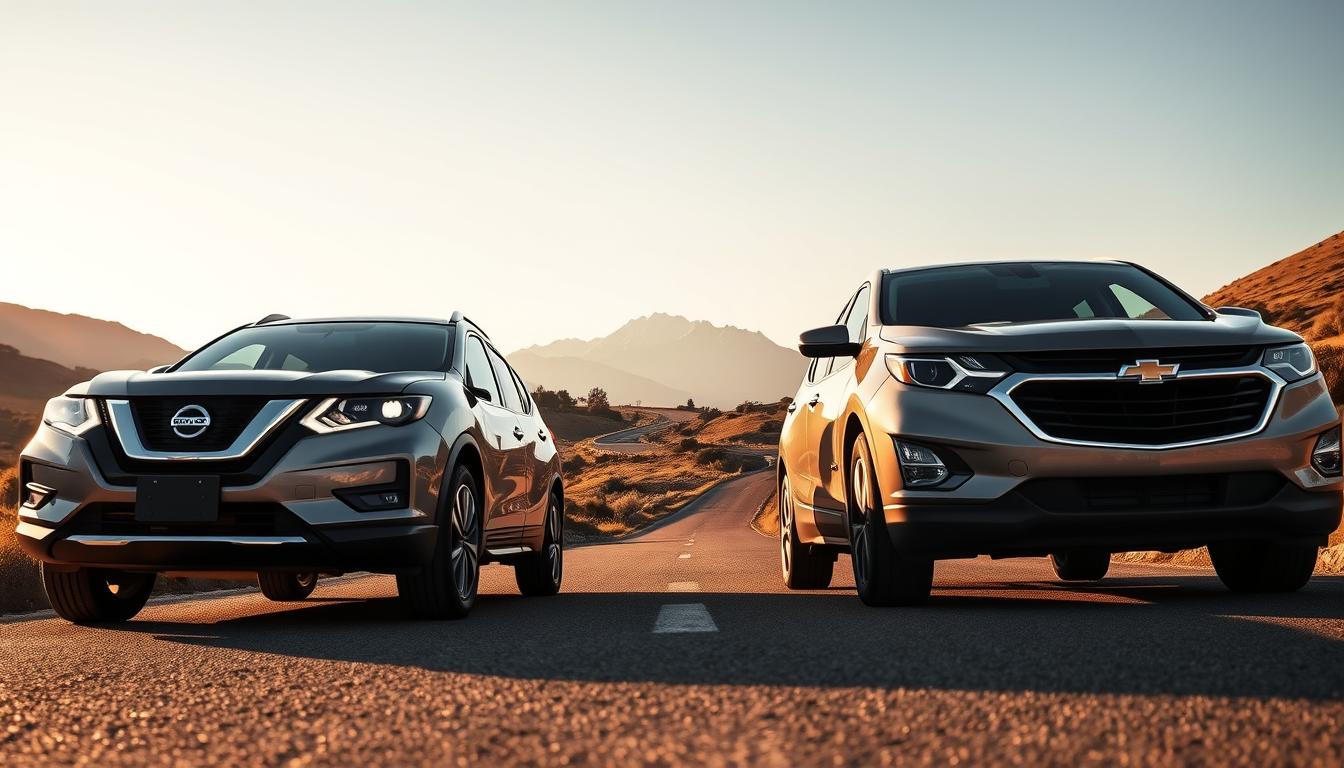
This comparison looks at the Nissan Rogue and Chevy Equinox. We’ll check their prices, fuel economy, performance, interior space, safety, and ownership costs. Our goal is to help you pick the best compact SUV for your needs.
The Chevy Equinox often starts at a lower price. But the Nissan Rogue has better fuel economy. The Rogue’s city and highway EPA ratings show it’s more fuel-efficient. Canadian models also show the Rogue’s trims and ratings are strong.
Reliability and running costs are important. The Nissan Rogue is more reliable and has lower repair costs than the Chevrolet Equinox. This article will compare MSRPs, fuel figures, performance specs, interior room, safety scores, tech, and total cost of ownership. We aim to help you understand the trade-offs.
Overview of Nissan Rogue and Chevy Equinox compact SUVs
The Nissan Rogue and Chevrolet Equinox are both compact SUVs. They have two rows of seats for five people. They aim to mix car-like driving with practical use.
Segment and target buyers
These SUVs appeal to those who need easy city driving and lots of space. The Nissan Rogue is great for those who want a roomy interior and good fuel economy. On the other hand, the Chevy Equinox is better for those who want more power options and a lower starting price.
Model years and trim availability
The 2026 models come in various trims. The Nissan Rogue has five, with the SV Premium being a mid-level option. The Chevy Equinox has four trims, with the LT being the most common. Both offer all-wheel drive as an option in most trims.
Quick comparison snapshot: seats, starting MSRP, and ratings
| Feature | Nissan Rogue (example) | Chevrolet Equinox (example) |
|---|---|---|
| Seating | 5 (2+3) | 5 (2+3) |
| Starting MSRP (example) | U.S. comparable: $30,585 · 2026 CAD: $34,398 | U.S. comparable: $30,495 · 2026 CAD: $33,999 |
| Overall rating (data-driven) | 3.9 / 5 (SV Premium) | 3.7 / 5 (LT) |
| Safety | NHTSA overall 5.0 | NHTSA overall 5.0 |
The table above gives a quick look at what each SUV offers. The Nissan Rogue is best for those who value comfort and fuel efficiency. The Chevy Equinox is a good choice for those looking for more power and a lower price.
Nissan Rogue vs Chevy Equinox
The battle between the Nissan Rogue and the Chevy Equinox is about what matters most to buyers. This includes the base price, available features, and what each trim level offers. We’ll look at current prices and real examples to see how these factors affect the cost and value of each car.
Head-to-head price comparison using MSRP data
A recent comparison shows the Chevy Equinox starts at $30,495, while the Nissan Rogue starts at $30,585. In Canada for 2026, the Rogue costs CAD $34,398–$45,898 (+ Freight & PDI CAD $2,030). The Equinox costs CAD $33,999–$41,099 (+ Freight & PDI CAD $2,300). Remember, the final price includes dealer fees and destination charges, which can add thousands of dollars.
Which offers better value based on ratings and features?
Value is a personal choice. The Rogue SV Premium gets 3.90/5 and is top-rated for safety and fuel efficiency. The Equinox LT scores 3.70/5 and also gets five stars for safety. The Rogue has better fuel efficiency and more cargo space, great for those who care about saving money and carrying more.
The Equinox, on the other hand, has a bigger touchscreen and navigation, perfect for tech lovers.
How pricing varies by trim and optional equipment?
Choosing a higher trim level can quickly increase the price. Upgrades include bigger wheels, leather seats, better audio, and navigation. Adding all-wheel drive also adds a lot to the cost.
| Item | Nissan Rogue (example) | Chevrolet Equinox (example) |
|---|---|---|
| Base starting MSRP (U.S.) | $30,585 | $30,495 |
| Canada range (MSRP) | CAD $34,398–$45,898 + PDI CAD $2,030 | CAD $33,999–$41,099 + PDI CAD $2,300 |
| Notable standard features | Fuel-efficient powertrain, driver assists, roomy cargo | Large touchscreen options, available navigation, safety tech |
| Example midtrim | SV Premium — higher efficiency, larger cargo area | LT — 11.0″ touchscreen, available nav |
| Cost drivers | AWD, 19″ wheels, packages, destination | AWD, tech packages, upgraded upholstery, destination |
When comparing the Nissan Rogue and the Chevy Equinox, get quotes that include all fees and incentives. Looking at the features and prices side by side helps find the best match for your budget and needs.
Pricing and trim breakdown with MSRP details
Pricing is key when choosing a car. This section explains starting MSRPs, key features by trim, and fees to consider when comparing models.
Nissan Rogue starting price and highlighted trims
The 2026 Nissan Rogue starts at CAD $34,398. It comes in five trims, with the Rogue SV Premium being the top choice. It scores a 3.90/5 overall rating.
The Rogue SV Premium has synthetic leather, a 7.0-inch touchscreen, and 6-speaker audio. It also has 19-inch alloy wheels and an AWD option. It’s known for its safety and efficiency.
Chevrolet Equinox starting price and highlighted trims
The 2026 Chevrolet Equinox starts at CAD $33,999. It has four trims, with the Equinox LT being the mid-level choice. It has a 3.70/5 overall rating.
The Equinox LT has an 11.0-inch touchscreen, Apple CarPlay and Android Auto, and 6-speaker audio. It also has cloth seating and optional navigation, plus 17-inch alloy wheels. It’s great for those who want a big screen and good connectivity.
Trim-to-trim cost comparisons and dealer fees to watch for
Trim pricing changes with added features. Moving from base to mid trims adds comfort and tech for about $1,000–$2,500. Top trims and performance upgrades can cost over $3,000.
Remember to include destination and freight charges in your total cost. For example, the Rogue’s freight & PDI is CAD $2,030, and the Equinox’s freight is CAD $2,300. Dealership add-ons and optional features can add $1,000–$3,000 or more.
| Model | Base MSRP (2026 CAD) | Highlighted Trim | Key features | Typical add-ons |
|---|---|---|---|---|
| Nissan Rogue | CAD $34,398 | Rogue SV Premium | Synthetic leather, 7.0″ touchscreen, 6-speaker audio, 19″ wheels, AWD option | AWD, tech packages, larger wheels ($1,000–$3,000+) |
| Chevrolet Equinox | CAD $33,999 | Equinox LT | 11.0″ touchscreen, CarPlay/Android Auto, 6-speaker audio, cloth seats, nav available | Upgraded audio, driver-assist bundles, wheel upgrades ($1,000–$3,000+) |
Use trim pricing to match your needs. If you want tech and a big screen, Equinox LT might be best. If you prefer safety and a nice interior, Rogue SV Premium is a good choice. Compare different levels to find the right mix of features and cost.
Fuel economy and efficiency comparison using EPA/NRCan data
The fuel economy of these two compact SUVs differs a lot. You can use EPA and NRCan data to know what to expect for city, highway, and combined efficiency. This helps when planning your daily commute or longer trips.
City and highway MPG: Rogue vs Equinox
The Nissan Rogue has about 28 city and 35 highway MPG in U.S. EPA figures. The Chevy Equinox is around 26 city and 29 highway MPG. These EPA numbers match Canadian NRCan data when converted. The Rogue does better in both city and highway driving.
Combined efficiency and real-world fuel costs
NRCan figures show the Rogue at about 7.6 L/100 km and the Equinox at 8.9 L/100 km. This means the Rogue is more efficient overall. For a 12,000-mile year, the Rogue could save drivers hundreds of dollars. This depends on the local gas prices and how you drive.
Driving range and fuel tank capacity comparison
The Rogue has a 55 L tank, while the Equinox has a 59 L tank. Even with a smaller tank, the Rogue’s better fuel economy means it can go about 718 km (446 miles) on a full tank. The Equinox can go about 641 km (398 miles), based on NRCan data.
| Metric | Nissan Rogue | Chevrolet Equinox |
|---|---|---|
| U.S. EPA (city/highway) | 28 / 35 mpg | 26 / 29 mpg |
| NRCan (city/highway) | 8.4 / 6.7 L/100 km | 9.6 / 8.1 L/100 km |
| Combined efficiency | 7.6 L/100 km | 8.9 L/100 km |
| Fuel tank capacity | 55 L | 59 L |
| Estimated range (km) | ~718 km (~446 miles) | ~641 km (~398 miles) |
- Use local fuel prices to estimate exact savings between the two models.
- City driving magnifies differences in fuel economy; highway runs narrow the gap.
- Smaller tanks can deliver longer range if combined efficiency is better.
Performance and powertrain specs including engines and torque
This section breaks down engine numbers and drivetrain choices for each model. It gives clear figures for horsepower, engine torque, transmissions, and how they affect driving and towing. Small, focused notes make comparison easy.
Nissan Rogue engine output, torque, and transmission details
The 2026 Nissan Rogue has a 1.5L turbocharged three-cylinder engine. It makes 201 hp at 5600 rpm and 225 lb-ft of engine torque at 2800 rpm. This high torque at low speeds helps with smooth starts and better hill climbing.
The Rogue comes with a variable-speed automatic transmission. This transmission is designed for steady power delivery and good fuel efficiency.
Chevrolet Equinox engine choices, horsepower, and transmission details
The 2026 Chevrolet Equinox often has a 1.5L four-cylinder engine. It makes 175 hp at 5800 rpm and 203 lb-ft at 2000 rpm, paired with an 8-speed automatic. Some trims have had other engine options in past years, like higher-power gas engines or diesel.
These options change the horsepower and low-end torque. So, buyers should check the engine for their trim.
AWD availability and towing or payload considerations
Both models offer AWD across many trims. AWD improves traction in wet, snowy, and light off-road conditions. The Rogue’s 225 lb-ft of engine torque gives it stronger low-speed pull, making towing easier on hills.
The Equinox may have higher towing or payload numbers on certain trims. Some configurations show payload near 1,422 lbs.
| Model | Engine | Horsepower | Peak engine torque | Transmission | Typical payload (approx.) |
|---|---|---|---|---|---|
| Nissan Rogue (2026) | 1.5L turbo I‑3 | 201 hp @ 5600 rpm | 225 lb‑ft @ 2800 rpm | Variable‑speed automatic | ~1,047 lbs (475 kg) |
| Chevrolet Equinox (2026) | 1.5L I‑4 (base) | 175 hp @ 5800 rpm | 203 lb‑ft @ 2000 rpm | 8‑speed automatic | ~1,422 lbs (575 kg) on some trims |
Choose the Rogue for stronger low-end thrust and better everyday responsiveness. Pick the Equinox when higher rated towing or alternative engines are available and prioritized. Always check factory towing packages, hitch ratings, and specific trim figures before towing heavy loads.
Interior space, cargo capacity, and dimensions comparison
The Nissan Rogue and Chevrolet Equinox both seat five in a 2+3 layout. Small differences in measurements affect passenger comfort and how much gear each SUV can carry. This section breaks down passenger room, trunk volume, and exterior dimensions so readers can see practical trade-offs between models.
Passenger seating and room figures matter on long drives. The Rogue has a 2706 mm (106.5 in) wheelbase. The Equinox uses a slightly longer 2730 mm (107.5 in) wheelbase. Front shoulder room is close: Rogue 1374 mm (54.1 in) versus Equinox 1377 mm (54.2 in).
Rear legroom shows a noticeable edge for the Equinox, at about 1016 mm (40.0 in) compared with the Rogue’s roughly 995 mm (39.2 in).
Seat shaping and cushion length also influence perceived space. Nissan Rogue features include flexible seat adjustments and a low floor for rear passengers. Chevy Equinox features prioritize a flat rear floor and slightly more knee clearance for taller adults.
Trunk capacity becomes critical for shoppers who haul gear. The Rogue offers 1,028 L (36.3 ft³) behind the rear seats and expands to 2,064 L (72.9 ft³) with seats folded. The Equinox provides 844 L (29.8 ft³) behind the rear seats and up to 1,798 L (63.5 ft³) folded. Those numbers give the Rogue a clear advantage in cargo capacity for road trips and larger loads.
Exterior dimensions influence parking and garage fit. Overall lengths are similar: Rogue 4,648 mm (183.0 in) and Equinox 4,653 mm (183.2 in). Heights and widths track closely, so curb-to-curb turning and parking footprints remain comparable for both models. The Rogue’s larger cargo volume stems from rear packaging and hatch design, not a much larger exterior footprint.
Drivers who value cargo flexibility will note differences in hatch access and rear overhang. Nissan Rogue features include a wide, low lift-over and split-fold seats that create a nearly flat load floor. Chevy Equinox features deliver tidy storage and a smaller footprint when back seats remain upright, which can help in tight parking spaces.
| Dimension / Capacity | Nissan Rogue | Chevrolet Equinox |
|---|---|---|
| Wheelbase | 2706 mm (106.5 in) | 2730 mm (107.5 in) |
| Overall length | 4,648 mm (183.0 in) | 4,653 mm (183.2 in) |
| Front shoulder room | 1374 mm (54.1 in) | 1377 mm (54.2 in) |
| Rear legroom | 995 mm (39.2 in) | 1016 mm (40.0 in) |
| Trunk – seats up | 1,028 L (36.3 ft³) | 844 L (29.8 ft³) |
| Trunk – seats folded | 2,064 L (72.9 ft³) | 1,798 L (63.5 ft³) |
| Notable interior trait | Low lift-over, flexible cargo floor | Flat rear floor, slightly more rear knee room |
Safety ratings and standard safety features
This summary compares the Nissan Rogue and Chevrolet Equinox in safety. Both SUVs have strong safety systems. They focus on keeping occupants safe and avoiding crashes.
NHTSA and IIHS performance
Both models got 5.0 overall NHTSA ratings for recent years. This shows they have good crash protection. It’s great for shoppers looking at these crossovers.
IIHS testing shows both vehicles do well in many areas. They have strong frontal and side protection. This is thanks to their design and safety systems.
Airbags and driver-assist systems
The Nissan Rogue has 10 airbags, including a driver knee airbag. This helps protect against injuries in severe crashes.
The Equinox has six airbags, covering front, side, and curtain areas. Both vehicles also have seatbelt pretensioners and load limiters. These help reduce movement during a crash.
Both models offer advanced driver-assist technology. Features like forward collision warning and lane-keeping assist are standard or available. The choice of trim level affects which features are included.
Crash-category differences
The Rogue does better in side-impact testing, with top scores for occupant protection. This shows its strength in side collisions.
The Equinox excels in frontal and side impact tests. It has strong frontal protection, making it great for head-on crashes.
| Metric | Nissan Rogue | Chevrolet Equinox |
|---|---|---|
| Overall NHTSA rating | 5.0 | 5.0 |
| IIHS notable strengths | High side-impact scores; strong restraint control | High frontal and side-impact scores; roof and structure commendable |
| Airbags | 10 (includes knee airbag) | 6 (front, side, curtain) |
| Standard ADAS | Forward AEB, adaptive cruise, lane assist | Forward AEB, adaptive cruise, lane assist |
| Rollover rating (dataset) | 4 stars | 4 stars |
For those interested in crash test details, check the full IIHS ratings. Both models have strong safety features. The choice of trim and optional bundles affects the features you get.
Infotainment, connectivity, and in-car technology features
The infotainment system is key in compact SUVs. Nissan and Chevrolet have different systems. These affect how easy it is to use, the value, and the convenience of technology for everyone inside.
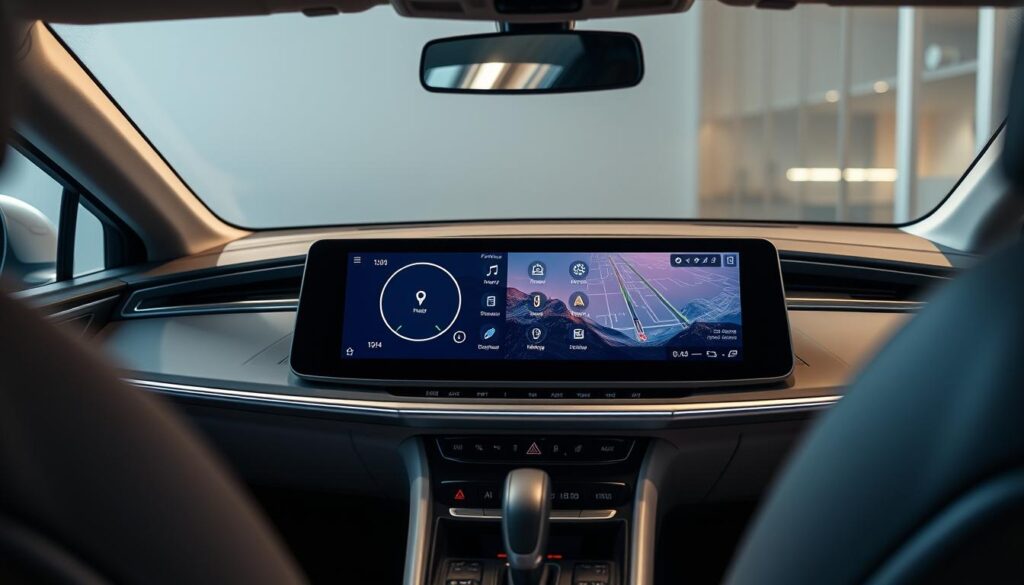
Touchscreens and smartphone pairing are important for those who use maps and media a lot. The Nissan Rogue has a 7.0-inch touchscreen that supports Apple CarPlay and Android Auto. The Chevy Equinox has an 11.0-inch touchscreen with the same features. Both offer USB ports, Bluetooth, AM/FM, and satellite radio.
Connectivity and audio options vary by trim level. The Equinox has available navigation and internet services for live traffic and updates. The Rogue offers in-car Wi‑Fi on some trims and remote app controls for climate settings. Both start with a six-speaker system, with upgraded trims adding premium sound and bass.
The design of the user interface and instrument cluster affects how quickly drivers get used to it. Some Equinox trims have a reconfigurable TFT digital display for trip data and media. The Rogue mixes analog gauges with a central TFT in many trims, making controls simple for those who prefer it.
There are more connectivity features than just the screen. Both vehicles have multiple USB charging points and wireless phone charging on higher trims. Nissan and Chevrolet’s remote apps allow for remote start, lock/unlock, and checking the vehicle’s status.
| Feature | Nissan Rogue | Chevy Equinox |
|---|---|---|
| Standard touchscreen | 7.0-inch | 11.0-inch |
| Smartphone integration | Apple CarPlay, Android Auto | Apple CarPlay, Android Auto |
| Built-in navigation | Available via package or app | Available with connected services |
| In-car Wi‑Fi | Available on select trims | Internet-connected services available |
| Standard audio | 6-speaker system | 6-speaker system |
| Digital gauge cluster | Analog + TFT in many trims | Reconfigurable TFT display on some trims |
| Wireless charging | Available on higher trims | Available on higher trims |
| Remote app features | Remote start, status, climate control via app | Remote start, status, vehicle controls via app |
Comfort, convenience, and standard equipment highlights
The Nissan Rogue and Chevrolet Equinox offer many comfort features for daily driving. They mix practical and premium options. This lets buyers choose what they need.
Seating materials, heated seats, and driver comfort options
Nissan Rogue trims often have synthetic leather and heated seats on higher trims. Front seats adjust power and have lumbar support in some packages. This helps on long drives.
The Chevrolet Equinox has cloth on base trims and heated seats as an option. It has power-adjustable driver seats and tilt/telescopic steering in mid and upper trims.
Climate control, keyless entry/start, and cargo convenience features
Dual-zone automatic climate control is on many Rogue variants. Remote app control for climate and vehicle functions is in higher packages. Keyless entry and push-button start are common on both models.
The Equinox has single-zone automatic A/C on lower trims, with dual-zone on higher trims. Both SUVs have split-folding rear seats, cargo tie-downs, and power liftgate options. These features make loading and unloading easier.
Wheels, exterior convenience, and visibility aids
Higher Rogue trims have 19-inch alloy wheels and LED projector headlights with auto high-beam. Parking aids, blind-spot monitoring, and rear cross-traffic alert help with safe driving in tight spots.
The Equinox starts with 17-inch alloys and upgrades to larger wheels on mid trims. It offers LED lighting packages and visibility aids. These improve sightlines and low-light performance.
Both the Nissan Rogue and Chevrolet Equinox focus on everyday practicality. They have comfort features like heated seats and keyless entry across their trims. This lets buyers pick comfort and convenience without losing value.
Ownership costs, reliability, and warranty comparisons
Buying a compact SUV is more than just the initial cost. We’ll look at reliability, repair costs, warranties, roadside help, resale value, and maintenance needs for the Nissan Rogue and Chevrolet Equinox.
The reliability scores of these SUVs differ. The Nissan Rogue scores about 4.0 out of 5, with an average repair cost of $467 a year. The Chevrolet Equinox scores around 3.5 out of 5, with repair costs averaging $537 annually. The number of reported issues and recalls also varies, affecting long-term costs.
Predicted reliability scores and average annual repair costs
Comparing the two SUVs is straightforward. The Rogue’s higher reliability score and lower repair costs mean fewer visits to the shop. The Equinox might need more repairs, which could increase yearly expenses.
Warranty coverage differences and roadside assistance terms
The warranties for both brands are similar for basic coverage. They offer a 36-month / 60,000 km warranty for parts and a 60-month / 100,000 km warranty for the engine. Roadside assistance terms differ, with Nissan providing 36 months / 9,999,999 km and Chevrolet 60 months / 100,000 km. Always check with a U.S. dealer for specific terms, as they can vary.
Resale value and common maintenance considerations
Resale value is better for models with strong reliability records. Nissan tends to hold its value well in the compact SUV market. Equinox resale value can vary, affecting long-term costs.
Maintenance for both SUVs is similar. Expect regular oil changes, brake checks, tire rotations, and suspension inspections. Given the data, the Equinox might need more repairs than the Rogue.
| Item | Nissan Rogue | Chevrolet Equinox |
|---|---|---|
| Predicted reliability score | 4.0 / 5 | 3.5 / 5 |
| Average annual repair cost | $467 | $537 |
| Known problems (dataset) | 247 | 1,155 |
| Recalls (dataset) | 37 | 18 |
| Comprehensive warranty | 36 mo / 60,000 km | 36 mo / 60,000 km |
| Powertrain warranty | 60 mo / 100,000 km | 60 mo / 100,000 km |
| Roadside assistance (dataset) | 36 mo / 9,999,999 km | 60 mo / 100,000 km |
| Resale trend | Strong for reliable trims | Varies by trim and engine |
- Plan for routine items: oil, brakes, tires, filters.
- Monitor recalls and service bulletins to limit surprise repair costs.
- Verify exact U.S. warranty and roadside terms with a dealer before purchase.
Which SUV is best for different buyers and use cases?
The Nissan Rogue and Chevrolet Equinox meet different needs for drivers. This guide helps match each model to common buyer needs. This way, you can easily compare the Nissan Rogue and Chevy Equinox.
For those who care about fuel, the Rogue is the best choice. It has better fuel economy and a longer driving range. Plus, it has lower repair costs, making it great for daily commutes.
For families, the Rogue is a top pick. It offers more space for strollers, groceries, and weekend trips. Higher trims add comfort features like synthetic-leather seats and climate control.
Those looking for more power should try the Equinox. It has various engine options and configurations. Choosing the right trim and engine can change how the SUV drives, so test drives are key.
Here’s a quick comparison to help find the best SUV based on your priorities.
| Priority | Better Fit | Why it fits |
|---|---|---|
| Fuel economy / commuting | Nissan Rogue | Lower combined consumption, longer estimated range, lower typical operating costs |
| Family space & comfort | Nissan Rogue | Larger cargo capacity, strong safety features, available comfort options in higher trims |
| Performance and optional power | Chevrolet Equinox | Optional engine variety and trims that cater to drivers wanting more power or alternative fuels |
| Overall versatile daily use | Depends on needs | Rogue leans toward efficiency and family utility; Equinox suits buyers targeting powertrain choice |
Conclusion
This SUV comparison summary shows both the Nissan Rogue and Chevrolet Equinox are top picks in the compact SUV class. They both seat five, offer AWD, and have various trims and options. The Rogue has a slight edge in fuel economy, cargo space, and overall rating (3.9 vs 3.7).
The Equinox, on the other hand, is known for its lower starting price, a bigger 11.0-inch infotainment screen, and more engine options.
For those looking to save on fuel and repairs, the Nissan Rogue is the better choice. It offers more fuel savings and lower repair costs. If you’re looking for a lower price, a bigger screen, or more engine choices, the Chevrolet Equinox is a great option.
Remember, when choosing between the Nissan Rogue and the Chevrolet Equinox, compare prices and incentives in your area. Take both for a test drive. Look at the towing, warranty, and package details of each trim. This will help you find the SUV that meets your needs and goals.
FAQ
Which is more fuel-efficient, the Nissan Rogue or the Chevrolet Equinox?
The Nissan Rogue is more fuel-efficient. It gets around 28 city / 35 highway mpg. The Equinox gets about 26 city / 29 highway mpg. This means the Rogue costs less to run.
Which model offers more cargo space and interior room?
The Nissan Rogue has more cargo space. It offers about 1,028 L (36.3 ft³) behind the rear seats. This increases to roughly 2,064 L (72.9 ft³) with seats folded. The Equinox has about 844 L (29.8 ft³) and up to 1,798 L (63.5 ft³) folded. The Rogue has more cargo space.
How do starting prices compare between the Rogue and Equinox?
Prices vary by market and trim. The Equinox sometimes starts lower (e.g., Equinox ,495 vs Rogue ,585). In Canada, the Rogue starts at CAD ,398 and the Equinox at CAD ,999. Destination and optional packages can affect the final cost.
Which vehicle scores better on reliability and ownership costs?
The Nissan Rogue is more reliable, scoring 4.0/5. It has an average annual repair cost of about 7. The Equinox scores 3.5/5 with a repair cost near 7. Rogue owners might save on repairs.
Are safety ratings similar between the two SUVs?
Yes. Both vehicles have strong safety ratings. They both get 5.0 from the NHTSA. The Rogue is praised for side-impact protection. Both offer ADAS suites on many trims.
Which model has better tech and infotainment features?
The Equinox often has a larger infotainment display, up to 11.0 inches. The Rogue has a 7.0-inch screen. Both support Apple CarPlay and Android Auto. They also offer USB connectivity and 6-speaker audio as standard.
Which SUV is better for commuters versus performance-oriented drivers?
The Nissan Rogue is better for commuters. It’s more fuel-efficient and has lower repairs. The Chevrolet Equinox is better for those who want a lower price, a larger screen, or different engine options.