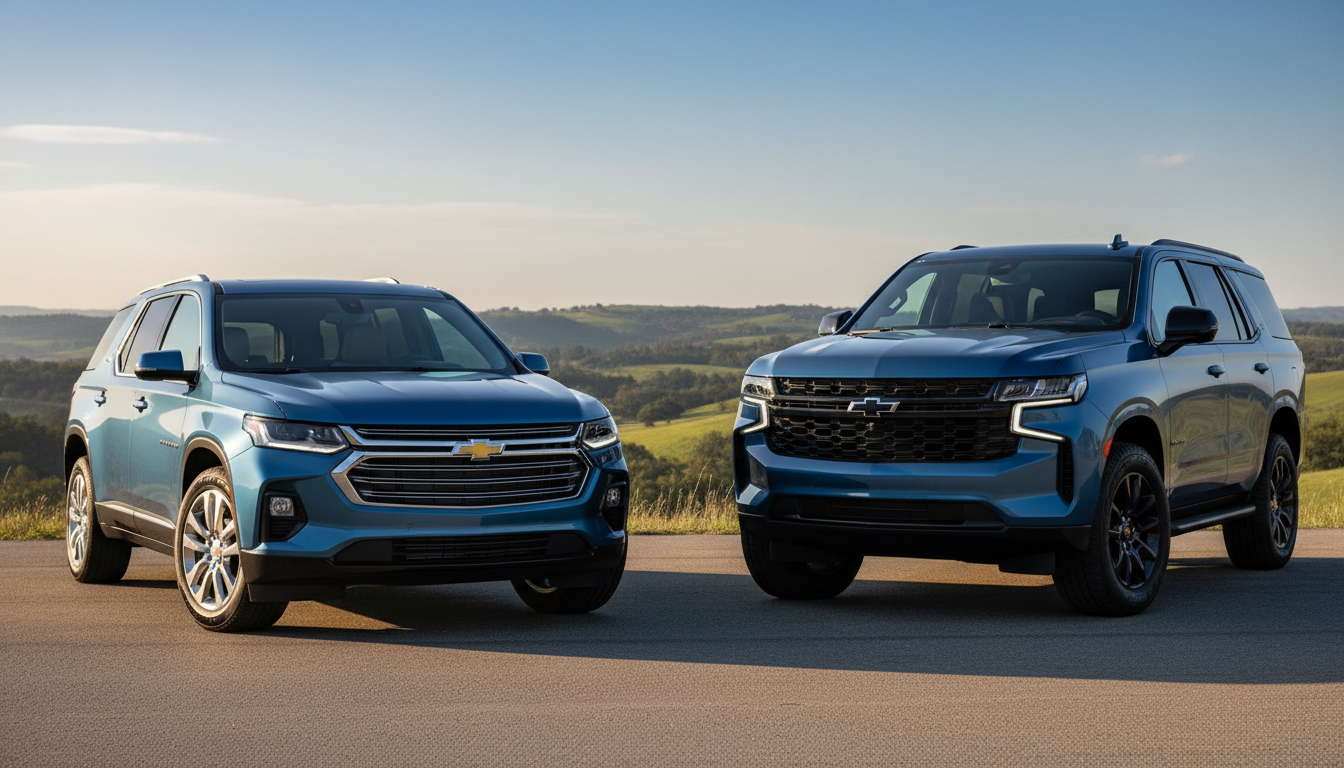
Chevy Traverse vs Tahoe: Choosing the Best Midsize SUV
This practical comparison frames a common U.S. buying choice: a midsize three-row crossover set against a full-size SUV. You will see why these two models overlap in mission family hauling and flexible seating yet differ in platform, size, and capability.
Key decision drivers include space and cargo, towing, fuel economy, technology, comfort, and real-world costs for purchase and ownership. Starting MSRPs help set expectations: roughly $40,700 for the midsize and about $59,000 for the full-size, with higher prices for loaded trims.
It points out who usually shops each vehicle: the crossover for easier city driving and better efficiency; the larger SUV for maximum room and towing peace of mind. Sources include dealer figures and independent testing, and the article flags where numbers change by trim or drivetrain.
Use this guide by jumping to the section that matches your top priority gear, towing, price, or road-trip comfort to make a clear, practical choice for daily life, not just spec-sheet bragging.
Quick Snapshot: Traverse vs Tahoe buyers and what matters most?
Choosing between a midsize crossover and a full-size body-on-frame SUV starts with how you use the vehicle each week. The frame and platform shape steering, ride feel, and how much you can tow or load for a weekend trip.
Midsize crossover vs body-on-frame: what that means?
Midsize crossover (unibody) means the body and frame are one piece. That yields lighter weight, crisper steering, and a smoother ride for daily driving.
Body-on-frame puts the body on a separate frame. That gives stronger towing and a more “big SUV” feel under load, with better long-term durability for heavy work.
Best-fit use cases for US drivers
- City-to-suburb daily: The midsize crossover suits commuters, tight parking, and carpool lanes.
- Long road trips and big crews: The full-size option fits larger families and frequent long-haul driving with more cargo room.
- Work and towing: For trailers, boats, or heavy gear, the body-on-frame platform offers superior confidence and stability.
| Feature | Midsize Crossover | Full-Size Body-on-Frame |
|---|---|---|
| Typical length (in) | 204.5 | 210.7 |
| Max cargo (cu ft) | 97.6–98.2 | 122.7–122.9 |
| Best use | Daily driving, tight parking, better fuel | Heavy hauling, bigger crews, towing stability |
Size differences matter in parking, turning radius, and garage fit—even a 6.2-inch gap changes how you park and navigate tight streets. Think about how often you need the full max cargo numbers for coolers, strollers, and sports bags.
Throughout this guide the focus will return to space, towing, fuel, tech, and price. Those priorities give the clearest way to pick the right SUV for your life.
Chevy traverse vs Tahoe: size, seating comfort, and cargo space
Space and seating layout dictate whether a vehicle feels roomy on short hops or long hauls. This section compares passenger comfort, legroom, and real cargo numbers so you can picture daily use.
Passenger capacity and everyday comfort: seats, legroom, and third-row usability
Seating layouts work for large families in both models. The larger SUV feels bigger once all three rows are occupied, especially when adults ride in the back.
Second-row comfort: Rear legroom/headroom is close — 42.0″/38.9″ for the larger model and 41.5″/39.9″ for the midsize. Both are adult-friendly, though the larger unit gives a more spacious feel.
Third-row usability: The larger model provides 34.9″ rear legroom versus 32.1″ in the midsize. Kids will be fine on long trips; adults are comfortable for short drives in the bigger third row.
Cargo capacity in cubic feet: behind the third row, behind the second row, and max space
| Row | Large SUV (cubic feet) | Midsize (cubic feet) |
|---|---|---|
| Behind 3rd | 25.5 | 22.9 |
| Behind 2nd | 72.6 | 56.6 |
| Max (all folded) | 122.7 | 97.6 |
Real-world practicality: loading strollers, sports gear, and road-trip luggage
Behind the third row you can fit a stroller plus groceries in both models, but the larger vehicle adds headroom and a little extra width for bulky items.
Fold the second row and the larger SUV swallows more tournament gear or two large suitcases. The midsize still offers nearly 98 cubic feet, which is class-leading for a crossover.
Loading convenience: Folding mechanisms and access vary. Easier third-row entry and flatter load floors in the larger model make daily loading smoother for families who regularly handle bulky cargo.
The midsize offers strong space for its class, but the larger choice wins on outright cargo capacity and third-row legroom when you routinely carry big loads.
Engine, power, and on-road performance differences
Powertrain choices define how an SUV feels on the road, from quick city pulls to heavy highway passes.
Engine options and output
V8 strength: The chevy tahoe offers two V8 choices — a 5.3L with about 355 hp and a 6.2L near 420 hp. Those engines deliver strong low-end torque for towing and confident passing.
Boosted efficiency: The chevy traverse typically uses a smaller, turbocharged 2.5L four (about 328 hp in one source) or a 3.6L V6 (around 310 hp in others). The setup favors responsiveness and better fuel numbers in everyday driving.
Transmission, drivetrain, and control
The larger SUV uses a 10-speed transmission with RWD or 4WD. The 10-speed helps keep the V8 in its power band under load.
The midsize comes with an 8-speed and FWD or AWD. That layout feels lighter and more efficient in stop-and-go traffic but reacts differently when towing.
Ride tech and cabin quietness
Ride systems: Magnetic ride control and optional air suspension on the bigger model smooth rough pavement and improve stability when loaded.
Both models test similarly quiet on the highway: about 57.2 dB for the larger unit and 57.7 dB for the midsize at 55 mph, so long trips are comparable for cabin fatigue.
| Feature | chevy tahoe | chevy traverse |
|---|---|---|
| Typical engine | 5.3L / 6.2L V8 (355–420 hp) | 2.5L turbo or 3.6L V6 (310–328 hp) |
| Transmission & drive | 10-speed, RWD/4WD | 8-speed, FWD/AWD |
| Main benefit | Power and towing control | Efficiency and city responsiveness |
- Everyday impact: V8 power helps merging and towing; the smaller turbo is quicker off the line in city driving.
- Choose by priority: If towing or heavy loads matter, tahoe vs. traverse priorities tilt toward the V8 and its suspension system.
Towing capacity and hauling capability for trailers, boats, and campers
Towing capability often decides which SUV ends up on a buyer’s driveway. Towing capacity is the maximum rated weight a vehicle can safely pull and it separates these two models more than almost any other spec.
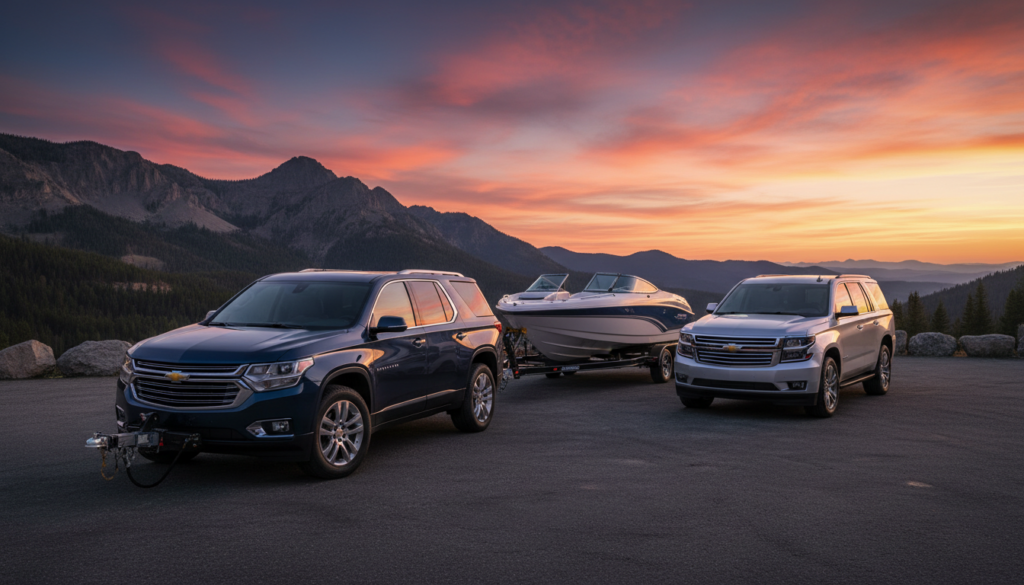
Headline numbers: the larger model tops out near 8,400 lbs, while the midsize reaches about 5,000 lbs. Specific equipment can change that — for example, one configuration lists 8,100 lbs with the 6.2L and max tow package.
- Small utility trailer: both SUVs handle this easily.
- Pop-up camper or mid-size boat: the midsize is often enough, but check gross trailer weight.
- Large travel trailer: the full-size body-on-frame choice is the safer match for long trips and heavy loads.
The body-on-frame design gives the larger vehicle more stability when hauling. It resists twist under load, helps with highway control, and stands up better to crosswinds. That matters when you carry heavy gear or tow frequently.
Shopping tip: verify towing capacity by trim, drivetrain, and tow package on the exact unit on the lot. If towing is occasional and light, the midsize rating can save purchase price and fuel without sacrificing practicality.
Fuel economy comparison: city, highway, and combined fuel costs
Fuel costs shape ownership more than sticker price for many SUV buyers. Small mpg gaps turn into real dollars over years and long trips. This section compares EPA numbers and real-world 4WD/AWD figures so readers can budget for commuting, school runs, and interstate travel.
EPA-estimated mpg and what it means for daily driving?
Common EPA figures list the midsize at about 18 city / 27 highway and the full-size at about 16 city / 20 highway. Those numbers assume specific drivetrains and trim levels.
Independent 4WD/AWD testing tightens the gap: full-size tests near 14 city / 18 highway / 16 combined, while the midsize posts roughly 19 city / 24 highway / 21 combined. Use the combined mpg to estimate yearly fuel spend.
The trade-off between fuel savings and V8 power when you drive and tow
The heavier V8 platform typically drinks more fuel, especially in stop-and-go city driving and short trips. When towing, both SUVs lose mpg, but the full-size drops harder because of weight and aerodynamics.
If frequent towing or heavy payloads matter, the extra fuel cost can be justified by capability. For mostly commuting and highway miles, the midsize offers clear savings.
| Use case | Midsize (approx mpg) | Full-size (approx mpg) |
|---|---|---|
| City driving / school runs | 18–19 mpg | 14–16 mpg |
| Highway / road trips | 24–27 mpg | 18–20 mpg |
| Combined (4WD/AWD test) | 21 mpg | 16 mpg |
| Towing impact | Significant drop; plan −20–30% | Larger drop; plan −25–35% |
- Run simple math: (Annual miles / mpg) × fuel price to compare ownership costs.
- Roof racks, boxes, and trailers reduce mpg for either vehicle.
- Pick the model whose mpg aligns with your typical driving and towing needs, not peak capability alone.
Interior features, tech, and safety systems that matter day to day
Interior tech choices often make the biggest difference in everyday comfort and convenience. Small shifts in connectivity and driver aids cut stress on school runs and long trips.
Infotainment and smartphone integration
17.7-inch display with Google built-in keeps maps and searches working even if a phone disconnects. Wireless Apple CarPlay and Android Auto make podcasts and navigation easy to use on the go.
Driver assistance and hands-free driving
Adaptive cruise smooths highway tempo and gap control on long trips. Super Cruise is available on higher trims for hands-free driving on compatible highways, reducing fatigue on long stretches.
Family-friendly comfort and safety
Both models include Teen Driver and offer a 360-degree camera for tricky parking in a busy lot. Rear-seat entertainment appears on select trims, and three-zone climate plus heated and ventilated seats cut cabin complaints on mixed trips.
| Feature | Common availability | Trim notes |
|---|---|---|
| 17.7″ display | Standard | Fast menus, Google built-in |
| Adaptive cruise | Available | Standard on some trims |
| 360 camera / Rear screens | Available | Rear entertainment on select higher trims |
Trim check: Always confirm the exact package on the lot. If you’re looking to get key tech without premium pricing, midsize trims often bundle core features; larger trims add HUD and luxury upgrades for a premium feel.
Price, trims, and overall value in the current market
A quick look at MSRPs shows a clear gap, but dealer incentives and trim choices often narrow that difference.
Starting MSRP and real-world spread
Base numbers: the midsize starts near $40,700, while the full-size begins around $59,000. Transaction prices shift by region, dealer incentives, and demand.
Loaded examples show the ceiling: a fully optioned midsize can top the low $60s, while a fully loaded full-size climbs near $95,600.
What buyers get for the money?
- Space and towing: the larger model adds max cargo and higher tow ratings.
- Premium options: air suspension, head-up display, and upscale materials appear on higher trims.
- Value proposition: the midsize delivers strong space-for-dollar and many core tech features at lower cost.
Ownership and long-term costs
Full-size suvs can cost more to run. Expect higher fuel, bigger tires, heavier brakes, and pricier maintenance tied to V8 engines and heavy-duty parts.
Choose a trim by listing must-haves and skipping unused options to control both purchase and ownership cost.
| Item | Midsize (approx) | Full-size (approx) |
|---|---|---|
| Starting MSRP | $40,700 | $59,000 |
| Loaded example | ~$59,290 | ~$95,605 |
| Main advantage | Value, efficiency, good space | Capability, towing, premium options |
Conclusion
The clearest choice depends on priorities. The key differences boil down to towing and cargo versus economy and cost.
Tahoe leads in towing (up to about 8,400 lbs), max cargo (≈122.7 cu ft), and ride tech for heavy loads. The traverse wins on fuel economy and a lower starting price while still offering near-class-leading cargo and modern infotainment.
Pick the larger SUV if you tow boats or campers often and need the extra space and power. Choose the midsize crossover for daily commutes, lower running costs, and roomy family gear hauling without V8 fuel penalties.
Final sanity check: test-drive both on the same roads and confirm tow ratings and exact features on the build you plan to buy before you decide.
FAQ
Which model is better for everyday family use—the midsize crossover or the full-size body-on-frame SUV?
The midsize crossover suits daily family life with easier parking, better fuel economy, and carlike handling. The full-size body-on-frame SUV offers superior towing, more cargo room when seats are folded, and a stronger feel for hauling heavy gear. Choose the crossover for city commutes and weeknight errands; pick the larger SUV for towing, long road trips with lots of luggage, or frequent rugged use.
How do passenger space and third-row comfort compare between the two models?
The midsize option typically provides comfortable first and second rows and a usable third row for kids or short trips. The full-size model gives more legroom and adult-friendly third-row seating, better headroom, and easier access. For regular three-row adult travel, the larger vehicle is the better choice.
What are the cargo capacities behind each row and the maximum cargo volume?
The midsize crossover offers competitive cargo space behind the third row for strollers and smaller suitcases, with a larger second-row area when the third is folded. The full-size SUV provides significantly more cubic feet behind both the third and second rows and the greatest maximum capacity when all rear seats fold, making it the best option for moving gear or loading bulky items.
What engine options and power differences should buyers expect?
The full-size SUV is available with V8 engines that deliver higher horsepower and torque, ideal for towing and heavy loads. The midsize crossover uses a turbocharged four-cylinder that balances performance and efficiency for everyday driving. If you need strong low-end torque for trailers or boats, the V8 is preferable; for commuter fuel savings, the turbo four is sensible.
How do transmissions and drivetrains compare for handling and traction?
Full-size models often come with a 10-speed automatic and rear-wheel drive as standard, with four-wheel-drive options for tougher conditions. The midsize crossover typically pairs an 8-speed automatic with front-wheel drive as standard and available all-wheel drive. RWD/4WD setups on the larger SUV deliver better towing stability; FWD/AWD on the crossover boosts fuel economy and everyday grip.
Which vehicle rides quieter and handles better on the highway?
The large SUV can be equipped with advanced suspension systems like magnetic ride control or air suspension to smooth rough pavement and improve high-speed stability, often resulting in a quieter cabin at highway speeds. The crossover has a more carlike suspension that feels nimble in traffic but may transmit more road noise at 55 mph. For long highway cruises, the full-size SUV tends to offer the quieter, more composed experience.
What are realistic towing capacities for trailers, boats, and campers?
The full-size SUV, with available V8s and stronger frames, provides the highest towing capacity—suitable for larger boats and campers when properly equipped. The midsize crossover can tow moderate loads like small trailers and light boats, but it’s not designed for heavy fifth-wheel or large-camper duty. Always check the vehicle’s tow package limits and match hitch, cooling, and braking equipment to the trailer’s weight.
How do fuel economy figures differ for city and highway driving?
Expect the midsize crossover to post higher EPA mpg numbers in both city and highway cycles thanks to its lighter weight and smaller engine. The full-size SUV, especially with a V8, will consume more fuel, with its advantage being power and towing capability rather than economy. For daily commuting and long-term running costs, the crossover typically costs less at the pump.
Are advanced driver aids and hands-free driving systems available?
Both vehicle types offer modern driver-assist tech. Higher trims on the full-size model can include hands-free highway driving systems and advanced adaptive cruise control. The midsize crossover also provides adaptive cruise and lane-keeping aids, though some premium features may be limited to top trims or optional packages. Verify availability by trim level when shopping.
What infotainment, family tech, and comfort features matter most for daily use?
Look for large touchscreens, smartphone integration, rear-seat entertainment, multiple USB ports, and configurable cargo tie-downs. Three-zone climate control, heated/ventilated seats, and an available head-up display increase comfort on long drives. For families, rear-seat reminders, a 360-degree camera, and integrated Wi‑Fi can be especially helpful.
How big is the typical price gap and what affects real-world value?
The midsize crossover starts lower in MSRP, offering better base value for buyers focused on economy and daily usability. The full-size SUV has a higher starting price reflecting larger size, stronger towing, and available luxury options. Real value depends on needs: space and towing justify the higher cost for many buyers; otherwise, the crossover offers strong overall value.
What ownership costs should buyers expect beyond purchase price?
Full-size SUVs generally cost more to insure, fuel, and maintain because of larger engines and heavier components. Tire and brake replacement can be pricier as well. The midsize crossover tends to have lower ongoing costs, making it cheaper to run for most families and commuters.