
Chevy 8 Lug Bolt Pattern Guide: Specs, Years & Size Chart
If you’re upgrading the wheels on your heavy-duty Chevy truck or SUV, getting the bolt pattern right isn’t just about aesthetics—it’s about safety, payload capacity, and avoiding a very expensive mistake. For decades, the Chevy and GM 8 lug bolt pattern has been the gold standard for full-size haulers like the Silverado 2500/3500, Suburban 2500, and Express vans.
While the classic 8×6.5″ (165.1mm) layout ruled the road for generations, GM’s shift to metric sizes on newer heavy-duty platforms has tripped up plenty of truck owners. Bolt on a mismatched set of wheels, and you risk severe highway vibrations, sheared M14 x 1.5 studs, or catastrophic wheel separation.
In this guide, we’re cutting through the confusion. We’ll break down the exact specs by year, show you how to measure your hub correctly, and cover the crucial center bore and torque specs you need to verify before tightening a single lug nut.
What Is a Bolt Pattern and Why Does It Matter?
Your truck’s bolt pattern (or bolt circle) tells you two things: the number of wheel lugs and the diameter of the imaginary circle they form.
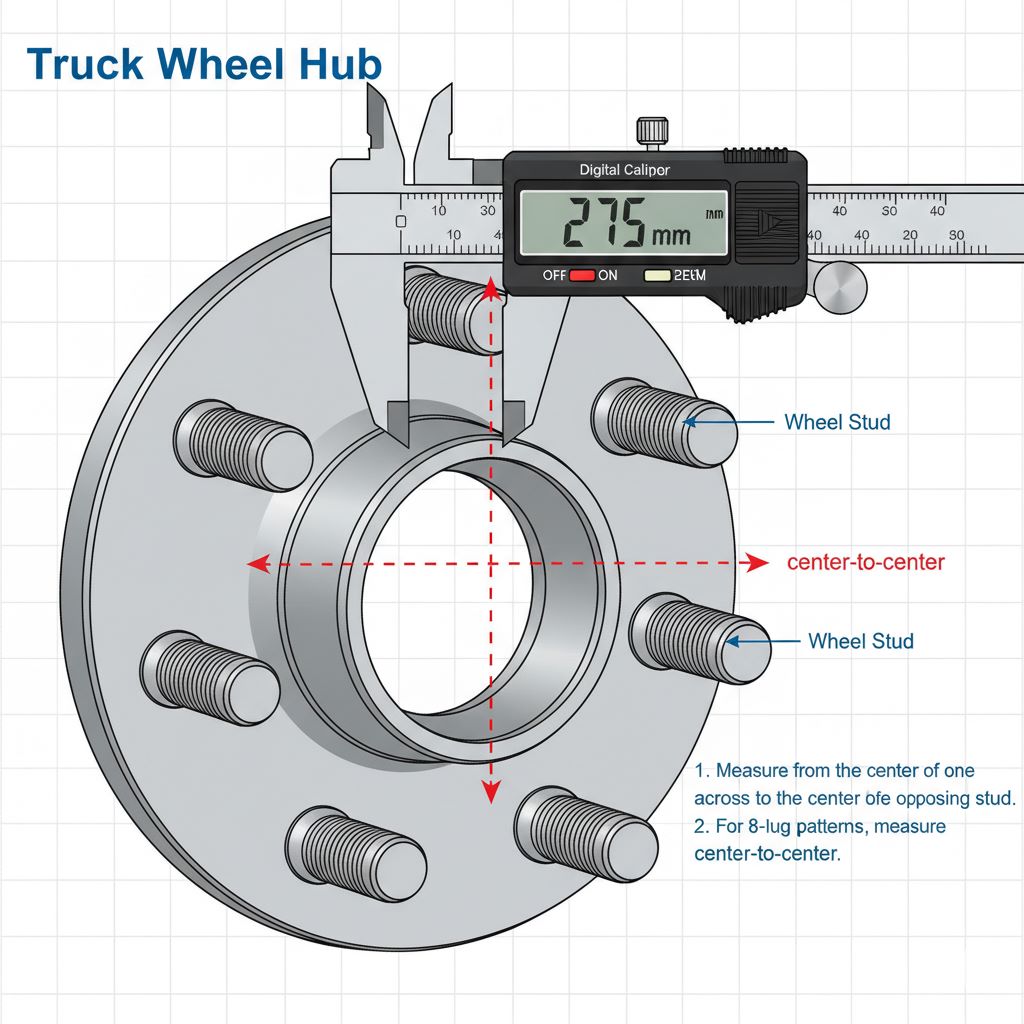
When you see a spec like 8×6.5, it means the hub features 8 lugs spaced evenly across a 6.5-inch diameter circle. Because it’s an even-numbered layout, checking it is straightforward—you just measure from the center of one lug directly across the hub to the center of the opposite lug.
Getting this measurement wrong has real consequences:
- Uneven Seating: A mismatched wheel won’t sit flush against the hub.
- Hardware Failure: Forcing an incorrect fit puts extreme shear stress on your wheel studs.
- Warped Rotors: Uneven clamping force can warp your brake rotors over time.
The Shift: Standard 8×6.5 vs Metric Variations
Whether you’re dealing with a classic square body, a Chevy OBS, or an early 2000s Duramax, the 8×6.5 inch (8×165.1mm) pattern was nearly universal. If you own an older 3/4-ton or 1-ton Chevy, this is almost certainly your setup.
However, as towing capacities skyrocketed, General Motors made a significant change to beef up their hardware. Starting in the 2011 model year, many heavy-duty Silverado and Sierra trucks transitioned to larger metric hubs.
Because a 165.1mm circle and a 180mm circle look nearly identical to the naked eye, always verify your specific model year, trim, and axle before ordering a new set of rims or spacers.
Chevy 8 Lug Bolt Pattern by Year & The 2011 Change
For example, if you are looking for a 2006 or 2010 Chevy 8 lug bolt pattern, you need the classic 8×6.5″ size. If you are fitting a newer 2015 Silverado 2500, you need the updated metric 8x180mm pattern.
| Era / Generation | Typical Bolt Circle | Common Applications |
| 1960s – 2010 | 8 x 6.5″ (165.1mm) | 3/4-ton and 1-ton Chevy/GMC pickups and SUVs |
| 2011 – Present | 8 x 180mm | Modern HD Pickups (Single Rear Wheel) |
| Late Model DRW | 8 x 200mm / 210mm | 3500 Dually (Dual Rear Wheel) & Chassis Cabs |
How to Measure and Convert Your Bolt Pattern
If you are unsure how to measure a bolt pattern on 8-lug wheels, the process is simple. Use digital calipers or a reliable steel tape to measure from the center of one lug directly across the hub to the center of the opposite lug.
Patterns are shown in either inches or millimeters. North America traditionally uses inches, while the metric system lists the exact same circle in millimeters (6.5 inches = 165.1 millimeters). Watch out for rounded labels like “8 x 165mm” that aftermarket vendors sometimes use.
Chevy Bolt Pattern Conversion Chart
| Designation (Inches) | Millimeters | Notes / Applications |
| 8 x 6.5″ | 165.1mm | Classic Chevy 2500/3500 SRW, full-size heavy SUVs |
| 8 x 7.08″ | 180mm | 2011+ heavy-duty Chevy/GMC trucks with updated hubs |
| 8 x 7.87″ | 200mm | Some non-GM and select heavy platforms |
| 8 x 8.26″ | 210mm | Certain one-ton dually rear hubs, late-model applications |
Chevy 8-Lug Model Compatibility: Pickups, Duallys, and SUVs
Whether you are swapping rims onto a dedicated work truck or outfitting a heavy-duty family hauler, GM’s 3/4-ton and 1-ton platforms share a lot of DNA. However, there are crucial nuances between the pickups and SUVs that you need to watch out for before pulling the trigger on a new set of wheels.
Silverado & Sierra 2500HD / 3500HD (SRW & DRW)
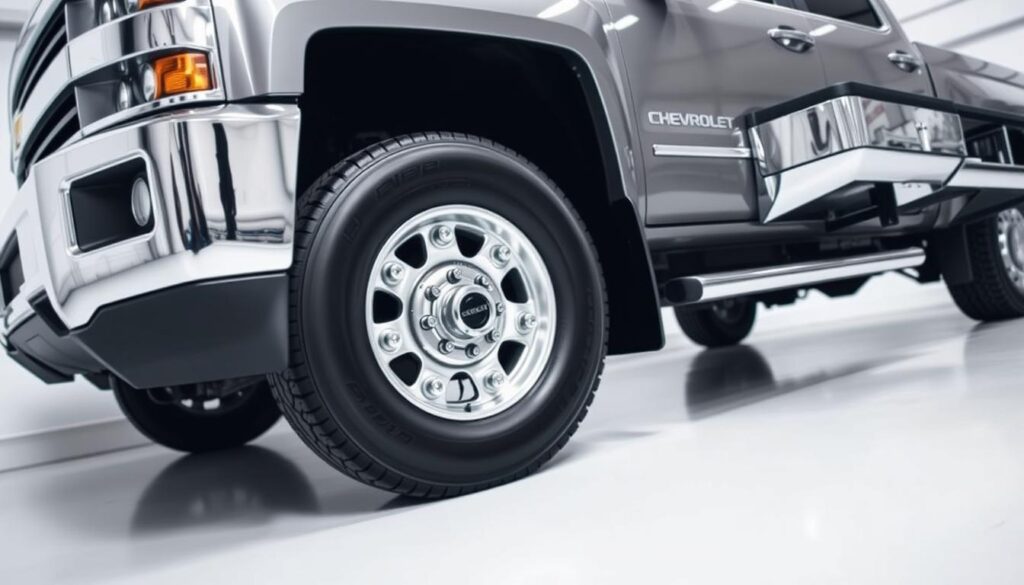
The Silverado HD lineup is the most common home for the Chevy 8-lug pattern. For decades, both the 2500 and 3500 Single Rear Wheel (SRW) models relied on the tried-and-true 8 x 6.5″ (165.1mm) bolt circle paired with M14 x 1.5 studs.
- The 2011 Metric Shift: If you drive a 2011 or newer HD, your truck almost certainly uses the larger 8 x 180mm pattern.
- Dually (DRW) Specs: Dual rear wheel setups play by their own rules. While older duallys kept the 8 x 6.5″ pattern, late-model 3500 DRW trucks frequently utilize larger 8 x 200mm or 8 x 210mm bolt circles to handle massive payload capacities. Always verify your specific rear axle stamping.
Suburban K2500 & Yukon 2500/XL
Heavy-duty SUVs were built to meet extreme towing and payload demands, utilizing the exact same 8 x 6.5″ bolt pattern and M14 x 1.5 studs as their pickup counterparts from 1988 through the end of their heavy-duty run in 2013.
While truck wheels will often bolt right up to an SUV hub, you need to account for a few SUV-specific differences:
- Load Rating: SUVs carry different weight distributions. Ensure your aftermarket wheels are rated for your K2500 or Yukon’s specific Gross Vehicle Weight Rating (GVWR).
- Offset and Backspacing: Small changes in track width can alter your bearing load or cause the tires to rub on the fender liners during tight turns.
Wheel Fitment: Hub-Centric vs Lug-Centric
Finding wheels with the correct Chevy 8 lug bolt pattern is only half the battle. To prevent violent highway shaking and premature bearing wear, you must nail the center bore measurement.
Most heavy-duty Chevy hubs feature a center bore ranging from 116mm to 125mm.
- Hub-Centric (Ideal): The wheel’s center hole fits perfectly over the hub lip. The truck’s weight rests securely on the hub itself, exactly as the factory intended.
- Lug-Centric (Proceed with Caution): The wheel’s center hole is larger than the hub. The weight of the vehicle is supported entirely by the lug studs.
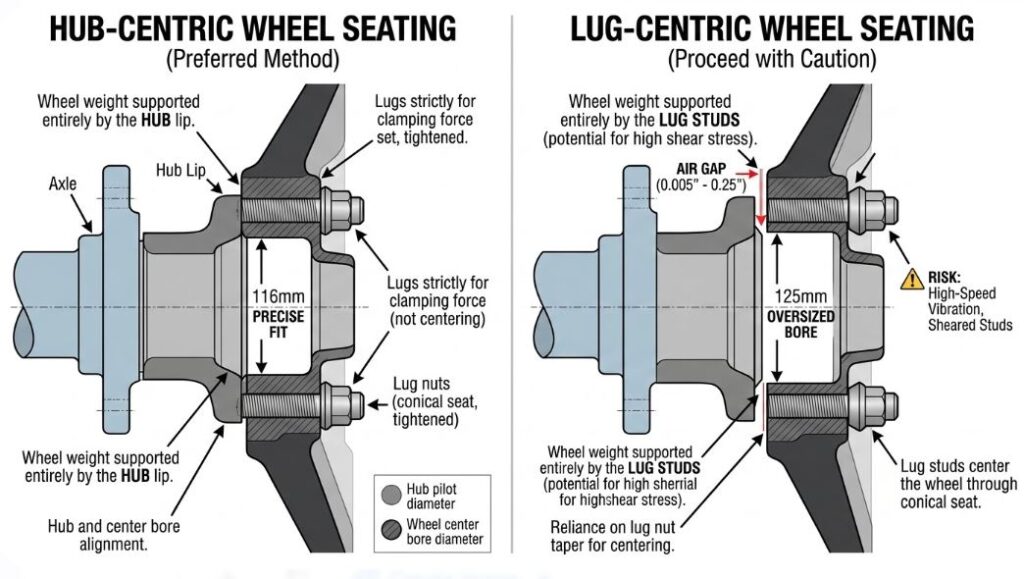
Left Panel: Hub-Centric Wheel Seating (Preferred)
This panel demonstrates the ideal fitment. A detailed cross-section of the axle flange and hub (light blue/grey) and the dark grey wheel are shown. Key technical details are included:
- Precise Fitment: A measurement of 116mm is shown for both the hub pilot lip and the wheel’s center bore, labeled ‘PRECISE FIT.’
- Direct Load Transfer: Annotations and arrows point to the direct contact between the wheel bore and the hub pilot. One note reads: ‘Wheel weight supported entirely by the HUB lip.’
- Clamping Force Only: Another label points to the lug studs (M14 x 1.5) and conical lug nuts, stating: ‘Lugs strictly for clamping force (not centering).’
Right Panel: Lug-Centric Wheel Seating (Proceed with Caution)
This panel visualizes the potential risks of using improper fitment or oversized aftermarket wheels without proper centering rings.
- Oversized Bore: The hub is identical to the left panel (116mm pilot), but the wheel features an oversized center bore (e.g., 125mm). This creates a highly visible gap (0.005″ – 0.25″), highlighted with red arrows and labeled ‘AIR GAP.’
- Lug Stress: An annotation points to the direct contact at the lug studs, reading: ‘Wheel weight supported entirely by the LUG STUDS (potential for high shear stress).’
- Risk Warning: A small yellow warning icon explicitly lists the risks of this setup: ‘High-Speed Vibration, Sheared Studs.’
Pro-Tip: Make sure to always consult a wheel professional if you are using aftermarket wheels with a different center bore. They can help you source high-quality hub-centric rings to convert your lug-centric wheels into a safer, hub-centric setup.
If you buy aftermarket wheels with a larger bore, always install high-quality hub-centric rings to bridge the gap.
A Warning on Spacers and Adapters
If you find a killer deal on 8x180mm wheels but drive an older 8×6.5″ truck, you might be tempted to use bolt-pattern adapters. While these can work, they introduce massive leverage and stress onto your factory studs. For heavy-towing applications, avoid cheap, unrated adapters at all costs. Stick to load-rated, billet aluminum adapters and follow the manufacturer’s torque specs religiously.
Hardware Check: Lug Nuts, Studs, and Torque Specs
Even the perfect set of rims will fail if clamped down with the wrong hardware. The vast majority of 8-lug Chevys utilize M14 x 1.5 wheel studs.
Before mounting your wheels, verify your lug nut seat type:
- 60° Acorn (Tapered): The standard for most aftermarket wheels. The conical shape centers the wheel as you tighten it.
- Flange Nuts: Often found on OEM flat-faced wheels to distribute clamping force over a wider surface area.
Proper Torque Sequence
Never hit your lugs with an impact wrench and call it a day. Grab a calibrated torque wrench and tighten your M14 studs to 85–95 lb-ft using an alternating 8-lug star pattern. Ensure you get at least eight full turns of thread engagement.
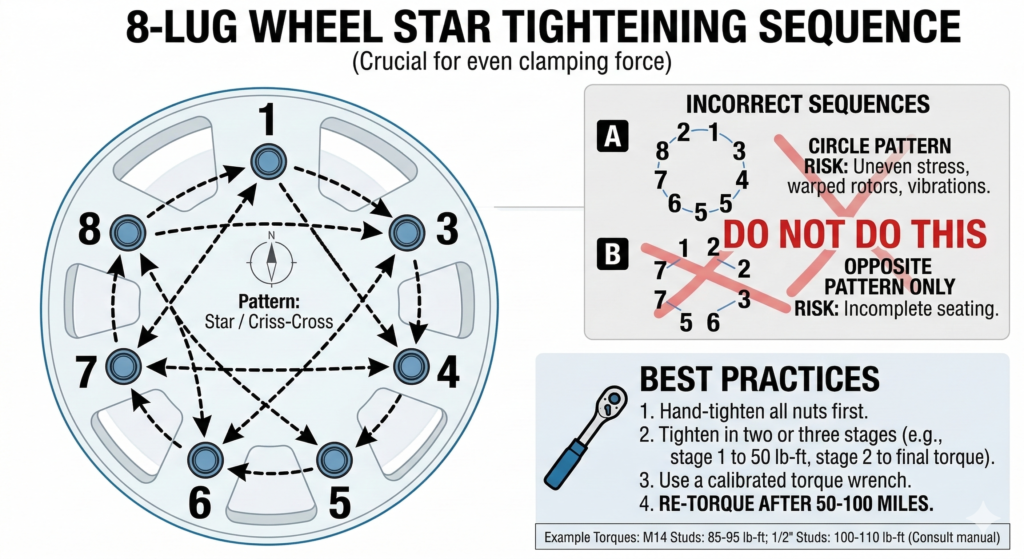
Left Panel: The Star Sequence
The main diagram features a stylized 8-lug pattern.
- Sequential Numbering (1 through 8): Clear, bold numbers show the exact order to tighten the lug nuts to ensure even clamping force is applied to the hub face.
- Directional Arrows: Dash-and-arrow paths illustrate the true “star” motion, moving from ‘1’ to ‘2’, ‘2’ to ‘3’, ‘3’ to ‘4’, and so on. A sub-label in the center confirms the ‘Pattern: Star / Criss-Cross.’
Right Panel: Incorrect Sequences (WARNING)
This section is critical for user safety, marked with a large red ‘X’.
- Circle Pattern (Example A): This demonstrates the dangerous, but often instinctive,
1-2-3-4-5-6-7-8method. It is explicitly labeled with the RISK:Uneven stress, warped rotors, vibrations. - Opposite Pattern Only (Example B): This shows an simplified
1-2, 3-4, 5-6, 7-8opposite tightening method which is marked as RISK:Incomplete seating.
Best Practices Section
A dedicated section with a torque wrench icon provides actionable advice:
- Multi-Stage Tightening: A note recommends tightening in two or three stages (e.g., stage 1 to 50 lb-ft, stage 2 to final torque).
- RE-TORQUE AFTER 50-100 MILES: A prominent note highlights this mandatory safety rule.
- Example Torque Values: A chart lists example ranges for common heavy-duty studs:
M14 Studs: 85-95 lb-ft; 1/2" Studs: 100-110 lb-ft (Consult manual).
Safety Rule: Always inspect your stud threads for galling or wear, and re-torque your wheels after the first 50 to 100 miles of driving!
Conclusion
The Chevy 8 lug bolt pattern most owners will see is the 8 x 6.5″ layout. This is common on pre-2011 2500/3500 trucks and heavy SUVs. Knowing this standard, alongside the newer metric 8x180mm variants, is key to safe and correct wheel fitment.
Before buying wheels, measure center-to-center to confirm your exact bolt circle. Make sure to check your M14 x 1.5 stud threads, match your center bore (using hub-centric rings if necessary), and choose wheels rated for your vehicle’s specific load. If unsure, consult a GM parts database or a trusted wheel professional to confirm fitment before installation.
Frequently Asked Questions (FAQ)
What is the standard Chevy 8 lug bolt pattern in millimeters?
The classic 8×6.5″ bolt pattern translates exactly to 8×165.1mm. If you are buying aftermarket wheels, these two designations are completely interchangeable.
What year did Chevy change their 8 lug pattern?
General Motors officially transitioned from the 8×6.5″ layout to the larger metric 8x180mm pattern for their 2500HD and 3500HD trucks starting in the 2011 model year.
Can I put newer 8×180 wheels on an older 8×6.5 Chevy?
Not directly. The bolt circles are different, meaning the lugs will not line up. You would need to use a high-quality, load-rated wheel adapter that converts an 8×6.5 hub to an 8×180 wheel.
What is the torque spec for a Chevy 2500HD?
For most Chevy 2500HD models, the factory recommended torque for M14 x 1.5 studs is between 85 and 95 lb-ft. Always tighten in a star pattern.
How many lugs does a Chevy 2500 have?
A heavy-duty Chevy 2500 always features an 8-lug wheel setup. Light-duty trucks like the standard Chevy 1500 typically use a 6-lug pattern.
Is the GMC 8 lug bolt pattern the same as Chevy?
Yes. Because Chevrolet and GMC are both manufactured by General Motors (GM), their heavy-duty trucks share the exact same wheel hardware and patterns for matching model years.
What is the bolt pattern for a 2000-2010 Chevy 2500?
From the year 2000 through 2010, the standard Chevy 2500 and Duramax lug pattern was 8×6.5″ (165.1mm). GM switched to the 8x180mm metric pattern in 2011.