
Chevy 8 Lug Bolt Pattern Guide & Specs
We covers the chevy 8 lug bolt pattern and specs for full-size trucks and heavy SUVs. It focuses on the common 8×6.5 bolt pattern chevy owners see. It also mentions metric variants on newer heavy-duty platforms.
You will learn how the chevrolet 8 lug wheel pattern affects fitment, safety, and wheel choice. The article talks about bolt circle sizes, typical stud thread choices like M14 x 1.5. It also covers center bore ranges and common lug nut styles such as 60° acorn and flange designs.
It includes clear measurement methods, interchangeability guidance, and torque and stud engagement basics. This is for Chevy 2500/3500, Silverado, Suburban, Yukon, and Express models. Use this section as a quick orientation before detailed specs and measurement steps in the next parts.
Overview of Chevy wheel bolt patterns and why they matter?
Wheel bolt patterns show how a wheel fits with a hub. For Chevy trucks, the bolt circle shows the number of lug holes and the circle’s diameter. This info helps owners choose the right wheels, avoiding unsafe adaptors.
What a bolt pattern is and how it’s measured?
A bolt pattern, or bolt circle, lists the lug count and circle diameter. Even-number patterns like 8-lug are measured across the hub center-to-center. For example, measure from one lug center to the opposite one to confirm an 8 x 6.5″ layout.
Why bolt patterns matter for safety, fitment, and performance?
Correct bolt pattern ensures wheels fit flush on the hub. It also spreads load evenly across studs. A wrong fit can cause vibration, stripped threads, and wheel separation.
On heavy-duty models like 2500 and 3500, the bolt pattern affects load ratings and stud engagement. It also impacts hub-centric alignment.
Common measurement units: inches vs millimeters
Patterns are shown in inches or millimeters. North America uses inches, like 8 x 6.5″. The metric system lists the same circle as 8 x 165.1mm.
Later heavy-duty trucks might use metric circles like 8 x 180mm, 8 x 200mm, or 8 x 210mm. Always convert before ordering wheels to match the chevy 8 lug wheel bolt pattern exactly.
Practical checklist: verify bolt pattern first, then center bore, stud thread, lug nut type, and load rating before installing wheels.
History of Chevy truck bolt patterns
Chevrolet’s wheel patterns changed as truck duty increased. Early light-duty pickups and SUVs used 5-lug and 6-lug designs. These fit passenger applications well.
Tow ratings rose, and fleets demanded stronger hubs. This pushed 3/4-ton and 1-ton models toward more robust bolt circles.
The shift to eight studs began in the mid and late 20th century. Many 3/4-ton and 1-ton Chevy and GMC pickups used the 8 x 6.5″ configuration from the 1960s to the 1990s. This standard provided better load distribution for heavy hauling and towing.
By the late 20th century, service guides and catalogs commonly showed the 8-lug layout on Chevy 2500 and 3500 SRW trucks. The chevrolet 8 lug wheel pattern became the go-to choice for factory heavy-duty models. Many aftermarket wheels followed suit.
Model-year changes emerged with modern engineering and global sourcing. Around 2011, General Motors began using metric bolt circles on some heavy-duty models. Examples include 8 x 180mm on certain 3/4-ton trucks and 8 x 210mm for some 1-ton duallys. This move away from imperial sizing reflected new manufacturing standards and load-rating optimizations.
When restoring a vintage Chevy or ordering wheels for a newer Silverado, verify the exact bolt circle for your year and model. The chevy truck 8 lug pattern label spans decades. But the specific chevrolet 8 lug wheel pattern can shift to 180mm, 200mm, or 210mm on contemporary heavy-duty platforms.
| Era | Typical Bolt Pattern | Common Applications |
|---|---|---|
| 1960s–1990s | 8 x 6.5 inches (165.1mm) | 3/4-ton and 1-ton Chevy pickups and some SUVs |
| 2000s | 8 x 6.5 inches and select metric variants | Transition period; mix of legacy and updated hubs |
| 2011–present | 8 x 180mm, 8 x 200mm, 8 x 210mm | Modern Chevy 2500/3500 heavy-duty pickups, dual-rear-wheel models |
Chevy 8 lug bolt pattern
The chevy 8 lug bolt pattern is found in many Chevy and GMC trucks and SUVs. This section explains the standard pattern, notes on metric variations in newer models, and how to measure your truck’s pattern.
Standard designation: 8 x 6.5 inches (8 x 165.1mm)
For years, the standard size for many Chevy 3/4- and 1-ton pickups is 8 x 6.5 inches. This is the same as 8 x 165.1mm in metric terms. Many Chevy 2500 and 3500 models have this size listed for wheel replacements.
Variations across years and platforms
In the 2010s, some heavy-duty Chevy and GMC trucks switched to metric bolt circles. You might see 8 x 180mm, 8 x 200mm, or 8 x 210mm on some one-ton and dually models. The pattern depends on the trim, axle, and model year.
How to measure to confirm your truck’s pattern?
To check an eight-lug hub, measure across opposite lug holes. Use calipers for the most accurate reading. A tape measure is good for a quick check, then convert inches to millimeters if needed.
Here’s a quick checklist:
- Count lugs to confirm eight.
- Measure center-to-center across opposite lugs.
- Convert 6.5″ to 165.1mm when comparing charts.
- Confirm stud thread (example: M14 x 1.5) and center bore.
| Designation | Inches | Millimeters | Common applications |
|---|---|---|---|
| 8 x 6.5 | 6.5″ | 165.1mm | Classic Chevy 2500/3500 SRW, many full-size SUVs |
| 8 x 180mm | 7.087″ | 180mm | Later heavy-duty Chevy/GMC trucks with updated hubs |
| 8 x 200mm | 7.874″ | 200mm | Some non-GM and select heavy platforms, cross-compatibility varies |
| 8 x 210mm | 8.268″ | 210mm | Certain one-ton dually rear hubs, specific late-model applications |
When looking at aftermarket wheels, make sure they match the chevy 8 lug wheel bolt pattern. Also, check the center bore and stud fit. The term 8×6.5 bolt pattern chevy is often used in parts and wheel listings. Accurate measurement is key to avoid mismatches and ensure safe installations.
Which Chevy models use the 8×6.5 bolt pattern Chevy?
Many Chevrolet heavy-duty vehicles come with the 8 x 6.5″ bolt circle. This setup is found in trucks and large SUVs made for heavy towing and carrying loads. It’s a common pattern for owners and mechanics to know.
Chevy 2500 and Chevy 3500 SRW models from various years often have this pattern. These trucks have M14 x 1.5 studs and center bores that vary slightly. If you have a 3/4- or 1-ton Silverado, check if it has the 8 x 6.5″ bolt circle.
Heavy-duty SUVs like the Suburban K2500 and Yukon 2500/XL also use the 8-lug layout on certain years. They have similar stud threads and center bore sizes. This makes swapping wheels between trucks and SUVs easier. Make sure to check the chevy suburban 8 lug bolt pattern for your model year to avoid fitment problems.
Full-size vans and specialty trucks also have the 8 x 6.5″ pattern. The Chevrolet Express 2500/3500 and Avalanche 2500 HD use it on many years. Shops often find these vehicles share wheel options with the 2500/3500 pickups, making parts sourcing easier when the chevrolet 8 lug wheel pattern matches.
Here’s a quick guide for owners: check your year and trim, measure the bolt circle if needed, and confirm the stud size and center bore. Many vehicles will have the 8 x 6.5″ standard. But, newer heavy-duty models might use metric bolt circles, so double-check to avoid surprises.
Chevy truck 8 lug pattern differences by year and trim
Over the years, patterns and hardware have changed. Early heavy-duty Chevrolets had a consistent 8 x 6.5″ bolt circle. This pattern was used on many 3/4- and 1-ton pickups from the late 20th century. It fits a wide range of wheels made for M14 studs.
From the late 1970s to about 2010, most 3/4-ton and 1-ton Chevy trucks and HD SUVs had an 8 x 6.5″ wheel bolt circle. They used M14 x 1.5 stud threads with 60° seat lug nuts. Owners swapping wheels from that period usually find direct fitment when the chevy 8 lug bolt pattern and stud specs match.
Starting in the 2010s, Chevrolet and GMC began adopting metric bolt circles on some heavy-duty platforms. Choices like 8 x 180mm and 8 x 200mm appear on newer 2500/3500 models and select dually rear hubs. This modern shift means not every wheel labeled for heavy trucks will match older hubs even if it looks similar.
Confirming fitment requires checking three things. Measure the bolt circle (center-to-center or specified method), verify stud thread diameter and pitch with a gauge, and inspect lug nut seat angle. These steps tell whether a wheel suits a classic 8×6.5 bolt pattern chevy hub or a metric 8x180mm/8x200mm application.
Below is a compact comparison to help identify common year/trim groupings and hardware differences.
| Era / Years | Common Bolt Circle | Typical Stud / Lug Type | Typical Applications |
|---|---|---|---|
| Late 1970s–2010 | 8 x 6.5″ (165.1mm) | M14 x 1.5 studs, 60° acorn or flange nuts | 3/4-ton & 1-ton pickups, HD SUVs (Suburban, Tahoe variants) |
| 2011–present | 8 x 180mm; some 8 x 200mm / 8 x 210mm on duallys | M14 variants common; some hubs use different thread forms—verify | Modern Silverado/Sierra 2500/3500 trims and newer chassis cab trucks |
| Special trims & axle options | Varies (metric or inch) | Check factory placard or service manual for torque and thread | Upgraded axles, aftermarket wheel packages, dealer-installed kits |
Quick verification checklist:
- Measure bolt circle to confirm 8×6.5 bolt pattern chevy versus metric sizes.
- Use a thread gauge to read stud pitch and diameter; expect M14 x 1.5 on many models.
- Check lug seat angle; 60° taper is common but flange seats exist on some wheels.
Chevy 8 lug wheel bolt pattern compatibility and interchangeability
Choosing the right wheels for a heavy-duty Chevrolet is more than just looks. It’s about fitment, which includes bolt circle, center bore, stud size, and how the wheel centers. The 8 lug wheel bolt pattern is common in 3/4- and 1-ton trucks. Owners need to match bolt circle and bore to avoid vibration and stress on studs.
Many GM wheels that list 8 x 6.5 inches will fit directly on compatible trucks’ hubs. Aftermarket makers and some non-GM OEM wheels for full-size trucks often follow the 8×6.5 bolt pattern chevy standard. But, buyers must check center bore size and stud thread before buying.
Centering is key. A hub-centric wheel loads the hub, not the lug studs. Chevrolet SRW 2500/3500 entries show center bore ranges commonly between 116 mm and 125 mm, depending on year and model. If a wheel’s bore matches the hub, it will be hub-centric and reduce vibration.
If the wheel bore is larger than the hub, the assembly becomes lug-centric. Lug-centric fit relies on lug nuts to center the wheel. This setup works for street use but is less ideal for heavy towing. Using hub-centric rings restores proper centering when wheel bore exceeds the hub bore.
Adapters and spacers change fitment in two ways: they alter bolt pattern or offset. A bolt-pattern adapter can allow a non-matching wheel to bolt up. Spacers shift wheel position outward. Both options introduce extra leverage on studs and can alter hub-centric alignment.
Use adapters only when engineered for the truck’s load and installed per manufacturer specs. For heavy-duty trucks, avoid thin or low-quality adapters. Adapters may require extended studs or different lug nuts. Proper stud engagement and torque remain critical to safe operation.
Practical guidance for buyers:
- Prefer wheels that list the 8×6.5 bolt pattern chevy or matching metric designation.
- Confirm center bore matches your hub or plan to use hub-centric rings.
- When using adapters or spacers, choose load-rated parts and follow stud engagement and torque specs.
- Verify stud thread size and lug nut style to match aftermarket wheels.
| Fitment Detail | Typical Chevy Spec | Recommendation |
|---|---|---|
| Bolt Circle | 8 x 6.5 in (8 x 165.1 mm) | Match wheel to hub bolt circle exactly |
| Center Bore | 116–125 mm (varies by year/model) | Use hub-centric fit or rings for correct centering |
| Lug Stud Thread | M14 x 1.5 common on heavy-duty models | Confirm stud size before buying wheels or lug nuts |
| Adapters/Spacers | Can change bolt pattern or offset | Only use high-quality, load-rated parts; verify stud engagement |
| Common Wheel Sources | Chevrolet, GMC, aftermarket truck wheels | Prefer OEM or reputable aftermarket brands designed for truck use |
Chevy Silverado 8 lug bolt pattern and Silverado-specific specs
The Silverado HD lineup often uses robust wheel hardware made for heavy loads. Owners of Silverado 2500 and 3500 models should know the common bolt patterns, center bores, and stud sizes before buying wheels or replacement parts.
Many late 20th century and early 2000s Silverado 2500 and 3500 trucks used the 8 x 6.5″ bolt circle. Later heavy-duty Silverados sometimes shifted to metric circles such as 8 x 180mm or 8 x 210mm depending on axle and model year. Confirming the exact chevy silverado 8 lug bolt pattern prevents fitment issues.
Typical stud thread for older 8 x 6.5″ Silverado HD hubs is M14 x 1.5. Center bore dimensions vary by year and axle, commonly near 116–125mm on CK and modern HD variants. Stock lug nut types include M14 60° acorn nuts or flange nuts used on hub-centric and semi-hub-centric wheels.
Aftermarket wheels must match bolt pattern, center bore, stud thread, and lug seat shape. For Silverado 2500 and 3500 applications, pick wheels rated for the truck’s GVWR and axle loads. Dually rear setups and single-wheel heavy-duty configurations need attention to load rating and proper hub centering.
Practical checklist before purchase:
- Verify chevy 2500 8 lug bolt pattern or chevy 3500 8 lug bolt pattern for your model year.
- Confirm center bore and whether wheels are hub-centric or require adapters.
- Match stud size (often M14 x 1.5) and lug seat profile to the wheel spec.
- Choose wheels with manufacturer load ratings suitable for 3/4- or 1-ton duty.
| Specification | Common Values | Notes |
|---|---|---|
| Bolt Pattern | 8 x 6.5″ (165.1mm), 8 x 180mm, 8 x 210mm | Varies by year and axle; older HDs use 8×6.5″ |
| Stud Thread | M14 x 1.5 | Standard on many Silverado HD hubs; verify for your truck |
| Center Bore | ~116–125mm | Measured per model year; hub-centric fit improves balance |
| Lug Nut Type | M14 60° acorn or flange | Use the lug seat shape required by wheel manufacturer |
| Aftermarket Load Rating | Match or exceed OEM GVWR/axle load | Critical for chevy 2500 8 lug bolt pattern and chevy 3500 8 lug bolt pattern applications |
Chevy 2500 8 lug bolt pattern and Chevy 3500 8 lug bolt pattern specifics
The Chevy 2500 and 3500 trucks often have an 8-lug wheel setup. Most factory hubs have a bolt pattern of 8 x 6.5 inches (165.1 mm). They use M14 x 1.5 studs. Before buying wheels or hub-centric rings, check the center bore size.
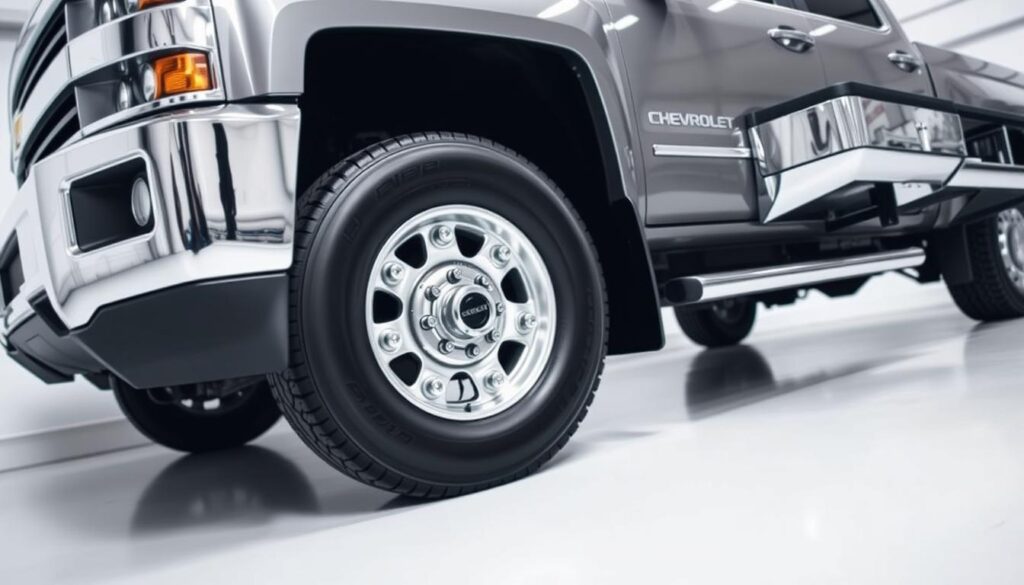
Most model years have a simple bolt circle and stud size. You’ll usually find an 8 x 6.5″ bolt circle with M14 x 1.5 studs. The center bore is often around 116.7–117 mm for many 3/4- and 1-ton trucks.
SRW and DRW rear ends might differ. Some DRW setups keep the 8 x 6.5″ pattern with a similar center bore. But, later heavy-duty models might use a metric circle, like 8 x 210 mm, on some dually axles. Always check the rear axle stamping or parts manual when swapping wheels.
It’s important to consider torque and lug engagement for safety. For 14mm studs, tighten to 85–95 lb-ft. Make sure to get about eight full turns of nut engagement on new studs, unless the manufacturer says differently.
Before installing wheels, do some checks to avoid problems. Replace any stretched or damaged studs. Also, check lug nuts for thread wear and use a calibrated torque wrench. After a short drive, re-tighten the wheels as per the vehicle manual to ensure proper seating and engagement.
| Specification | Common Value | Notes |
|---|---|---|
| Bolt pattern | 8 x 6.5″ (165.1 mm) | Standard for many Chevy 2500 and 3500 SRW hubs |
| Stud size | M14 x 1.5 | Typical factory stud thread for HD models |
| Center bore | 116.7–117 mm (approx.) | Measure hub bore to ensure hub-centric fit |
| DRW variations | Some DRW use 8 x 6.5″, others 8 x 210 mm | Later duallys may shift to metric bolt circles |
| Recommended torque | 85–95 lb-ft | Follow factory specs when available |
| Stud engagement | ~8 turns | Ensure full thread engagement on 14mm studs |
Chevy Suburban 8 lug bolt pattern and SUV applications
The heavy-duty Chevy Suburban and Yukon XL often share wheel hardware with pickup trucks. This is to meet towing and payload demands. Before changing wheels, it’s important to know about the chevy suburban 8 lug bolt pattern.
The Suburban K2500 (1988–1999) and Yukon 2500/XL (2000–2006) used an 8 x 6.5″ bolt circle with M14 x 1.5 studs. Most heavy SUV hubs have a center bore of 116–117mm. This pattern is similar to 3/4-ton pickup specs, making many truck wheels compatible if hub and offset match.
Before swapping wheels, check these differences between SUVs and pickups.
- Center bore: SUVs can have slightly different hub diameters, even with the same bolt circle.
- Offset and backspacing: Small changes alter track width and bearing load.
- Load rating: SUV wheels must be rated for the vehicle’s GVWR and towing capacity.
When upgrading wheels on a heavy SUV, prioritize load rating first. Then, consider bolt pattern and center bore. Use hub-centric rings if the wheel bore is larger than the hub. Confirm lug nut seat type and stud length to ensure proper engagement and safe torque.
Aftermarket wheels must match the chevy 8 lug bolt pattern and carry adequate load capacity for K2500/Yukon 2500 duty. For dually or higher GVWR setups, choose HD-rated wheels. Verify offset and backspacing to avoid excessive bearing stress.
Practical measurement guide and bolt pattern conversion
Before swapping wheels, make sure to check the bolt circle on the hub. Getting the measurement right prevents expensive mistakes and keeps your truck running smoothly. Use a clear method and a conversion guide if the specs are in inches or millimeters.
Measure an even-number lug pattern: center-to-center method
For an 8-lug hub, pick one lug and measure straight across to the opposite lug. This distance is the bolt circle diameter. Use calipers for the best accuracy. If you don’t have calipers, a steel tape will work. Just make sure to hold it flat and take two readings to confirm.
Converting inches to millimeters (6.5″ = 165.1mm) and recognizing equivalents
Many charts list patterns in inches or metric. To cross-check, convert inches to millimeters. Six and a half inches is 165.1 millimeters. So, 8 x 6.5 is the same as 8 x 165.1mm. Watch out for rounded labels like 8 x 165mm that vendors sometimes use.
Examples: confirming an 8×6.5 vs 8x180mm vs 8x200mm hub
If your measurement is about 6.5 inches, you have the common 8×6.5 bolt circle. A reading near 180mm means your hub fits 8 x 180mm wheels, used on some newer heavy-duty models. Readings closer to 200mm or 210mm indicate other metric HD standards. Always check stud thread (M14 x 1.5 is common on Chevy) and center bore for a safe and correct swap.
Tools and tips:
- Use digital calipers or a reliable steel tape for center-to-center readings.
- Record both inch and mm values, then consult a wheel supplier database by vehicle year.
- Check stud thread and center bore after confirming bolt circle to avoid fitment issues.
| Measured Diameter | Common Label | Typical Applications | Notes |
|---|---|---|---|
| 6.5 in / 165.1 mm | 8 x 6.5 (8 x 165mm) | Most 3/4- and 1-ton Chevy pickups and SUVs | Matches many aftermarket wheels labeled for chevy 8 lug bolt pattern and 8×6.5 bolt pattern chevy; verify stud size |
| 180 mm | 8 x 180mm | Newer heavy-duty models and some GM HD variants | Common on later HD trucks; confirm chevy 8 lug wheel bolt pattern listings before purchase |
| 200–210 mm | 8 x 200mm / 8 x 210mm | Certain dually hubs and later-model heavy-duty applications | Less common on light trucks; check center bore and stud thread to avoid mismatch |
Choosing the right lug nuts, studs, torque specs and safety tips
Choosing the right hardware is key to keeping a truck safe. When working with a chevy 8 lug bolt pattern, it’s important to match lug nut type, stud size, and torque. This ensures the wheel and hub work well together. Here are some quick tips to help you check fitment and avoid mistakes.
Common lug nut types and thread fit
Most full-size Chevrolet 8-lug wheels use M14 x 1.5 studs. You’ll find two main types of nut seats: a 60° tapered acorn and a flange style. The flange style spreads the load across the wheel face.
- 60° acorn nuts: Best for wheels with matching tapered seats. They center into the wheel and keep clamping load consistent.
- Flange nuts: Work well on wheels with flat or tapered contact areas. They add surface area under the nut for better load distribution.
- Ball/seat variants: Found on some aftermarket wheels. Verify seat type before installation to avoid mismatch.
Recommended torque ranges and stud engagement
For 14mm studs on heavy-duty Chevy hubs, a typical torque range is 85–95 lb-ft. This range balances clamping force with stud life and thread integrity for a chevrolet 8 lug wheel pattern application.
- Torque value: Use manufacturer torque when available. Many service guides list 85–95 lb-ft for M14 studs.
- Thread engagement: Aim for about eight full turns of lug nut engagement on M14 studs or the minimum thread depth specified by GM.
- Torque sequence: Tighten in a star pattern to seat the wheel evenly and avoid runout.
Inspection checklist and re-torque schedule
Regular inspection stops small issues from becoming failures. Follow this checklist when fitting wheels to an 8-lug hub or during routine maintenance.
- Study stud threads for wear, corrosion, or galling. Replace any damaged studs before reassembly.
- Confirm lug nut seat type matches the wheel. Mixing seats causes uneven clamping and can loosen hardware.
- Verify center bore fit. Use hub-centric rings when a wheel’s bore is larger than the hub to reduce runout.
- Measure stud engagement. Ensure nuts reach the required turns or specified thread depth for safe load transfer.
- Re-torque schedule: Re-torque after the first 50–100 miles following installation. Check again periodically per the vehicle manual.
Avoid mismatched lug nuts, under-torquing, and unverified adapters. Adapters that alter load paths must be engineered for heavy-duty use. Proper choice and routine checks make the chevy 8 lug wheel bolt pattern and chevrolet 8 lug wheel pattern safe and reliable for towing and daily driving.
Conclusion
The Chevy 8 lug bolt pattern most owners will see is the 8 x 6.5″ layout. This is common on 2500/3500 trucks and heavy SUVs with M14 x 1.5 studs. Knowing this standard and the chevy truck 8 lug pattern variants is key to safe and correct wheel fitment.
Before buying wheels, count the lugs and measure center-to-center. This confirms the 8×6.5 bolt pattern chevy or any metric alternative. Make sure to check stud thread, center bore, and lug seat type. Choose wheels and lug nuts rated for your vehicle’s load.
For chevy silverado 8 lug bolt pattern applications, pay special attention to center bore and torque specs. This avoids vibration or stud failure.
Use hub-centric rings or properly rated adapters only when needed. Follow manufacturer torque and engagement recommendations. If unsure, consult a GM parts database, a Chevrolet dealer service manual, or a trusted wheel and tire professional to confirm fitment before installation.
FAQ
What is the most common Chevy 8 lug bolt pattern?
The most common Chevy 8-lug pattern is 8 x 6.5″ (8 x 165.1mm). This pattern is found on many Chevy 2500/3500, Suburban K2500, Yukon 2500, Avalanche 2500, and Express 2500/3500 models across multiple years.
How do you measure an 8-lug bolt pattern correctly?
To measure an 8-lug pattern, pick one lug and measure straight across to the opposite lug. Use calipers or a steel tape. Then, convert inches to millimeters if needed (6.5″ = 165.1mm).
Do any Chevy heavy-duty trucks use metric 8-lug bolt circles?
Yes. Starting around 2011, some Chevy/GMC heavy-duty models use metric circles. For example, 8 x 180mm for 3/4‑ton hubs and 8 x 210mm for 1‑ton dually applications. Always check the year, axle, and trim before assuming 8 x 6.5″.
What stud thread and lug nut seat are common on Chevy 8-lug hubs?
Most Chevy 8-lug applications use M14 x 1.5 studs. Lug nut seats are usually 60° acorn (taper) or flange styles. Make sure the lug seat shape matches your wheel for proper seating.
What center bore sizes should I expect for Chevy 8-lug wheels?
Center bores vary by model and year, commonly in the ~116–125mm range. Confirm the specific center bore for your year/model. This ensures a hub-centric fit or the correct hub-centric ring.
Are aftermarket 8 x 6.5″ wheels interchangeable across Chevy and GMC trucks?
Many GM and aftermarket wheels listed as 8 x 6.5″ will bolt to matching hubs. But, you must also confirm center bore, lug seat type, stud thread (M14 x 1.5), and load rating. Wheels must be rated for the vehicle’s GVWR, which is important for 3/4‑ton and 1‑ton applications.
What torque and stud engagement should I use for M14 studs on Chevy 8-lug trucks?
The recommended torque for 14mm studs is about 85–95 lb‑ft. Aim for roughly eight full turns of engagement. Always use the factory torque spec and follow the re‑torque schedule after initial installation (usually after 50–100 miles).
Can I use wheel adapters or spacers to fit non‑matching wheels on an 8-lug Chevy hub?
Adapters and spacers can change bolt pattern or offset but introduce extra load. They may require extended studs. For heavy‑duty trucks, avoid adapters unless they are engineered and load‑rated for the application. If used, follow manufacturer installation, torque, and stud engagement specs.
How do I confirm whether my Silverado 2500/3500 uses 8 x 6.5″ or a metric 8-lug pattern?
Count lugs, measure center-to-center across opposite lugs, and convert measurements to mm if needed (6.5″ = 165.1mm). Cross-check with a vehicle fitment table or dealer spec for your exact year, axle, and trim. Many older Silverado HDs use 8 x 6.5″; some newer HDs moved to 8 x 180mm or 8 x 210mm.
What should I check before buying replacement wheels for a Chevy Suburban or Yukon 2500?
Verify bolt pattern, center bore, stud thread (M14 x 1.5 common), lug nut seat type, wheel offset/backspacing, and the wheel’s load rating. Use hub‑centric rings if the wheel bore is larger and re‑torque lug nuts after initial miles. Match load rating first for heavy‑duty SUVs.