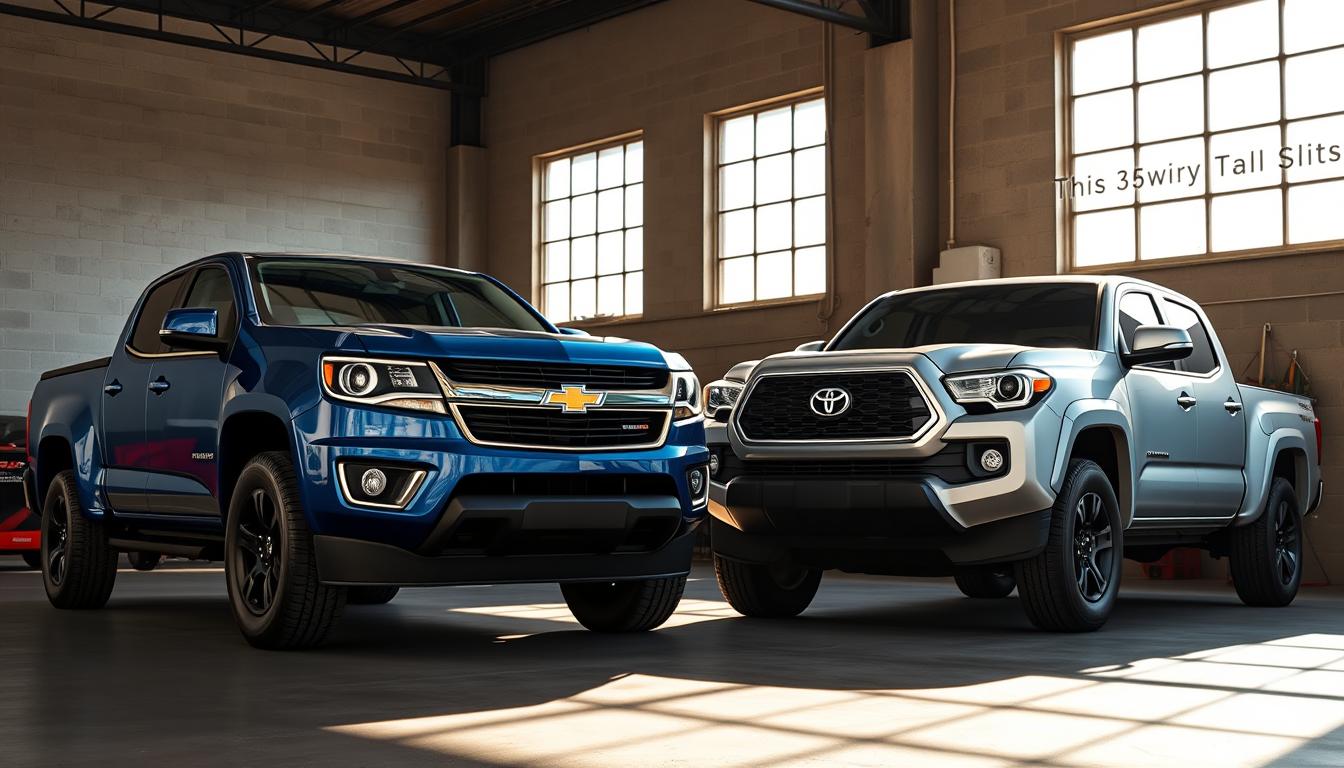
Chevy Colorado vs Toyota Tacoma: Pick-Up Duel
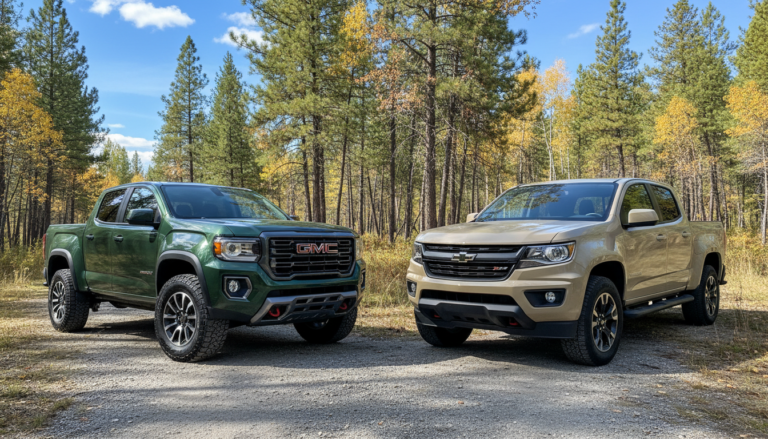
This comparison looks at the 2025 Chevrolet Colorado and the 2025 Toyota Tacoma for U.S. buyers. It uses verified specs, real-world use, and dealer views. This helps readers choose between towing, off-road, and daily comfort.
Both the Colorado LT and Tacoma SR5 have a 3.13 score out of 5. They also have a 4.0 NHTSA safety rating. These numbers set the stage for our discussion on performance, safety, and value.
The article will cover market position, pricing, performance, towing, and fuel economy. It will also look at off-road capability, safety, interior, infotainment, bed utility, and ownership costs. Each section highlights differences to help match priorities to the right truck.
Readers are advised to test drive the exact trims and check local dealer inventory and prices. This advice aims to make the comparison useful for buyers.
Market positioning and pricing comparison
The debate between the Chevy Colorado and Toyota Tacoma often starts with price and brand appeal. Buyers look at the MSRP, trim levels, and the long-term value each model offers. This helps dealers show shoppers the best options.
MSRP and trim-level overview
The 2025 Chevrolet Colorado comes in various trim levels, like LT and Trail Boss. Its prices start lower, with Canadian models beginning at around $38,999 CAD. The top trims cost near $60,199 CAD. Colorado offers larger touchscreens and extra towing hardware.
Toyota Tacoma is seen as a premium, long-lasting choice. Its 2025 prices start at about $48,320 CAD for the SR5. The Tacoma range includes SR5 to TRD Pro, with options for off-road and comfort.
Pricing comparison and what buyers should check
- Compare U.S. MSRPs and current incentives, not just international prices.
- Match trim levels and options for a fair Chevy Colorado vs Toyota Tacoma price comparison.
- Include dealer fees, destination charges, and local promotions in your comparison.
Value proposition and resale considerations
Toyota is known for its durable resale value. Many buyers pay more for the Tacoma upfront, expecting better long-term value and reliability. This affects the total cost of ownership for used buyers.
Chevrolet aims at buyers who want a lower initial price and more tech. The Colorado offers more features for the money. This appeals to those who value upfront savings and factory options.
Warranty and roadside assistance notes
Both brands offer similar warranties in some cases: 36 months/60,000 km for everything and 60 months/100,000 km for the engine. Check with dealers for U.S. warranty details, as some data shows odd roadside assistance entries. Make sure to confirm coverage before buying.
When comparing Chevy Colorado and Toyota Tacoma, use a checklist. Include MSRP, trim levels, resale value, and dealer quotes. This approach ensures a fair comparison based on local, verified data.
Chevy Colorado vs Toyota Tacoma
This comparison focuses on the key features of the 2025 Chevrolet Colorado and the 2025 Toyota Tacoma. It highlights differences in torque, payload, safety, and off-road capabilities. This guide helps you decide which truck to test drive first.
Head-to-head summary
The Colorado and Tacoma have the same overall rating of 3.13/5. They also share many safety features, with a 4.0 NHTSA overall score. The Colorado has more power and can carry more, thanks to its 2.7L Turbo engine.
The Tacoma is known for its 4WD system and reliability. It comes with eight airbags and Toyota Safety Sense on many models. The Tacoma is better for off-roading, with stronger systems and a higher resale value.
Which truck suits which buyer?
Go for the Colorado if you need to tow or carry heavy loads. It has more torque and bigger infotainment screens on some trims. Reviews often highlight its work capabilities and value.
Opt for the Tacoma if you prioritize off-roading, durability, and resale. Its off-road trims and reputation for reliability make it great for weekend adventures and long-term ownership.
- Match priorities: towing, off-road, resale. Rank your top three before shopping.
- Inspect local inventory for trim-specific gear; not all features are standard.
- Read multiple truck reviews to see real-world performance from drivers and fleet users.
Performance, powertrains, and towing capability
This section compares how each truck performs, pulls, and carries loads. The debate between the Chevy Colorado and Toyota Tacoma focuses on engine power, torque, and towing capacity. We provide detailed numbers and insights for everyday use.
Engine and torque comparison
The 2025 Toyota Tacoma has a 2.4L I-4 engine. It makes about 278 hp and 317 lb-ft of torque. It comes with an 8-speed automatic and a reliable 4WD system for steady power.
The 2025 Chevrolet Colorado has a 2.7L Turbo I-4 engine, known as TurboMax in some trims. It produces roughly 310 hp and 430 lb-ft of torque. It also has an 8-speed automatic and offers AWD or 4WD.
The Colorado feels stronger under load, thanks to its torque. This is noticeable when pulling a trailer or climbing steep grades. The Tacoma, on the other hand, offers consistent drivability and predictable response during long off-road trips.
Towing, payload, and drivetrain
Towing capacity varies by trim and equipment. The Tacoma can tow about 6,008 lbs. The Colorado can tow around 6,250 lbs, with some Trail Boss variants claiming even more.
Payload differences are significant. The Tacoma can carry about 1,411 lbs, while the Colorado can carry about 1,731 lbs. This extra payload is great for carrying tools, gear, or a heavy crew cab setup.
Drivetrain and off-road features are key. The Tacoma has Multi-Terrain Select and Crawl Control on TRD models, along with high ground clearance and proven off-road components. The Colorado’s Trail Boss adds a 2-inch lift, off-road suspension, skid plates, and 18-inch all-terrain tires for tough trails.
For heavy towing and large payloads, the Colorado is the better choice. For frequent off-road adventures or long trips in remote areas, the Tacoma’s rugged 4WD systems and proven track record are more suitable.
| Specification | Toyota Tacoma (2025 SR5 example) | Chevrolet Colorado (2025 LT/Trail Boss example) |
|---|---|---|
| Engine | 2.4L I-4 gasoline | 2.7L Turbo I-4 gasoline (TurboMax on Trail Boss) |
| Horsepower | 278 hp @ 6000 rpm | 310 hp @ 5600 rpm |
| Torque | 317 lb-ft @ 1700 rpm | 430 lb-ft @ 3000 rpm |
| Transmission | 8-speed automatic | 8-speed automatic |
| Drivetrain | 4WD with off-road systems on TRD trims | AWD/4WD availability; Trail Boss off-road hardware |
| Towing capacity (example) | 6,008 lbs (approx.) | 6,250–7,700 lbs (dealer-claimed ranges; confirm per trim) |
| Payload (example) | 1,411 lbs (640 kg) | 1,731 lbs (785 kg) |
| Notable off-road features | Multi-Terrain Select, Crawl Control, TRD Pro hardware | 2-inch factory lift, off-road suspension, skid plates, all-terrain tires |
Fuel economy and efficiency
Fuel economy figures show a clear difference between the two mid-size trucks. The Toyota Tacoma has 12.5 L/100 km city, 9.6 L/100 km highway, and 11.2 L/100 km combined. The Chevrolet Colorado has 13.6 L/100 km city, 11.0 L/100 km highway, and 12.4 L/100 km combined. These numbers mean different things for U.S. buyers and help set expectations for daily driving.
Official consumption figures and real-world range
The Tacoma is better for fuel efficiency, which is key on long trips. Its better highway numbers mean more miles between fill-ups.
The Colorado’s engine is made for power, not just fuel efficiency. This makes it use more fuel when driving hard. Dealers say the Colorado Trail Boss can get about 20 mpg combined. Some Tacoma models, including hybrids, can get around 23 mpg combined.
Fuel tank capacity and estimated range
The size of the fuel tank affects how far you can go. The Tacoma’s 69 L tank lets you go about 616 km. The Colorado’s 81 L tank lets you go about 656 km, even with higher fuel use.
How far you can go depends on how you drive, what you carry, and where you go. Choose the Tacoma for lower costs and better fuel use. Pick the Colorado for more range and towing power, even if it uses a bit more fuel.
Off-road capability and best truck for off-roading
The chevy colorado vs toyota tacoma debate gets intense on rough trails. Both trucks offer great off-road skills but tackle terrain in unique ways. Your choice depends on the trip’s length, payload, and how far off the beaten path you’ll go.
First, look at the factory equipment. Toyota’s TRD Pro and TRD Off-Road come with Multi-Terrain Select and Crawl Control. The TRD Pro also has FOX shocks, reinforced skid plates, and high ground clearance. These features are perfect for long, tough drives in areas with no services.
Chevrolet’s Trail Boss is ready for off-road adventures with a two-inch lift and off-road suspension. It also has 18-inch all-terrain tires, skid protection, and off-road displays. The Trail Boss offers more torque and a higher stance for tackling tough trails and heavy loads.
Dealer experiences are key. Whitehorse Toyota and others praise the Tacoma’s toughness in harsh climates. It excels in deep snow and long, remote trips. Its simple design makes repairs easier when you’re far from parts stores.
The Colorado shines in being ready for trails right out of the box. Trail Boss buyers get a truck that’s almost perfect for towing and navigating rock gardens. Its factory lift and torque make it great for towing and trail use.
So, what to choose? Go for a Tacoma TRD Pro or TRD Off-Road for reliable, low-maintenance travel in remote areas. Opt for the Colorado Trail Boss if you need immediate off-road capability, more torque, and integrated cargo solutions.
Think about the terrain when making your decision. For long, tough routes with no services, Toyota’s TRD series is a safe bet. For heavy towing and quick off-road readiness, the Trail Boss is often the top pick.
Safety ratings and driver-assist features
When we compare the chevy colorado vs toyota tacoma, safety ratings are key. Both trucks have an NHTSA overall score near 4.0. But, they differ in crash performance, airbag layout, and ADAS features.
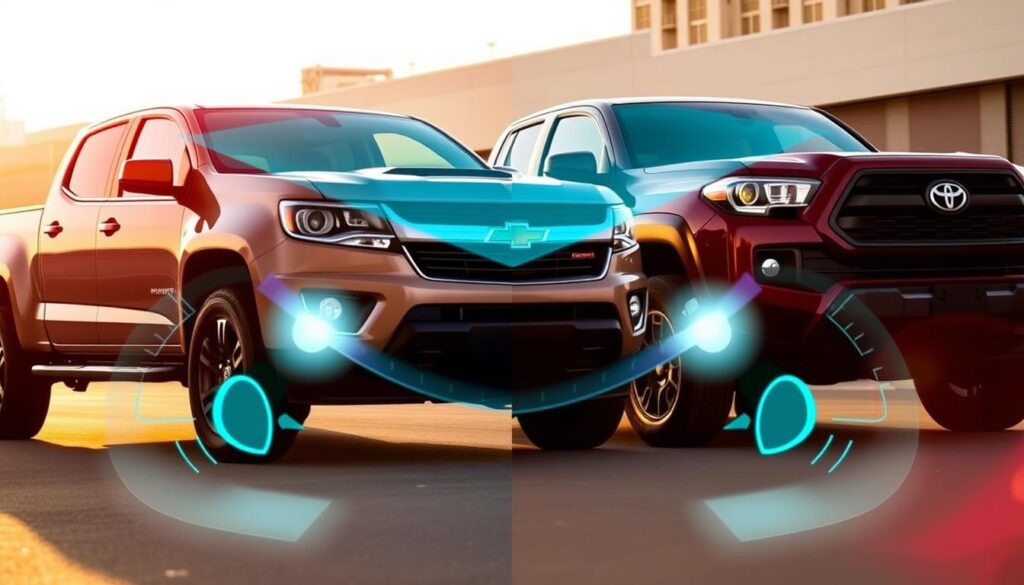
Crash test scores and airbag configurations
The Colorado gets a 5-star Side Impact score and a 4-star Frontal Crash rating. It has a 3-star Rollover protection rating. The Tacoma also scores well, with a Good Side Impact rating, a 4-star Frontal Crash rating, and a 4-star Rollover rating.
The Tacoma has eight airbags, including front, side, curtain, and a driver-knee bag. The Colorado has six airbags, covering front, side, and curtain positions. The Tacoma’s extra knee airbag is important in some frontal collisions.
Standard safety tech and advanced driver assistance
Toyota often includes the Toyota Safety Sense suite in the Tacoma. This package includes lane departure alert, dynamic radar cruise control, and pre-collision systems. These features are standard on many models, providing broad driver-assist coverage.
Chevrolet outfits the Colorado with radar- and camera-based systems, varying by trim. Higher trims add adaptive cruise and more advanced collision mitigation. Some versions also have rear radar and camera options for better blind-spot and trailer detection.
A quick checklist for shoppers comparing driver-assist offerings:
- Verify which ADAS features are standard versus optional for your trim.
- Compare airbags and passive protection if you prioritize occupant coverage.
- Check NHTSA sub-scores—side, frontal, and rollover—to match safety needs to typical use.
Interior comfort, infotainment, and daily usability
The chevy colorado vs toyota tacoma debate focuses on the cabin. Both trucks aim for a balance of ruggedness and modern tech. You’ll see differences in screen size, seating, and durability.
Infotainment and connectivity
The Colorado’s higher trims offer a larger touchscreen and more features. An 11.3-inch screen is available on LT and Trail Boss models. Apple CarPlay and Android Auto come standard. Some trims also include Amazon Alexa and Google Assistant for voice commands.
The Tacoma SR5 has a 7.0-inch touchscreen with Apple CarPlay and Android Auto. It also has a 6-speaker audio setup. This setup is simple and reliable, perfect for those who want easy access to navigation and music.
Comfort, seating, and climate features
Both trucks start with cloth seats and offer heated and power-adjustable seats in higher trims. Colorado’s upper trims include more tech-driven comfort features. These include dual-zone automatic climate control and integrated voice assistants.
Tacoma focuses on durable materials and ergonomic seating for long drives. TRD Sport and TRD Pro trims have sportier seats and a driver-focused layout. Dealers often talk about Tacoma’s comfort on long trips, even in cold weather.
Daily usability notes
- Colorado: its larger screen makes map reading and trail planning easier. It also has more connectivity for long trips.
- Tacoma: its rugged, simple layout makes maintenance easier and reduces distractions. It focuses on reliability on long drives.
Choice guidance
Drivers who want more infotainment and tech will choose the Colorado. Those who value simplicity and comfort for long drives will prefer the Tacoma. Seating comfort and touchscreen size are key when deciding between the chevy colorado and toyota tacoma.
Bed utility, cargo solutions, and towing equipment
The cargo area is as important as the engine for those choosing between the Chevy Colorado and Toyota Tacoma. The right truck bed features can make a big difference in daily tasks and weekend adventures. This section explores the built-in tools, storage options, and towing capabilities of each truck.
Bed features and practical storage
The Chevrolet Colorado, in Trail Boss and higher trims, comes with useful features like factory-installed latches and bed grooves. It also has built-in measurement markers. The dual-level bed and under-rail storage make it easy to organize your space. These features mean you might not need to add extra accessories for loading and unloading.
The Toyota Tacoma has a simpler, durable bed that focuses on lasting performance. It doesn’t come with as many factory utility add-ons. Instead, owners rely on aftermarket solutions for racks, drawer systems, and tonneau covers. This approach is great for those who prefer a basic, customizable platform.
Towing hardware and trailer integration
The Colorado often has an advantage in towing equipment and trailer integration. It has higher axle ratios and factory tow packages for heavy trailer work. Its wiring and hitch setups are designed to work well with trailer electronics, making it easier to use brake controllers and modern trailer systems.
The Tacoma is a reliable choice for everyday towing. Its hitch and trailer systems are proven for hauling various loads. Toyota’s established towing setup is suitable for many scenarios where high capacity isn’t needed.
| Attribute | Chevrolet Colorado | Toyota Tacoma |
|---|---|---|
| Factory bed tools | Integrated latches, measurement markers, dual-level bed | Basic durable bed, minimal factory tools |
| Aftermarket support | Good, growing range | Extensive, variety of modular cargo solutions |
| Towing capacity (example) | Around 6,250 lbs (varies by trim) | About 6,008 lbs (dataset example) |
| Payload example | 1,731 lbs | 1,411 lbs |
| Trailer integration | Strong wiring and hitch options for electronics | Proven, straightforward hitch and wiring |
For those who need to haul heavy loads often, the Colorado’s factory gear and towing equipment are practical. The Tacoma is a good choice for those who want a durable base with a wide range of aftermarket cargo solutions. Both trucks work well with trailer integration options that fit the owner’s needs.
Ownership costs, warranty, and long-term value
When you buy a pickup, think beyond the price tag. This section explores how ownership costs and warranties impact long-term value. We compare chevy colorado vs toyota tacoma.
Warranty and roadside assistance comparisons
Toyota and Chevrolet offer similar warranties. They cover parts and powertrains for 36 months or 60,000 km, and 60 months or 100,000 km, respectively. ToyotaCare gives free maintenance for some models.
Chevrolet’s warranty includes roadside assistance. Local dealers can extend this service. It’s key to check with a dealer as roadside assistance varies by area.
Look at what each warranty covers and any deductibles. Also, compare roadside assistance for towing, lockouts, and flat tires. The fine print in warranty papers can affect your costs.
Maintenance, reliability, and resale trends
Toyota is known for needing less maintenance and being reliable. This makes the Tacoma hold its value well. If you want a truck that keeps its value, Toyota might be the better choice.
Chevrolet offers a wide range of dealers and parts. The Colorado might be cheaper upfront. But, long-term costs depend on how you use it and where you live.
Dealers can offer local insights. Yukon and Whitehorse Toyota suggest the Tacoma for tough climates. Tom Bell Chevrolet recommends the Trail Boss for Southern California. Think about your needs and how you’ll use the truck when deciding on costs.
| Factor | Toyota Tacoma | Chevrolet Colorado |
|---|---|---|
| Factory comprehensive warranty | 36 months / 60,000 km | 36 months / 60,000 km |
| Powertrain warranty | 60 months / 100,000 km | 60 months / 100,000 km |
| Roadside assistance (typical listing) | ToyotaCare entry; verify term with dealer | Commonly 60 months / 100,000 km; verify locally |
| Expected maintenance trend | Lower routine costs; strong reliability | Moderate costs; depends on trim and regional service |
| Resale value trend | High retention across model years | Competitive initial value; resale weaker than Tacoma |
| Ownership costs considerations | Higher upfront price offset by resale value | Lower entry cost; may incur higher long-term expense |
Conclusion
This guide compares the Chevy Colorado and Toyota Tacoma. The Chevy Colorado is great for towing and payload. It has a 2.7L Turbo engine with 430 lb-ft of torque and can carry up to 1,731 lbs.
It also has bigger infotainment screens and starts at a lower price. This makes it perfect for those who tow a lot or need more carrying capacity.
The Toyota Tacoma is excellent for off-road adventures and keeps its value well. Its TRD models come with special features like Multi-Terrain Select and Crawl Control. Toyota Safety Sense adds many driver assist technologies.
Dealers in places like Yukon say the Tacoma is reliable in tough conditions. This is important if you value durability and resale value.
What to do next? Test drive the exact models you’re interested in. Try the Colorado Trail Boss against the Tacoma TRD or SR5. Check the current specs and towing ratings with local dealers.
Use dealer tools to compare prices and features. Both trucks are good midsize pickups. The best one for you depends on what you need most.
In short, there’s no single winner in this comparison. Choose the truck that fits your needs best. A focused test drive and checking the latest specs will help you decide.
FAQ
Which truck is better for towing heavy trailers — the 2025 Chevy Colorado or the 2025 Toyota Tacoma?
The 2025 Chevy Colorado is better for towing heavy trailers. It has a 2.7L turbo engine with 430 lb‑ft of torque. This gives it a higher payload capacity, around 1,731 lbs.
The Colorado can tow up to 6,250 lbs, sometimes more on certain trims. The Tacoma can tow about 6,000 lbs, but the Colorado’s power and payload make it the better choice for heavy towing.
Which pickup is best for off‑road use?
The Toyota Tacoma is best for off‑road use. It has proven 4WD hardware and features like Multi‑Terrain Select and Crawl Control. It’s also built to last in tough conditions.
The Chevrolet Colorado Trail Boss is also off-road ready. It comes with a 2‑inch lift and off-road suspension. It’s a great choice for those who need a factory lift and more torque for off-road tasks.
How do fuel economy and range compare between the two trucks?
The Tacoma is more fuel efficient, using about 11.2 L/100 km combined. The Colorado uses 12.4 L/100 km combined. But the Colorado has a bigger fuel tank, giving it a longer range.
For long trips and saving on fuel, the Tacoma is better. But if you need to tow or carry a heavy load for a long time, the Colorado is a better choice.
What are the key safety differences between the 2025 Colorado and Tacoma?
Both trucks have a 4.0 overall NHTSA rating. The Colorado does better in side-impact tests and has 6 airbags. The Tacoma has 8 airbags and a 4-star rollover rating, while the Colorado has a 3-star rating.
The Tacoma often comes with Toyota Safety Sense on many trims. The Colorado matches with radar/camera ADAS on higher trims. Check the ADAS features on the trim you’re interested in.
How do infotainment and interior features compare?
The Colorado’s higher trims have a larger 11.3‑inch touchscreen and voice assistants. This gives it a tech advantage at similar prices. The Tacoma SR5 has a 7‑inch screen with Apple CarPlay/Android Auto.
The Tacoma focuses on durable, comfortable cabins for long drives. The Colorado emphasizes larger screens and more connectivity on upper trims.
What about warranty, roadside assistance, and long‑term ownership?
Both brands offer similar warranties: 36 months/60,000 km for the first part and 60 months/100,000 km for the powertrain. Roadside assistance varies, with Toyota having at least one data inconsistency. Check with dealers for local U.S. terms.
Toyota has a better resale value and reliability, which can save you money in the long run. Chevrolet offers lower upfront prices and strong equipment value.
Which truck should I choose based on my priorities?
Choose the Chevy Colorado if you value towing capacity, payload, and tech for the price. Choose the Toyota Tacoma for off-road capability, reliability, and resale value.
Test-drive the exact trims you’re considering. Confirm local U.S. specs and towing ratings with dealers. Compare inventory and incentives in your area.