
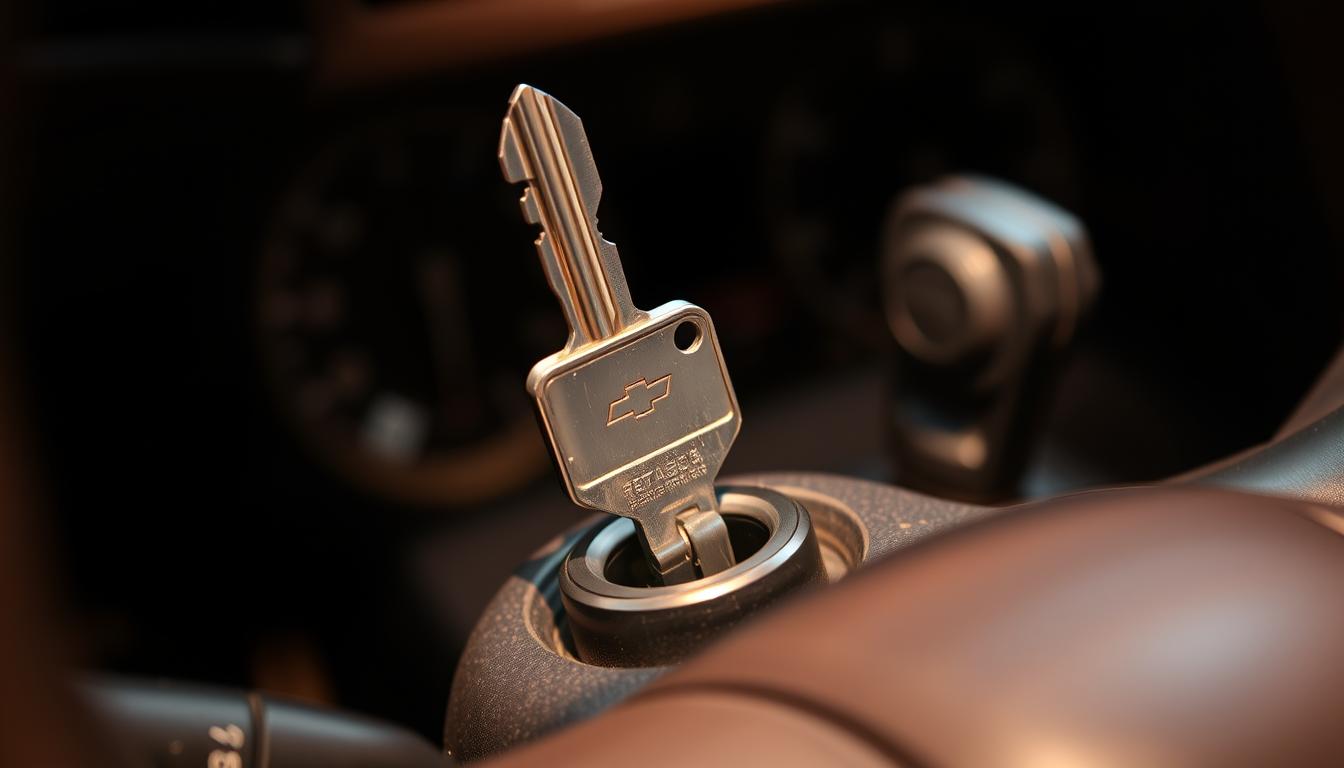
Why Is My Key Stuck in the Ignition Chevy? Signs of Ignition Cylinder Issues
A Chevy key stuck in the ignition is a common problem. It can be very stressful. Drivers often find the key won’t turn or won’t come out. This leaves the vehicle stuck and plans delayed.
This section tells you what to do first. Simple checks and minor fixes can solve the problem quickly. You might need to lubricate, adjust the steering wheel, or use a spare key.
But, some cases are tougher. A damaged key, worn or broken ignition wafers, or electrical issues might need a pro. For broken keys or failed cylinders, you might need a locksmith or a new ignition cylinder. This can take an hour or a few hours, depending on the parts and access.
Forcing the issue can lead to a snapped key, more damage, and higher repair costs. This guide helps Chevy owners know when to try DIY fixes or call a professional. It also previews the detailed causes and fixes in the next sections.
Why is my key stuck in the ignition Chevy?
When a Chevy key won’t come free, drivers need quick answers. This section explains common causes and signs. These signs help you figure out if it’s a mechanical, key, or electrical issue. Use these clues to decide what to do next.
Common immediate causes in Chevy models
Bent or worn keys are common problems. A key that feels gritty or hard to insert often has wear.
Broken ignition wafers, the thin tumblers inside many Chevy cylinders, can jam and trap the blade.
The steering-wheel lock can hold pressure on the cylinder. This prevents the key from reaching the release position.
Less often, electrical interlocks tied to the ignition switch or a transmission park sensor stop key removal. This happens even with smooth mechanical action.
How Chevy ignition design (wafers, steering lock) can trap a key?
Many Chevrolet models use wafer-style tumblers. Each wafer must align with the key cuts to allow rotation.
Fragments from a broken wafer or shifted wafers create a partial alignment. This stops the cylinder from turning cleanly.
The steering lock sits next to the ignition cylinder. If the wheel is under tension, the cylinder cannot rotate. The key stays stuck.
Symptoms that indicate a mechanical vs key damage problem
Key or mechanical damage: the key won’t insert smoothly, feels gritty, or catches at one rotation point. A spare key that works points to the original key as the issue.
Cylinder or wafer failure: the key may enter easily but won’t turn smoothly. Jiggling sometimes frees the key. Partial retraction with no full release signals internal tumbler trouble.
Steering-lock signature: the key turns to OFF but won’t remove until the steering is unlocked. Gentle wheel wiggling while turning the key often frees it.
Electrical/shift-interlock signs: no physical resistance but the key cannot be removed. This is because the transmission is not in Park or the ignition switch won’t return the lock to release. This shows up during troubleshooting chevy ignition key issue when the car’s electronics block removal.
| Cause | Key Signs | What to test first |
|---|---|---|
| Bent or worn key | Gritty insertion, visible wear, spare key works | Compare with spare key; inspect blade under light |
| Broken ignition wafers | Key inserts but won’t turn smoothly; intermittent freeing | Try gentle jiggling; avoid force and call locksmith if persistent |
| Steering-wheel lock | Key turns to OFF but won’t remove; wheel feels tight | Straighten wheel and apply gentle back-and-forth while turning key |
| Electrical / shift-interlock | No physical resistance; vehicle not in Park or switch won’t reset | Confirm Park, check dash indicators, try cycling the ignition |
Common mechanical reasons a Chevy key gets stuck
When a key gets stuck in the ignition, it’s usually because of mechanical issues. Drivers often notice this problem suddenly. This section will explain the common failures that cause a Chevy key to get stuck and how to check for them.
Worn or broken ignition wafers and how they fail?
Ignition wafers are flat parts that match the key’s cuts. Over time, they can chip, bend, or break. A broken wafer can get stuck between the key and cylinder, stopping it from turning or coming out.
Signs of broken ignition wafers include a rough turning feel, sudden binding, or the key only turning partway. If a spare key acts the same, it’s likely the wafers are the problem.
Steering wheel lock engagement and its effect on key removal
Many owners find the key won’t come out after parking because the steering lock has engaged. When the wheel is against the stops, the lock can apply tension to the column. This tension prevents the ignition from reaching the release position.
A quick check: gently straighten or rock the steering wheel while applying mild turning pressure to the key. If the key frees, the lock engaged instead of internal damage.
Ignition cylinder wear from age and mileage
Continuous use wears down the internal surfaces and changes the tolerances. Worn cylinders let wafers move unpredictably and can catch the key when inserting or removing it. Older Chevrolets with high mileage are most at risk.
Practical indicators of ignition cylinder wear include a loose insertion feel, keys that twist or fall inward, intermittent operation, or a grinding sensation when turning. These symptoms suggest internal deterioration that can lead to full failure if not fixed.
Key damage and wear: why a damaged key won’t release?
Keys wear out over time. A Chevy key with rounded peaks, deep nicks, or bends won’t fit right. This makes it hard to remove and can get stuck.
Bent blades don’t fit properly. If the key doesn’t sit right, it binds. Heavy keychains or dropping keys can speed up wear.
Repeated use changes the key’s shape. Small bends and scratches from inserting and removing the key change its shape. Try a spare key to see if it’s the key or the cylinder.
Cracks and corrosion can make a key snap. Applying too much force on a damaged key can break it inside the ignition. This makes it hard to remove and might need special tools.
Checking the key can prevent damage. Look for wear and compare it with a spare. If the key feels rough or loose, stop. For help with a stuck key, try a clean spare first and avoid using too much force.
| Issue | Signs on Key | Immediate Risk | Suggested First Step |
|---|---|---|---|
| Worn-cut profile | Rounded peaks, shallow grooves | Misalignment and jamming | Test with clean spare key |
| Bent blade | Visible bend near shoulder or tip | Pressure on wafers, stuck key | Do not force; attempt gentle straightening only if minor |
| Cracks / corrosion | Rust, hairline fractures | Key likely to snap under torque | Avoid turning; call locksmith if torque needed |
| Metal fatigue from heavy use | Micro-bends, uneven wear | Gradual loss of fit, intermittent sticking | Replace key and recheck cylinder |
Electrical and shift-interlock issues that make the key stick
Electrical problems and shift-interlock systems can stop the key from coming out. Even if the ignition feels free, the key might stay stuck. This happens because the ignition switch sends a signal to the lock cylinder. If this signal fails, the key gets trapped, even without feeling stuck.
Signs of electrical issues include a weird Park indicator on the dashboard. The car might not start or turn off right. You might not feel any resistance when turning the key. These signs often mean the ignition switch or wiring has a problem, not worn wafers.
How the ignition switch and electrical interlocks can prevent key removal?
Some Chevrolets have an electronic return position in the ignition switch. If this part fails, the cylinder won’t move to release the key. Faulty wiring or a damaged connector can also stop the circuit, making the key stuck.
Shift-to-park sensors (automatic transmissions) and stuck-key symptoms
Automatic models use a Park position sensor or pin. It must confirm Park before the key comes out. If the sensor or actuator fails, the system thinks the car is in gear. This can make the shifter look like it’s in Park, but the dash says it’s not.
Diagnosing an electrical vs mechanical stuck-key problem
A simple tactile test can help find the cause. Mechanical issues feel gritty or stuck. Wiggling the steering wheel might help.
Electrical faults feel smooth but the key won’t come out. Check if the car is really in Park and the Park indicator. Trying to shift in and out of Park can show sensor problems.
| Symptom | Likely Cause | Quick Check |
|---|---|---|
| Gritty feel turning key | Worn wafers or damaged key | Try a spare key; wiggle steering wheel |
| Smooth rotation but no release | Ignition switch or wiring fault | Check Park indicator; shift in/out of Park |
| Shifter shows Park but key won’t eject | Faulty park position sensor or linkage | Inspect shifter linkage; test sensor signal |
| Car won’t start and key stuck | Electrical interlock or ignition switch failure | Scan for fault codes; test ignition switch |
When dealing with a stuck ignition key in a Chevy, start by checking if the car is in Park. Use a spare key if possible. If there’s no mechanical jam, focus on the shift-interlock and ignition switch. Avoid using force to remove the key.
Quick DIY checks to try before calling a professional
Start with a few calm, safe tests to free a stuck Chevy key. These quick checks take just a minute and can save you time and money. Move slowly and carefully. Remove heavy keychains first to lessen stress on the key.
Confirm the car is in Park. For automatics, ensure the shifter is fully in Park. Shift out and back into Park to reset the sensor if needed. For manuals, check that the car is in neutral and the parking pawl or handbrake is set.
Center the steering wheel. If the wheel is off-center, it can bind the ignition. A straight wheel reduces column load and improves the chance the key will release.
Try the gentle wiggling wheel technique. Apply light outward pressure on the key while slowly moving the steering wheel left and right. Small, controlled movements release steering-lock tension. Never force the key or use excessive torque.
Inspect key for visible damage. Look for bends, cracks, worn edges, or metal loss that can stop proper engagement. If the original key looks damaged, avoid forcing it.
Perform a spare key test. If a spare is available, try it before lubricants or disassembly. If the spare turns and removes cleanly, the original key is the likely culprit and should be replaced or duplicated by a dealer or locksmith.
- Remove bulky keychains to prevent torque on the cylinder.
- If slight lubricant is used, choose graphite spray and apply sparingly.
- Document any odd resistance, clicking, or unusual feel for a locksmith.
Step-by-step quick fixes to unlock a stuck key in Chevy ignition
When a Chevy key won’t budge, take calm steps to avoid damage. Here’s a quick guide on how to fix a stuck key in your Chevy ignition. It uses common tools and simple checks before you call a professional.
Choose the right lubricant and use it sparingly.
Opt for a dry graphite lubricant or a lock-safe electrical contact cleaner. Spray a small amount into the slot, then insert the key and wiggle it gently. This spreads the lubricant. Stay away from heavy oils like WD-40, as they attract dirt and can clog the wafers. Also, don’t spray the cleaner too deep, where electrical parts are.
Free a key from a seized steering lock with gentle motion.
Try turning the key a bit towards the release while rocking the steering wheel. Use small, controlled movements to ease the lock. If the wheel doesn’t move easily, stop. Don’t force the key, as this can bend or break it.
Test a spare key only after basic checks.
If you have a good spare key, try it to see if it works. If it does, your original key might be damaged or worn out. Don’t keep trying if it doesn’t work; this can wear out the lock. Know when to use your spare key versus calling a locksmith.
- Set the parking brake and work on level ground to avoid hazards.
- Keep movements small and steady; patience prevents broken keys.
- If the key feels gritty when moved after lubricant, stop and call a locksmith.
When to call an auto locksmith for a Chevy key stuck in ignition?
A stuck key can be a simple problem or a sign of serious trouble. It helps drivers know when to call a locksmith. It also explains what to expect during the extraction and service.
Signs the problem requires a locksmith
Call a pro if the key is cracked, badly worn, or has partially snapped inside the ignition. These situations often need broken key removal to avoid pushing fragments deeper.
If steering-wheel wiggle, a spare key, and a light spray of lubricant fail, a locksmith should handle the job. Visible metal chips or a gritty, locked feel in the cylinder point to internal damage.
Typical locksmith methods for safe key extraction
Experienced locksmiths use special tools and picks to release wafers without harming the housing. For damaged wafers extraction, they may remove the ignition cylinder partially to clear lodged pieces.
Technicians assess whether the issue is the key, wafers, or steering lock. On-site rekeying or cylinder swap is possible if extraction shows internal failure.
Estimated time and cost ranges for locksmith service
Simple extractions are often completed within an hour. In the U.S., expect a locksmith visit for key removal to range roughly $75–$200 depending on region and complexity.
More complex jobs that require ignition removal, rekeying, or replacement can push costs into the several-hundred-dollar range. Avoid DIY attempts that raise the cost to remove a stuck key by causing extra damage.
Practical checklist before calling
- Confirm the vehicle is in Park and steering is centered.
- Try a spare key if available; do not force the original.
- Note any visible breakage or rough feel to report to the locksmith.
- Choose a technician experienced with Chevrolet models to reduce risk and extra expense.
| Service Type | Typical Time | Typical U.S. Cost Range | When Needed |
|---|---|---|---|
| Simple key extraction | 15–60 minutes | $75–$150 | Key stuck with no visible breakage |
| Broken key removal | 30–90 minutes | $100–$250 | Key partially snapped or lodged |
| Damaged wafers extraction & rekeying | 1–3 hours | $150–$400+ | Internal cylinder damage or worn wafers |
| Ignition cylinder removal & replacement | 2–4 hours | $300–$800+ | Severe cylinder failure or repeated issues |
When the ignition cylinder or assembly needs replacement?
The ignition can fail slowly or suddenly. Look out for repeated jams, a wobbly key, grinding noises, or lock fragments. A stuck spare key often points to ignition problems, not the key itself. Catching these signs early can make replacement easier and cheaper.
Signs of ignition failure include a key that won’t come out, sticking in certain spots, or visible play. If the steering lock won’t release the key, even when in Park, it’s a sign of worn parts. Temporary fixes won’t last, leading to more serious problems over time.
Replacing the ignition depends on the vehicle model and whether it’s part of the assembly. Some Chevrolets can have just the cylinder replaced, while others need the whole switch or module. Labor time varies from one hour for easy access to three hours for more complex jobs.
The cost of replacing a Chevy ignition varies by parts and location. Simple parts start at a few hundred dollars, but electronic switches or modules increase the price. Labor adds to the total cost. Getting both OEM and aftermarket quotes helps compare prices and warranties.
Delaying a replacement can lead to serious issues. A broken key inside the cylinder is hard to remove and may require more work. A failing ignition can leave you stranded and may compromise your vehicle’s safety and security.
Knowing when to replace the ignition is key. If problems keep happening after simple fixes or a spare key shows the same issues, it’s time to act. Replacing it early can save money and avoid being stranded.
| Item | Typical Range (U.S.) | Notes |
|---|---|---|
| Cylinder only (parts) | $50–$200 | Aftermarket lower cost, OEM higher; depends on model year |
| Full ignition assembly | $200–$800+ | Includes electronic switches or steering column modules on some models |
| Labor | $75–$300 | Typically 1–3 hours; dealer labor rates higher than independent shops |
| chevy ignition replacement cost (total) | $200–$1,200+ | Varies by parts selected, programming needs, and regional labor rates |
| Extra cost if key breaks inside | $150–$600+ | Extraction and possible additional parts or column repair increase expense |
Preventive maintenance to avoid a stuck key in your Chevy
Small habits keep a Chevy ignition working smoothly. Routine care reduces the chance of a jammed key and saves time and money down the road.
Inspect keys and keep a spare. Check keys for bends, burrs, or cracks every few months. Replace a worn key before it alters the tumblers in the cylinder. Keep a spare key in a safe place outside the vehicle for emergencies.
Reduce stress on the cylinder. Remove heavy keyrings and limit accessories on the fob. Large, dangling items increase leverage and can deform wafers over time. Teach drivers to avoid excessive force when turning or removing the key to prolong cylinder life.
Mind steering position and habits. Park with the steering wheel near center before extracting the key. This lowers steering-lock strain that can bind the key. Avoid habitually yanking the key while twisting the wheel; gentle alignment prevents early wear.
When to schedule preventive ignition service? If the key feels gritty, loose, or shows occasional binding, arrange a locksmith or dealer inspection. Early ignition service or rekeying can stop a simple issue from becoming a broken-key extraction job.
Routine intervals. For Chevrolets with high mileage or long-term ownership, inspect the key and ignition every few years or at the first sign of rough action. Proactive checks form the backbone of effective preventive maintenance and help prevent stuck key in chevy scenarios.
Troubleshooting chevy ignition key issue: step-by-step diagnostic checklist
Begin with a calm, methodical check. A short diagnostic checklist saves time and prevents extra damage. Follow each step and note what happens. Clear notes cut locksmith or mechanic diagnostic time.
Checklist for drivers: Position, key condition, steering lock, and electrical state
Confirm gear position: automatic transmissions must be in Park. Manual cars should be in neutral with the parking brake set. Check the Park indicator on the dash before trying to remove the key.
Center the steering wheel. Try a gentle wiggle while turning the key. If the wheel is locked, a small steering movement often frees the key.
Inspect the key for wear, bends, or cracks. Test a spare key when available. Note whether the key turns smoothly, sticks at one point, or will not rotate at all.
How to document symptoms for a mechanic or locksmith?
Write precise observations: does the key insert but not turn, turn but not eject, or feel gritty when rotating? Record sounds such as clicks or grinding.
Log what actions helped or failed: wiggle-and-turn, applying a tiny graphite lubricant, or using a spare key. Capture dashboard lights and any shift-to-park warning messages.
Take photos of the key edge and ignition face if visible. A short timeline of attempts is helpful: time, action, result. This documentation speeds up diagnosis and reduces labor costs.
Quick tests to isolate whether the problem is the key, cylinder, or steering lock
Test the spare key. If the spare works, the issue points to the original key. If both keys bind, suspect the ignition cylinder or wafers.
Apply gentle steering-wheel rocking while turning the key. If that frees the key, the steering lock likely caused the problem. Avoid brute force; that can worsen cylinder damage.
If the cylinder rotates freely but the key will not eject and Park status is unclear, check the shift-to-park sensor or indicator. Electrical interlocks can prevent key removal when the vehicle does not sense Park.
| Symptom | Likely Cause | Quick Test | What to Record |
|---|---|---|---|
| Spare key works, original sticks | Worn or damaged key | Compare key profiles and edge wear | Photos of both keys, description of wear |
| Both keys bind or feel gritty | Ignition cylinder or wafers | Insert key, feel rotation resistance and grit | Notes on rotation feel, any debris visible |
| Key turns only when steering wheel moved | Steering lock engagement | Rock wheel gently while turning key | Which direction freed it, degree of wheel movement |
| Key won’t eject; Park unclear | Shift-to-park sensor or electrical interlock | Verify Park indicator and try shifting into Park | Dashboard lights, message codes, shift feel |
| Clicking or no-turn electronic symptoms | Ignition switch or electrical fault | Check battery voltage and accessory power | Voltage reading, accessory behavior, noises |
Share the recorded checklist and observations with the service provider. A clear diagnostic checklist helps professionals isolate key vs cylinder vs steering lock faster and reduces unnecessary parts and labor.
Resolving key stuck in Chevy ignition: professional repair options and costs
When a Chevy key gets stuck, owners face a tough choice. Quick fixes might be easy. But, complex problems need new parts and electronic work. The choice between an auto locksmith and a dealer impacts time, cost, and repair scope.
Auto locksmith vs dealer — pros and cons
An auto locksmith comes to you and fixes simple problems fast. They charge less for basic work and can rekey your car right there.
Dealers offer GM OEM parts and handle complex repairs. They work on models needing special electronic work. Dealership service is more expensive but ensures quality work.
Cost examples and time estimates
Simple fixes usually take less than an hour. In many places, this costs a few hundred dollars.
Fixing a cylinder or replacing it takes longer. Expect to pay more if wafers are damaged or a key breaks inside.
Replacing the ignition or steering column module is more expensive. Newer Chevy models with electronics cost even more due to programming needs.
What to expect during the repair?
Repairs depend on the problem. You might need a new cylinder, ignition switch, or entire assembly. Keys must match the new wafers if a cylinder is replaced.
Locksmiths can rekey your car quickly. But, programming for transponder keys and immobilizers is more complex. Dealers or locksmiths with the right tools can do this. Make sure programming is included in the estimate.
Practical steps before authorizing work
- Get a detailed, written estimate with parts, labor, and programming costs.
- Check if parts are OEM or aftermarket and how it affects warranty and cost.
- Make sure the technician can handle rekeying and programming for your Chevy model.
Conclusion
Fixing a stuck key in your Chevy ignition often starts with simple steps. Look for damaged keys, worn or broken wafers, or issues with the steering-wheel lock. Also, check for electrical or shift-interlock faults.
First, make sure your car is in Park and the steering wheel is straight. Try using a spare key. Only use lubrication if it’s really needed.
Dealing with a stuck key requires care. Don’t use too much force, as it can break the key or harm the cylinder. If you see signs of damage or the problem persists, call a pro auto locksmith or a Chevy dealer.
They can safely remove the key and might need to replace the ignition. This is safer than trying to fix it yourself.
To avoid future problems, keep a reliable spare key handy. Don’t overload your keys with too much weight. Check your keys for wear and address any issues early.
If you need to call a professional, tell them about the problem and what you’ve tried so far. This helps them diagnose the issue faster and can save you time and money. Keep this troubleshooting guide handy for quick reference.
FAQ
Why is my key stuck in the ignition Chevy?
A Chevrolet key can get stuck for a few reasons. It might be due to a bent, worn, or cracked key. Or, it could be because of broken or worn ignition wafers inside the cylinder. Sometimes, the steering-wheel lock can also get in the way.
Another reason is an electrical/shift-interlock fault. This fault prevents the ignition from returning to the release position. Simple checks and lubrication can help many stuck keys. But, if the wafers are broken or the key is snapped, you might need an auto locksmith or a new cylinder.
What immediate steps should I take if a Chevy key won’t turn or eject?
First, make sure the transmission is in Park (automatic) or neutral with the parking brake set (manual). Center the steering wheel. Then, try a gentle left-right wiggle of the steering wheel while applying light turning pressure to the key.
Check the key for any visible damage. If you have a spare key, try using it. Use a graphite or electrical-contact lubricant sparingly if the key feels gritty. But, avoid forcing the key to prevent it from snapping.
How can I tell if the problem is the key or the ignition cylinder (wafers)?
If a spare key works smoothly, the original key might be worn, bent, or damaged. If both keys bind, feel gritty, or won’t turn, the cylinder’s wafers or internal components are likely failing.
Physical symptoms like a gritty feel, hard stops, or intermittent freeing point to physical wear or broken wafers. If the cylinder feels free but the key won’t release and Park is uncertain, suspect an electrical or shift-interlock issue.
What causes ignition wafers to fail in Chevys, and what symptoms appear?
Wafers are flat tumblers that align with the key’s cuts. Over time, they can chip, bend, or fracture from wear, corrosion, or debris. Symptoms include rough or partial rotation, sudden binding, and intermittent operation after jiggling the key.
Keys that won’t fully eject are also a sign. Broken pieces may lodge and create a gritty feel or complete seizure of the cylinder.
Can the steering-wheel lock make the key stuck, and how do I free it?
Yes, the steering-wheel lock can make the key stuck. When it engages, it puts tension on the column and prevents the ignition cylinder from rotating to the key-release position. With light turning pressure toward removal, gently rock the steering wheel left and right to relieve column load.
Small controlled movements often align the cylinder and let the key come free. Do not apply excessive torque to the key.
What lubricant should I use in a Chevy ignition and how should I apply it?
Use a dry graphite lock lubricant or a short burst of an electrical-contact cleaner safe for locks. Avoid heavy oils like WD-40, which attract dirt and worsen wear. Spray a small amount into the key slot, insert the key, and work it back and forth gently to distribute the lubricant.
Do not oversaturate or spray into electronic components behind the cylinder.
When should I call an auto locksmith instead of continuing DIY attempts?
Contact a locksmith if the key is cracked, deeply worn, bent, or has partially snapped. If the key won’t come out despite steering-wheel wiggle and lubrication, or if the cylinder feels mechanically jammed or gritty, call a locksmith. Also, if you see visible fragments in the lock, it’s time to call a locksmith.
How long and how much does locksmith extraction or ignition replacement typically take?
Simple on-site key extraction often completes within an hour. Typical U.S. locksmith call costs for extraction commonly range from about –0 depending on region and complexity. More complex jobs involving ignition removal, rekeying, or electronic programming can take 1–3 hours and cost more.
Dealers may charge higher rates, and programming immobilizer keys can add to the cost.
What signs indicate the ignition cylinder or assembly needs replacement?
Signs include repeated jams with good spare keys, excessive wobble of the key in the cylinder, and a persistent gritty feel or grinding noises. Visible fragments inside the lock and recurring temporary fixes that worsen over time are also signs.
When internal wafers or the switch fail, replacement of the cylinder or the full ignition assembly (if electronics are integrated) is often necessary.
What preventive steps stop a Chevy key from getting stuck again?
Inspect keys regularly for wear, carry at least one good spare, and remove heavy keychains to reduce leverage stress. Avoid excessive force when turning the key. Keep the steering near center when removing the key.
Address any early binding by scheduling a locksmith or dealership inspection before the problem worsens.
How should I document symptoms to help a mechanic or locksmith diagnose faster?
Note exactly how the key behaves: does it insert but not turn, turn but not eject, feel gritty, or only free after jiggling the key? Record whether a spare key worked, whether steering-wheel rocking helped, and any dashboard indicators (Park light). Photograph visible damage and list steps already tried.
A concise symptom log speeds diagnosis and can reduce service time and cost.