Ford Expedition vs Chevy Tahoe: A Comparison
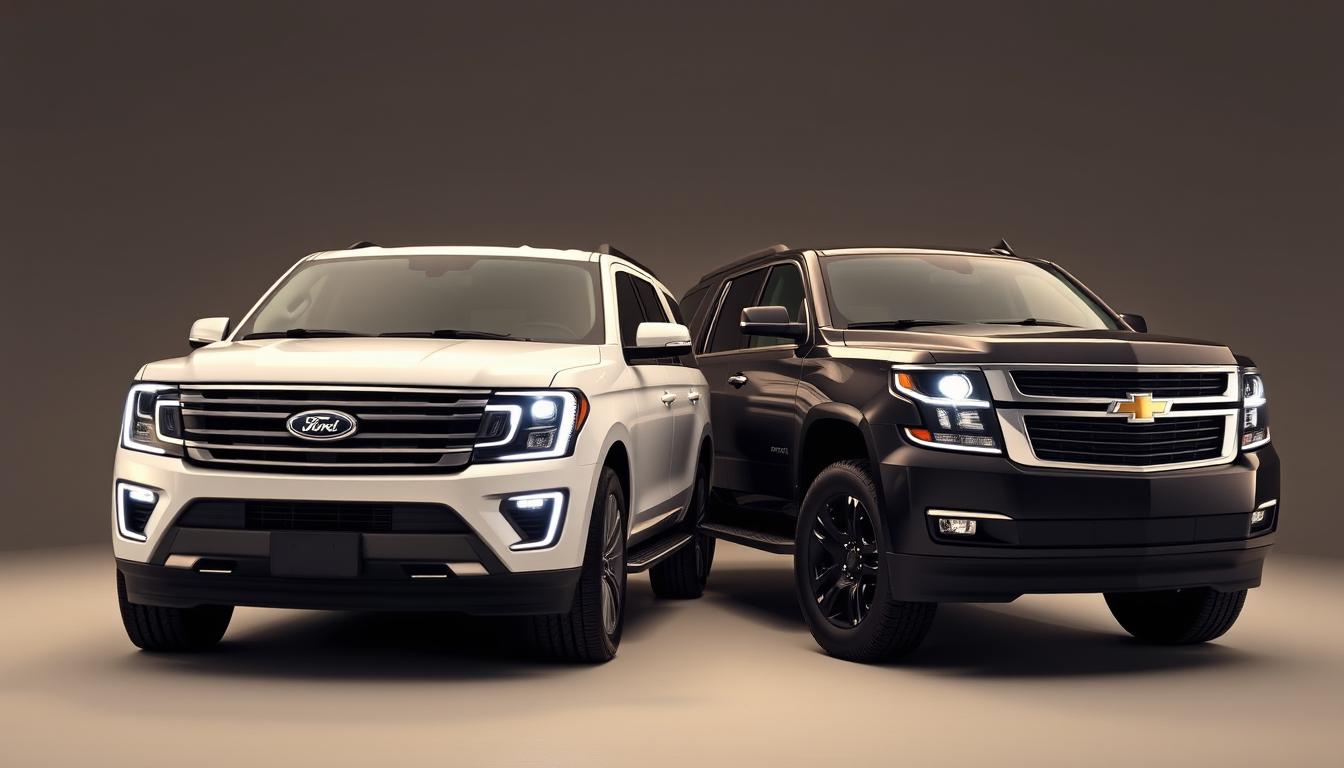
This section gives a detailed look at the Ford Expedition and Chevy Tahoe. It’s for those looking for the best full-size SUV for family needs, towing, or long trips. We aim to provide an honest comparison of their features, including performance, towing, fuel economy, and more.
Readers will find clear, reliable information from 2021–2025 model years. This includes EPA estimates, manufacturer specs, and NHTSA ratings. Our explanations are easy to understand, with examples that show how these differences affect daily use and towing.
Use this comparison to quickly find the right SUV for you. Each section focuses on a key area, like powertrains, towing, and safety. This helps buyers choose based on their specific needs, such as family space, payload, or towing capacity.
Overview of the Ford Expedition vs Chevy Tahoe full-size SUV comparison
This comparison looks at two top full-size SUVs. It helps shoppers understand the differences in space, towing, fuel, and recent updates. We cover models from 2021 to 2025, so you can see what’s new and why it’s important.
Why compare these two SUVs?
The Ford Expedition and Chevy Tahoe are great for families and those who need to tow. They offer similar features like towing capacity and tech. But, they differ in engine options, interior design, and daily tech use.
Who this comparison is for?
For families, this review focuses on seat comfort and cargo space. Tow owners will find useful towing ratings and hitch details. Road-trippers will appreciate fuel economy, ride quality, and tech for long trips.
Model years highlighted and relevance
We focus on 2021–2025 models to show changes over time. The 2023 to 2025 updates include new designs and tech for Ford. Chevy’s updates are smaller but affect trim levels and features. We use recent EPA and tow figures for accurate comparisons.
| Focus Area | Ford Expedition (2021–2025) | Chevy Tahoe (2021–2025) |
|---|---|---|
| Primary audience | Large families, heavy tow owners, tech-focused buyers | Families, light-to-moderate tow owners, value-oriented buyers |
| Notable 2025 updates | Exterior refresh, two-piece tailgate, larger displays | Minor styling tweaks, updated trim options |
| EPA figures (approx.) | ~17 city / 23 hwy for comparable years | ~14 city / 20 hwy for comparable years |
| Towing relevance | Higher max trailer ratings on properly equipped models | Strong towing, but generally lower max ratings than Expedition |
| Who benefits most | Tow-focused buyers and those needing third-row room | Buyers seeking familiar V8 feel and value trims |
| Search intent match | ford expedition vs chevy tahoe; best full-size SUV | SUV comparison; 2021 models; 2025 updates |
Performance review and engine options
It looks at how engines affect daily driving and towing. It compares the Ford Expedition and Chevy Tahoe, focusing on engine specs and off-road capabilities. This makes it easy to see the differences.
Ford’s main engine is the 3.5L EcoBoost twin‑turbo V6. Its power varies by year and trim, but most are around 380–400 hp. Some trims and the High‑Output version reach about 440 hp and 510 lb‑ft of torque. This engine works with a 10‑speed automatic, providing strong midrange power while being lighter than V8s.
Chevrolet, on the other hand, offers V8s and a diesel. The 5.3L V8 is common, with about 355 hp in recent years. The 6.2L V8 is for top trims, with near 420 hp. The 3.0L Duramax diesel is for those who need efficient towing, with 277 hp but lots of torque. Most engines pair with a 10‑speed automatic.
Transmission and drivetrain setups are key for real-world use. Both SUVs start with rear‑wheel drive and offer four‑wheel drive options. The Expedition Timberline often has intelligent 4WD and Terrain Management. The Tahoe Z71 has standard 4WD and off-road tuning, with the option for Four‑Corner Air Ride Adaptive Suspension.
The choice between engines affects how the SUVs perform. The turbocharged 3.5L EcoBoost gives high peak torque and horsepower for many Expedition trims, but is more fuel efficient under light load. Chevy’s V8s offer familiar power and towing strength. The Duramax diesel is great for steady towing, even with lower peak horsepower.
- Powertrain pairing: both use 10‑speed automatics for smooth shifts and gear-span flexibility.
- Off-road trims: Timberline (Expedition) emphasizes terrain modes and torque; Z71 (Tahoe) focuses on suspension and protection.
- Everyday tradeoffs: turbo V6s for efficiency and punch, V8s for linear power delivery, diesel for torque economy on long hauls.
Towing capacity and trailering features
Trailering is more than just power. Drivers need clear tow ratings, useful trailering features, and help when hitching and reversing. It compares the Ford Expedition and Chevy Tahoe on these points. It also highlights tech that keeps trailers safe and aligned.
Expedition towing ratings vary by year and equipment. Many earlier models can tow up to 9,300 pounds. The 2025 models can tow up to 9,600 pounds with the right equipment. Ford also offers tools designed for trailering tasks.
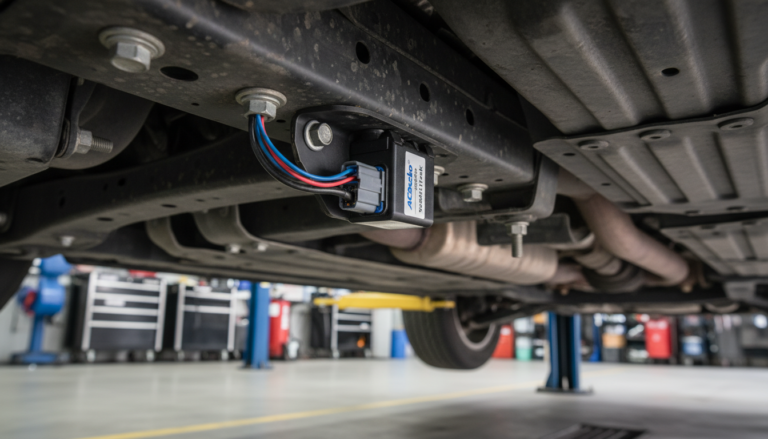
Expedition has key trailer tech like Pro Trailer Backup Assist and a 360-degree camera. Pro Trailer Backup Assist lets drivers steer the trailer with a knob. The camera and guidance lines help align the trailer quickly and easily.
Tahoe towing capability depends on engine and package choices. Some configurations can tow near 7,900 pounds. The 2025 Tahoe can tow up to 8,400 pounds with the right setup. This range covers most boat and camper needs, but it’s lower than the Expedition’s top numbers.
Chevrolet Tahoe comes with towing aids and up to 13 camera views. These cameras improve visibility when backing trailers and checking load ties. Super Cruise helps with hands-free driving on mapped roads, but it doesn’t have a dedicated trailer backup function like Pro Trailer Backup Assist.
Towing safety starts before you start the engine. It’s important to check if your vehicle and trailer are compatible. You also need to choose the right hitch and ensure proper load distribution. Remember, payload, passengers, and cargo reduce the towing capacity, so calculate tongue weight and total load before you go.
Practical differences are important. Expedition’s higher maximum tow capacity makes it better for heavy boats and large trailers. Tahoe’s trailering features and camera suite are great for safe handling of mid-weight trailers and everyday towing tasks.
| Category | Ford Expedition | Chevy Tahoe |
|---|---|---|
| Max towing capacity (typical high end) | Up to 9,300–9,600 lbs depending on year and equipment | Approximately 7,900–8,400 lbs depending on configuration |
| Trailer-assist technology | Pro Trailer Backup Assist; 360° camera with Trailer Reverse Guidance | Advanced camera views (up to 13); trailer-specific guidelines via camera overlays |
| Highway assist | Adaptive cruise and lane tech; not trailer-specific for hands-free highway towing | Super Cruise for hands-free driving on mapped roads; not a trailer backup assistant |
| Towing safety aids | Guided trailer reversing, trailer sway control, integrated hitch guidance | Camera angles for hitching, sway control, trailer brake controls |
| Best use case | Heavier trailers, large boats, frequent heavy towing | Mid-weight trailers, family boats, occasional towing with strong camera support |
Fuel efficiency and running costs
Filling up the tank shows the real-world impact of fuel efficiency. Looking at highway, city, and combined numbers helps set realistic expectations. When comparing the Ford Expedition and Chevy Tahoe, the choice of powertrain and driving habits matter.
EPA estimates are a baseline for planning fuel spending. The Ford Expedition has EPA estimates near 17 city / 23 highway mpg. The Chevrolet Tahoe with V8 engines is rated closer to 14 city / 20 highway mpg.
Engine and drivetrain choices affect these numbers. The Expedition’s turbocharged V6 tends to yield better fuel economy. Opting for four-wheel drive reduces mpg for both SUVs. A diesel Tahoe can improve highway mpg and torque for towing, but may trade off peak horsepower and raise initial purchase cost.
Towing makes a big difference in running costs. Pulling heavy trailers lowers mpg sharply and raises wear on brakes, transmission, and cooling systems. Drivers who tow regularly should factor in extra fuel consumption and scheduled service for drivetrain components.
Ownership costs go beyond fuel. Higher trims add air suspension, advanced electronics, and towing packages that raise repair and replacement costs. Resale value can offset some expenses, but higher-spec models often produce greater long-term maintenance spend.
| Metric | Ford Expedition (typical) | Chevy Tahoe (typical V8) |
|---|---|---|
| EPA estimates (city/highway) | 17 / 23 mpg | 14 / 20 mpg |
| Real-world highway (cruise) | 20–24 mpg depending on load | 17–21 mpg depending on load |
| Effect of 4WD | Drop of ~1–2 mpg | Drop of ~1–3 mpg |
| Diesel option impact | Not typical | Better highway mpg, higher torque, lower peak HP |
| Fuel cost for 15,000 mi/yr (estimate) | Lower than Tahoe by several hundred dollars | Higher by several hundred dollars due to V8 use |
| Maintenance & ownership costs | Higher with advanced tech and heavy towing | Higher fuel and brake/drive component wear when towing |
When comparing the Ford Expedition and Chevy Tahoe, match the powertrain to your needs. Choose the turbo V6 Expedition for better fuel efficiency in mixed driving. Pick the Tahoe V8 or diesel if towing torque or specific GM features are essential, while accounting for higher ownership costs and fuel use.
Interior space comparison and seating comfort
The Ford Expedition vs Chevy Tahoe battle is not just about engines and towing. It’s also about interior space for families, long trips, and carrying gear. This section compares cargo volume, legroom, and seating options to see which SUV fits your needs better.
The Tahoe claims more maximum cargo volume due to its longer body. It can hold up to 122.9 cubic feet when the second-row seats are folded. The Expedition also offers usable cargo space, ranging from 20.9 to 63.6 cubic feet, depending on the seat configuration. It’s noted for its flexible storage and higher roof, making it easier to load bulky items.
Legroom and passenger comfort
The Expedition has more third-row legroom, with about 36.5 inches. This is compared to the Tahoe’s roughly 34.9 inches. This difference is important for adults on long trips.
On the other hand, the Tahoe offers more front and second-row legroom. The front row has about 44.5 inches, and the second row has near 42.0 inches. This is more than the Expedition’s 43.9 and 41.5 inches in some comparisons. Your choice depends on who rides where most often.
Seating configurations and third-row usability
Both SUVs can seat seven or eight people. You can choose second-row captain’s chairs for a seven-passenger setup or a bench for eight. Power-folding rear seats are available on various trims of both brands, making it easier to switch between cargo and passengers. Higher Expedition trims offer reclining and power-folding third-row features for better comfort.
| Category | Ford Expedition | Chevy Tahoe |
|---|---|---|
| Cargo volume (seats up) | About 20.9 cu ft (varies by model) | About 25.5 cu ft |
| Cargo volume (max) | Up to ~122.9 cu ft in some configurations; noted flexibility | Up to 122.9 cu ft; generally larger max due to length |
| Third-row legroom | ~36.5 in | ~34.9 in |
| Front-row legroom | ~43.9 in | ~44.5 in |
| Second-row legroom | ~41.5 in | ~42.0 in |
| Seating options | 7–8 passengers; captain’s chairs; power-folding third row | 7–8 passengers; captain’s chairs; power-folding rear seats |
| Practical note | Better third-row comfort and usable cargo layouts | More max cargo when rear seats stowed; slightly more front/second-row legroom |
When choosing between the Expedition and Tahoe, consider who rides in the third row and how you use the interior. The Expedition is better for adult third-row passengers and flexible interior use. The Tahoe offers more cargo space when the rear seats are folded and slightly more legroom in the front and second rows. This comparison helps you choose based on your needs, not just the brand.
Technology, infotainment, and convenience features
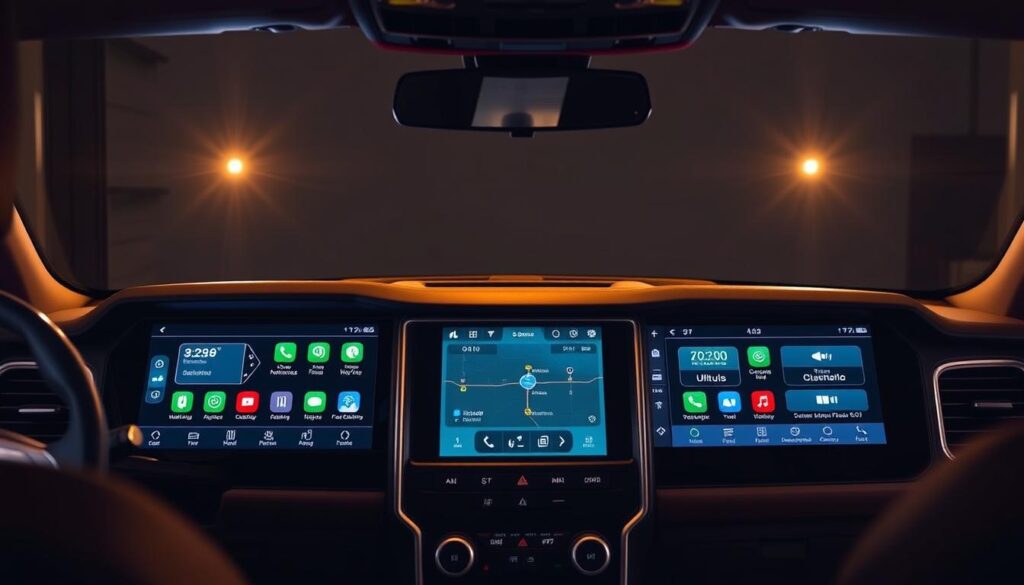
The tech battle between the Ford Expedition and Chevy Tahoe takes two paths. Ford focuses on big digital screens and top-notch sound systems. Chevy, on the other hand, offers bigger center touchscreens and hands-free driving on some models. It helps you understand the differences in screens, audio, driver aids, and connectivity.
Ford touchscreen and audio
Ford SYNC 4 is standard in many Expeditions. Lower trims have a 12-inch center screen. Upper trims might get a 24-inch digital cluster and a 13.2-inch center screen in refreshed models.
B&O audio is an upgrade option. The Bang & Olufsen Unleashed system can have up to 22 speakers. There are also rear-seat entertainment options with dual-headrest screens and Amazon Fire TV support.
Chevrolet screen and Super Cruise
Chevy starts with an 8-inch screen on base models. LT and above get a 10.2-inch Chevrolet Infotainment 3 Premium with Google built-in. Some 2025 Tahoes have a 17.7-inch center display and an 11-inch instrument cluster.
Super Cruise is optional on Premier and High Country trims. It allows hands-free driving on mapped highways. Tahoe models often include up to 13 camera views and rear-seat dual 12.6-inch screens or Bose 10-speaker audio.
Connectivity and device support
Expedition supports FordPass Connect Wi-Fi for up to 10 devices. It has multiple USB ports, with some trims having four or more. Wireless Apple CarPlay and Android Auto are usually available.
Tahoe includes six USB ports in many trims and offers a Wi-Fi hotspot. It also has remote start and robust camera systems for families and towing users.
Practical convenience comparison
Expedition focuses on bold instrument displays and premium audio. Tahoe highlights a larger center touchscreen on select trims and Super Cruise for hands-free driving. Camera coverage, rear entertainment, and USB counts vary by trim, so buyers should check specific packages.
| Feature | Ford Expedition | Chevy Tahoe |
|---|---|---|
| Base center screen | 12-inch (SYNC 4) | 8-inch (Infotainment 3) |
| Top center screen | 13.2-inch (with 24-inch cluster on some trims) | 17.7-inch (on select 2025 trims) |
| Instrument cluster | Up to 24-inch panoramic digital cluster | Up to 11-inch digital cluster |
| Premium audio | B&O audio up to 22 speakers | Bose 10-speaker available |
| Rear entertainment | Dual-headrest Amazon Fire TV option | Dual 12.6-inch rear screens on select trims |
| Hands-free driving | Next-gen hands-free features with SYNC | Super Cruise available on Premier/High Country |
| USB ports | Multiple, up to four+ depending on trim | Commonly six ports standard |
| Wi-Fi hotspot | FordPass Connect, up to 10 devices | Available hotspot, varies by trim |
Use this comparison to decide on screens, audio, and driver-assist features. Choose the best tech for you when picking between the Ford Expedition and Chevy Tahoe.
Safety, driver assistance, and ratings
The Ford Expedition and Chevrolet Tahoe both have advanced safety features. It’s important to look at crash scores and the tech they offer. This includes systems for towing and driving on highways.
The 2023 Ford Expedition got a top five-star NHTSA rating. The 2023 Chevrolet Tahoe scored a four-star NHTSA rating. These ratings show how well each SUV performs in crashes and rollovers.
Both SUVs come with lots of standard safety features. The Expedition has Ford CoPilot360, which includes Auto High-Beam Headlamps and Automatic Emergency Braking. It also has a Lane-Keeping System and BLIS with Cross-Traffic Alert.
The Tahoe has Chevy Safety Assist, which includes Automatic Emergency Braking and Forward Collision Alert. It also has Lane Keep Assist and IntelliBeam high-beam assist. Teen Driver technology is available too.
Both SUVs offer advanced features for complex tasks. The Expedition has Pro Trailer Backup Assist 2.0 and a 360-degree camera. These features make towing easier.
The Tahoe offers Super Cruise for hands-free driving on highways. It also has up to 13 camera views and Four-Corner Air Ride Adaptive Suspension. This suspension helps with ground clearance but changes how the SUV handles.
When choosing between the Expedition and Tahoe, think about your needs. The Expedition is better for towing, thanks to its top NHTSA rating and trailer-specific features. The Tahoe is great for long drives with its Super Cruise feature.
When comparing the Ford Expedition and Chevrolet Tahoe, look at crash scores and standard safety features. Also, consider the optional tech that fits your driving style. This will help you make a smart choice.
Pricing, trims, and value proposition
When comparing msrp and features, there are clear differences between the Tahoe and Expedition. The Tahoe starts at around $62,995, while the Expedition begins at $57,625. Prices can change based on options, packages, and location. This section explores pricing, trim levels, and factors that affect long-term value.
Starting MSRPs and quick notes
The Tahoe starts higher with a standard V8 engine. The Expedition, on the other hand, offers strong twin-turbo V6 power and towing capacity at a lower price. The initial price can influence choices before adding options and destination fees.
Trim-level highlights
Ford offers trims for utility and luxury. The Expedition has trims like Active (400 hp, cloth seats), Tremor (off-road features), King Ranch (Del Rio leather), and Platinum (multi-contour seats).
Chevrolet’s Tahoe starts with LS (355-hp V8), LT (upgraded comfort), RST (sporty looks), Z71 (off-road gear), Premier (premium audio), and High Country (top-tier features).
Trim-by-trim value comparison
When comparing features, the Expedition often offers modern tech and towing tech at lower prices. The Tahoe focuses on traditional V8 performance and luxury at higher prices. Off-road enthusiasts can choose between Tremor and Z71 based on their needs.
- Entry trims: Expedition offers tech at lower cost. Tahoe starts with V8 power.
- Mid trims: Leather, upgraded audio, and comfort options increase prices for both brands.
- Top trims: Platinum and High Country add luxury, justifying higher prices for comfort.
Resale, ratings, and owner satisfaction
Resale values depend on trim, options, and use. Heavy towing can reduce resale value. User ratings show Tahoe owners are generally happier, with TrueCar averages near 4.91/5 compared to Expedition’s 4.52/5. These ratings reflect happiness but don’t replace mechanic inspections for used cars.
Practical value comparison tips
- Identify must-have features and match trims to avoid overpaying.
- Consider towing needs. Expedition’s higher towing ratings can offer better value for frequent towing.
- Check resale trends for specific trims. Some specialty trims retain value better.
Pricing and trim choices are key to value. Buyers should match trim levels and options to their needs for the best value comparison between the Ford Expedition and Chevy Tahoe.
Conclusion
The debate between the Ford Expedition and the Chevy Tahoe comes down to what you value most. The Ford Expedition has stronger power from its 3.5L EcoBoost engine. It also has a higher towing capacity and more legroom in the third row.
This makes it great for those who need to tow, want family comfort, and want good fuel economy. The Chevy Tahoe, on the other hand, offers different engine options. It also has a bigger size, which means more room for cargo when the seats are folded.
The Tahoe also has advanced features like Super Cruise and lots of cameras. These appeal to those who want a traditional V8 feel or hands-free driving. It also has luxury trims that some buyers might prefer.
When deciding on the best full-size SUV, consider what you need. Choose the Expedition for towing, comfort, and fuel efficiency. Pick the Tahoe for V8 or diesel engines, more cargo space, or Super Cruise.
Remember, always check the tow ratings and payload for the exact model you’re interested in. Test drive both SUVs in the trims you’re considering before making a decision. This comparison should help guide you, but don’t forget to try them out yourself.
FAQ
Which SUV to choose for maximum towing — Ford Expedition or Chevy Tahoe?
The Ford Expedition can tow up to 9,300–9,600 lbs when equipped right. This makes it better for heavy trailers and boats. The Tahoe can tow about 7,900–8,400 lbs, depending on the engine and equipment. If you need the highest towing capacity, the Expedition is the better choice.
How do fuel economy and running costs compare between the two?
The Expedition’s turbocharged 3.5L EcoBoost V6 gets better fuel economy. It averages around 17 city / 23 highway mpg. In comparison, the Tahoe V8s get about 14 city / 20 highway mpg.
The Tahoe diesel improves highway MPG and torque for towing. But, V8 Tahoes will cost more in fuel for daily driving and heavy towing.
Which vehicle offers more interior space and third-row comfort?
The Expedition has more comfortable third-row legroom, about 36.5 inches. The Tahoe has 34.9 inches in 2025 figures. The Expedition also offers more flexible cargo layouts.
The Tahoe has a larger maximum cargo volume with rear seats stowed. It’s up to about 122.9 cu ft in some configurations. Choose Expedition for third-row comfort; choose Tahoe for max cargo with seats folded.
What are the key performance and engine differences?
Ford uses a 3.5L EcoBoost twin-turbo V6 across the range. It has base around 380–400 hp and High-Output up to ~440 hp and 510 lb-ft. Chevrolet offers a 5.3L V8 (~355 hp), optional 6.2L V8 (~420 hp), and a 3.0L Duramax diesel (~277 hp).
Both use 10-speed automatics and offer RWD standard with optional 4WD. The choice depends on whether you prefer turbo V6 efficiency or V8 character and diesel torque for towing.
How do technology and driver-assist features compare for towing and highway driving?
Ford equips Expeditions with SYNC 4 and large digital displays. The refreshed 2025 models have 12-inch standard and 24-inch options. They also have trailer-focused aids like Pro Trailer Backup Assist and 360-degree Trailer Reverse Guidance.
The Tahoe offers strong infotainment, up to 17.7-inch center screen on some trims. It also has extensive camera views, up to 13, and available Super Cruise for hands-free driving on mapped highways. Expedition’s trailer guidance tools are more specialized; Tahoe’s Super Cruise is a unique advantage for hands-free highway driving.
Are there notable safety rating differences between the two?
Yes—NHTSA ratings for 2023 show the Expedition with an overall five-star rating. The Tahoe has an overall four-star rating. Both have active safety suites as standard (Ford Co-Pilot360 vs Chevy Safety Assist).
They offer advanced features like adaptive cruise, lane-keep, and expansive camera systems. Expedition’s trailer-focused safety aids and higher NHTSA score give it an edge for towing and occupant protection in cited model years.
Which trims and options are best for off-road or heavy-duty use?
Ford’s Tremor and Timberline trims add off-road hardware. They include e-locker options and specialized driveline tuning. Timberline often includes the High-Output EcoBoost on some model years.
Chevrolet’s Z71 brings off-road suspension, skid plates, and recovery hooks. Tahoe also offers Four-Corner Air Ride Adaptive Suspension (available) for better ground clearance and loading. For serious off-road towing and trail use, choose Tremor/Timberline on Expedition or Z71 on Tahoe depending on desired engine and accessory fitment.