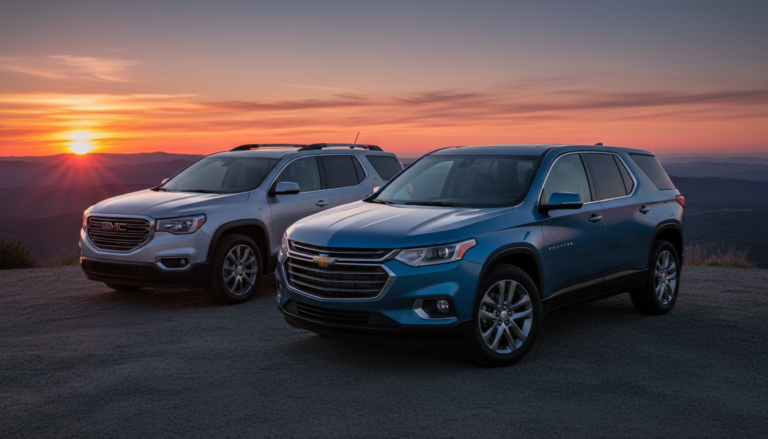
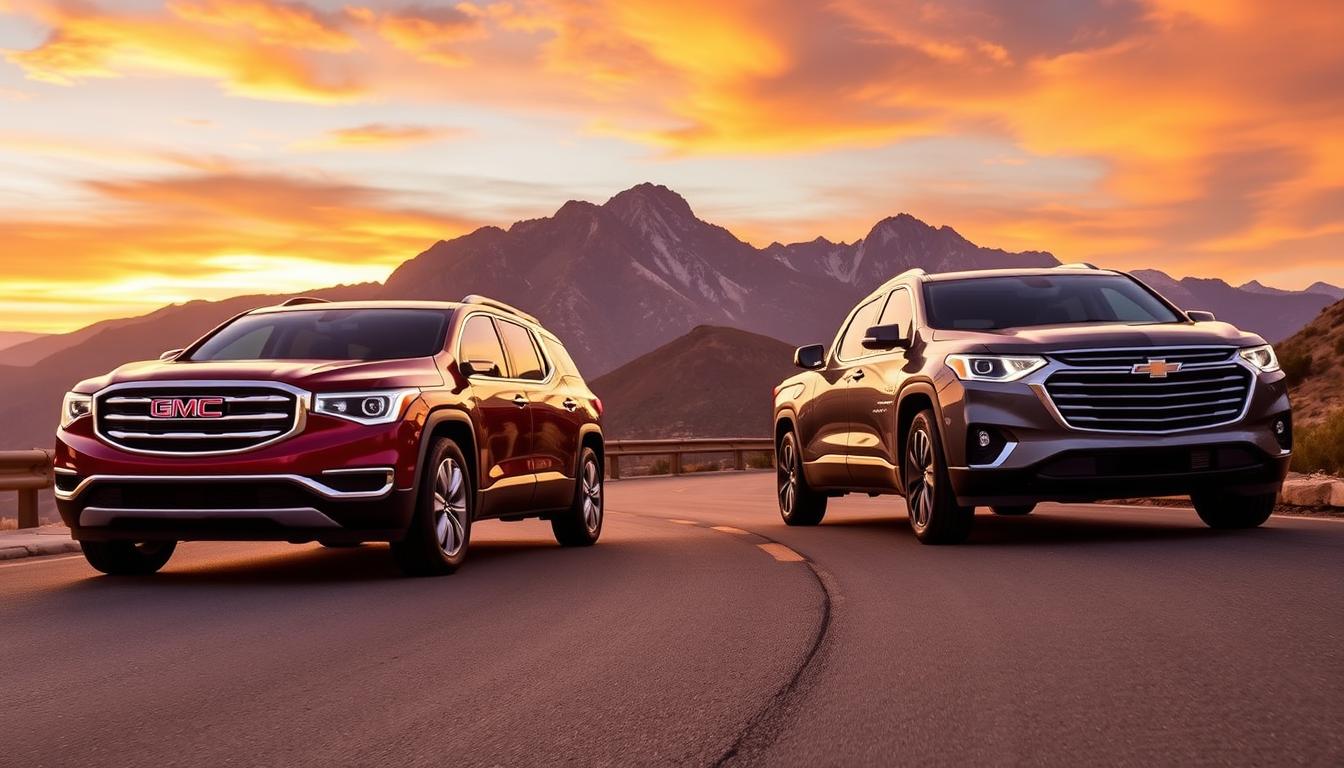
GMC Acadia vs Chevy Traverse: SUV Showdown
Compares the GMC Acadia and Chevy Traverse head-to-head. It focuses on what U.S. buyers look for in a midsize, three-row SUV. The goal is to make the differences clear and help you choose the best vehicle for your needs.
It covers important areas like seating, cargo space, engine options, price, and tech features. You’ll also learn about safety, fuel efficiency, towing, and how well these SUVs hold their value. Each section offers easy-to-understand information and comparisons based on Chevrolet and GMC specs.
You’ll find concise explanations, examples, and direct advice. This will help you decide if the Acadia’s luxury or the Traverse’s spaciousness is better for you.
Overview of the GMC Acadia and Chevy Traverse midsize SUVs
The GMC Acadia and Chevrolet Traverse are in the midsize three-row SUVs market. They aim at families needing space, cargo room, and reliable service. This overview prepares you for the detailed comparison that follows.
Both models use a GM midsize platform and share many parts. This common platform cuts costs and provides a solid base. Yet, each brand caters to different buyers with unique styling, trim options, and features.
Market positioning and target buyers
GMC targets the Acadia at those wanting luxury at a lower price. It offers upscale touches and extra tech on lower trims. Chevrolet, on the other hand, focuses the Traverse on value and space for big families.
Platform commonality and brand distinctions
The Acadia and Traverse share many mechanical parts. But, they differ in trim levels and powertrain options. GMC has sub-brands like Denali and AT4 for luxury and off-road. Chevrolet has a broader range that emphasizes value and space.
Quick comparison snapshot (seating, cargo, engine highlights)
| Attribute | GMC Acadia | Chevrolet Traverse |
|---|---|---|
| Seating capacity | Up to 7 passengers | Up to 8 passengers |
| Maximum cargo (approx.) | About 79.0 cu ft | About 97–98.2 cu ft |
| Common engines | 2.5L I4 (base), 2.0L turbo I4, optional 3.6L V6 | Predominantly 3.6L V6 (~310–328 hp) |
| Trim focus | Premium touches, Denali luxury, AT4 rugged | Spacious family trims, RS sport, High Country top trim |
| Buyer appeal | Buyers seeking refinement and varied powertrain choices | Buyers prioritizing interior volume and seating flexibility |
These points help understand the GMC Acadia and Chevy Traverse comparison. The discussion on size and seating will be key, as these factors are critical for families in the midsize SUV market.
GMC Acadia vs Chevy traverse: pricing and value comparison
The GMC Acadia and Chevrolet Traverse have different prices for a reason. The Traverse starts at around $30,995 to $38,995 for its base models. These models come with a V6 engine and can seat eight people. The Acadia, on the other hand, starts at about $43,995. It offers less seating and smaller engines but comes with more standard features and luxury finishes.
When it comes to value, the choice depends on what you need. The Traverse L or LT offers a lot of space and a strong V6 engine at a lower price. The Acadia SLE or SLT, though pricier, comes with more tech and materials right off the bat.
At the top end, both models enter the luxury market. The Acadia Denali can cost over $60,000 fully loaded. The Traverse High Country and RS can also go over $57,000 with all the extras. Denali focuses on premium materials and chrome, while High Country emphasizes comfort and features. RS is all about sporty looks and upgrades.
Deals and promotions can make a big difference in the price you pay. Local offers, financing specials, and when you buy can all affect the final cost. Both vehicles share GM parts, making maintenance and repairs similar, which impacts long-term costs.
Looking at resale value, the Acadia holds about 55.81% of its original price after five years. The Traverse retains about 54.71%. This gives the Acadia a slight edge in resale value. The Acadia also scores slightly better in reliability, making it a better choice for long-term ownership.
Consider these points when deciding between the two. If you’re looking for a good deal upfront and lots of space, the Traverse might be the better choice. But if you want more standard features and a slight edge in resale, the Acadia is worth considering.
| Item | Chevrolet Traverse | GMC Acadia |
|---|---|---|
| Reported starting price (base trim) | $30,995–$38,995 | ~$43,995 |
| Common base powertrain | 3.6L V6 (eight seats) | Turbocharged four-cylinder or optional engines (seven seats common) |
| Top-trim range | Mid $50ks to $60k+ (High Country/RS) | $57k+ to $65k+ (Denali) |
| Primary value pitch | Space and V6 performance at lower entry cost | Higher standard equipment and upscale finishing |
| Estimated 5-year resale | ~54.71% | ~55.81% |
| Reliability/long-term score | ~8.2/10 | ~8.4/10 |
| Ownership cost notes | Lower initial price, similar maintenance; insurance varies by trim | Higher base cost, slightly better resale; parts commonality eases service |
Vehicle specs and powertrain options
It compares engines, transmissions, towing ratings, and roles for buyers. It aims to help pick the right powertrain for their needs. Technical terms are explained in simple language when needed.
Engine choices: Acadia’s multiple engines vs Traverse’s single 3.6L V6
The Acadia offers several engines across its trims. The base model uses a 2.5L four-cylinder with about 193 hp. Mid trims might have a 2.0L turbo four with around 230 hp. Top Acadia trims include a 3.6L V6 with up to 328 hp.
The Traverse, on the other hand, has a single 3.6L V6. It usually has between 310 and 328 hp, depending on the model year.
Horsepower, transmission, and towing capacity differences
Horsepower shows the difference between Acadia and Traverse. Acadia ranges from about 193 hp to 328 hp. Traverse centers around 310 hp with the 3.6L V6.
Both SUVs often use a nine-speed automatic. This helps with smooth shifts and better highway economy.
Towing capacity varies by engine and equipment. Traverse can tow up to about 5,000 lbs with the V6 and proper package. Acadia tops out at around 4,000 lbs on most configurations. These numbers affect trailer size and heavy-load use.
How powertrain choices impact fuel economy and driving role?
Smaller engines and turbo options improve mpg in light loads. For example, a 2.0L turbo Acadia FWD gets near 22 city / 29 highway / 25 combined. The 2.5L four shows around 21/27/23.
The Acadia 3.6L V6 is near 19/27/22 (FWD) and 19/26/21 (AWD).
Traverse with its 3.6L returns roughly 18/27/21 mpg in FWD and about 17/25/20 with AWD. Choose Traverse for steady V6 power and towing confidence. Choose Acadia for better fuel economy and engine flexibility.
Read the specifications table below for direct side-by-side figures. These figures help decide between everyday commuting, family hauling, or towing work.
| Specification | GMC Acadia (typical) | Chevy Traverse (typical) |
|---|---|---|
| Available engines | 2.5L I4 (≈193 hp); 2.0L turbo I4 (≈230 hp); 3.6L V6 (up to ≈328 hp) | 3.6L V6 (≈310–328 hp) |
| Common transmission | Nine-speed automatic | Nine-speed automatic |
| Typical towing capacity | Up to ≈4,000 lbs (varies by engine/equipment) | Up to ≈5,000 lbs (with V6 and towing package) |
| FWD city/highway/combined mpg (example) | 2.0L turbo: 22/29/25; 2.5L: 21/27/23; 3.6L: 19/27/22 | 3.6L V6: 18/27/21 |
| AWD city/highway/combined mpg (example) | 3.6L AWD: 19/26/21 | 3.6L AWD: 17/25/20 |
| Best use case | Fuel-conscious buyers who want engine choice and balanced performance | Buyers who want consistent V6 power and stronger towing capability |
| Relevant comparison keyword | gmc acadia comparison chevy traverse specs | gmc acadia vs chevy traverse performance |
For shoppers focused on engines or towing, weigh Acadia’s variety against Traverse’s single V6. Use real-world mpg and towing needs to pick the right trim and drivetrain for daily life.
Exterior design and dimensions comparison
The GMC Acadia and Chevrolet Traverse have different looks. The Acadia has a bold, truck-like design with a big grille. It also has clean lines and chrome accents on the Denali trim.
The Traverse, on the other hand, focuses on family needs. It’s longer and wider, giving it a practical look. This design helps it carry more people and stuff.
Looking at size, the Traverse is about 204–206 inches long and 79.5 inches wide. The Acadia varies, being 193–204 inches long and 75–79 inches wide. Both have similar heights, around 67–71 inches, depending on the trim.
Size matters for comfort. The Traverse has more room for legs and cargo. But the Acadia is easier to park in tight spots.
Each trim has its own look. The Acadia AT4 is rugged with off-road tires. The Denali is all about luxury with chrome and fancy finishes. The Traverse RS is sporty with dark trim and aggressive front.
| Metric | GMC Acadia (typical range) | Chevrolet Traverse (typical range) |
|---|---|---|
| Overall length (in) | 193–204 | 204–206 |
| Overall width (in) | 75–79 | 79.5 |
| Overall height (in) | 67–71 | 69.6–71 |
| Third-row room | Moderate; tighter for adults | Roomier; better for adults |
| Cargo behind third row (cu ft) | Smaller max cargo | Larger max cargo |
| Trim visual highlights | Denali chrome, AT4 rugged elements | RS sport fascia, dark accents |
When comparing the GMC Acadia and Chevrolet Traverse, think about what you need. Choose a trim and size that fits your life. Whether it’s the Denali’s luxury, the AT4’s off-road look, or the RS’s sportiness.
Interior comfort, seating capacity, and cargo versatility
The cabin layout is key for families and drivers. This comparison looks at seating, cargo space, and interior materials and tech. It shows how each SUV balances comfort and practicality.
Seating layouts and passenger comfort
The Chevrolet Traverse seats up to eight people. It’s great for families and carpools. The rear seats are roomy in real life.
The GMC Acadia seats seven with captain’s chairs. This makes it more premium but loses one seat. You can choose a bench for more space, but it’s less comfortable.
Cargo space behind each row and maximum load
The Traverse has more cargo space, near 97–98.2 cubic feet. The Acadia has about 79.0 cubic feet. The Traverse is better for big loads.
Behind the third row, both are close. The Acadia has about 23.0 cu ft and the Traverse about 22.9 cu ft. The Traverse is better for cargo, but the Acadia has clever storage.
Materials, tech layout, and perceived luxury
The Acadia Denali has upgraded surfaces and premium upholstery. It has wood- or metal-look trim and firmer seats. It feels more luxurious.
Traverse cabins are spacious and practical. Higher trims have leather and comfort packages. Both have useful storage and family-friendly features.
Below is a compact comparison showing key interior points and features to weigh when choosing between the two models.
| Aspect | GMC Acadia (typical) | Chevrolet Traverse (typical) |
|---|---|---|
| Seating capacity | 7 standard (captain’s chairs available) | Up to 8 with three full-size rows |
| Cargo, max (cu ft) | About 79.0 cu ft | About 97–98.2 cu ft |
| Cargo behind 3rd row (cu ft) | Approx. 23.0 cu ft | Approx. 22.9 cu ft |
| Second-row room | Competitive, often roomy with captain’s chairs | Very roomy, favors overall cargo and passenger space |
| Materials and trim | Denali trim emphasizes premium finishes and Acadia Denali interior upgrades | Higher trims offer leather and comfort packs; more utilitarian base trims |
| Tech and layout | Driver-focused dash, premium options on Denali | Large screen options on select trims, family-friendly controls |
| Best for | Buyers wanting a premium-feeling midsize SUV and passenger comfort | Families needing maximum seating and larger cargo capacity |
When choosing between the GMC Acadia and the Chevrolet Traverse, consider your needs. Think about how often you use the third row and how much cargo you carry. The Acadia Denali interior upgrades are worth noticing during a test drive.
Technology, infotainment, and convenience features
The GMC Acadia and Chevrolet Traverse are packed with modern tech for families and tech lovers. They share some systems but differ in screens, driver info, and extra comforts. It’s important to choose what fits your daily needs best.
When comparing infotainment, the Traverse stands out with its large screens on top trims. Some models have screens up to 17.7 inches. The Acadia focuses on higher trims with a 15-inch screen and smaller ones on lower grades. Both support Apple CarPlay and Android Auto for easy phone connection.
Both SUVs offer driver displays and rear entertainment. They have digital clusters up to 11 inches for speed, navigation, and alerts. Higher trims include entertainment for long trips and family fun.
Comfort packages add heated and ventilated seats, Bose sound systems, navigation, and climate control. These are available on mid- and upper-level trims. They let you customize warmth, sound, and climate for everyone.
Standard equipment varies by base trim. The Acadia includes more safety features on entry models. The Traverse might need a higher trim or options to match these features.
When comparing features, look at the exact trim sheets. The Acadia’s simpler structure makes it easier to get a good base vehicle. The Traverse offers more trims for customizing tech and comfort.
Below is a compact comparison of key tech and convenience items by typical trim levels to help spot differences at a glance.
| Feature | Acadia (base to mid) | Traverse (base to mid) |
|---|---|---|
| Infotainment screen | Typically 8–15 inches; 15-inch on higher trims | 10–17.7 inches on higher trims; larger screens available |
| Apple CarPlay / Android Auto | Standard on most trims | Standard on most trims |
| Digital driver display | Up to ~11 inches on select trims | Up to ~11 inches on select trims |
| Rear entertainment | Available on upper trims or packages | Available on upper trims or packages |
| Comfort packages | Heated/ventilated seats, upgraded audio, tri-zone climate | Heated/ventilated seats, upgraded audio, tri-zone climate |
| Standard driver assists | Blind-spot monitor, rear cross-traffic alert, parking assist common | Some features reserved for LT or options; base can be lighter |
| Customization | Simpler trim ladder; easier to spec well-equipped base | Many trims for targeted options and larger screen choices |
When choosing between the GMC Acadia and Chevrolet Traverse, compare each trim’s features. Small differences can make a big difference, depending on your budget and needs.
Safety features and crash-test performance
Both SUVs have modern safety tech and good crash scores. The GMC Acadia and Chevrolet Traverse have automatic emergency braking, lane-keep assist, and forward collision warning. The Acadia often has these features on lower trims, but the Traverse might need higher trims or a special bundle.
The mix of standard driver aids affects real-world value. Blind-spot monitoring, rear cross-traffic alert, and rear parking assist are standard on more Acadia base trims. The Traverse matches these features on mid-level trims or with option packages. Buyers should compare base equipment lists closely if they prefer minimal upgrades.
NHTSA and IIHS crash-test results show both models did well. Many model years got five-star overall NHTSA ratings. IIHS crashworthiness ratings are generally “good” for multiple areas. But, frontal and headlight scores varied by trim and testing year, so check a specific model/trim when safety is key.
Family buyers should look at test scores and standard equipment. Strong NHTSA ratings and active-safety suites give parents confidence. The Acadia might win the safety debate if base-feature content is important. But, the Traverse is competitive when equipped right.
Child-seat installation and LATCH placement work well in both SUVs. Each offers modern LATCH anchors and top tethers across rear seating positions. Ease-of-use varies by seat material and layout, so hands-on verification is recommended for caregivers who install car seats often.
Advanced packages add adaptive cruise control, enhanced lane-centering, and surround-view cameras to higher trims. These systems reduce stress on long drives and tight parking. Pricing and availability differ, making trim selection important when comparing reliability and long-term ownership expectations.
| Feature | GMC Acadia (typical) | Chevy Traverse (typical) |
|---|---|---|
| Standard emergency braking | Yes | Yes |
| Blind-spot monitoring (base) | Often standard | Usually requires higher trim |
| Rear cross-traffic alert | Often standard | Available on mid trims |
| Lane-keep assist | Standard on many trims | Standard or optional by trim |
| Adaptive cruise control | Available in packages | Available in packages |
| IIHS overall ratings | Good in multiple categories | Good in multiple categories; headlights vary by trim |
| NHTSA overall rating | Five-star in cited years | Five-star in cited years; some frontal test variation |
| Child-seat/LATCH ease | Modern anchors; check in person | Modern anchors; check in person |
| Value for safety equipment | High on base trims | High when upgraded |
Performance, ride quality, and towing capability
The Acadia offers a smooth ride, perfect for city streets and suburban highways. It absorbs bumps and keeps the cabin quiet. The Traverse, on the other hand, has a firmer ride. This makes it better for high speeds and passing power.
When it comes to performance, the Acadia and Traverse have different strengths. The Acadia is more comfortable and premium. The Traverse, with its V6, has more power for long trips.
Handling is also different between the two. The Acadia is designed for comfort, with lighter steering. The Traverse is more stable and predictable, great for highways and towing.
Towing capacity is another area where they differ. The Traverse can tow up to 5,000 pounds, ideal for small boats and trailers. The Acadia can tow around 4,000 pounds, suitable for weekend trailers.
For frequent heavy towing, the Traverse is the better choice. But for occasional light towing, the Acadia is easier to handle daily.
Both models offer all-wheel drive for better traction in wet and snowy conditions. The Acadia AT4 adds features for off-road use, like all-terrain tires and hill descent control.
Below summarizes key ride and towing traits to help compare real-world use-cases and drivetrain choices.
| Attribute | GMC Acadia (typical) | Chevy Traverse (typical) |
|---|---|---|
| Ride Character | Comfort-focused, refined, quiet cabin | Stable, confident, firmer suspension feel |
| Performance Feel | Smooth acceleration, lighter steering | Stronger midrange from V6, decisive passing power |
| Max Tow Capacity | About 4,000 lbs (varies by engine/equipment) | Up to ~5,000 lbs with tow package |
| Best Towing Use-Cases | Light trailers, small boats, cargo trailers | Small campers, larger boats, heavier utility loads |
| AWD & Off-Road Options | Available; Acadia AT4 adds all-terrain tires and off-road aids | Available; improves traction but limited off-road hardware |
| Everyday Driving Pick | Drivers valuing comfort and refined road manners | Drivers needing power, space, and higher towing capacity |
Fuel economy and ownership costs
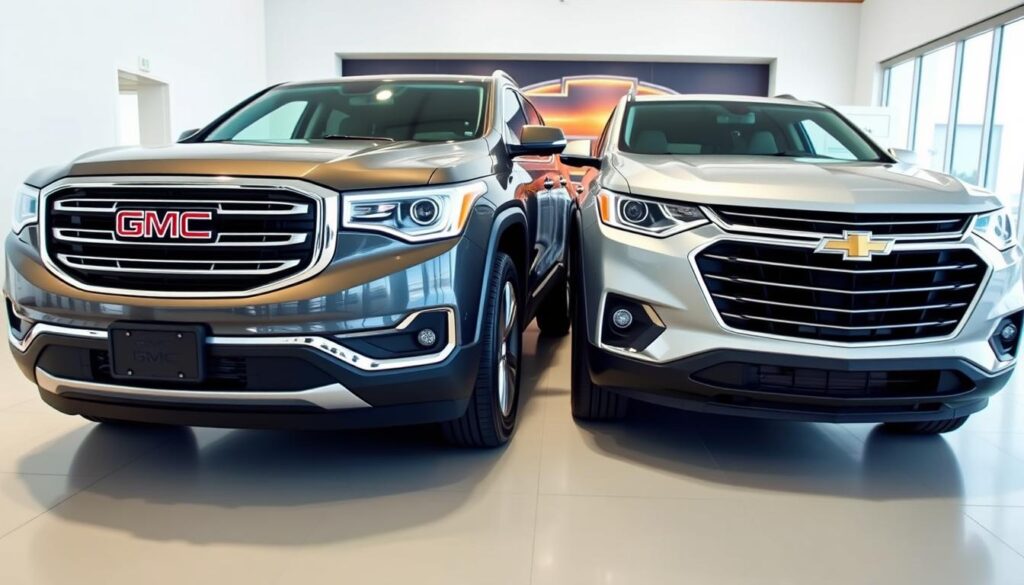
Fuel economy varies by engine and drivetrain. When comparing gmc acadia vs chevy traverse mpg, the Acadia’s smaller engines often beat the Traverse’s V6. Real-world fuel use depends on load, driving style, and AWD.
City/highway/combined mpg across common powertrains and drivetrains
| Model / Powertrain | FWD City | FWD Hwy | FWD Combined | AWD City | AWD Hwy | AWD Combined |
|---|---|---|---|---|---|---|
| Traverse 3.6L V6 | 18 | 27 | 21 | 17 | 25 | 20 |
| Acadia 2.5L 4-cyl | 21 | 27 | 23 | — | — | — |
| Acadia 2.0L turbo | 22 | 29 | 25 | 22 | 27 | 24 |
| Acadia 3.6L V6 | 19 | 27 | 22 | 19 | 26 | 21 |
Fuel tank sizes, range estimates, and real-world efficiency notes
The Traverse has a 19.4-gallon tank, good for over 500 miles on the highway. Acadia models with smaller engines are lighter and feel more efficient. But towing, heavy cargo, and city driving cut down on range.
Insurance, maintenance expectations, and predicted reliability scores
Insurance costs go up with trim level and value. Denali and High Country trims cost more than base models. Routine maintenance follows GM’s schedule, making repairs easier.
| Ownership factor | Acadia | Traverse |
|---|---|---|
| Predicted reliability score | 8.4 / 10 | 8.2 / 10 |
| Estimated 5-year retention | ~55.81% | ~54.71% |
| Maintenance profile | Typical GM midsize SUV schedule | Typical GM midsize SUV schedule |
| Insurance trend | Higher for Denali/upper trims | Higher for High Country/RS trims |
When comparing gmc acadia vs chevy traverse ownership costs, consider fuel use, insurance, and resale. Both models are reliable for long-term ownership.
Conclusion
The choice between the GMC Acadia and the Chevy Traverse comes down to what you need. The Traverse is great for those who want lots of space for people and stuff. It has a simple 3.6L V6 engine and can tow up to 5,000 pounds.
It’s also more affordable, perfect for families who need eight seats or tow trailers often.
The GMC Acadia is better for those who want luxury and different engine options. The Acadia Denali has fancy materials and more standard features. It also offers various engines for better fuel economy or quicker performance.
It’s expected to hold its value and be reliable, which is good for long-term ownership.
When buying, test drive the exact model you want. This will help you feel the engine, see how comfortable the third row is, and check the infotainment system. Look at the equipment lists and dealer offers to compare prices.
Make sure to check the headlights and LATCH system for child seats. If you need extra traction or light off-roading, consider the AWD or AT4 options.
In the end, the decision is simple. Choose the Traverse for lots of space and towing. Choose the Acadia for luxury, more engine choices, and standard features. Both are safe and capable family SUVs. Your needs will guide your choice.
FAQ
What are the main differences between the GMC Acadia and the Chevrolet Traverse?
The Traverse focuses on carrying more people and stuff, seating up to eight and having about 97–98 cu ft of cargo space. The Acadia is a bit fancier, seats seven, and has different engine options. These options balance fuel savings and power. Both SUVs share a GM platform but differ in what they offer and who they’re for.
Which SUV offers more seating and cargo space?
The Chevrolet Traverse can seat eight and has more cargo room. The Acadia seats seven and has less cargo space. But, the third row of both can have similar space.
How do the engine and performance options compare?
The Traverse has a single 3.6L V6 engine, providing strong power and better towing. The Acadia offers a 2.5L four, a 2.0L turbo four, and a 3.6L V6 on higher trims. This gives Acadia buyers more options for fuel economy, balanced performance, or V6 power.
Which model is better for towing?
The Chevrolet Traverse can tow up to about 5,000 lbs, making it better for towing heavy loads. The Acadia can tow around 4,000 lbs, which is good for lighter loads.
How do fuel economy figures differ between the two SUVs?
Fuel economy depends on the engine and drivetrain. The Acadia’s smaller engines might get better mpg than the Traverse’s V6. The Traverse’s V6 gets mid-to-high teens city and mid-to-high twenties highway mpg. Choose the Acadia for better fuel efficiency or the Traverse for consistent V6 power.
Are there significant price differences between comparable trims?
The Traverse often starts lower and comes with a V6 engine that seats eight. The Acadia has a higher base price but may include more standard safety and tech. Top trims can cost around the same, so it’s key to compare them.
Which SUV has better safety and reliability ratings?
Both SUVs do well in crash tests and offer modern safety features. The Acadia might have more standard safety features and slightly better reliability and resale value. Always check the latest IIHS and NHTSA ratings and standard features.