Small Block Chevy Firing Order
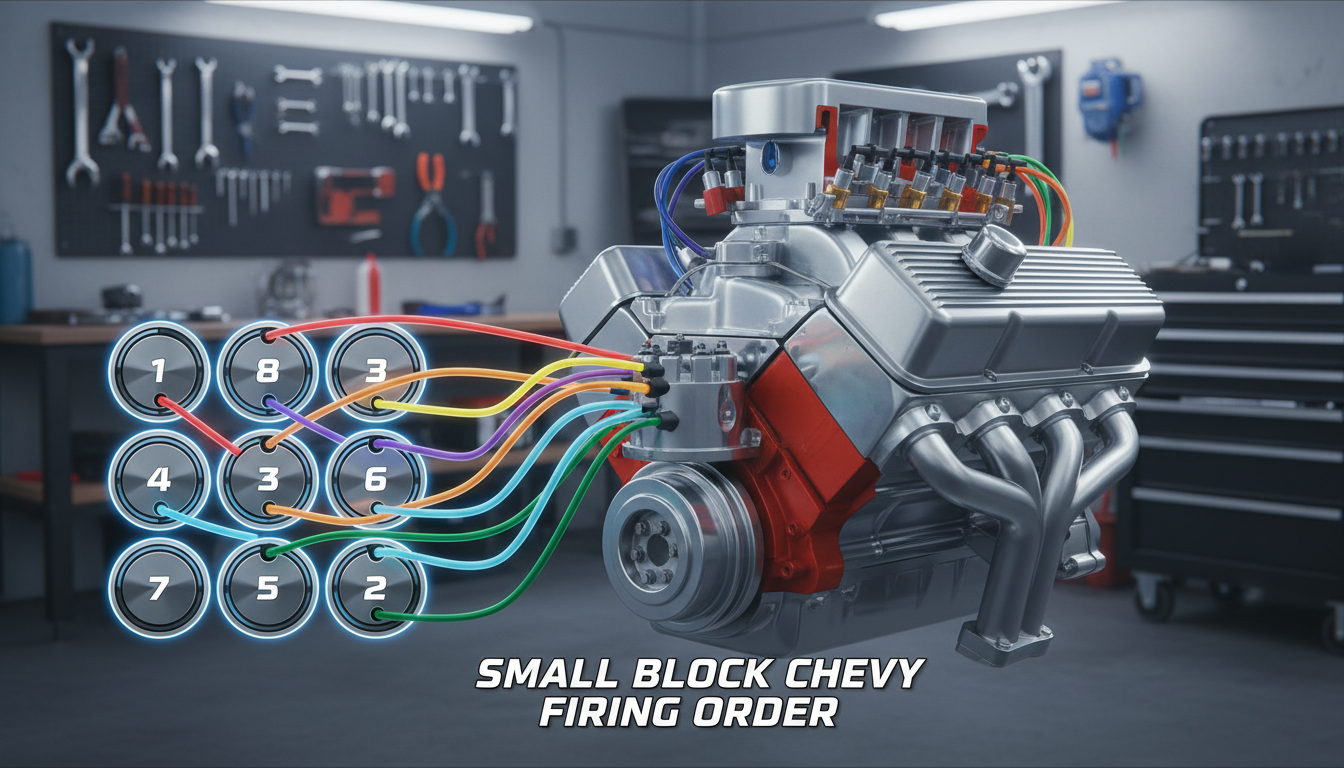
The firing sequence is simply the order the spark plugs fire to light the air/fuel mix in each cylinder. For classic SBC V8s (265/283/302/327/350/400), the correct sequence is 1-8-4-3-6-5-7-2. This guide helps a reader identify cylinder #1, find TDC on the compression stroke, and route plug wires on the distributor cap correctly.
Why it matters: a wrong routing can cause misfire, backfire, poor running, or no-start. Correct spark timing gives smooth idle, crisp throttle response, and steady drivability. This is a driveway-friendly task, but accuracy matters—an incorrect setup can stop an engine from starting.
Two big gotchas to watch: mixing up cylinder numbering (front vs back, left vs right bank) and assuming every Chevy V8 uses the same sequence. The article will cover basics first (numbering and distributor rotation), then step-by-step cap setup, followed by troubleshooting and cam-related sequence changes.
Small block chevy firing order basics: cylinders, numbering, and rotation
Identifying cylinder #1 and the crankshaft position removes guesswork from spark routing. Mechanics use a simple rule set to match rotor position with the plugs and confirm the ignition sequence.
Correct firing order for Chevy V8 engines
Standard firing order: 1-8-4-3-6-5-7-2. This is the ignition sequence used to route spark plug wires on distributor-style setups.
Cylinder numbering and engine front
- Odd-numbered cylinders sit on the driver side: 1-3-5-7.
- Even-numbered cylinders sit on the passenger side: 2-4-6-8.
- The front of the engine is the belt and harmonic balancer end in rear-wheel-drive cars; that end defines cylinder numbering.
Crank, cam, and paired pistons
A four-stroke cycle takes 720° rotation of the crankshaft while the camshaft turns once (360°). That timing links valve events to spark timing.
Paired pistons (1-6, 5-8, 4-7, 2-3) reach top dead center together. One piston is on compression while its mate is on intake. So, if #1 is at TDC compression and ready to fire, #6 is also at TDC but not firing. That rotor position check is the final truth when setting the firing sequence, and later notes on new firing orders usually involve cam changes, not just wire swaps.
How to set the firing order on a distributor Chevy small block?
Start by getting piston #1 exactly at top dead center on its compression stroke before touching any plug wires. Use the timing mark on the balancer and turn the crank until the mark aligns with the TDC pointer. Confirm compression by feeling air at the #1 plug hole or watching the intake valve close just before top dead.
Confirm rotor and mark the cap
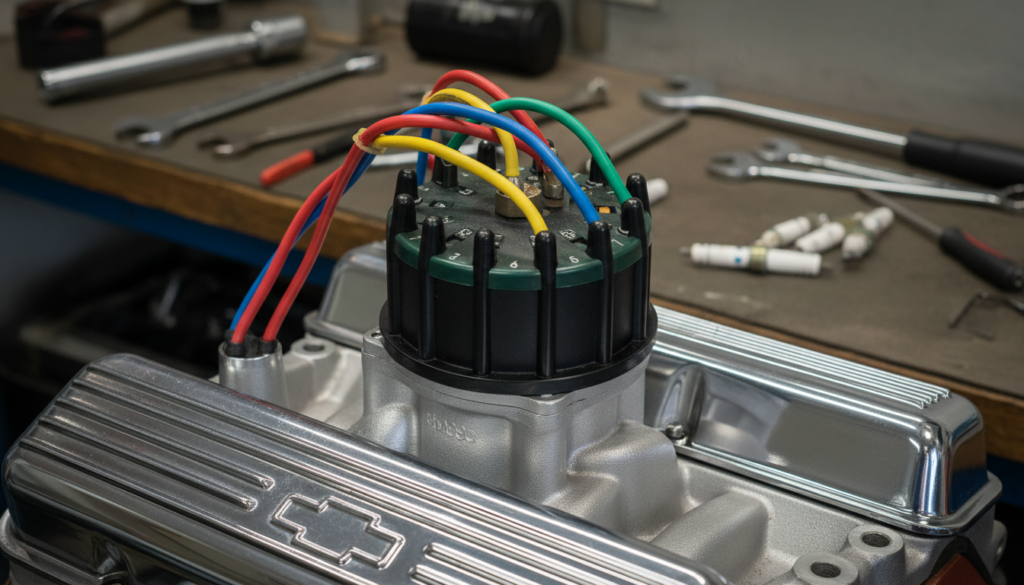
Remove the distributor cap and check the rotor. The rotor should point to the cap tower for #1. If it points to the opposite tower, rotate the crank one full turn and recheck. When correct, mark the #1 terminal on the distributor cap.
Route plug wires following distributor rotation
Use the standard sequence: 1-8-4-3-6-5-7-2. Start at the marked #1 tower and connect each plug wire in the direction the distributor turns. Replace wires one at a time when possible to avoid mixing the pattern.
Double-check and prevent crossfire
Trace each wire from the cap to the actual cylinder location. Confirm odds on the driver side and evens on the passenger side. Keep long runs separated, use looms, and crisscross pairs that must run together to cancel induction. This reduces ignition crossfire and misfires.
- Final check: engine cranks and starts smoothly, idle is steady, and timing can be set normally.
- Tip: if the engine won’t start, reverify TDC compression and rotor alignment — the paired-piston trap causes a 180° mistake if skipped.
| Check | Tool or method | Expected result |
|---|---|---|
| Top dead center | Timing mark, crank wrench | Balancer mark at TDC pointer; #1 ready to fire |
| Rotor alignment | Visual inspection with cap off | Rotor points to #1 terminal |
| Wire routing | Marked cap, sequence diagram | Wires follow 1-8-4-3-6-5-7-2 in distributor rotation |
| Crossfire prevention | Wire looms, spacing | No stray misfires; stable idle |
Common mistakes and “new firing order” options that change the firing sequence
Mistakes in spark routing quickly show up as misfires, rough idle, or a no-start. These symptoms point to bad wire routing, rotor alignment, or a swapped cam that changes timing events.
Camshaft design and valve actuation are the real drivers when the pattern itself changes. A popular race cam (the 4-7 swap) reshuffles firing order to smooth pulses and aid traction; that’s why builders accept extra complexity for power gains.
Modern LS engines use a different sequence than classic V8s to reduce stress and improve balance. Marine engines that run in reverse also use special sequences to match rotation direction.
When considering a new firing order, plan checks for rotor position and valve timing. Upfront verification prevents wasted days chasing a misdiagnosis and makes any new firing order swap predictable and serviceable.
FAQ
What is the correct firing order for a Chevrolet V8?
The classic small-block Chevrolet V8 uses the 1-8-4-3-6-5-7-2 sequence. This sequence dictates which cylinder fires next as the crankshaft turns and the distributor or ignition system advances spark to the appropriate plug.
How are cylinders numbered and which side is the front?
Chevy V8s number cylinders 1–4 on the driver’s side and 5–8 on the passenger side, with #1 at the front on the passenger side. “Front” refers to the accessory end of the crankshaft, where belts and pulleys sit.
How does a four-stroke V8 complete its firing cycle?
A four-stroke engine needs 720° of crankshaft rotation to complete all intake, compression, power, and exhaust strokes. The camshaft turns once for every two rotations of the crank, so it completes a full cycle in 360° of camshaft rotation.
Why do two pistons reach top dead center at the same time?
Pairs of pistons are linked by crankshaft geometry; when one reaches top dead center (TDC) on the compression stroke, another reaches TDC on the exhaust stroke. Only the compression-stroke piston is ready to fire, which the ignition timing and distributor account for.
How do you set timing by bringing cylinder #1 to TDC on the compression stroke?
Rotate the crank until #1 piston is at TDC and confirm the valves: intake and exhaust for #1 should be closed. Then align the timing mark on the harmonic balancer to the pointer, set the distributor so the rotor points to the #1 cap terminal, and tighten the distributor while preserving the rotor position.
How can I confirm the rotor is correctly positioned at the #1 terminal?
With the engine at #1 TDC compression, install the distributor so the rotor arm points directly at the #1 terminal inside the cap. If the rotor doesn’t align, remove the cap and note distributor housing rotation; re-index or adjust by one tooth if needed before final timing.
What’s the best method to route spark plug wires by distributor rotation?
Route wires from the distributor in the firing sequence matching rotor rotation—clockwise or counterclockwise depending on your engine. Use coil-on-plug or cap labels, follow the shortest non-crossing path, and keep wires separated from high-heat areas and headers to reduce interference.
How do I double-check wire routing at the plugs and cylinders?
Verify each wire’s corresponding cylinder number at the plug end. Trace each lead from its labeled distributor post to the spark plug; confirm #1 matches the rotor’s starting point and proceed through the full sequence. Use numbered boots or tags to avoid mistakes.
What tips prevent ignition crossfire when routing plug wires?
Keep high-tension leads separated, use spiral wrap or wire looms, maintain 1–2 inch spacing between parallel wires, and avoid running wires close to the coil pack or alternator. Replace degraded boots and use resistive wires to reduce radio frequency interference and crossfire.
What symptoms indicate an incorrect firing sequence?
Misfires, rough idle, backfire through the intake or exhaust, loss of power, poor fuel economy, and a no-start condition all suggest incorrect spark order or misplaced wires. Check timing, plug wires, and distributor installation when these issues appear.
What actually changes a firing order in an engine?
The camshaft lobe arrangement and valve-actuation timing determine which cylinder fires when. Swapped cam profiles or different crank triggers and ignition mapping can alter the effective firing sequence for performance or balance reasons.
What is a 4-7 swap and why do racers use it?
A 4-7 swap reorders cylinder ignition—commonly swapping which cylinders fire earlier—to improve exhaust scavenging and reduce crankshaft torsional vibration. Racers use revised firing sequences to optimize power and component longevity in high-RPM applications.
How does the LS firing order differ from the classic SBC and big-block patterns?
Late-model LS V8 engines use a different sequence (for many LS: 1-8-7-2-6-5-4-3) and cylinder numbering, designed to improve balance and reduce NVH. GM updated the pattern to match new crank and cam designs, so wiring or timing changes are required when swapping components between families.
Are there special firing orders for reverse-rotation marine engines?
Yes. Marine engines with reverse crank or accessory rotation often require mirrored ignition timing and altered distributor or trigger settings. Manufacturers supply specific sequences and timing marks for marine applications to ensure proper cooling and propeller compatibility.