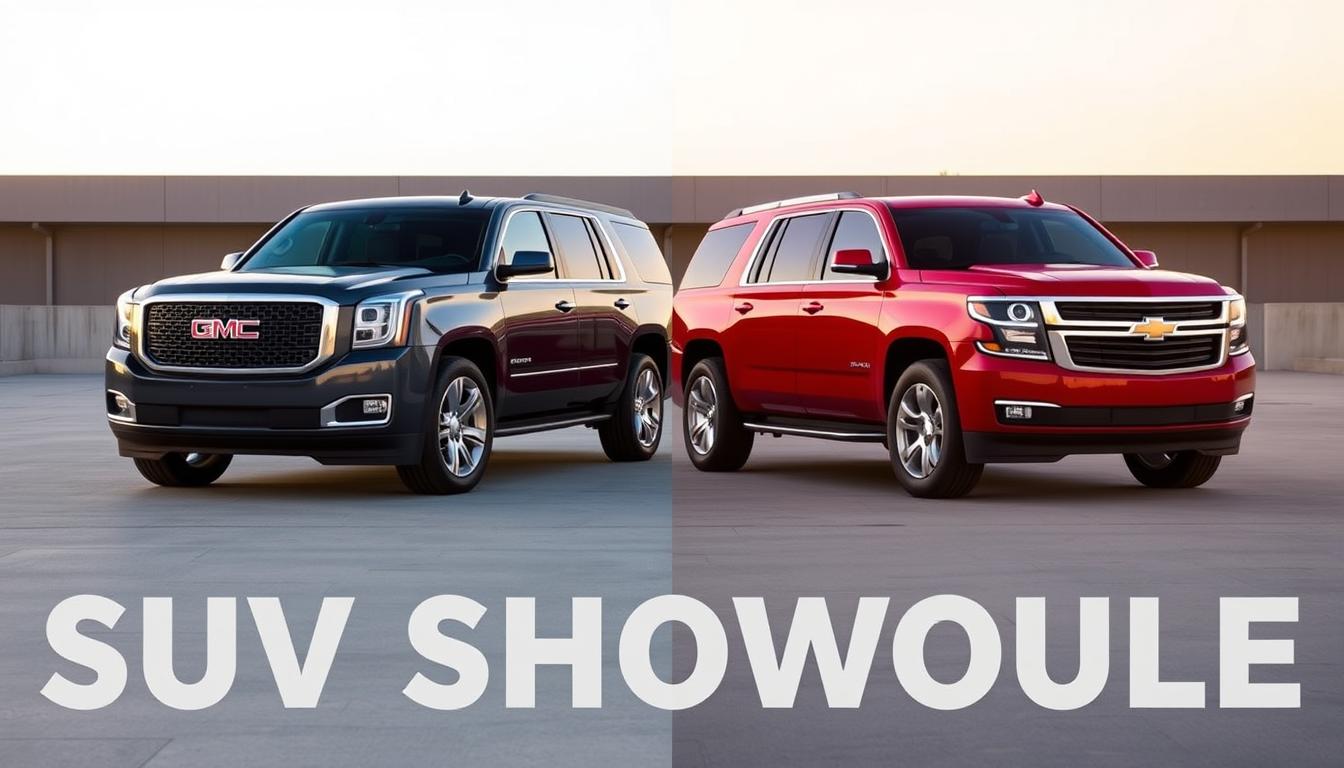
GMC Yukon vs Chevy Tahoe: SUV Showdown
This comparison looks at the 2025 GMC Yukon and 2025 Chevrolet Tahoe. It covers what U.S. buyers care about most. This includes pricing, engine choices, fuel economy, and interior comfort.
It also talks about cargo space, child-seat fit, tech, safety systems, warranties, and overall costs. The goal is to give clear, practical information.
The Tahoe is great for families who want value and lots of room. The Yukon, with its Denali trim, offers luxury and extra features. This comparison uses official specs and real-world tests to show the differences.
Readers will learn about engine options, towing capacity, and infotainment screens. It’s easy to compare trims and choose the right SUV for your needs.
GMC Yukon vs Chevy Tahoe: overview and buying considerations
The GMC Yukon and Chevrolet Tahoe share a platform and many mechanical parts. Buyers will spot differences in trim levels, interior finish, and standard tech. This overview helps readers compare gmc yukon vs chevy tahoe on points that matter when choosing a full-size SUV.
Who should consider each SUV?
Chevrolet Tahoe suits families who need roomy cargo space and straightforward utility. Its broad trim range makes it easier to find a model that fits a tighter budget.
GMC Yukon fits buyers who want a more premium feel from the start. Denali and Denali Ultimate trims add upscale materials and comfort features for drivers who favor refinement and a richer cabin experience.
Key decision factors: budget, space needs, luxury vs value
Budget is a clear divider. Tahoe base trims start lower in price, which helps buyers prioritize essentials without extra cost. Yukon base pricing begins higher but includes more standard tech and upscale touches.
Space needs overlap between the two. Tahoe and Suburban combinations offer strong cargo flexibility. Yukon XL competes with the Suburban for extended-wheelbase cargo and passenger room. Consider rear-seat use and cargo behind the third row when comparing gmc yukon chevy tahoe differences.
Luxury versus value is a matter of taste. Yukon emphasizes premium materials such as open-pore wood and available massaging seats. Tahoe emphasizes practical layouts and straightforward controls. Test drives reveal whether perceived refinement beats raw value for a given buyer.
Model year focus and relevance (2025 highlights)
The 2025 models keep shared engine choices and many common options. Both maintain the 5.3L and 6.2L V8s plus the 3.0L turbo-diesel for buyers who want efficiency with torque.
Standard tech shows a split. Yukon base models come with a larger digital cluster and a 10.2-inch touchscreen as standard. Tahoe starts with an 8-inch screen on base trims and offers larger displays on higher trims. These differences matter when you compare gmc yukon vs chevy tahoe for standard features and driver interface.
Practical advice: plan back-to-back test drives. Focus on perceived refinement, visibility, and control layout. If luxury matters, consider Yukon Denali. If family-first value is the priority, look at Tahoe LS or mid trims to compare gmc yukon chevy tahoe tradeoffs in real use.
Pricing and value comparison: sticker price and trim lineup
The Tahoe and Yukon differ in price when you walk into the dealership. The Tahoe LS is for those watching their budget, starting at a lower price. The Yukon SLE, on the other hand, is closer to premium prices.
The Tahoe LS starts at about $58,500. It comes with an 8-inch touchscreen, wireless Apple CarPlay and Android Auto, and tri-zone climate control. It also has Chevy Safety Assist, which includes automatic emergency braking and lane keep assist.
The Yukon SLE begins around $68,895. It has a 12-inch digital gauge cluster and a 10.2-inch center screen. It also has upgraded cabin materials compared to the Tahoe base.
For those looking at specs, the difference grows in the premium trims. GMC’s Denali and Denali Ultimate offer open-pore wood and massaging front seats. They also have advanced infotainment and optional surround-view cameras.
The Tahoe High Country has strong tech and comfort. It offers Bose audio and many luxury features. Pricing and features usually place High Country slightly below Denali Ultimate in luxury and sound.
Choosing a trim depends on what you value most. If you’re watching your budget and need cargo space, the Tahoe is a good choice. For more comfort and premium features, the Yukon is worth the extra cost.
Below is a quick reference comparing starting prices and hallmark features across key trims to help readers compare gmc yukon chevy tahoe at a glance.
| Trim | Starting Price (approx.) | Key Standard Features | Premium Options |
|---|---|---|---|
| Chevy Tahoe LS | $58,500 | 8″ touchscreen, wireless Apple CarPlay/Android Auto, tri-zone climate, Chevy Safety Assist | Bose audio, upgraded driver aids, towing package |
| GMC Yukon SLE | $68,895 | 12″ digital cluster, 10.2″ touchscreen, upgraded interior trim, advanced convenience features | Denali-style options, larger screens, driver-assist bundles |
| Chevy Tahoe High Country | $78,000 (typical) | Premium audio, leather, advanced safety tech, comfort upgrades | Air ride, surround camera, adaptive cruise |
| GMC Yukon Denali / Denali Ultimate | $85,000+ (Denali Ultimate higher) | Open-pore wood, massaging seats, AKG audio (Ultimate), air suspension, extra sound deadening | Full luxury tech packs, highest-level audio and comfort features |
When comparing the GMC Yukon and Chevy Tahoe, total cost of ownership is key. The Tahoe is often cheaper to buy and offers a wide range of trims for different budgets. The Yukon costs more upfront but includes more premium features as standard.
Practical advice: go for the Tahoe if you’re looking to save money and need lots of cargo space. Choose the Yukon for a more luxurious ride and higher-end features that make long-term ownership more satisfying.
Engine options and GMC Yukon vs Chevy Tahoe performance
The 2025 GMC Yukon and Chevrolet Tahoe have the same engine choices. You can pick from a 5.3L V8, a 6.2L V8, or a 3.0L turbo-diesel. They all come with a 10-speed automatic transmission.
Shared engine lineup: 5.3L V8, 6.2L V8, and 3.0L turbo-diesel
The 5.3L V8 makes about 355 hp and 383 lb-ft of torque. It’s a good choice for everyday driving and fuel efficiency. The 6.2L V8 has more power, with GMC’s Yukon reaching 420 hp/460 lb-ft in some models.
Chevrolet’s Tahoe can get up to 433 hp with the right package. The 3.0L turbo-diesel offers strong low-end torque and better highway fuel economy.
Horsepower, torque, and real-world driving differences
The 5.3L V8 is great for city driving and short trips. It gets mid-teens mpg in the city and about 20 mpg on the highway. The 6.2L V8 has more power and a smoother ride, perfect for the Denali and High Country trims.
The diesel engine has more torque at low speeds. This makes long trips easier. Diesel models also get better highway mpg, perfect for towing or steady driving.
Towing capacity comparisons and towing equipment
Both SUVs can tow up to 8,300–8,400 pounds with the right setup. The Yukon can tow up to 8,400 pounds, while the Tahoe can tow up to 8,300 pounds. The diesel and 6.2L engines provide more confidence when towing.
Towing packages include trailer brake controllers, heavy-duty hitches, and tow/haul modes. These features improve towing control and feel.
Practical advice on engine choice
Go for the 5.3L V8 for everyday use and cost balance. Choose the 6.2L for towing or quick acceleration. The 3.0L diesel is best for long trips, towing, and low-rpm torque.
gmc yukon chevy tahoe specs and gmc yukon vs chevy tahoe differences in tuning and towing gear matter more than numbers. Test drives help show how each engine meets your needs.
Fuel economy and efficiency: real-world mpg and range
The GMC Yukon and Chevrolet Tahoe have similar parts but use fuel differently. This depends on the engine, trim, and how you drive. People often wonder if the diesel engine is worth it, how EPA ratings compare to real life, and what the driving range is for long trips.
EPA ratings are a starting point for comparison. They show V8s getting 15–16 mpg in the city and 19–20 mpg on the highway. The Yukon and Tahoe have similar numbers, like 14/18/16 for the Yukon and 15/19/17 for the Tahoe. Real-world driving often falls within these ranges, depending on how you drive and the gear you use.
For long trips, the 3.0L turbo-diesel engine is best for highway driving. Some diesel Tahoes get up to 21 mpg in the city and 27 mpg on the highway. The Yukon diesel models also show similar numbers. This makes the diesel great for steady-speed driving and towing at constant speeds.
The size of the fuel tank is important for how far you can go. Most setups have a 24.0-gallon tank. With mid-teens mpg for V8s, you can drive between 330 and 460 miles. This depends on the engine and whether you drive more in the city or on the highway.
Below is a compact comparison to clarify EPA and practical ranges across common setups.
| Configuration | EPA City/Hwy/Combined (mpg) | Approx. Tank (gal) | Estimated Range (miles) |
|---|---|---|---|
| Yukon, gasoline V8 | 14 / 18 / 16 | 24.0 | 336 city / 432 hwy |
| Tahoe, gasoline V8 | 15 / 19 / 17 | 24.0 | 360 city / 456 hwy |
| Yukon/Tahoe, 3.0L diesel | ~21 / ~27 / ~24 | 24.0 | 504 city / 648 hwy (est.) |
Choose diesel if you want better highway fuel economy and longer range. Gasoline V8s get mid-teens mpg, so plan for fuel stops on long drives. Looking at gmc yukon chevy tahoe specs helps choose the right engine for your needs. For those deciding between power and efficiency, comparing gmc yukon vs chevy tahoe performance and fuel metrics helps make a better choice.
Interior design and comfort: materials, seating, and ride
The Yukon and Tahoe aim to be family-friendly in different ways. GMC focuses on luxury materials and quietness in the Denali trims. Chevrolet goes for easy-to-use design and tough surfaces in most Tahoes.
Cabin materials and luxury touches
The Yukon Denali and Denali Ultimate have unique touches. They feature open-pore wood, perforated leather, and sound insulation. Higher Denali packages add massaging front seats and a digital cluster.
The Tahoe offers leather on its top trims and strong cloth on the base. It also has physical knobs for easy control.
Seating capacity and passenger comfort
Both SUVs can seat up to nine with a front bench. But, many choose seven or eight with captain’s chairs. The third row has about 35 inches of legroom, good for kids and short trips.
The second row can have a bench or captain’s chairs. A bench is better for three-across car seats. Captain’s chairs, though, offer more comfort, making long drives easier.
Ride quality and suspension options
Denali models often come with adaptive air suspension. This makes the ride smoother and quieter. The Tahoe has a conventional suspension for a stable ride. Its upper trims offer adaptive options to match the Yukon’s comfort.
When choosing between the Yukon and Tahoe, consider the interior, seat technology, and ride quality. If you want a quiet, plush ride, the Yukon might be better. For practical, easy-to-use controls, the Tahoe is a good choice.
| Aspect | GMC Yukon (Denali) | Chevy Tahoe |
|---|---|---|
| Premium trim touches | Open-pore wood, perforated leather, massaging seats, upgraded cluster | Leather on higher trims, durable cloth on base, clear physical controls |
| Noise insulation | Enhanced sound deadening for quieter cabin | Good insulation, less emphasis on luxury hush |
| Seating configurations | Seats up to 9; common 7-8 with captain’s chairs; third-row ~35″ legroom | Seats up to 9; common 7-8; third-row similar space for kids and adults |
| Second-row options | Bench or captain’s chairs; captain’s enhance comfort | Bench or captain’s chairs; bench helps three-across car seats |
| Suspension and ride feel | Adaptive air suspension available; softer, more isolated ride | Conventional tuned suspension; composed and practical; adaptive available on higher trims |
| Best for | Buyers seeking a quieter, more luxurious cabin and advanced seat tech | Buyers wanting rugged comfort, simple ergonomics, family-friendly layout |
Cargo space and family practicality
The GMC Yukon and Chevy Tahoe are designed to meet family cargo needs. They offer similar space behind the third row, about 25.5 cubic feet. This is perfect for groceries, a few suitcases, or a stroller.
When the third row folds, both SUVs expand to over 72 cubic feet. The max cargo space is almost identical, with the Tahoe at 122.9 cubic feet and the Yukon at 122.2 cubic feet. These numbers show they’re close in capacity.
Extended-wheelbase models, like the Yukon XL and Chevrolet Suburban, offer more space. They add over 15 inches of wheelbase. This extra length is great for strollers, long sports gear, or group luggage.
Both vehicles have practical features like flat load floors and wide openings. They also have power liftgates and underfloor storage. The Yukon has more vertical space for bulky items. The Tahoe is better for long objects like skis or lumber.
| Measure | Chevy Tahoe | GMC Yukon |
|---|---|---|
| Behind third row | ~25.5 cu ft | ~25.5 cu ft |
| Behind second row | >72 cu ft | >72 cu ft |
| Max cargo | ~122.9 cu ft | ~122.2 cu ft |
| Extended-wheelbase gain | +15+ inches (Suburban) | +15+ inches (Yukon XL) |
| Notable loading features | Flat floor, power liftgate, underfloor storage | Flat floor, power liftgate, underfloor storage, taller vertical space |
Both models are good for regular family hauling. Choose the Yukon XL or Suburban for more third-row use or extra trunk space. Use the cargo and specs to find the best fit for your needs.
Car seat compatibility and third-row access
Parents looking at the GMC Yukon and Chevy Tahoe want to know about installing car seats. A comparison shows both SUVs are easy to use for car seats in the second row. They also work well in the third row for many families.
Second-row LATCH anchors and fit
Both SUVs have two sets of exposed lower LATCH anchors in the second row. They also have three top tether anchors. This makes installing car seats easy for both rear- and forward-facing seats.
The wide second row allows many bulky seats to fit without pushing the front seats too close. Bench seats often let you install three seats across, with narrower seats.
Third-row tether and belt installs
The third row of neither vehicle has lower LATCH anchors. You’ll need to use the seat belt and top tether anchors for forward-facing seats or booster seats. Belt routing is the usual method for secure installs.
Reading the car-seat manual and using a locking clip when needed helps get a tight fit.
Ease of third-row access and family-friendly features
Large rear doors and second-row seats that slide and fold make getting to the third row easy. The Yukon Denali trim might offer smoother seat movement and assist features. For daily family errands, both models are easy to use.
Practical advice for heavy third-row use
For families using the third row often, consider the extended-wheelbase Suburban or Yukon XL. They offer more legroom and space. For most family needs, the second row in both SUVs is great for safety and comfort.
Quick checklist for installers
- Use lower LATCH anchors in the second row when possible for rear-facing seats.
- For third-row seats, follow belt-routing steps and connect the top tether firmly.
- Test forward/backward clearance to avoid contact with front-seat occupants.
- Confirm three-across fit with the actual combination of car seats you plan to use.
Technology and infotainment features
The GMC Yukon and Chevy Tahoe both have modern tech for families and drivers. This section compares screens, connectivity, audio, and rear-seat systems. It helps readers see the practical differences easily.

Screen size and driver displays make a big first impression. The Tahoe has an 8-inch touchscreen on base LS models and a 10.2-inch on higher trims. Many Tahoe trims also have physical knobs for volume and tuning, making quick adjustments easy.
The Yukon starts with a more premium feel. Many Yukon SLE models come with a 10.2-inch center touchscreen and a 12-inch digital gauge cluster. Denali trims add more to the instrumentation and offer an optional head-up display for navigation and driver info.
Both SUVs support smartphones well. They offer wireless Apple CarPlay and Android Auto, along with multiple USB ports and an in-vehicle Wi‑Fi hotspot. Navigation and wireless charging are available on higher trims for longer trips and daily use.
Audio packages vary by trim and brand. Tahoe often has Bose systems for clear sound. Yukon Denali and Denali Ultimate offer premium options from Bose or AKG for a richer sound in luxury trims.
Rear-seat tech keeps families happy on long drives. Both brands offer optional rear-seat entertainment systems, second-row USBs, and separate climate zones. Yukon Denali packages usually add more integrated rear entertainment and deluxe controls for rear passengers.
Practical advice for buyers: the two models are similar in core connectivity and safety tech. The Yukon has a larger standard display and digital cluster for a more upscale feel. The Tahoe, on the other hand, offers intuitive infotainment at a lower entry price.
| Feature | Chevy Tahoe | GMC Yukon |
|---|---|---|
| Base touchscreen | 8.0-inch (LS) | 10.2-inch (SLE) |
| Upper touchscreen option | 10.2-inch | 10.2-inch plus 12-inch cluster |
| Digital gauge cluster | Available on higher trims | 12-inch standard on many trims, upgraded on Denali |
| Smartphone integration | Wireless Apple CarPlay/Android Auto | Wireless Apple CarPlay/Android Auto |
| Wi‑Fi hotspot | Available | Available |
| Wireless charging | Available on higher trims | Available on higher trims |
| Premium audio | Bose options common | Bose or AKG on Denali/Denali Ultimate |
| Rear entertainment | Optional systems, multiple USBs, rear climate | Optional advanced systems, more premium rear features on Denali |
| Notable strength | User-friendly infotainment and lower starting tech price | Stronger first impression with larger baseline displays |
When comparing gmc yukon vs chevy tahoe technology, look at trims, not badges. Features like navigation, head-up display, and premium audio vary by package. Test screens for responsiveness and sound for real-world clarity.
For families, compare rear-seat amenities and ease of use. The Yukon has a higher-tech baseline, while the Tahoe offers user-friendly controls and a lower entry cost.
Safety features and driver-assist systems
The 2025 GMC Yukon and Chevrolet Tahoe come with lots of safety features. They have automatic emergency braking, forward collision alert, and pedestrian braking. They also have lane keep assist, lane departure warning, blind-spot monitoring, and rear cross-traffic alert.
For more safety, you can add advanced driver assists. You can get surround-view cameras, adaptive cruise control, and lane-change alert. There’s also enhanced automatic parking assist and advanced trailer safety assist.
Trim and package differences
Higher trims offer more tech. Yukon Denali Ultimate and Tahoe High Country have the most features. They include adaptive cruise and enhanced parking systems.
Practical buying notes
- Mid-level Yukon trims have extra driver-assist tech without the Denali Ultimate.
- Choose Tahoe High Country or add safety packages for Denali-level features.
- Think about towing-specific aids for frequent trailer use. Advanced trailer safety assist helps on highways.
When comparing safety, both models have similar core systems. But, higher trims show differences. The choice between GMC Yukon and Chevy Tahoe comes down to standard versus optional advanced tech. Focus on adaptive cruise and surround-view for better highway and parking comfort.
Warranty, Reliability and Ownership Costs
Both brands have the same warranty terms. This includes a 3-year/36,000-mile bumper-to-bumper plan and a 5-year/60,000-mile powertrain warranty. Many dealers offer a free maintenance visit in the first year. This helps lower early service costs for both models.
Both GMC Yukon and Chevrolet Tahoe share the same mechanical parts. This means they face similar wear and failure issues. Owners often report similar reliability for both models.
Choosing between the two affects costs. V8 engines use more fuel, but diesel can save money. Luxury features like air suspension and massaging seats increase repair and tire costs over time.
When comparing gmc yukon vs chevy tahoe ownership costs, consider these factors:
- Initial price and trim level.
- Expected annual mileage and fuel type.
- Maintenance needs for luxury options.
- Insurance differences driven by trim and equipment.
Resale value varies by trim. High-end Yukon Denali models often hold value due to luxury branding. The Tahoe benefits from broader appeal and a lower starting price, helping resale by volume.
| Factor | Typical Yukon Outcome | Typical Tahoe Outcome |
|---|---|---|
| Factory Warranty | 3 yrs / 36k basic, 5 yrs / 60k powertrain | 3 yrs / 36k basic, 5 yrs / 60k powertrain |
| Complimentary Maintenance | Often first-year service included | Often first-year service included |
| Expected Reliability | Strong; mirrors Tahoe with shared parts | Strong; mirrors Yukon with shared parts |
| Fuel & Service Costs | Higher on V8; diesel lowers fuel but ups service complexity | Higher on V8; diesel lowers fuel but ups service complexity |
| Resale Value | Higher for Denali trims due to luxury cachet | Broad resale strength from volume and value |
| Long-Term Ownership Costs | Trim-driven; luxury options increase expenses | Trim-driven; lower entry price can reduce lifecycle cost |
Estimate 5–10 year ownership costs by combining purchase price with fuel, insurance, and maintenance. Remember, a higher upfront cost for luxury trims can be offset by stronger resale.
For lowest routine expense, a mid-level Tahoe is wise. For premium appointments and higher upkeep, a Yukon Denali is suitable. Balance mileage and features to forecast costs accurately.
Visual design and brand positioning: luxury vs value
The visual tone between these two full-size SUVs is deliberate. A gmc yukon vs chevy tahoe visual design read as two different promises. The Yukon presents a refined, upscale face that leans into premium cues. The Tahoe keeps a rugged, practical look that favors utility over ornamentation.
The exterior styling cues are a big part of brand identity. Denali Yukons use bold grille patterns, polished chrome trim, and premium lighting to project formality and presence. Tahoe trims stay grounded with squared proportions, functional roof rails, and simpler lighting that underscore hard-use capability.
The cabin feels different on first touch and sight. Denali interiors emphasize materials like open-pore wood, perforated leather, and stitched surfaces. Those details change how owners perceive value and quietness. Tahoe cabins focus on straightforward ergonomics and durable finishes. Higher Tahoe trims lift materials, but the character stays pragmatic.
Comparing finishes helps shoppers pick the right vibe. A gmc yukon chevy tahoe comparison shows Denali adds massaging seats and refined displays that mimic near-luxury brands. Tahoe High Country brings nicer leather and trim but keeps controls and layout simple for daily usability.
Buyers often choose on personality and mood. Someone who values a polished presence and a quieter, show-ready cabin will lean toward the Yukon. Someone who wants straightforward function, lower fuss, and a more rugged statement will prefer the Tahoe.
Practical advice during test drives matters. Match expected textures, tech responsiveness, and sightlines to how the vehicle will be used. Trim selection changes perceived luxury drastically, so inspect the specific package to judge gmc yukon vs chevy tahoe features.
Conclusion
The 2025 GMC Yukon and 2025 Chevy Tahoe have a lot in common. They share strong engineering, engines, and safety features. But, they focus on different things.
The Tahoe is all about value and being family-friendly. It has more trim options and better cargo space, even compared to the Suburban. On the other hand, the Yukon offers a more luxurious feel, a quieter ride, and more standard features in its Denali trims.
When deciding between the two, think about your budget and daily needs. The Tahoe is a better choice if you’re watching your wallet and need practicality. But, if you want a more luxurious ride and premium features, the Yukon is the way to go. You’ll have to accept a higher price for the Yukon.
Before making a decision, take a test drive of both mid and top trims. Check out the third-row comfort and car-seat layouts. Also, consider the extended-wheelbase versions like the Suburban or Yukon XL if you need more space for cargo or passengers. This hands-on experience will help you choose the best fit for your needs.
FAQ
Which should I choose — the 2025 GMC Yukon or the 2025 Chevrolet Tahoe?
Choose the Chevrolet Tahoe for a lower entry price and more trim options. It also offers better cargo flexibility, which is great for families. The GMC Yukon is better for those who want a premium feel with a quieter ride and luxury features.
What are the starting prices and key differences between base trims?
The 2025 Chevy Tahoe LS starts at about ,500. It comes with an 8-inch touchscreen and wireless Apple CarPlay/Android Auto. The 2025 GMC Yukon SLE starts at around ,895 with a 10.2-inch touchscreen and a 12-inch digital gauge cluster.
Do Yukon and Tahoe share engines and performance specs?
Yes, they share the same engine lineup. This includes a 5.3L V8 and an optional 6.2L V8. They also have a 3.0L turbo-diesel option. Both have a 10-speed automatic transmission.
How do towing capacities compare?
Towing capacities are very close. The Yukon can tow up to 8,400 lbs, and the Tahoe can tow up to 8,300 lbs. Adding tow packages improves towing confidence and capability.
What fuel economy can I expect from each model?
Fuel economy varies by engine and drivetrain. Gasoline V8s get around 14–16 mpg in the city and 20 mpg on the highway. The 3.0L turbo-diesel gets better highway efficiency.
How practical are these SUVs for families and cargo hauling?
Both are great for families. They offer similar cargo space behind the third row and second row. For more space, consider the extended-wheelbase Suburban or Yukon XL.
Are Yukon and Tahoe car-seat friendly? What about LATCH and third-row installs?
Yes, they are car-seat friendly. Both have exposed lower LATCH anchors in the second row. The third row lacks lower LATCH anchors, so seat belts and top tethers are used for installs.
What are the infotainment and tech differences?
Tech features are similar, but the Yukon SLE has a larger touchscreen and digital gauge cluster. Both support wireless Apple CarPlay/Android Auto and have premium audio options.
Which model has better ride comfort and suspension options?
The Yukon Denali offers adaptive air suspension for a smoother ride. The Tahoe has a solid, composed ride with conventional suspension. Higher Tahoe trims improve comfort but are more utilitarian.
How do standard and available safety features compare?
Both have a full suite of driver assists. Advanced options like surround-view camera and adaptive cruise are available at higher trims. Denali Ultimate and Tahoe High Country often have these features standard.
What warranty and ownership costs should buyers expect?
Warranty coverage is the same for both. Dealers often include complimentary maintenance for the first year. Ownership costs depend on engine choice, trim-specific features, and fuel/insurance.
Does one model hold resale value better than the other?
Resale value depends on trim and market. Yukon Denali trims may retain value due to luxury positioning. Tahoe’s broad appeal and lower entry price can also lead to strong resale.
How much does exterior and interior styling influence the choice?
Styling is important. The Yukon has a premium look with bold grilles and polished chrome. The Tahoe has a rugged, functional aesthetic. Test both to see which vibe you prefer.
Which trim should families consider for the best balance of features and value?
Mid-level Tahoe trims are great for families on a budget. They offer good value and practicality. Yukon Denali or Denali Ultimate are worth the extra cost for passenger comfort and upscale materials.