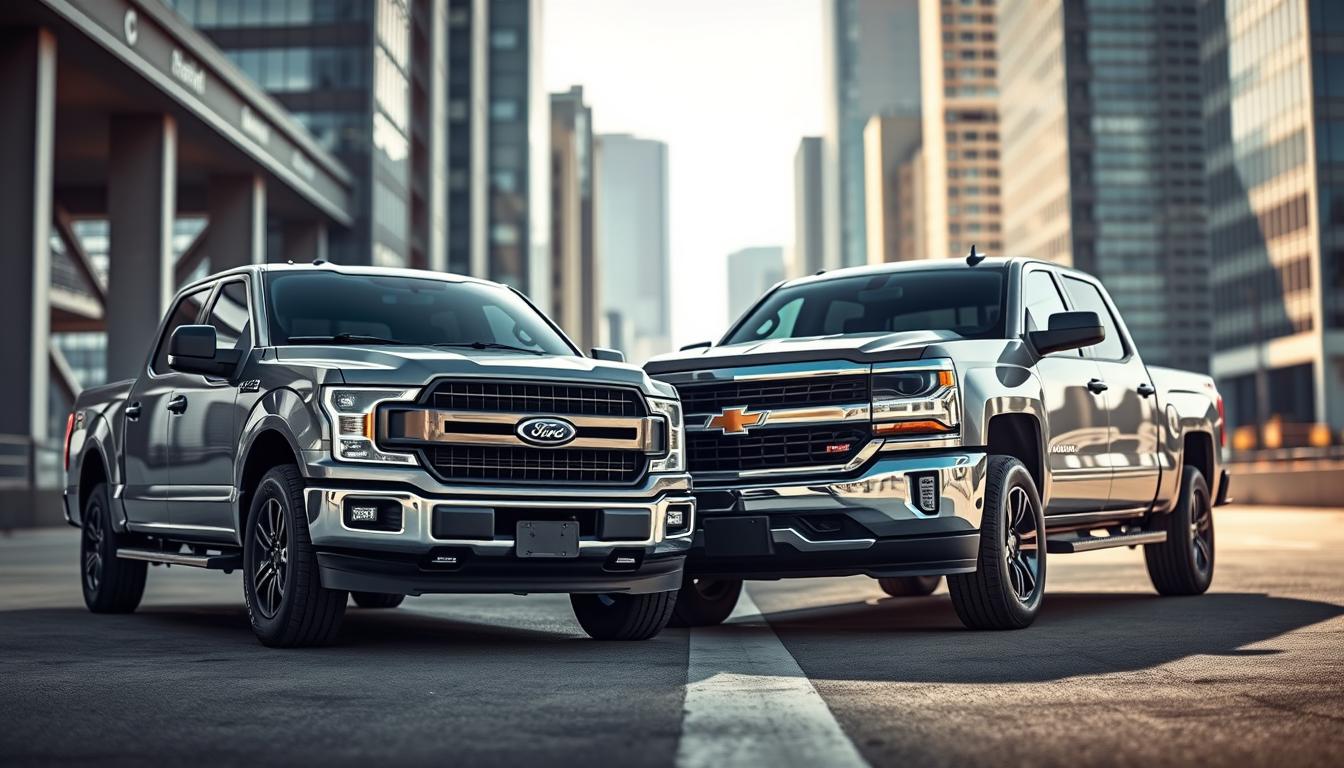
Ford F150 vs Chevy Silverado: Truck Showdown
This comparison aims to give you practical insights. We’re looking at the Ford F-150 and Chevrolet Silverado 1500. These trucks are at the top of their game, so we’ll compare their capabilities, tech, durability, and costs.
We’ve gathered data from the manufacturers and dealers in places like Greensboro and Kansas City. We’ll also use performance figures for 2024–2026 models. You’ll see how these trucks stack up in towing, payload, engine choices, and more.
Expect to learn about off-road features like Tremor, Raptor, and ZR2. We’ll also dive into infotainment, driver assists, and bed innovations. This guide will help you choose the right truck for your needs.
Overview: Ford F-150 and Chevrolet Silverado at a glance
The Ford F-150 and Chevrolet Silverado are common sights on American roads. This comparison looks at their market position and what buyers value most.
Market position and legacy
Ford’s F-150 is America’s top-selling half-ton for years. It leads in sales and innovation, from engines to towing tech. Chevrolet’s Silverado is known for its rugged V8s and diesel options.
This competition affects choices in both cities and rural areas.
Generational updates for 2024–2026
The F-150 got a 2024 update and smaller changes in 2025-2026. These updates added hybrids and electric models like PowerBoost and Lightning. Ford kept the core engineering but added new tech and efficiency.
Chevrolet updated the Silverado in 2022 and made tweaks through 2026. It expanded off-road and tech options, including ZR2 hardware.
Trim breadth and target buyers (work, family, off-road)
Both lines offer a wide range of trims for different buyers. Ford has options from work-focused XL to luxury Platinum and Raptor. Chevrolet has Work Truck, LT, RST, ZR2, and High Country trims.
Contractors and heavy haulers often choose Ford for its towing and payload. Those looking for diesel economy or cost per mile might prefer Silverado. This comparison helps find the right model for your needs.
Powertrain comparison and performance metrics
This part compares the drivetrains that shape towing capacity, acceleration, and daily usability in the ford f150 vs chevy silverado debate. Readers get a clear view of engine lineups, peak power figures, and how transmission choices affect real-world driving. A short table follows to make direct contrasts easier to scan.
Engine lineups: gasoline, diesel, hybrid, and electric options
Ford offers a broad range that spans 2.7L and 3.5L EcoBoost V6s, a 5.0L V8, the 3.5L PowerBoost full hybrid, a 5.2L supercharged V8 in the Raptor R, plus the F-150 Lightning electric models. Chevrolet fields a 2.7L turbo four, a 5.3L V8, a 6.2L V8, and a 3.0L Duramax inline-six diesel. Silverado EV exists as an electric option but the Lightning is the mainstream half-ton EV currently in wide production.
Horsepower and torque highlights (Raptor R, Lightning, Duramax diesel)
Raptor R targets the high end with roughly 700 hp from its supercharged 5.2L V8. Lightning trims push near 580 hp in dual-motor form while delivering instant electric torque for quick launches. The PowerBoost hybrid mixes 400+ horsepower with strong torque for towing and everyday driving. Chevrolet’s 6.2L V8 reaches about 420 hp. The Duramax diesel produces near 495 lb-ft of torque, which favors steady pulls and long-range efficiency.
The pickup truck comparison shows Ford leaning toward peak horsepower and high-performance trims. Chevrolet emphasizes torque and diesel efficiency for extended hauls and steady highway pulling.
| Powertrain | Representative Output | Notable Strength |
|---|---|---|
| Ford 3.5L EcoBoost | ~400 hp / strong torque | Balanced power for towing capacity and acceleration |
| Ford PowerBoost hybrid 3.5L | ~430 hp / high torque | Improved efficiency plus towing flexibility |
| F-150 Lightning (dual motor) | ~580 hp (top trims) | Instant torque, brisk acceleration, EV tow capability |
| Raptor R 5.2L | ~700 hp | Maximum horsepower for high-performance off-road use |
| Chevrolet 6.2L V8 | ~420 hp | Traditional V8 power with broad usability |
| Chevrolet 3.0L Duramax | ~300 hp / ~495 lb-ft torque | Diesel torque and fuel economy for long-distance towing |
Transmission choices and driving impressions
Ford pairs most gasoline and hybrid engines with a 10-speed automatic. The Lightning uses dual-motor electric drivetrains with single-speed gear reduction. Chevrolet uses 8-speed and 10-speed automatics depending on engine, with many diesel pairings routed through a 10-speed box.
Reviews note Ford’s drivetrains give a wide power band and quick throttle response in EV and high-output trims. Chevrolet’s Duramax setup favors low-end torque and steady pulls during extended towing runs. For drivers choosing the best truck for towing, consider how the transmission calibration matches trailer weight and expected driving speeds.
When weighing ford f150 vs chevy silverado in a pickup truck comparison, match your expected tow loads, daily driving style, and fuel type preference to the drivetrain options. That approach clarifies which configuration will meet your needs on the road or job site.
Towing capacity and payload: best truck for towing
When picking the top truck for towing, it’s all about ratings, real-world use, and tech for towing. The towing capacity and payload depend on the engine, cab, bed, axle ratio, and hitch packages. These specs are key when matching a truck to a trailer, boat, or work rig.
The Ford F-150 and Chevrolet Silverado 1500 have similar max towing numbers. The F-150 can tow up to 13,500 lbs with the right setup. The Silverado 1500 can tow about 13,300 lbs, depending on the options. Both need the right trailer prep packages and axle choices to reach these maxes.
When it comes to payload, there’s a bigger difference. Ford’s payload can go up to 2,445 lbs in certain models. Chevrolet’s payload maxes out at around 2,260 lbs. This means more room for heavy toolboxes or compact equipment for contractors and crews.
But towing isn’t just about numbers. Fifth-wheel and gooseneck setups change how weight is distributed. A long-bed crew cab might have a different towing capacity than a short-bed regular cab. Always check the gross combined weight ratings and tongue weight limits for big loads.
Trailering tech has become more helpful and easy to use. Ford offers Pro Trailer Hitch Assist, Pro Trailer Backup Assist, integrated trailer brake controllers, and trailer camera views. These features can get better with over-the-air updates.
Chevrolet has its own trailering apps, extended camera suites, and blind-zone alerts that cover trailers. The Silverado’s Multi-Flex tailgate makes loading gear easier for towing tasks.
Here’s a quick comparison of peak figures and trailering features to help with buying decisions.
| Item | Ford F-150 | Chevrolet Silverado 1500 |
|---|---|---|
| Max towing capacity | About 13,500 lbs (selected configs) | About 13,300 lbs (depends on configuration) |
| Max payload | Up to ~2,445 lbs | Up to ~2,260 lbs |
| Key trailering tech | Pro Trailer Hitch Assist, Pro Trailer Backup Assist, integrated brake controller, trailer camera views, OTA updates | Trailering apps, advanced camera suites, blind-zone trailer coverage, Multi-Flex tailgate |
| Typical use-case edge | Heavier payload tasks like contractor gear and accessory-laden beds | Strong camera and app support for trailer visibility and maneuvering |
| Factors affecting ratings | Cab style, bed length, axle ratio, hitch and trailer prep packages | Cab style, bed length, axle ratio, hitch and trailer prep packages |
When choosing between the Ford F-150 and the Chevrolet Silverado, compare tow setups. Look beyond the max towing capacity. Test the trailering tech that makes hitching, backing, and long trips with a trailer easier.
Off-road capabilities and specialized trims
When choosing between the Ford F150 and Chevy Silverado for off-road adventures, it’s all about capability. Both trucks have special trims that change how they handle different terrains. These trims adjust ride height, suspension, and protection under the truck.
Ford Tremor and Raptor suspension features
The Ford Tremor offers a mix of comfort and trail readiness. It has a balanced lift and heavy-duty shocks. The Raptor takes it up a notch with race-tuned suspension for desert speeds. The Raptor R even adds a supercharged V8 for extreme off-road fun.
Chevrolet ZR2 and Multimatic hardware
The Chevy ZR2 uses Multimatic DSSV dampers for precise control on rough trails. It also has a wider track and lifted suspension for better off-road performance. But, it might ride firmer when unloaded compared to softer setups.
Angles, skid protection, and tires
Angles change with cab and bed choices. Off-road trims add heavy skid protection for key parts. They also come with all-terrain or mud-terrain tires for better traction.
Practical drivers like the Ford Tremor’s balance of comfort and off-road capability. The Chevy ZR2 is for those who want aggressive trail performance. Test each trim on real trails to see the differences before making a choice.
| Feature | Ford Tremor / Raptor | Chevrolet ZR2 |
|---|---|---|
| Suspension | Lifted with heavy-duty shocks; Raptor uses race-tuned damping | Lifted with Multimatic DSSV dampers on key models |
| Differentials | Electronic locking rear; available front locker on extreme trims | Front and rear locking differentials on select ZR2s |
| Skid protection | Full underbody skid plates standard on off-road trims | Heavy-duty skid plates covering core drivetrain |
| Tires | All-terrain/mud-terrain options; Goodyear fits on many trims | Aggressive all-terrain or mud-terrain with wider track fitment |
| On-road comfort | Balanced for daily use, specially the Tremor | Firmer unloaded ride due to aggressive Multimatic setup |
Interior comfort and technology
Both trucks aim to balance roomy cabin space with modern tech. They have similar passenger volume for crew configurations. You can choose from Regular Cab, SuperCab/Double Cab, and Crew Cab. Seating can fit five or six people, depending on the layout.
Cabin ergonomics focus on long drives and workdays. Ford places controls within reach and offers seats with heating and cooling. Chevrolet has a straightforward layout with generous headroom and various upholstery choices.
Infotainment is a key feature in both trucks. Ford often has a 12.0-inch touchscreen with SYNC 4 and a 12-inch digital cluster. Wireless Apple CarPlay and Android Auto are standard in higher trims, along with updates for system improvements.
Chevrolet offers screens from 7.0 inches to 13.4 inches on upper trims. Google apps are available on larger systems, and wireless smartphone integration is common. Voice recognition works well across both brands.
Premium options enhance the cabin feel. Ford offers a Bang & Olufsen audio system, heated steering, and stitched leather on Lariat and higher trims. Chevy has Bose systems and High Country finishes for an upscale feel.
Materials and fit vary by trim level. Base Silverado models use durable plastics, while top trims have soft-touch surfaces and metal accents. Premium options include seat padding, lumbar support, and sound packages.
Connectivity and practical features are important for daily life. Both trucks offer USB ports, wireless charging, and storage cubbies. A test drive is the best way to see which infotainment system is easier to use.
Safety and driver assistance features
Modern pickups now have more safety features than ever. Ford and Chevrolet add systems to prevent crashes, make towing easier, and reduce blind-spot risks. When comparing the Ford F150 and Chevy Silverado, consider how these features work together every day.
Standard safety suites: Co-Pilot360 vs Chevy Safety Assist
Ford’s Co-Pilot360 is standard on most F-150 models. It includes automatic emergency braking, lane-keeping, and blind-spot monitoring with trailer coverage on many models.
Chevrolet’s Chevy Safety Assist offers forward collision alert, lane-keep assist, and blind-spot monitoring on many Silverado trims. Check which features are included on the specific model you’re interested in.
Hands-free driving systems: BlueCruise vs Super Cruise
BlueCruise lets drivers go hands-free on mapped highways and is available on more Ford trims. It tracks driver attention and works with adaptive cruise and lane centering for long drives.
Super Cruise offers similar hands-free driving on GM-mapped routes. It’s mainly on upper Silverado trims, like Denali, and has different coverage and trim availability than BlueCruise.
Trailer safety tech, cameras, and IIHS/NHTSA considerations
The F-150 has Pro Trailer Backup Assist, 360-degree camera options, and trailer-brake controls. These features make hooking up and reversing a trailer easier.
Silverado offers trailering apps, HD surround vision on some trims, and side blind-zone alerts. Both brands add more camera sets and trailer features each year.
IIHS ratings and federal data are key for crash protection. The 2024 F-150 got IIHS Top Safety Pick for some models. Check the latest IIHS ratings and NHTSA scores for your chosen model before buying.
Fuel efficiency and real-world economy
Choosing between gasoline, hybrid, diesel, and electric affects daily costs and long trips. This section compares the PowerBoost hybrid, Duramax diesel, and electric options in real-world driving. You’ll find key figures and tips for city driving, highway cruising, and towing in the ford f150 vs chevy silverado debate.
Hybrid and electric efficiencies
Ford’s 3.5L PowerBoost hybrid combines a twin-turbo V6 with an electric motor. This combo boosts mpg without losing towing power. EPA estimates for some PowerBoost models are around 22 city / 24 highway mpg. But, actual numbers depend on cab, bed, and axle ratios.
The F-150 Lightning electric truck can go up to 320 miles on certain battery and trim levels. Electric trucks eliminate tailpipe emissions and offer instant torque. This changes how they perform in city driving and short trips.
Diesel economy advantages
Chevrolet’s 3.0L Duramax diesel is great for highway driving. It has combined estimates of about 28 mpg in the right setups. This efficiency, along with large fuel tanks, can give ranges over 600 miles on a single fill in light-duty use.
Duramax diesel is also efficient for long-haul towing and steady-speed driving. Drivers who spend a lot of time on the highway find lower fuel costs compared to larger gasoline V8s.
EPA estimates versus owner-reported figures for mixed driving
EPA numbers are a standard but don’t cover every situation. Payload, trailer weight, altitude, and driving style greatly affect real-world economy.
Owner reports often show the PowerBoost hybrid and Duramax diesel beating gasoline V8s in mixed driving. When towing or driving uphill, mpg drops below EPA highway estimates. Hybrids and electrics do better in city driving and short trips. Diesels are best for long, steady drives.
Here are some quick tips for better fuel economy:
- Limit unnecessary weight and rooftop cargo to improve mpg.
- Use cruise control on highways to stabilize consumption.
- Match engine choice to primary duty: diesel for long hauls, hybrid/electric for mixed urban use.
Styling, bed practicality, and exterior features
Both trucks have their own looks that appeal to buyers. Ford goes for bold with unique grilles and bright colors. Chevrolet takes a more muscular approach with sharp lines and ZR2 accents.
Exterior design language and cosmetic trim differences
Ford’s 2024–2026 F-150 has sharper lines and big grilles on trims like the Raptor. Chrome and black packages change its look from work truck to weekend car. Chevrolet’s Silverado keeps a strong hood and boxy shape. ZR2 and high-trim models have fender flares and unique badging.
Bed options, tailgate innovations (Multi-Flex vs power tailgate)
Bed sizes differ by truck. The F-150 has beds from 5.5 to 8.0 feet long. Ford has a power tailgate and step on some models, plus outlets and accessories.
Chevrolet’s Durabed is up to 89.1 cu ft in some setups. It has a Multi-Flex tailgate for six positions.
Tailgates are key for daily use. Ford’s power tailgate makes access easy. Chevrolet’s Multi-Flex tailgate works as a bench or step without extra parts.
Color, wheel choices, and utility add-ons (running boards, bed volume)
Colors and wheels matter to buyers. Ford has colors like Argon Blue and Ruby Red on certain trims. Silverado offers new paints and durable finishes for work.
Wheels range from 18-inch alloys on off-road trims to larger ones on premium packages. This affects ride comfort and tire clearance.
Utility add-ons include running boards and bed liners. Tremor and Raptor steps make entry easier. Bed liners and extenders protect cargo and increase volume.
| Feature | Ford F-150 | Chevrolet Silverado |
|---|---|---|
| Styling cues | Bold grille variations, trim-specific colors, aggressive fascia on Raptor | Muscular, conservative lines, ZR2 cosmetic hardware, refreshed paint options |
| Bed lengths | About 5.5′ to 8.0′ (varies by cab) | Multiple lengths; Durabed configurations up to ~89.1 cu ft |
| Bed volume | Up to ~77.4 cu ft depending on bed | Up to ~89.1 cu ft in select layouts |
| Tailgate innovations | Power tailgate, tailgate step on select trims, Pro Power Onboard outlets | Multi-Flex tailgate (six positions) for loading versatility |
| Wheels and tires | 18″ alloys common on off-road trims; range of sizes for comfort vs clearance | Varied wheel sizes; ZR2-specific wheels and tires for terrain grip |
| Utility add-ons | Running boards, Tremor steps, bed liners, tie-downs, multi-use accessories | Running boards, bed extenders, integrated tie-downs, durable bed finishes |
| Everyday practicality | Strong balance of styling and function; multiple tailgate assists for hauling | Exceptional cargo flexibility via Multi-Flex; larger max bed volume |
Durability, ownership costs, and resale value
When buying a truck, people think about how long it will last and the costs over time. This section explores the materials used, expected use, and how these choices affect costs and resale value.
Build materials and structural notes
Ford uses strong, military-grade aluminum-alloy body panels in F-150 models. This makes the truck lighter, improving towing and payload. But, it can make repairs more expensive because aluminum needs special shops.
Chevrolet, on the other hand, uses traditional steel and adds the Durabed design to many Silverados. Steel is tough and easier to fix after accidents. Both materials impact how trucks last and age over time.
Warranty coverage, dealer services, and maintenance expectations
New trucks usually have similar basic warranties for 3 years or 36,000 miles. GM offers a 5 years/60,000 miles powertrain warranty on many models. Ford matches this with similar powertrain warranties, but some dealers offer extra perks.
Both brands have wide dealer networks and maintenance plans. Ford focuses on updates and scheduling services to make visits easier. Regular maintenance and using the right fluids are key to keeping costs down and trucks durable.
Resale trends and total cost of ownership comparisons
The F-150 often holds its value well, thanks to high demand and fleet use. This keeps used prices high for similar trims. Silverado also holds value but might be less expensive than the F-150 in some cases.
Costs over time depend on fuel, maintenance, and how the truck is used. Diesel models can save on fuel for heavy towing. But, hybrids and electric models might increase costs for charging and battery service.
| Factor | Ford F-150 | Chevrolet Silverado |
|---|---|---|
| Primary body material | High-strength aluminum-alloy panels | Steel-heavy structure with Durabed options |
| Typical basic warranty | 3 years / 36,000 miles | 3 years / 36,000 miles |
| Powertrain warranty | Factory standard; select dealers offer extended regional plans | 5 years / 60,000 miles powertrain |
| Repair complexity | Higher for aluminum body repairs; specialized shops needed | Easier body repairs in many areas due to steel construction |
| Resale value trend | Strong resale; often leads in used-price benchmarks | Solid resale but can lag F-150 for similar trims |
| Effect on total cost of ownership | Lower fuel and payload benefits, potentially higher repair costs | Durable beds and simpler repairs, slightly different TCO profile |
| Best for | Buyers prioritizing capability and resale strength | Buyers valuing repair accessibility and proven steel durability |
When comparing Ford F-150 and Chevy Silverado, consider local repair costs, driving habits, and what matters most. Look at fuel expenses, service schedules, and how materials affect durability. This will help understand the total cost of ownership and resale value over time.
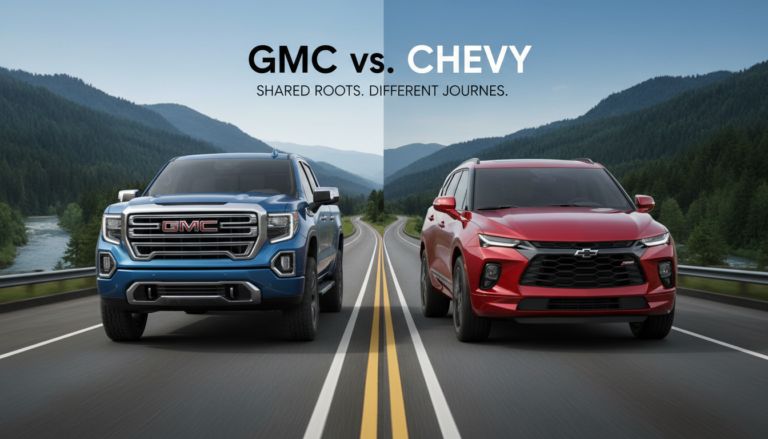
Ford F150 vs Chevy Silverado
This final comparison helps buyers make informed choices. It highlights the main strengths and weaknesses of each truck. This summary is short and focused, helping you find the right truck for your needs.
Head-to-head summary of strengths and weaknesses
The Ford F-150 offers a wide range of powertrains, including hybrid and electric options. It has a top towing capacity near 13,500 lbs and high payload capacity. It also comes with advanced driver aids like BlueCruise and Pro Trailer systems.
But, it might have higher repair costs due to its aluminum body. Also, dealer warranty programs can vary.
The Chevrolet Silverado shines with its strong V8 and Duramax diesel torque. It has a versatile Multi-Flex tailgate and a ZR2 package for off-road adventures. Yet, it has fewer electrified options and some economy trims with less-refined interiors.
Which truck wins by use case: towing, daily driving, off-road, efficiency
For towing and payload, the Ford F-150 is the clear winner. It’s perfect for heavy trailers and commercial tasks.
In daily driving and tech, Ford leads with integrated infotainment and over-the-air updates. It also has a richer suite of driver assists for comfort and convenience.
Off-road, the choice depends on the trim. The Raptor and Raptor R are great for desert running and aggressive terrain. The Silverado ZR2, with Multimatic dampers, excels on technical trails.
Efficiency-wise, the Silverado’s long-haul diesel offers better highway mpg. Ford’s hybrid PowerBoost models and the all-electric Lightning are strong in urban driving, with zero emissions.
Regional considerations (dealership support, incentives, and dealer-specific warranties)
Local dealer offerings and regional incentives impact your purchase and ownership experience. Some Ford dealers offer lifetime powertrain warranties with local service.
Dealerships vary by market in stock, service, and promotions. Always check dealer-specific warranties, incentives, and demo or fleet units before buying.
| Use Case | Ford F-150 | Chevrolet Silverado |
|---|---|---|
| Max Towing | Leads with ~13,500 lbs and strong payload options | Competitive towing; strong diesel torque in Duramax models |
| Daily Driving / Tech | Advanced infotainment, OTA updates, BlueCruise available | Solid systems; good value on higher trims |
| Off-Road | Raptor/Raptor R for high-speed and heavy-duty terrain | ZR2 excels with Multimatic dampers for technical trails |
| Efficiency | Hybrid PowerBoost and Lightning EV for city/highway economy | Diesel Duramax delivers best long-haul mpg |
| Ownership Factors | Strong resale; variable dealer warranties; aluminum body trade-offs | Good durability; fewer electrified mainstream options; value trims |
| Regional Incentives | Some dealers offer lifetime powertrain deals; incentives vary by region | Local promotions and dealer service packages influence net cost |
Conclusion
The debate between the Ford F-150 and the Chevy Silverado comes down to what you value most. The Ford F-150 offers more tech and better towing and payload. It also has hybrid and electric options, plus lots of trailering and driver-assist systems.
For those looking for the best truck for towing and top resale value, the F-150 is a great choice. It’s also known for its integrated technology.
The Chevy Silverado is a strong competitor, though. It has a Duramax diesel and strong V8 engines for better fuel economy and power. The ZR2 and off-road hardware make it perfect for those who need a truck for off-road adventures.
So, what should you do? Match the truck to how you plan to use it. If you need to tow a lot or want hybrid or electric options, the F-150 is a good pick. If you’re looking for diesel efficiency and strong V8 performance, the Silverado is the way to go.
Try out both trucks in your usual driving conditions. Make sure to check the trailering packages and driver-assist features on the exact trim you’re interested in. Also, ask local dealers about warranty and maintenance to get a better idea of the total cost of ownership.
FAQ
Which truck is better for maximum towing — the Ford F-150 or the Chevrolet Silverado 1500?
The Ford F-150 can tow up to 13,500 lbs when set up right. The Silverado 1500 can tow about 13,300 lbs, depending on the engine and setup. The exact towing capacity depends on the truck’s trim and options.
Which truck offers higher payload capacity for heavy hauling?
The F-150 can carry up to 2,445 lbs, making it better for heavy loads. The Silverado 1500 can carry up to 2,260 lbs. If you need to haul heavy gear often, the F-150 is a better choice.
How do the engine lineups compare, including diesel, hybrid, and electric options?
Ford has a wide range of engines: EcoBoost gas, a hybrid, a supercharged V8, and an electric model. Chevrolet offers gas and diesel engines, including a diesel Duramax. The Silverado EV is a separate model, but Ford’s Lightning is a mainstream electric truck.
Which truck is best for fuel economy and long-distance towing?
Diesel Silverados are great for long-distance towing with good MPG. Ford’s PowerBoost hybrid is good for mixed driving. The Lightning is efficient for daily use if you can charge it.
How do off-road trims compare between the F-150 and Silverado?
Ford’s Tremor and Raptor trims are great for off-road driving. The Raptor R has a supercharged V8 for extreme performance. Chevrolet’s ZR2 is for very tough off-road terrain. Raptor is better for speed, ZR2 for technical trails.
Which truck has the better infotainment and driver-assist tech?
Ford has large screens and connectivity, including SYNC 4 and OTA updates. Chevrolet has a 13.4-inch touchscreen with Google on higher trims. Ford’s BlueCruise is available on more trims than Chevrolet’s Super Cruise.
What are the warranty and ownership differences to consider?
Both trucks have similar warranties. But, some dealers offer extended warranties. Ownership costs depend on fuel type and repair costs. Check dealer offers before buying.
Which truck holds value better and which is cheaper to own long term?
The Ford F-150 usually holds its value better. But, total cost of ownership depends on many factors. Consider fuel type and local incentives to estimate costs.
How do bed features and tailgates compare between the two trucks?
Ford has bed utility with outlets and power tailgates. Chevrolet has the Durabed and a Multi-Flex tailgate. Ford focuses on power and accessories, while Chevrolet emphasizes bed size.
If I mainly tow heavy loads versus daily driving with family, which truck should I choose?
For towing, the Ford F-150 is better with its higher figures and tech. For daily driving, the Silverado is good with its diesel or V8. Choose a cab size and trim based on your needs.
Are there regional differences or dealer incentives that affect buying one over the other?
Yes. Dealer inventories and incentives vary. Local promotions can change the cost. Always check local offers and warranty conditions before buying.