Ford Edge vs Chevy Equinox: Which SUV Is Worth It?
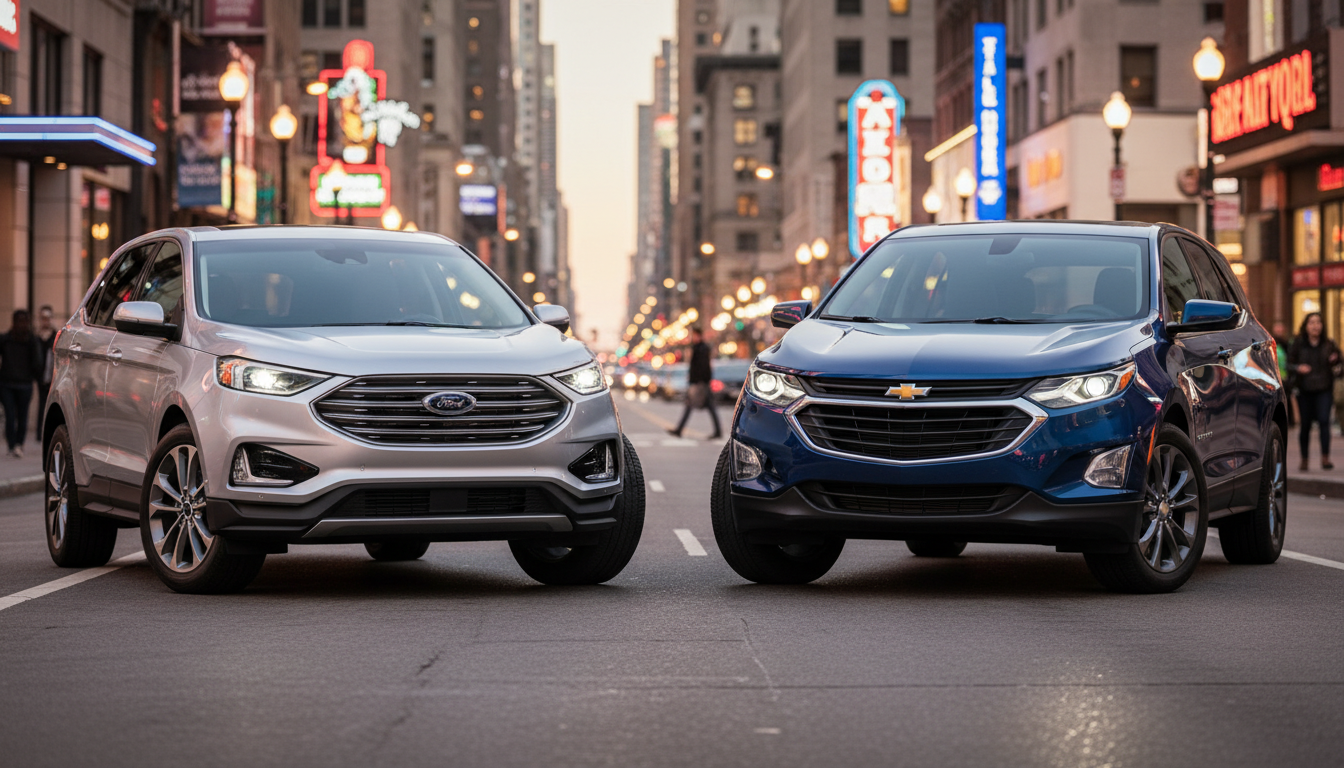
We helps U.S. shoppers see what truly separates these two popular two-row crossovers. It highlights price, fuel economy, cabin space, safety tech, and real-world usability so you can decide faster.
Price and efficiency matter: the more affordable model starts around $30,795 with about 26 city / 29 highway MPG, while the pricier option begins near $39,960 and trades a bit of fuel economy for stronger performance and more interior room.
It will go beyond MSRP. It will weigh standard features, upgrade paths, and whether added capability is worth the cost. Expect clear notes on horsepower and towing, second-row comfort for car seats, and parking aids for crowded lots.
Specs vary by model year and trim. The numbers cited here are concrete and chosen to explain what those differences feel like behind the wheel.
Price, trims, and overall value for U.S. SUV shoppers
Choosing starts with the sticker. The starting MSRP for the more affordable crossover is $30,795; the pricier model begins near $39,960. “Starting” means the base trim before taxes, dealer fees, or optional packages are added.
Starting MSRP comparison: Equinox vs Edge
At base level, a lower MSRP helps buyers hit monthly payment targets and avoid costly add-ons. Budget-first shoppers who mainly commute and run errands will likely find the entry price attractive and practical.
What you get for the price: standard features and upgrade paths?
Value is more than the first number. The higher-priced model typically offers more interior room, stronger highway power, and extra technology on select trims. To match some convenience options on the pricier crossover, buyers often pay for packages on the cheaper model.
- Base price is only a starting point—AWD, upgraded infotainment, and park aids raise the total.
- Think of upgrades as an insurance policy: add them if you need towing, cargo room, or highway confidence.
- Lower running costs from better fuel economy may favor the cheaper model for high-mileage drivers.
| Model | Starting MSRP | Base strength |
|---|---|---|
| chevy equinox | $30,795 | Efficient daily driver |
| ford edge | $39,960 | Stronger performance & tech |
Decision guide: choose the lower-cost option if your trips are mostly local and fuel economy matters. Pay up front for the pricier model if you need extra towing, passenger space, or built-in conveniences and want them without heavy option stacking.
Ford edge vs Chevy equinox performance, engines, and fuel economy
Engine and transmission choices determine how confident a crossover feels on ramps and highways.
Standard engine specs and everyday feel
The base engine in the chevy equinox is a 1.5L turbo I4 with 175 hp and 203 lb-ft of torque. It suits commuting and light loads, offering good fuel economy for city/highway mixes.
The ford edge starts with a 2.0L EcoBoost I4 rated at 250 hp and 280 lb-ft. That extra power and torque makes merging and passing easier, especially on grades or when loaded.
Available powertrains and upgrade path
Equinox keeps a single-engine approach for simplicity. The Edge offers an upgrade path, including a 2.7L EcoBoost V6 with 335 hp and 380 lb-ft for drivers who want more performance.
Transmission, MPG, and real-world performance
Edge’s 8-speed automatic holds gears and feels more direct during spirited passing. Equinox uses a CVT in FWD trims for smoothness, and an 8-speed automatic when AWD is chosen.
| Spec | Equinox | Edge |
|---|---|---|
| Engine | 1.5L I4, 175 hp / 203 lb-ft | 2.0L I4, 250 hp / 280 lb-ft (2.7L V6 optional) |
| MPG (city/highway) | 26 / 29 | 21 / 28 |
| Towing capacity | Up to 1,500 lbs | Up to 3,500 lbs |
0–60 times highlight the gap: a high-output Edge variant can hit about 5.1 seconds, while an AWD Equinox is nearer 8.6 seconds. That difference matters on short on-ramps and when passing at highway speeds.
Towing capacity differences are practical: the larger capacity fits a small utility trailer, lightweight pop-up, or a couple of jet skis. Always confirm payload and hitch ratings before towing.
All-wheel drive is standard on the Edge and optional on the Equinox. AWD helps traction on wet roads, light snow, or gravel, but it’s not a substitute for winter tires.
Tip: take a highway test drive to judge power delivery, transmission feel, and adaptive cruise or automatic emergency system behavior under real conditions.
Interior comfort, second-row room, and cargo space
Interior measurements tell a clear story about daily comfort for families and frequent travelers. Passenger volume and legroom numbers help buyers picture life inside the cabin.
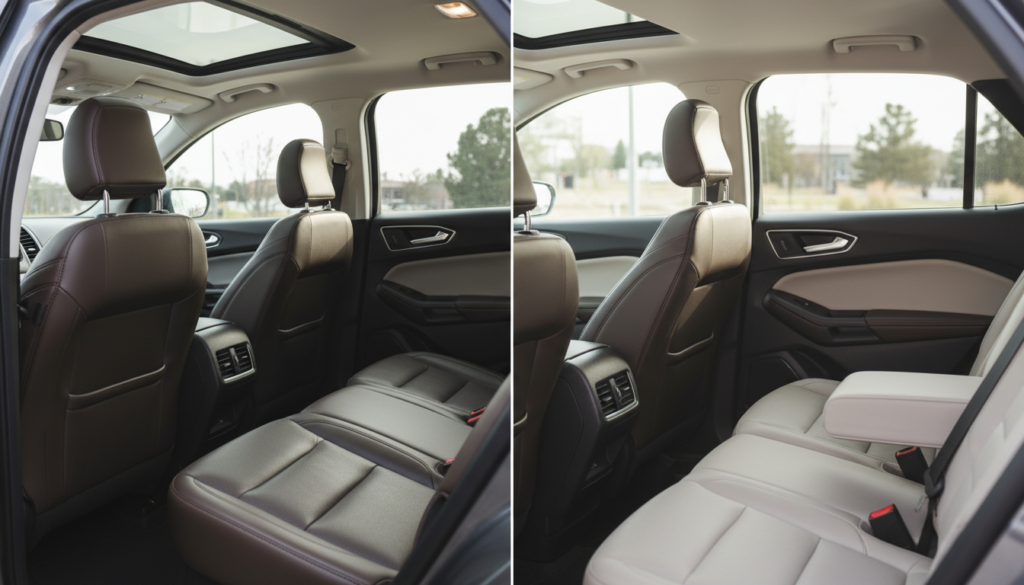
Passenger volume and overall interior space
Passenger volume: the larger model lists 113.9 cubic feet versus 103.5 cubic feet. That extra space translates to an airier cabin and more shoulder room for adults.
Legroom where it matters?
Front legroom measures 42.6″ in the larger vehicle and 40.9″ in the smaller one. More inches up front cut fatigue when driving long distances and improve visibility behind wheel.
Second row legroom is 40.6″ versus 39.9″. Those extra inches matter for boosters, rear-facing car seats, and tall teens.
Cargo capacity and max cargo with seats folded
Behind the second row, cargo space is about 39.2 cubic feet compared with roughly 29.9 cubic feet. That makes daily hauling—groceries, a stroller, or sports gear—easier without stacking items high.
With seats folded, max cargo ranges by source. The smaller model reaches about 63.5–63.9 cubic feet; the larger is listed between 63.5 and 73.4 cubic feet depending on model year.
| Spec | chevy equinox | ford edge |
|---|---|---|
| Passenger volume (cu ft) | 103.5 | 113.9 |
| Second row legroom (in) | 39.9 | 40.6 |
| Cargo behind second row (cu ft) | ~29.9 | 39.2 |
| Max cargo with seats folded (cu ft) | 63.5–63.9 | 63.5–73.4* |
Quick packing examples: several carry-on suitcases, a folded stroller, or a medium dog crate fit more easily in the larger cargo bay. The other model still offers usable room for daily needs.
Safety features and driver-assist technology for daily driving and parking
Everyday safety features can turn stressful traffic and tight parking into routine tasks. This section compares the core driver-assist tech that matters on commutes and in crowded lots.
Standard safety tech: automatic emergency braking, lane-keeping, and alerts
Automatic emergency braking helps stop the car or reduce speed when a collision is likely. It is most useful in stop-and-go traffic and sudden slowdowns.
Lane-keeping alerts and gentle steering assists reduce fatigue on long drives. They support an attentive driver, not replace one.
Blind spot monitoring and trim-level availability
The ford edge includes blind spot monitoring and cross-traffic alert as part of its standard safety suite. That adds real value for highway lane changes.
The chevy equinox offers similar AEB and lane-keeping, but blind spot monitoring often requires a higher trim. Trim differences change the practical value of safety features.
Parking and camera systems: active park assist vs front/rear park assist
Enhanced Active Park Assist can steer into parallel or perpendicular spaces and handle sensing, while front/rear park assist mainly warns of nearby obstacles.
Available surround view camera systems and a digital rearview mirror reduce stress in tight U.S. parking lots or when cargo blocks the rear view.
| Feature | Typical availability | Everyday benefit |
|---|---|---|
| Automatic emergency braking | Standard | Helps in sudden slowdowns |
| Blind spot monitoring | Standard on edge, optional on equinox | Eases lane changes |
| Active park assist / Park assist | Available on higher trims | Makes tight parking easier |
Tip: during a test drive, try a tight parking maneuver and a lane-change with alerts on to judge how natural the system behavior feels. Also test adaptive cruise on the highway to see how the broader driver-assist system handles traffic flow.
Conclusion
The choice comes down to monthly cost versus capability. The chevy equinox wins on starting price and fuel economy, so it suits commuters and budget-first shoppers who want low running costs.
The ford edge answers buyers who need more power, interior room, and towing capacity for weekend gear or small trailers. Its extra space and stronger highway performance make it better for families and road trips.
Match to your life: choose the budget-first commuter if economy and value matter. Choose the capability-first driver if cargo, towing, and highway confidence are priorities.
Before buying, plan a short test drive that includes a highway merge, a rough patch of road, and a parking maneuver. Then check current incentives, compare trims side-by-side, and confirm features by model year. If you outgrow a two-row SUV, the brand lineup — including the ford f-150 — offers larger options to consider.
FAQ
Which model offers a stronger standard engine and more horsepower?
The midsize model comes with a higher-output standard engine that delivers noticeably more horsepower and torque than the compact rival’s single-engine setup. That translates to stronger passing power and a more confident feel on highways and merging lanes.
How do fuel economy and real-world MPG compare for daily commuting?
The compact option generally posts better EPA numbers in combined and city driving thanks to lighter weight and smaller displacement. The midsize vehicle sacrifices a bit of efficiency for performance, so expect lower MPG on stop-and-go routes but similar highway figures when both are equipped with available all-wheel drive.
Which offers more second-row legroom and passenger comfort?
The larger crossover provides more rear-legroom and shoulder space, making it a better choice for families or taller passengers. The compact still seats three across but is best for two adults in the second row for longer trips.
What about cargo capacity with seats up and folded down?
Behind the rear seats the compact delivers usable daily cargo volume, while the midsize model offers significantly more cubic feet both behind the second row and with seats folded. The larger vehicle also tends to fold seats flatter for easier loading of bulky items.
Are advanced safety systems standard or optional across trims?
Both models include core safety features like automatic emergency braking and lane-keeping aids on most trims. Higher-level items — adaptive cruise control, surround-view cameras, and advanced parking assist — appear on upper trims or option packages, so check trim sheets when shopping.
Which one to choose for towing and hauling small trailers?
The midsize option has higher published towing capacity on properly equipped models and is better suited for light trailers, bike racks, or small boats. For occasional towing the compact can manage lighter loads, but its capacity is noticeably lower.
How do transmissions and driving feel differ between the two?
The larger vehicle typically uses an 8-speed automatic that prioritizes smooth shifts and stronger low-end response. The compact favors a simpler transmission tuned for efficiency, which can feel less responsive during hard acceleration but helps fuel economy in daily driving.