
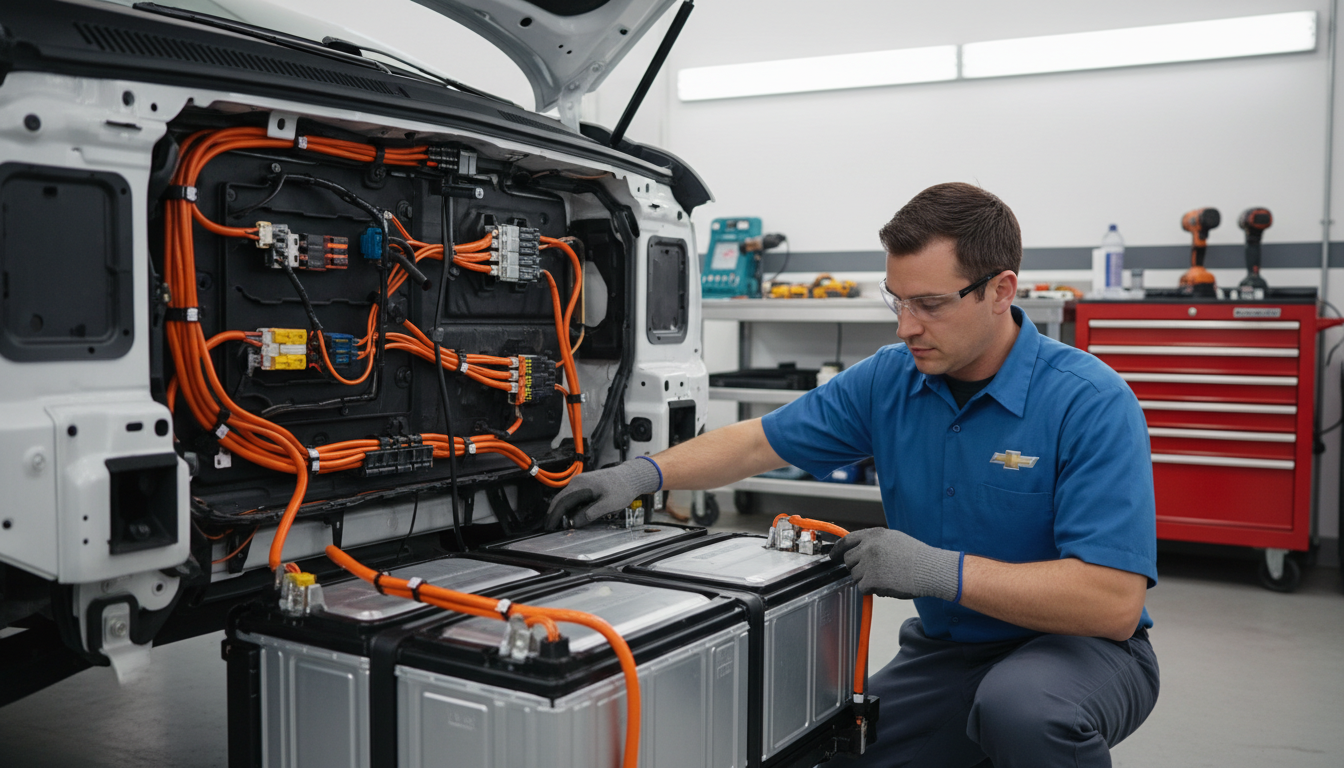
Chevy Volt Battery Replacement: A Step-by-Step Guide
We helps U.S. owners decide what to do when a high-voltage system starts acting up. It focuses on clear, practical choices rather than hype and marketing claims.
How to spot failure signs, a realistic 2025 budget range, the main service options, and typical installation steps. It defines confusing terms pack vs modules, remanufactured vs used, and capacity testing in plain language so non-technical owners can follow along.
Price listings online can be confusing. Some quotes show parts-only numbers while others include labor, diagnostics, programming, and disposal. Expect a wide range depending on generation, chosen pack, and shop rates.
The goal is a confident decision whether that means a full swap, module repair, or walking away if costs exceed the car’s value. High-voltage work is not a typical DIY job; professional service is usually the safest path.
Is Your Chevrolet Volt Battery Failing? Signs It’s Time to Act
Spotting the right early symptoms can save time and money before a major repair.
Common warning signals include dash alerts, a sudden drop in electric range, or charging that takes longer than usual. Owners often notice one of these first and then start researching options.
Compare today’s EV miles to your own driving baseline rather than the original EPA number. A steady loss of practical range on routine trips is more telling than a single cold-weather day.
Everyday drivability can change too. Expect sluggish acceleration in EV mode, the gas engine running earlier, and worsening fuel economy as the hybrid system compensates.
- Not every symptom means the whole pack is bad 12V faults, cooling faults, or software errors can mimic serious issues.
- First diagnostic steps: scan for trouble codes, check cooling performance, and request a capacity or battery health test before paying for a full swap.
Why diagnosis matters: replacing a pack when a smaller fix will do is costly. Act sooner rather than later; delays can limit drivability and complicate service plans.
Chevy Volt Battery Lifespan in the U.S.: What Owners Typically See?
Real-world use shows these packs age over years, with common thresholds where major service becomes likely.
Typical longevity and mileage
Most packs last about eight to ten years with proper care. In U.S. driving, owners commonly reach roughly 100,000 150,000 miles before considering major work.
Normal aging vs failure
Expect gradual range loss over time. Sudden drops or repeated fault codes are more concerning than steady decline. Many packs keep working past the mileage range with reduced capacity.
- Big wear accelerators: high heat (long summers), sustained high-load or high-speed use, and long storage at extreme state of charge.
- Buying note: a 2013 model with original pack carries more risk than a 2018 with documented service history.
Simple habits to help longevity: keep cooling-system maintenance up, avoid long-term storage fully charged or nearly empty, and don’t ignore warning lights. These steps protect battery health and can change what owners will pay in future costs and time.
| Factor | Typical effect | Action |
|---|---|---|
| Age (years) | 8–10 | Monitor capacity |
| Mileage | 100,000 150,000 miles | Plan service options |
| Stress (heat, loads) | Faster wear | Change driving or storage habits |
Chevy Volt Battery Replacement Cost in 2025: Realistic Price Ranges
Understanding realistic 2025 costs helps owners avoid sticker shock and bad comparisons. Most installed replacements land around $4,000–$10,000. That band is wide because parts, labor, and add-ons vary a lot.
Parts-only listings can look tempting. They often show a low price for a pack without labor, coding, or testing. Ask for an installed total so you know the full cost.
- New OEM/OEM-equivalent: parts $5,000–$8,000; installed about $6,500–$10,500.
- Quality remanufactured: parts $3,500–$6,000; installed $4,500–$8,000.
- Used (salvage): parts $2,000–$4,000; installed $3,000–$6,000.
- Module repair: parts $500–$2,000; installed $800–$3,000.
Labor drives totals. A dealership often has higher hourly rates than an independent hybrid shop. That difference alone can push a quote well above the midrange price.
| Line item | Typical effect | Ask for |
|---|---|---|
| Diagnostics & testing | Adds $100–$400 | Itemized fee |
| Towing / shop supplies | Adds $50–$300 | Included or listed |
| Software/calibration | Required post-install | Confirm in estimate |
Practical tip: demand an itemized estimate and confirm if coding, calibration, and post-install testing are included. If a quote is vague or unusually high, get a second opinion from a hybrid/EV specialist.
Battery Pack Options: New vs Remanufactured vs Used vs Module Repair
Choosing the right pack option shapes long-term cost, performance, and peace of mind.
Four choices dominate the market: a new OEM or OEM-equivalent pack, a quality remanufactured pack, a used salvage pack, or a module/section repair. Each option trades price, risk, and warranty length differently.
New OEM / OEM-equivalent
Best performance and longest confidence. Expect top-grade parts, full capacity return, and the longest warranties. Typical 2025 installed price: $6,500–$10,500.
Quality remanufactured
Value with tested modules. Modules are inspected, rebalanced, and reassembled. Warranties are mid-length and the installed price usually sits around $4,500–$8,000.
Used (salvage)
Lowest upfront price but higher risk. Unknown heat or crash history can shorten life. Installed ballpark: $3,000–$6,000. Warranties are often limited.
Module / section repair
Cheaper short-term fix. Replace weak modules only. Installed cost typically runs $800–$3,000, but it can be temporary on an aging pack.
- Match quotes like-for-like: battery type, warranty length, diagnostic and programming work included.
- Choose new for a newer model or long ownership horizon; remanufactured or used can suit lower-value, high-mileage cars.
| Option | Installed Price (2025) | Typical Warranty | Risk / Notes |
|---|---|---|---|
| New OEM / OEM-equivalent | $6,500–$10,500 | Long (years) | Best performance, highest price |
| Quality remanufactured | $4,500–$8,000 | Mid-length | Good balance of cost and quality |
| Used (salvage) | $3,000–$6,000 | Short or limited | Lowest cost, unknown history |
| Module / section repair | $800–$3,000 | Varies | Cost-effective short-term, may repeat |
Gen 1 vs Gen 2 Volt Battery Pack Differences That Change Your Budget
Generation matters because model year determines pack design, usable capacity, and often the installed price. Owners should identify their model year group before comparing quotes so they don’t shop for the wrong hardware.
Gen 1 (2011–2015)
These older models are more likely to be out of warranty in the U.S. Specialty shops commonly offer rebuild or reman options for Gen 1 cars.
Typical all‑in quotes often range from about $4,000–$8,000 depending on warranty length and pack type. That availability can lower prices but may shift the repair‑vs‑value decision for older vehicles.
Gen 2 (2016–2019)
Later models use higher usable capacity packs and costlier hardware. Parts prices trend higher, so installed totals commonly reach toward $9,000–$10,000 at many shops.
For Gen 2 cars, higher residual value often makes investing in a quality pack easier to justify.
- Quick ID tip: if your model year is 2011–2015 it’s Gen 1; 2016–2019 is Gen 2. Use that when you call shops.
- Always ask what exactly is being installed (new, reman, or used) and the warranty length those two items explain most price differences.
| Generation | Model Years | Typical All‑In Price Range | Notes |
|---|---|---|---|
| Gen 1 | 2011–2015 | $4,000–$8,000 | More reman/repair options |
| Gen 2 | 2016–2019 | $9,000–$10,000 | Higher capacity, higher parts cost |
Warranty Coverage and Eligibility: Don’t Pay Out of Pocket Too Soon
Before authorizing paid work, confirm any remaining factory warranty so you avoid unnecessary out-of-pocket costs.
Baseline federal coverage
The common high‑voltage baseline is 8 years / 100,000 miles. Many owners find this covers most serious faults that trigger error codes.
State and extended programs
Some state programs extend warranty coverage to as much as 10 years / 150,000 miles. Check local consumer protections and emissions rules.
What to request before paying?
Always ask for an official capacity or battery health test and a printed report. “Feels weak” is not qualifying evidence.
- Gather service history, diagnostic codes, and records of prior battery repairs.
- Confirm whether the vehicle’s active coverage applies to the specific fault.
- If coverage is active, dealer channels often simplify claims; if not, independent shops may offer better value.
| Item | Why it matters | Action |
|---|---|---|
| Capacity test | Proof of loss | Request printed report |
| Service records | Shows maintenance | Collect receipts |
| Prior repairs | Affects coverage | Document dates and shops |
Finally, confirm any replacement pack carries its own warranty and ask what actions could void either the vehicle’s or the pack’s coverage.
Where to Buy a Volt Battery: Dealerships, Hybrid Specialists, and Online Sellers
Buyers typically choose among three channels: a dealership, an independent hybrid/EV specialist, or an online third‑party seller. Each route balances cost, warranty support, and post‑sale help differently.
Dealership pros and cons
Dealerships supply OEM parts and a clear warranty path. Service follows standardized steps and paperwork helps claims.
Expect higher prices in many metro areas, but simpler warranty handling and factory data access.
Independent hybrid/EV specialists
Independent shops often offer fixed‑price service packages and deep pack expertise. They can undercut dealership prices while including install and testing.
Choose a specialist for transparent installed pricing and an expert who knows Volt pack quirks.
Third‑party and online sellers
Online packs can be the lowest upfront option. Vet carefully: confirm VIN compatibility, pack history (salvage or reman), warranty terms, and post‑sale support.
- Ask every provider the same questions: pack type, warranty length, what labor covers, and whether programming/verification is included.
- Match quotes on like‑for‑like options so prices and risk are comparable.
| Channel | Main advantage | Main risk |
|---|---|---|
| Dealership | OEM parts, straightforward warranty | Higher cost |
| Independent specialist | Competitive packages, expert service | Variable warranty length |
| Online seller | Lowest upfront prices | Unknown history, spotty support |
Installation Options in the United States: In-Shop Service vs Mobile Installation
Installation options vary in cost and convenience, and the right choice depends on access, timing, and risk tolerance.
In-shop installation: lifts, safety, and faster troubleshooting
In-shop service gives technicians full access to lifts, hoists, and shop-grade tools. That setup makes it easier to follow strict safety protocols for high‑voltage work.
Key advantage: immediate diagnostics and deeper troubleshooting if the system won’t initialize.
Mobile installation: convenience and when it fits?
Mobile installation can cut towing costs and save the owner time. It works well when the provider brings the right tools, schedules clearly, and includes post‑install checks.
Good-fit criteria for mobile work include a safe, level work area, permission to work on the property, and confirmation that software resets and road testing are part of the quoted price.
- Verify what the install price covers: removal, installation, software steps, road test, and disposal of the old pack.
- Expect some complications (stuck fasteners, extra fault codes) may still require shop tools and a return visit.
| Option | Main benefit | Main risk | Best use |
|---|---|---|---|
| In‑shop installation | Full equipment, fast diagnostics | Higher shop rates, travel | Complex faults or unknown history |
| Mobile installation | Lower downtime, avoids towing | Limited tools on site | Simple swaps at-home with certified tech |
| Hybrid approach | Initial mobile service, shop follow-up | Two appointments possible | When risk is moderate and schedule tight |
Chevy Volt Battery Replacement Step-by-Step: What the Process Looks Like?
A clear, orderly service flow helps owners know what to expect when a high‑voltage pack is serviced. Below is the typical sequence shops follow so the job is safe and verifiable.
Pre-service checks
Technicians first pull fault codes and read stored battery health data. They also inspect the cooling system because thermal issues often cause recurring faults.
High‑voltage safety
Work begins with power‑down and isolation steps to protect people and the car’s electronics. Shops verify isolation with meter checks before touching high‑voltage connectors.
Removal, replacement, and why labor costs add up?
The pack sits under the car, is heavy, and requires precise fastener torque on reassembly. That handling and vehicle lifts add usable shop time and safety procedures.
Resets, updates, and calibration
After install, techs run system resets and any software updates so modules recognize the new pack. Calibration aligns state‑of‑charge readings and regen behavior.
Post‑install verification
- Confirm normal charging behavior and EV‑mode operation.
- Watch for returning fault codes and perform a road test to check performance.
- Provide documented proof of parts installed, serials, warranty, and any recommended maintenance.
| Step | Why it matters | Expected time |
|---|---|---|
| Diagnostics | Identifies real issues | 30–60 min |
| Safety isolation | Protects techs & electronics | 15–30 min |
| Pack removal & install | Heavy, precise work | 2–4 hours |
| Software & calibration | Ensures correct operation | 30–60 min |
| Verification & road test | Confirms resolution | 30–60 min |
DIY Chevy Volt Battery Replacement: Why It’s Usually a Bad Idea?
High-voltage work demands tools, checks, and habits not found in a typical DIY toolbox. A traction pack can carry lethal voltage, and a single misstep risks serious shock or fire.
High-voltage risks and required equipment
Insulated tools, safety gear, and proper lifting equipment are essential. Technicians use isolation testers, insulated gloves, and vehicle lifts to safely remove and install a pack.
Without those, a driveway swap can go wrong fast: dropped connectors, stripped fasteners, or unseen damaged modules.
How DIY mistakes become expensive problems?
One error can damage sensors, control modules, or wiring harnesses. That multiplies cost and adds bench diagnostics and software work from an expert service.
Warranty complications: many packs and reman units require certified installation to keep warranty coverage. DIY work can void warranties and make claims harder.
- Not comparable to swapping a 12V cell high-voltage protocols differ.
- Making do in a driveway raises safety and legal risks.
- Save money by shopping smarter: compare like-for-like quotes, warranty length, and parts coverage rather than attempting DIY.
| Risk | Consequence | Mitigation |
|---|---|---|
| Shock | Injury, fire | Use certified shop |
| Connector/module damage | Higher repair bills | Professional installation |
| Voided warranty | No coverage | Confirm installer certification |
How Long Does Battery Replacement Take and What Should You Expect That Day?
Plan for the service day so small delays don’t turn into a long wait. Many scheduled jobs finish within a day when the correct parts are on hand and the shop has a booked slot. That one‑day goal is common for routine swaps and programmed installs.
Typical turnaround
With parts confirmed, expect 4–8 hours of shop time. Technicians need time for diagnostics, safe isolation, removal, installation, and software calibration. The final road test and verification may add another hour.
Planning considerations
- Confirm appointment time and ask when the shop will call with status updates.
- Verify parts availability by model year before arrival to avoid delays.
- Know that back‑ordered parts or extra diagnostics can extend the job to multiple days.
- Ask whether post‑install verification and a road test are included; this affects pickup time.
Budget tip: extra shop time can add costs for loaner cars or rides. Planning transport and confirming parts ahead reduces hassle and unexpected costs.
| Item | Typical duration | Why it matters |
|---|---|---|
| Diagnostics & isolation | 30–90 min | Find root cause before major work |
| Pack removal & installation | 2–4 hours | Heavy, precise work |
| Software & road test | 30–60 min | Confirms correct operation |
How to Save Money Without Sacrificing Battery Quality?
A few checks and a structured quote process let owners cut price while keeping quality. Start with clear comparisons and a short list of must‑have inclusions before you sign anything.

Get multiple like-for-like quotes
Ask for two baseline quotes: one from a dealer and one from a hybrid/EV specialist. Insist the same pack category, the same warranty length, and identical inclusions (diagnostics, programming, testing).
Compare new vs remanufactured pricing side by side
Look past headline prices. Match warranty terms and who stands behind the pack. A higher upfront price can be cheaper long term if the warranty covers pack health and labor.
Request itemized estimates and challenge duplicate fees
Demand a written line‑item estimate. Spot duplicate diagnostics, vague shop fees, or repeated labor entries. Ask shops to remove or explain unclear charges.
Use the repair‑vs‑value test
If projected costs approach about 60–70% of the car’s real‑world value, consider selling or trading instead of paying for a full replacement. Negotiate with competing quotes and focus on warranty and post‑install checks, not just the lowest price.
- Force like‑for‑like comparisons.
- Negotiate using written quotes, not emotion.
- Remember: the cheapest option can cost more if warranty support is weak.
Conclusion
A calm, evidence-based approach saves money: verify symptoms with diagnostics, request a capacity report, and balance lifespan against the quoted cost before acting.
Most installed jobs in 2025 land around $4,000–$10,000. Separate parts-only numbers from full installed totals to avoid surprises.
Best-fit logic: new packs give maximum confidence; quality remanufactured units balance price and life; used packs cut upfront cost but carry risk; module repair suits targeted fixes.
Check any active warranty before paying out of pocket. Choose a provider with proven experience, clear estimates, and warranties that match how long you’ll keep the car.
Next steps: gather two quotes, get a battery health report, then decide if repair or replacement supports your long-term plan for your chevrolet volt.
FAQ
How can I tell the high-voltage pack is failing?
Look for warning lights, a sudden drop in electric driving range, longer charging times, sluggish acceleration, or a shift in fuel economy. These signs often show before a full failure; have a professional run a capacity and fault-code test to confirm.
How long do these packs normally last in U.S. use?
With proper care, owners typically see about eight to ten years of service. Many cars reach 100,000–150,000 miles before needing major work. Climate, driving style, and storage at high state of charge accelerate wear.
What will a complete pack change cost in 2025?
Most all-in installed jobs range roughly from ,000 to ,000. Prices vary by new vs. remanufactured units, labor rates, and local fees. Ask shops for itemized estimates that include diagnostics, shop fees, and any towing.
What are the realistic options for replacing the pack?
Choices include new OEM or OEM-equivalent packs (best performance), quality remanufactured packs (mid-price, limited warranties), used salvage packs (cheapest but risky), and module-level repairs (cost-effective when only sections are bad).
Do model years affect cost and availability?
Yes. Early-model packs (Gen 1, 2011–2015) are more commonly rebuilt and cheaper to source. Later packs (Gen 2, 2016–2019) have higher capacity and usually cost more to replace or rebuild.
Am I likely still covered by warranty?
The baseline high-voltage warranty is typically 8 years/100,000 miles. Certain states or programs extend coverage to 10 years/150,000 miles. Before paying, request an official capacity test and written warranty documentation.
Where should I buy a replacement pack?
Options include dealerships for OEM parts and clear warranty paths, independent hybrid/EV specialists for competitive packages, and vetted online sellers. When buying third-party, verify pack history, testing, and seller support.
Should I get the work done in a shop or have a mobile tech come to me?
In-shop service offers lifts, full safety protocols, and faster troubleshooting. Mobile installers add convenience and may save towing fees for straightforward swaps, but confirm their safety equipment and warranty terms first.
What happens during a professional pack swap?
Technicians run pre-service diagnostics, isolate high-voltage systems, remove the old pack, install the new one, perform software updates and calibrations, and verify EV-mode charging and road performance before release.
Can I replace the pack myself to save money?
DIY is not recommended. High-voltage work requires insulated tools, training, and safety procedures. Mistakes can cause severe injury, damage electronics, or void remaining warranties. Use certified pros for safety and reliability.
How long will the service day take?
Most scheduled replacements finish within a day if the shop has the correct part. Allow extra time for diagnostics, software updates, or unexpected findings. Confirm parts availability and estimated turnaround when booking.
Tips to save money without sacrificing quality?
Get multiple like-for-like quotes, compare new vs. remanufactured options, request itemized estimates, and challenge duplicate fees. Use a repair-vs.-value test—if the cost approaches the car’s worth, consider alternatives like module repair or selling the vehicle.