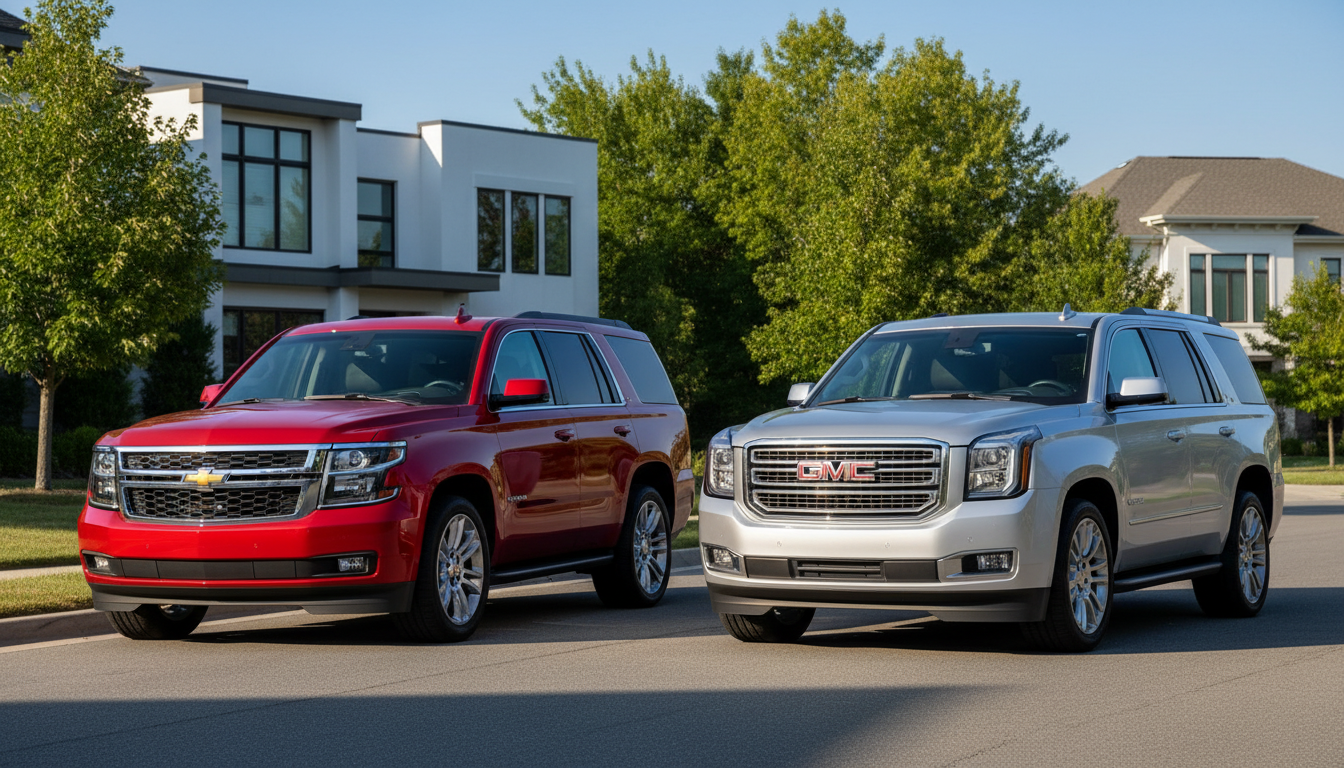
Chevy Tahoe vs GMC Yukon: Off-Road Comparison
This comparison focuses on what U.S. buyers need to decide between two closely related full-size SUVs. The 2025–2026 models share the same platform and three engine options (5.3L V8, 6.2L V8, 3.0L diesel), three-row seating, and similar cargo and passenger space.
Think of this matchup as siblings with different personalities: one leans toward value and lower starting price, while the other packs more standard comfort and premium features. Shoppers should check price, trim packaging, third-row usability, cargo capacity, towing, and overall operating costs first.
This guide points out where they match shared powertrains and interior room and where they split standard tech, luxury-grade trims, and comfort features. Tahoe models often suit value-focused buyers, while GMC Yukon trims reward buyers who want extra appointments without jumping trims.
How to use this guide: start with pricing and trim packages, then confirm third-row and cargo fit for daily life, and finally validate powertrain, MPG, and towing needs. Terminology used here: “row” and “third row” mean seating lines; “payload” is cargo plus passengers; “properly equipped” describes towing capacity with factory options in place.
Chevy Tahoe vs GMC Yukon: quick take for U.S. SUV shoppers
These two full-size SUVs share a lot, but they target different buyers. One is built around value; the other arrives with more standard comfort and higher-end options.
Who each fits best:
- Value-focused buyers: pick the model that gives more features per dollar and keeps MSRP lower.
- Premium-leaning buyers: choose the model that includes more standard comforts and upscale interior touches.
What’s the same under the skin?
The core chassis, three-row layout, and engine lineup are shared. That means baseline towing, seating capacity, and drivetrain options match closely.
What differs where it matters?
Practical ownership differences show up in which trims add heated seats, upgraded audio, driver-assist packs, and nicer materials as standard. Both can be ordered with different seating and 4WD, so the right configuration depends on passenger count and whether you need off-road or winter-ready drive setups.
| Category | Value Model | Premium Model | Why it matters |
|---|---|---|---|
| Standard comfort | Selective options | More features standard | Daily comfort without add-ons |
| Interior materials | Durable, cost-conscious | Higher-grade trims offered | Cabin feel and perceived quality |
| Tech & safety | Available packages | Some systems standard | Convenience and resale value |
| Seating & space | Flexible row layouts | Same layout, different trim choices | How often you use the third row |
Quick decision shortcut: choose the value-minded model when maximizing value per dollar; choose the higher-trim model when you want more standard comfort and an upscale vibe.
We’ll score price/value, daily comfort, tech, MPG, towing, and safety in the next sections to help finalize your pick.
Pricing, MSRP, and overall value
Start your comparison at the sticker: price tells the first story about real-world ownership. A recent snapshot lists a starting MSRP of $63,495 for the value-minded model and about $72,395 for the premium-leaning counterpart. Those figures show the typical gap buyers will see before options.
Lower starting price can still climb fast once you add comfort, safety, and towing packages. Match trims when you compare: don’t compare a base value trim to a luxury trim and call it a tie.
How trims change the final cost?
Higher trims often bundle leather, upgraded audio, and driver assists. That bundling can make a pricier base model reach your must-have list with fewer add-ons.
- Value shoppers: prioritize safety tech, second-row comfort, and only add towing gear if needed.
- Premium shoppers: pick trims that deliver quiet cabins, better materials, and large displays you’ll notice daily.
| Item | Value Model | Premium Model |
|---|---|---|
| Snapshot MSRP | $63,495 | $72,395 |
| Typical advantage | Lower entry price | More standard features |
| Ownership cost tip | Watch fuel and maintenance | Higher resale, higher initial cost |
Recommendation framework: set a budget cap, list non-negotiables (safety, seats, towing), then choose the vehicle that meets those needs with the fewest costly add-ons. Consider economy and fuel impact when selecting engines; big SUVs can swing monthly costs by engine and driving mix.
Trim levels and feature packaging
Trim ladders reveal what each model puts behind the badge and what drivers actually get for their money. Below are the 2025 lineups so you can map intent base, off-road, sporty, near-luxury, and flagship luxury.
2025 Chevy Tahoe trims
LS, LT, RST, Z71, Premier, High Country. These steps let buyers add comfort or capability as needed.
2025 GMC Yukon trims
Elevation, AT4, Denali, AT4 Ultimate, Denali Ultimate. The lineup moves quicker toward premium gear at mid-levels.
| Role | Value Model | Premium Model |
|---|---|---|
| Base | LS | Elevation |
| Off-road | Z71 | AT4 |
| Flagship | High Country | Denali Ultimate |
GMC tends to make heated front seats, a heated steering wheel, and heated second row seats standard sooner than the other brand. The other brand often requires stepping up trims or buying option packages to match that comfort level.
- Real-life value: heated seats shorten cold morning discomfort on short trips.
- Family-first checklist: captain’s chairs vs bench, charging ports in the second row, and quick cabin warm-up for passengers.
- Sweet spot: mid-level trims (Premier or Denali) usually give strong features without flagship pricing.
Interior space, seating, and third row comfort
How a cabin feels in daily life often matters more than a spec sheet for families. These full-size models share identical legroom numbers 44.5 inches front, 42 inches second, and 34.9 inches third so differences are about layout and features.
Second-row choices and family flexibility
Choose a bench to maximize passenger capacity or captain’s chairs for easier access and fewer in-flight squabbles. Captain’s chairs slide and fold to improve third-row entry. Bench seats let you carry up to eight people when needed.
Third-row legroom, access, and real-world comfort
The third row offers usable legroom for kids and short adult trips. Adults fit on short drives; children will be comfortable for longer rides. Note: the third row has top tethers but no lower LATCH anchors.
Seating capacity and cabin feel across all rows
Both models seat up to eight. Tall rooflines and wide seats create a roomy feel even with three rows filled. Rear vents, cupholders, and thoughtful storage keep the cabin practical.
| Attribute | Detail | Why it matters |
|---|---|---|
| Legroom (F/S/3) | 44.5 / 42 / 34.9 inches | Predictable comfort for adults up front and kids in the third row |
| Car-seat fit | 2 lower LATCH (second), 3 top tethers (second), third row tethers only | Easy installs in the second row; third-row tethers support forward-facing seats |
| Second-row options | Bench (8 seats) or captain’s chairs | Bench = max seats; captains = access and comfort |
Recommendation: Families who use the third row often should prioritize captain’s chairs or an easy slide/fold second row for access, plus enough cargo room behind the third row for real errands not just the published volume.
Cargo room and everyday usability
How cargo fits with people is the real test of a full-size SUV. Owners care most about the space left when all seats are occupied and how that space adapts when seats fold.
Space behind the third row and behind the second row
Both models list 25.5 cubic feet behind the third row and 72.5 cubic feet behind the second row. Those numbers mean you can carry groceries and a few bags with all rows in use.
Maximum volume and small differences that matter
Maximum cargo is essentially a tie on paper (about 122.8 vs 122.7 cu ft). Still, real usability changes with load-floor height, the cargo opening shape, and how flat seats fold.
When to consider the extended-wheelbase option?
If the third row is used often carpools, travel teams, or big family trips the longer body adds useful space behind the third row. For example, a stroller, cooler, and two suitcases fit without resorting to a roof box.
- Daily groceries: third row up, easy fit for bags and small boxes.
- Sports gear: third row folded, more room for bags and equipment.
- Home projects: all seats down, near-max volume for bulky items.
| Scenario | Typical usable space | Why it matters |
|---|---|---|
| Family road trips | Extended length helps | More luggage without roof storage |
| Daily errands | 25.5 cu ft behind third row | Enough for everyday needs |
| Maximum hauling | ~122.8 cu ft | Close to identical on paper |
Shopping tip: Bring a stroller, a suitcase, and a gear bag to the dealer and load them with the third row in place. That quick test reveals what specs alone cannot.
Tech and infotainment features shoppers compare most
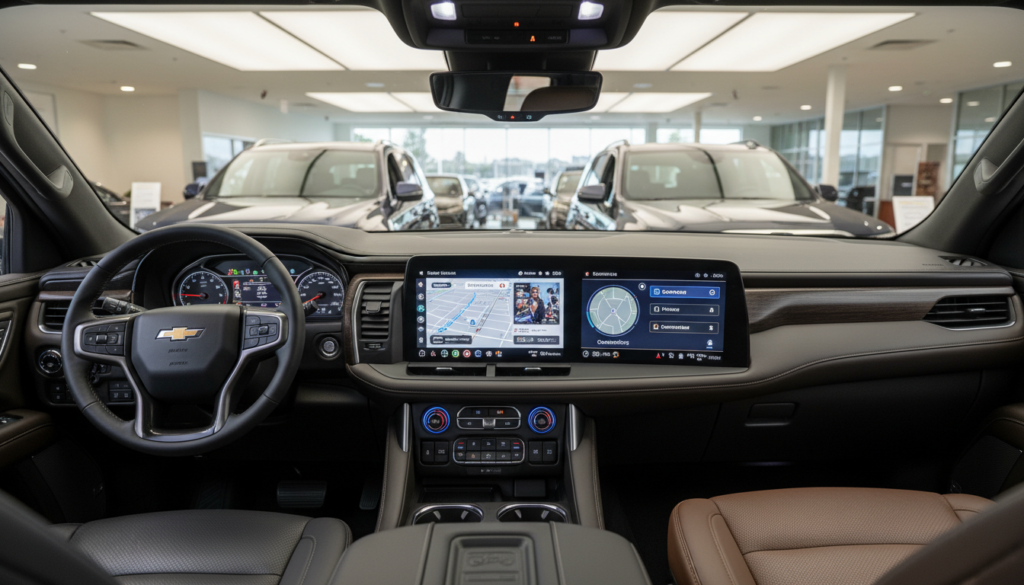
Screen size and system logic matter when you use tech for errands, school runs, and road trips. Both models offer modern touch controls, but real-world ease comes from menus and responsiveness, not inches alone.
Core display and driver aids
The value-minded model has a 17.7-inch touchscreen while the premium-leaning sibling uses a 16.8-inch unit. Both include an 11-inch driver information display and an available 15-inch HUD to keep eyes near the road.
Smartphone integration and daily use
Wireless Apple CarPlay and wireless Android Auto are standard on both. That means pairing is cable-free for quick trips and busy drop-offs.
Audio, rear entertainment, and Yukon-leading tech
Audio options range up to a high-end Bose setup, with the premium model offering an available 18-speaker system.
The gmc yukon adds a rear climate touchscreen and optional Night Vision for buyers who prioritize passenger control and nighttime confidence.
| Item | Value Model | Premium Model |
|---|---|---|
| Main display | 17.7-inch | 16.8-inch |
| Driver display & HUD | 11-inch driver display; 15-inch HUD available | 11-inch driver display; 15-inch HUD available |
| Rear tech | No rear climate touchscreen | 8-inch rear climate touchscreen |
| Night driving | HD Surround Vision and camera views | HD Surround Vision, camera views, Night Vision |
Test-drive script: pair your phone, try voice commands, check camera angles, and confirm rear climate controls are easy to adjust. Notice how the system responds to touch and how the driver displays reduce glance time.
Engines, power, and driving feel
All three available engines shape how these large SUVs drive. Each uses a 10-speed automatic and the same basic hardware, so pick based on load and habit rather than badge loyalty.
Standard 5.3L V8 and who it fits
The 5.3L V8 makes 355 hp and 383 lb-ft. It suits families who haul people, run errands, and tow occasionally. Expect familiar V8 feel, steady midrange power, and balanced fuel use for mixed driving.
Available 6.2L V8 for maximum performance
The 6.2L pushes 420 hp and 460 lb-ft. Choose it if you tow heavy trailers, climb mountains often, or want quicker passing power. It costs more in fuel but gives confident acceleration under load.
Available 3.0L diesel: torque for highway and towing
The 3.0L I‑6 diesel delivers 305 hp and 495 lb-ft. That torque helps relaxed highway cruising, smoother merges, and steadier towing at speed. Diesel is ideal for long hauls and heavy payloads.
RWD vs 4WD: pick by use case
- RWD: better fuel city numbers and fine for warm climates and paved roads.
- 4WD: choose for snow belts, dirt roads, boat ramps, and confidence off pavement.
| Option | Best for | Notes |
|---|---|---|
| 5.3L V8 | Daily driving & light towing | Balanced power and fuel |
| 6.2L V8 | Heavy loads & performance | Higher power, lower mpg |
| 3.0L Diesel | Highway towing | High torque, relaxed cruising |
Quick recommendation: choose the engine first, then the trim that gives the comfort and tech you will use every day. Test low-speed maneuvering, brake feel, and stop‑and‑go response before you decide.
Fuel economy MPG and real-world operating costs
Fuel costs shape ownership more than most buyers expect, especially in full-size SUVs. Expect EPA numbers to vary by drivetrain, tires, and how much weight you carry. Compare trims and options, not just the badge.
EPA-estimated mpg by engine and drivetrain
Typical EPA estimates (examples):
| Engine & Drive | City / Hwy / Combined (mpg) |
|---|---|
| 5.3L RWD | 15 / 20 / 17 |
| 6.2L 4WD | 14 / 18 / 16 |
| 3.0L Diesel 4WD | 20 / 24 / 22 |
City vs highway: which setup to pick?
Gas V8s sit in the mid-teens city and about 20 mpg on the highway. The diesel shines for long trips and towing, returning low-20s in many tests.
- City drivers: expect lower city mpg with stop-and-go traffic; RWD helps slightly.
- Highway drivers: diesel gives the best fuel economy for road miles.
- Power vs economy: larger V8s and 4WD cut mpg for better towing and acceleration.
Finally, use a simple calculator mindset: annual miles × share of city driving × local gas price to see if diesel or extra capability pays off. Remember: towing, roof boxes, and heavy cargo will reduce real-world fuel economy regardless of model choice.
Towing and payload: capability for boats, campers and trailers
Max tow ratings are useful, but the build details decide what you can actually pull. The gmc yukon is engineered to tow up to 8,200 pounds when properly equipped; the chevy tahoe generally matches that capability on similar builds because the engines and chassis are shared.
What “properly equipped” means for buyers?
“Properly equipped” means the right drivetrain, factory towing package, heavy‑duty cooling, correct axle/gear ratio, and rated hitch hardware. The headline pounds properly equipped number applies only to that configuration.
Payload ratings and why they matter?
Payload is the weight you can carry inside the vehicle: passengers, cargo, and tongue weight. The gmc yukon can carry up to 2,120 lbs; the chevy tahoe tops out near 2,020 lbs.
That difference matters on family trips. A full cabin, cooler, two bikes, and trailer tongue weight can eat payload fast even if towing capacity looks high.
Towing tech and camera systems that help
Available trailering tech reduces stress. Features include an Auxiliary Trailer Camera, Blind Zone Steering Assist with Trailering, trailer camera provisions, and Transparent Trailer View. These systems give wider angles and tow‑specific overlays for safer maneuvers.
- Verify receiver size and integrated brake controller availability on the walkaround.
- Check rear camera views and trailer settings in the infotainment system during a test drive.
- Confirm factory tow package items; aftermarket pieces can change ratings.
| Item | gmc yukon | chevy tahoe |
|---|---|---|
| Max towing (properly equipped) | 8,200 pounds | Comparable when similarly equipped |
| Max payload | 2,120 lbs | 2,020 lbs |
| Notable tech | Transparent Trailer View, Auxiliary Camera | Trailer Camera Provisions, Blind‑spot trailer assist |
Recommendation: occasional towing suits the standard V8. For frequent heavy towing or long highway climbs, choose the diesel or the higher‑output V8 and verify the pounds properly equipped on your specific build to protect mpg and drivetrain life.
Safety, driver assistance and reliability signals
Safety tech now shapes daily confidence as much as power or cargo space. Both SUVs include a broad set of standard safety features to reduce common crash risks on highways and in parking lots.
Standard safety features and what they do?
Base systems include Intersection Automatic Emergency Braking, Blind Zone Steering Assist, Rear Cross‑Traffic Braking, and HD Surround Vision. These components aim to prevent or mitigate collisions in routine scenarios.
Automatic emergency braking helps when forward collisions are likely, applying brakes if the driver does not react. It has limits: it won’t see every object, and it cannot replace attentive driving.
Available advanced assists
Adaptive cruise control and hands‑free options like Super Cruise are available on higher trims. These upgrades help highway commuters by maintaining speed, lane position, and distance more easily.
Adaptive cruise control is most useful on long road trips. Hands‑free driving adds convenience but requires driver monitoring and mapped roads to work safely.
Night driving and visibility tech
Visibility matters in large vehicles. The gmc yukon offers Night Vision as an available option to detect pedestrians and animals beyond headlight range. That can be a deciding factor for rural drivers.
The other model provides strong camera coverage and HD Surround Vision but does not offer Night Vision.
Reliability snapshot
RepairPal rates both models as “Above Average” for reliability. That suggests fewer unexpected repairs than average, but routine maintenance and driving style still shape ownership costs over 100k+ miles.
- Buyer checklist: confirm which standard safety features your chosen trim includes.
- Test camera clarity at night and check Rear Cross‑Traffic Braking activation points.
- Verify adaptive cruise control and hands‑free restrictions (mapped highways, driver monitoring).
- Prioritize a trim with key safety tech standard to avoid expensive add‑ons later.
| Feature | Standard | Available / Notes |
|---|---|---|
| Intersection Automatic Emergency Braking | Yes | Operates at low-to-moderate speeds |
| Rear Cross‑Traffic Braking | Yes | Alerts and applies brakes when reversing |
| Adaptive Cruise Control | No (base) | Available on mid and upper trims |
| Hands‑Free Driving (Super Cruise) | No (base) | Available; requires driver monitoring and mapped roads |
| Night Vision | No | Available on gmc yukon only |
Practical stance: if safety tech is a top priority, choose the trim or package that makes these systems standard. That avoids skipping important features later for budget reasons and gives real-world protection from day one.
Conclusion
The right pick depends less on badges and more on how you plan to carry people, cargo, and tow. For many buyers the chevrolet tahoe wins on raw value and flexible trims. The gmc yukon rewards buyers who want more premium content without chasing every option.
Families that use the third row often should test cargo with real gear and try both second row layouts. Commuters should pick engines for better fuel economy rather than extra power they rarely use.
Both SUVs can handle serious towing when properly equipped, so focus on payload, tow packages, and real‑world capability. Pick the trim that bundles the indoor interior comforts and safety items you will use, keeping costly options to a minimum.
Do an apples‑to‑apples test drive on the same route, same seats, and compare real quotes to lock the best deal on the tahoe gmc yukon matchup of interest.
FAQ
Which full-size SUV offers better value—Chevrolet Tahoe or GMC Yukon?
Value depends on priorities. The Chevrolet model generally starts lower in MSRP and gives strong standard equipment for the price. The GMC leans premium, with more luxury touches and higher-level trims that justify the premium for buyers wanting upscale materials and exclusive features.
Are these SUVs built on the same platform and do they share engines?
Yes. Both share a common platform, many powertrains, and a three-row layout. Expect the same 5.3L V8 as the common engine, with available 6.2L V8 and a 3.0L diesel on certain trims — so performance and basic drivetrains are very similar.
What standard safety tech comes with the base models?
Base trims include essential systems such as automatic emergency braking, lane-keep assist, and rear vision cameras. Higher trims add adaptive cruise control, rear cross-traffic alert, and more advanced driver-assist packages.
How much third-row space and seating comfort can families expect?
Both deliver usable third-row seating for kids and shorter adults. Second-row configurations (bench or captain’s chairs) affect access and comfort — captain’s chairs improve entry to the third row and increase family flexibility.
What are the cargo differences behind the third and second rows?
Cargo volume behind the third row is modest but adequate for groceries and small gear. Folding the second row opens substantially more space. For significantly greater cargo capacity, consider the extended-length model like the XL/Denali Ultimate options.
Do they support Apple CarPlay and Android Auto, and are they wireless?
Yes. Both support Apple CarPlay and Android Auto; many trims offer wireless connectivity for daily convenience. Infotainment screen size and available head-up displays vary by trim.
Which engine is best for towing and highway driving?
The 6.2L V8 provides the highest towing and acceleration. The 3.0L diesel delivers strong torque and better highway fuel economy, making it a smart choice for steady long-distance towing and lower operating costs.
What real-world fuel economy should owners expect?
EPA estimates vary by engine and drivetrain. The 5.3L V8 gives balanced city/highway mpg, the 6.2L drops economy when prioritized for power, and the 3.0L diesel yields the best highway mpg. Expect real-world figures to fall below highway estimates when towing or in city traffic.
How much can these SUVs tow when properly equipped?
Maximum towing capacity depends on engine, axle ratio, and trailering package. With the right configuration, both can tow substantial loads — often sufficient for boats and travel trailers. Always check the model’s towing spec and ensure the vehicle is properly equipped and loaded within its payload limits.
Are advanced driver assists like adaptive cruise control standard or optional?
Adaptive cruise control and hands-free driving features are typically optional or tied to higher trims and packages. Standard driver aids cover collision warning and emergency braking; advanced systems require upgrading.
Does the GMC offer unique tech or luxury features not found on the Chevrolet?
The GMC tends to lead in premium offerings: exclusive trim materials, available rear climate touchscreens, Night Vision on select top trims, and more concierge-style amenities. These differentiate the premium feeling and justify higher trim costs.
Which configuration is better for families who need daily versatility?
A second-row captain’s-chair layout paired with the 5.3L engine balances comfort, seating flexibility, and reasonable fuel economy for most families. Choose the diesel or 6.2L only if your priority is towing or highway efficiency/power respectively.