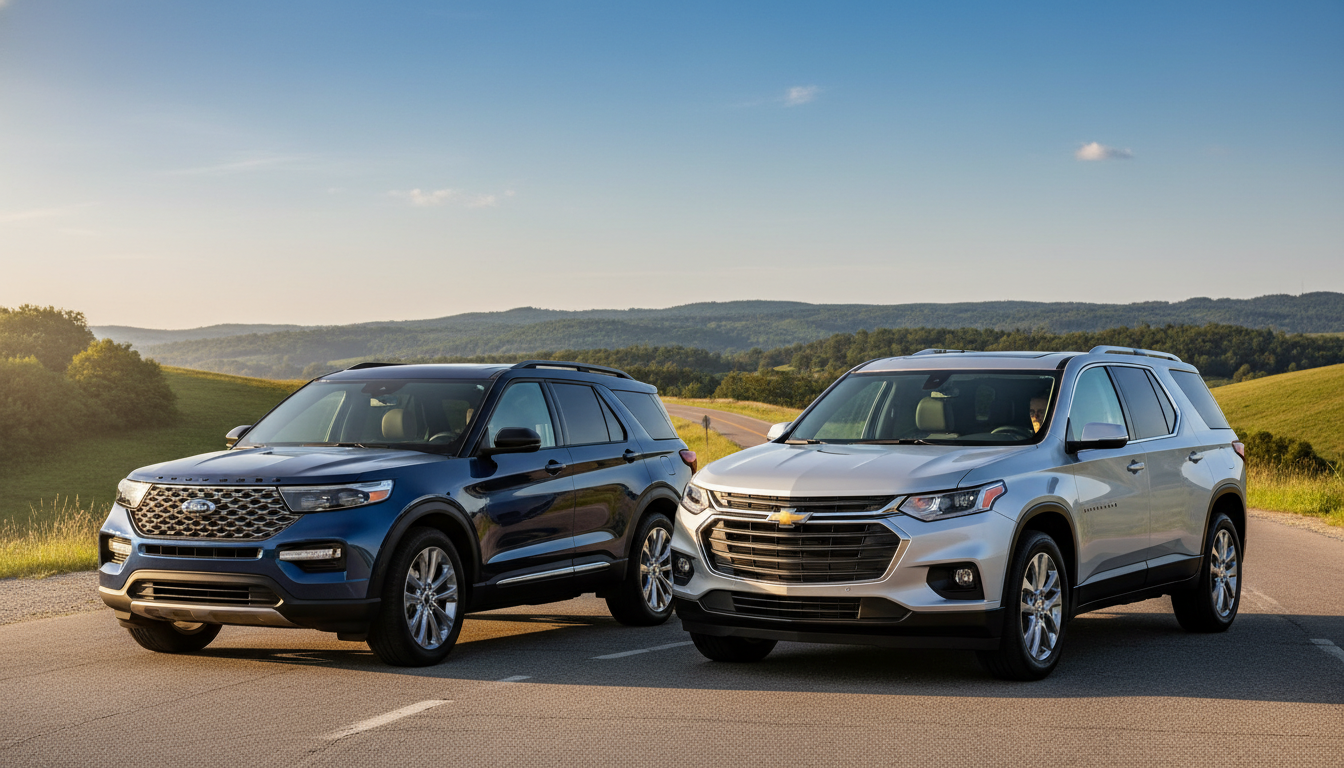
Ford Explorer vs Chevy Traverse: Which SUV is Best?
The US three-row family market narrows to two close choices. Both models start near $40,000, so budget and real-world utility lead many buyers. Shoppers care most about space, tech, safety, resale and how the vehicle feels on daily drives.
This comparison lays out why a 2025 refresh differs from a full redesign. A “refresh” updates cabin tech and styling. A “redesign” changes packaging and dimensions. Those changes affect daily life cargo fit, control layout, and long-term comfort.
Quick preview: the chevrolet traverse often wins for people and cargo room. The ford explorer tends to win on driving refinement and available power, plus hands-free highway tech in higher trims.
The article then breaks down pricing, third-row usability, tech, towing, and real-world tests. Specs and MSRP are cited, then translated into practical impacts like luggage space and ease of controls. Decide your primary use case commute, road trips, carpool, or light towing before choosing a trim and drivetrain.
Ford Explorer vs Chevy Traverse: Quick Take for US SUV Shoppers
Families shopping for a three-row SUV usually pick between cargo room and highway manners. This quick take highlights what changed for 2025 and who each model suits best.
What changed recently: refresh vs redesign?
The 2025 ford explorer arrives with a strong refresh. It adds a new dashboard layout and a larger standard center screen to modernize the interior.
The chevrolet traverse is all-new. The redesign focuses on bigger packaging, especially behind the second and third row, to maximize usable cargo depth.
Who each SUV fits best?
- Maximum space: The traverse usually makes more sense for families that use the third row and haul strollers, sports gear, or airport luggage.
- Driving feel: The 2025 ford explorer tends to satisfy drivers who value sharper steering and stronger acceleration in higher-output trims.
- Daily comfort: Consider control layout (physical knobs vs. large screens), ease of loading kids, and cabin calm at highway cruising speeds.
| Trait | 2025 ford explorer | chevrolet traverse |
|---|---|---|
| Primary strength | Driving dynamics and available power | Interior packaging and cargo depth |
| Recent update | New dash and larger center screen | Full redesign for more space |
| Best for | Highway miles and driver engagement | Families needing third-row seating and cargo |
Bottom line: Both compete closely on price and towing. Choose the model that matches seating needs and preferred driving character rather than hoping one is simply “better.”
Price, Trims and Value in the United States
Sticker price is where most SUV decisions begin, but it rarely tells the whole story. The listed starting MSRP excludes destination charges, dealer fees, and popular options that add quickly to the final bill.
Starting MSRP and what it means?
Starting ranges: the 2025 ford explorer lists at about $40,050–$40,160, while the chevrolet traverse starts around $40,700–$42,795. Those numbers are baseline figures for the U.S. market.
Top-trim examples and real totals
Compare similarly equipped top trims: a Traverse RS AWD totals roughly $58,090 (destination included). A Explorer Platinum AWD with common options can reach about $59,865.
What buyers actually get?
Base trims often include useful safety and convenience tech. Expect items like adaptive cruise control, heated front seats, push-button start, blind spot monitoring, power liftgate, navigation, and basic towing hardware.
- Chevrolet may bundle a surround-view camera system at base price; on the other model it can be optional depending on package choice.
- Choose trims by required seating and drivetrain (FWD vs AWD) those choices often move the final price more than small cosmetic options.
| Item | Starting MSRP (approx.) | Top-trim totals |
|---|---|---|
| Entry-level | $40,050–$42,795 | – |
| High-end AWD | – | $58k–$60k |
| Key standard tech | Adaptive cruise, blind spot monitoring | Premium audio, advanced driver assist |
Cross-shop sanity check: if you’re also looking at a Hyundai Santa Fe, use these pricing notes to compare which trims include the safety features you need. When price is close, let space, controls, and long-term costs decide the winner.
Shopping takeaway: filter trims first by seating and drivetrain, then pick two must-have features (for example adaptive cruise and blind spot monitoring). That trims the options and keeps your budget realistic before you consider high-end packages.
Exterior Size, Styling and Practical Details
A few extra inches in overall length change how an SUV performs for families. The longer model measures 204.5 inches while its rival is 198.7 inches. That difference shows up in cargo depth and third-row usability.
Dimensions and presence
The extra length helps deliver more usable rear space and deeper cargo behind the third row. Expect easier installation of bulky items and better luggage fit for road trips.
On the flip side, the longer side profile makes tight parking and garage maneuvering slightly trickier.
Lighting and visibility
Both suvs use premium LED projector headlamps. One adds animated lighting in select trims, while the other uniquely offers LED fog lamps for improved low-angle illumination.
Good lighting makes nighttime highway merges and suburban early-morning departures feel safer.
Towing, wheels and daily utility
Both models are rated to tow up to 5,000 lbs capacity. That covers small campers, utility trailers, or a pair of jet skis though payload and tongue weight still matter.
| Feature | Example | Note |
|---|---|---|
| Length | 204.5 in vs 198.7 in | More cargo depth vs easier maneuvering |
| Wheel sizes | 22-inch vs 21-inch | Larger wheels can hurt ride comfort and cost more to replace |
| Towing | 5,000 lbs | Useful for small tow tasks; check tongue weight limits |
- Mirrors and side view aid everyday confidence when changing lanes.
- Larger wheels improve looks but may reduce ride smoothness and raise tire costs.
Size on the outside only matters when it adds usable interior room. The next section looks at how that translates to cabin space and third-row comfort.
Interior Quality, Controls and Tech Features
Interior tech and control layout shape daily comfort as much as raw space. From the driver seat, screen size and control style decide how quickly you find what you need.
Screen and gauge cluster comparison
The chevrolet traverse uses a large 17.7-inch screen paired with an 11-inch digital gauge cluster. That big center display makes media and maps easy to read from a distance.
The ford explorer keeps a 13.2-inch touchscreen and a 12.3-inch digital cluster. The slightly larger cluster helps with speed, navigation prompts, and driver-assist status without glancing down.
Comfort, seats, and climate controls
Both models offer heated and ventilated front seats. The ford explorer adds front-seat massage, which can reduce fatigue on long highway runs.
Physical knobs on the traverse mean faster climate adjustments when kids are noisy. The other cabin tends to route more functions through the screen, which looks modern but can be slower to use in traffic.
Audio, cameras, and daily usability
Audio systems differ: a 14-speaker B&O setup aims for richer clarity and stronger bass control, while a 10-speaker Bose system emphasizes balanced sound for voices and music.
Both often include a 360-degree camera for tight parking. The traverse also offers a rear camera mirror, useful when cargo stacks block the rear view.
| Feature | chevrolet traverse | ford explorer |
|---|---|---|
| Center screen | 17.7-inch | 13.2-inch |
| Gauge cluster | 11-inch | 12.3-inch |
| Audio | 10-speaker Bose | 14-speaker B&O |
Try-before-you-buy checklist: test the climate controls, connect your phone, adjust the steering wheel, and confirm camera views feel intuitive within five minutes.
Seating, Third Row and Cargo Capacity for Real Life
Real family life tests an SUV in two areas: how many people fit and what gear they carry.
Second-row comfort and family features
Second-row livability matters on carpools and road trips. Look for rear climate controls, dedicated vents, multiple USB ports, and heated rear seats for cold mornings.
Power outlets and easy-to-reach ports keep tablets and cameras charged without tugging cords across the cabin.
Third-row seating, access and folding
The chevrolet traverse fits three across in the third row, enabling up to eight passengers depending on second-row setup. The ford explorer limits the 3rd row to two seats, capping seating for larger groups.
Access matters: sliding second-row seats help, but the tilt-forward mechanism on the larger model lets parents keep child seats latched while getting passengers in and out.
Cargo with rows up and row folded
Think in use cases: behind the third row is the “stroller and groceries” test. Numbers: the larger SUV offers about 22.9 cu ft behind the 3rd row, 56.6 cu ft behind the 2nd row, and 97.6 cu ft max. The other model provides roughly 16.3 cu ft, 46.0 cu ft, and 85.3 cu ft respectively.
Power practicality
Both models include a power-folding third row. The bigger cabin also adds power-fold buttons for the second row, which saves time when your hands are full.
| Item | Seating | Cargo behind 3rd row (cu ft) | Notes |
|---|---|---|---|
| chevrolet traverse | Up to 8 (3-across 3rd row) | 22.9 | Tilt-forward access; power 2nd-row buttons |
| ford explorer | Up to 7 (2-across 3rd row) | 16.3 | Smaller 3rd row, power-fold 3rd row |
| Practical test | Daily passengers | Stroller/groceries vs weekend gear | Pick based on how often the 3rd row is used |
Decision shortcut: if the third row is used often and you carry gear at the same time, the larger interior capacity is the smarter choice. If the 3rd row is occasional, the smaller footprint may be sufficient and easier to park.
Power, Steering, and On-Road Performance
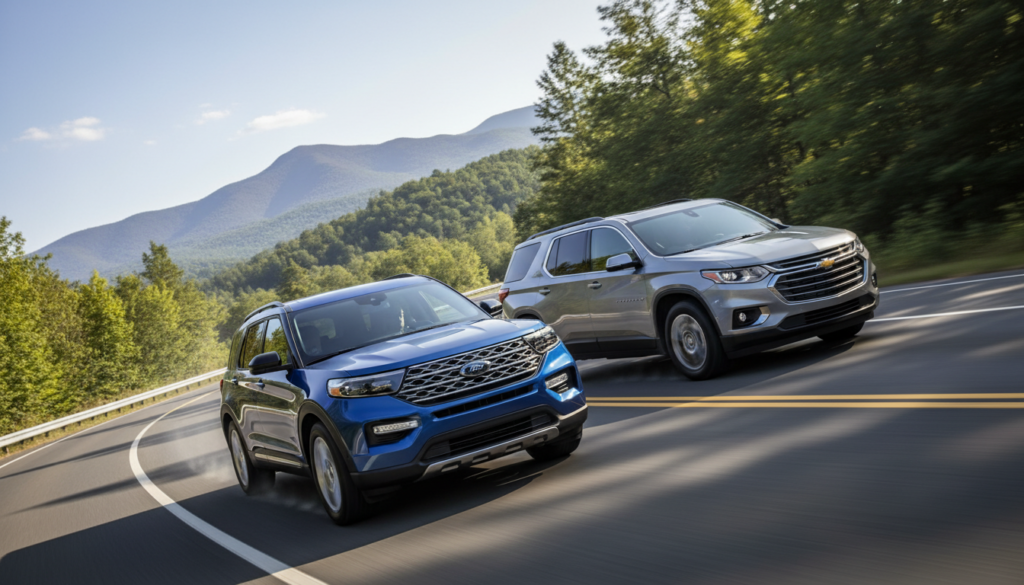
Power delivery and steering feel are the traits drivers notice first when daily miles add up. This section compares available engine choices, gearbox behavior, and how each SUV behaves on streets and highways.
Engine options and output
The lineup offers two distinct approaches. One model can be fitted with a 3.0L twin-turbo V6 that makes about 400 hp and 415 lb-ft. The other uses a 2.5L turbo four putting out roughly 328 hp and 326 lb-ft.
Transmission and drive
Transmissions differ: a 10-speed automatic aims to keep the engine in its sweet spot, while an 8-speed simplifies the setup. Both offer AWD as an option.
Ride, handling, and steering feel
Reviewers commonly praise the first model for more engaging steering and sharper responses on lane changes and sweeping ramps. The second still steers predictably and makes parking and slow turns easy.
Cabin noise at 55 mph is close: about 57.0 dB versus 57.7 dB. In practice, both are quiet enough for conversation.
- Why output matters: stronger power helps passing on the highway and merging with a full load.
- Transmission note: more gears can help fuel economy and smooth pulls, but tuning is key.
- AWD: best for rain and snow confidence—not a substitute for off-road tires.
| Item | Higher-output V6 | Turbo I-4 |
|---|---|---|
| Peak power | 400 hp / 415 lb-ft | 328 hp / 326 lb-ft |
| Transmission | 10-speed automatic | 8-speed automatic |
| On-road character | More athletic steering, stronger acceleration | Relaxed, easy-to-place big SUV |
Buyer tip: choose the V6 option if you want a composed, confidence-inspiring feel for highway miles. Pick the turbo four if you prefer a simpler, roomy SUV that’s easy to live with day to day.
Fuel Economy and Driver-Assist Safety Tech
Real-world fuel costs and driver aids shape daily ownership more than peak horsepower.
EPA figures show small differences: city/highway bests are about 20/29 mpg for the 2025 ford model and roughly 20/26–27 mpg for the chevrolet traverse depending on drivetrain.
AWD trims usually land near the low 20s for mpg combined in testing. Examples include the V6 AWD at about 18/25/21 (city/highway/combined) and the larger model’s AWD at roughly 19/24/21.
What those numbers mean for owners?
Expect fuel economy to shift with wheels, tires, cargo, and how you drive. Over 12,000 miles, a 1–3 mpg gap can cost several hundred dollars a year in fuel.
Neither SUV offers a hybrid at this time, so buyers seeking major mpg gains may need to compare other models.
Safety tech and active systems
Both include core active features: adaptive cruise control, automated emergency braking, and blind spot monitoring. Adaptive cruise helps in stop-and-go traffic by keeping distance and speed without constant pedal use.
Hands-free highway systems are available: Ford’s BlueCruise and GM’s Super Cruise. Super Cruise often has wider mapped coverage and automatic lane-change aids, while BlueCruise covers many long interstates effectively.
These systems lower fatigue on long interstate drives and heavy commutes, but they are driver-assist tools not full self-driving. The driver must stay attentive and respond to alerts, including steering wheel prompts.
- When to test: try features on a long highway run during your test drive.
- What to check: steering wheel feedback, alert timing, and how easily the system disengages for unexpected events.
| Item | City / Highway / Combined (typical) | Practical note |
|---|---|---|
| 2025 ford model (RWD best) | 20 / 29 / — | Strong highway mpg with RWD; AWD lowers combined |
| chevrolet traverse (varies) | 20 / 26–27 / — | Drivetrain affects highway mpg; larger body can reduce efficiency |
| AWD examples | 18/25/21 and 19/24/21 (city/hwy/combined) | Real-world combined mpg often near 21 mpg |
| Driver-assist systems | Adaptive cruise, blind-spot monitoring, BlueCruise/Super Cruise | Reduce fatigue on long highway trips; driver attention required |
Buyer tip: enable the systems during a test drive and confirm alerts are clear but not intrusive. Also, compare expected mpg on the exact trim and wheel size you’re considering to estimate annual fuel cost accurately.
Reliability, Resale Value and Warranty Coverage
Long-term ownership often comes down to how reliable a vehicle is and how much value it keeps. These two factors can change the total cost of owning an SUV more than the initial price.
Reliability outlook
A combined reliability index places the Chevrolet traverse above average and the ford explorer below average. This is a directional signal not a guarantee but it helps set expectations about repair risk and maintenance needs.
Resale after 5 years / 60,000 miles
Projected retained value: the traverse holds roughly 54.71% of its MSRP at five years, while the explorer lands near 48.8%. That gap can equal thousands of dollars at trade-in.
| Item | chevrolet traverse | ford explorer |
|---|---|---|
| 5-year retained value | ~54.71% | ~48.8% |
| Reliability index | Above average | Below average |
| Warranty / maintenance | 3 yr/36k basic, 5 yr/60k powertrain; first maintenance visit included | 3 yr/36k basic, 5 yr/60k powertrain; no complimentary first visit |
What buyers should do?
Reliability and resale matter for total cost. A higher retained percentage lowers effective ownership cost if you sell or trade at five years.
- Long-term owners should favor stronger reliability trendlines and practical features.
- Frequent upgraders may prioritize resale figures and useful trim options that buyers actually use, like seating capacity and driver assists.
- Check insurance, dealer service reputation, and owner forums before deciding on ford explorer vs chevrolet traverse.
Conclusion
After weighing space, tech, and driving feel, the right three-row SUV depends on how you use it most.
Choose the chevrolet traverse if you regularly use the third row, need the most cargo behind that row, and value simple controls and roomy seats for families. It also gives a practical edge for hauling luggage and strollers.
Pick the ford explorer if you want stronger available power, a more engaging steering feel, and an SUV that holds composed highway manners. It suits drivers who favor dynamic on-road character over maximum interior volume.
Final checklist before buying: confirm required seating count, load typical cargo, test the camera views in a tight lot, and try hands-free highway driving if you plan long commutes. If fuel economy is king or neither fits, consider a Hyundai Santa Fe as an alternative. Then match trims to needs rather than chasing every option for best value.
FAQ
Which model offers more passenger space in the third row?
The longer crossover provides a wider three-across third row, making it better for three children or adults in a pinch. The competitor’s third row is narrower and better suited to two passengers or occasional use.
How do cargo volumes compare behind the third row and with rows folded?
The longer model gives roughly 22.9 cubic feet behind the third row versus about 16.3 cubic feet in the other. With seats folded, the longer vehicle also yields more total cargo capacity, useful for weekend gear or moving larger items.
Are both SUVs available with power-folding rear seats?
Yes. Both offer a power third row. The longer model adds convenient power buttons to fold the second row on higher trims, while the other uses power controls for the third row and manual or assisted second-row operations depending on trim.
Which one has the more powerful engine options?
The V6 twin‑turbo option in the larger displacement lineup produces the highest horsepower and torque (around 400 hp and 415 lb-ft). The turbocharged four-cylinder in the other delivers strong numbers too (roughly 328 hp/326 lb-ft) but sits below the twin‑turbo V6 on peak output.
What are the typical fuel-economy figures?
Fuel economy varies by engine and drivetrain. Expect city/highway numbers near 20/29 mpg for the higher-output V6 setup, while the turbo four-cylinder numbers land close to 20 city and mid‑20s highway. All‑wheel‑drive arrangements generally bring combined figures to about 21 mpg in real-world testing.
Which infotainment and screen setups are available?
The longer model offers a very large infotainment display — nearly 18 inches in top configurations — whereas the other features a smaller 13.2-inch unit. Gauge clusters range from around 11 to 12.3 inches depending on trim, and premium audio options include a 14‑speaker branded system versus a 10‑speaker alternative.
How do safety and driver-assist systems compare?
Both packages include adaptive cruise control, blind‑spot monitoring, lane‑keeping aids, and 360‑degree camera systems on higher trims. Hands‑free highway driving is available on both under different names: one offers a manufacturer’s BlueCruise system, the other supports GM’s SuperCruise on certain trims.
What about towing capacity and utility?
Both vehicles are rated for towing up to roughly 5,000 pounds when properly equipped, making either suitable for small trailers, boats, or toys. Tow packages and wiring options vary by trim, so choose equipment that matches intended use.
How do ride, steering feel, and highway manners compare?
The twin‑turbo V6 option tends to feel more planted with confident steering at highway speeds, while the longer crossover emphasizes smooth midsize comfort and predictable handling in town. Cabin noise at steady speeds is similar, with tested figures within about 1 dB of each other.
Which vehicle holds value and has better reliability scores?
The longer model shows stronger projected resale rates after five years and typically scores higher on reliability indices. The other offers competitive warranty terms and sometimes includes complimentary first maintenance on certain packages.
How do prices and top-trim costs stack up?
Base prices start in the low k range for both, with top trims climbing into the high k area. The higher‑spec Platinum/RS equivalents reach similar territory, so your final cost depends on engine, AWD, and option packages chosen.
Which is better for families with car‑seat needs and easy third-row access?
The longer crossover’s wider third row and tilt/slide second‑row access make installing and accessing car seats easier. The alternative offers adequate family features too, including heated rear seats and multiple USB ports, but third‑row ingress is slightly less spacious.
Do either offer advanced climate and seat comfort features?
Yes. Both provide heated and ventilated front seats on mid-to-high trims; the higher‑spec model can include a driver massage function. Climate control interfaces vary: one favors physical knobs for quick adjustments while the other relies more on touchscreen controls in select trims.
Which infotainment setup is easier to use on the move?
Physical controls and larger, familiar buttons make the system with more tactile knobs quicker to adjust while driving. The very large touchscreen in the other is visually impressive but may require more glance time for some functions unless steering-wheel shortcuts are used.