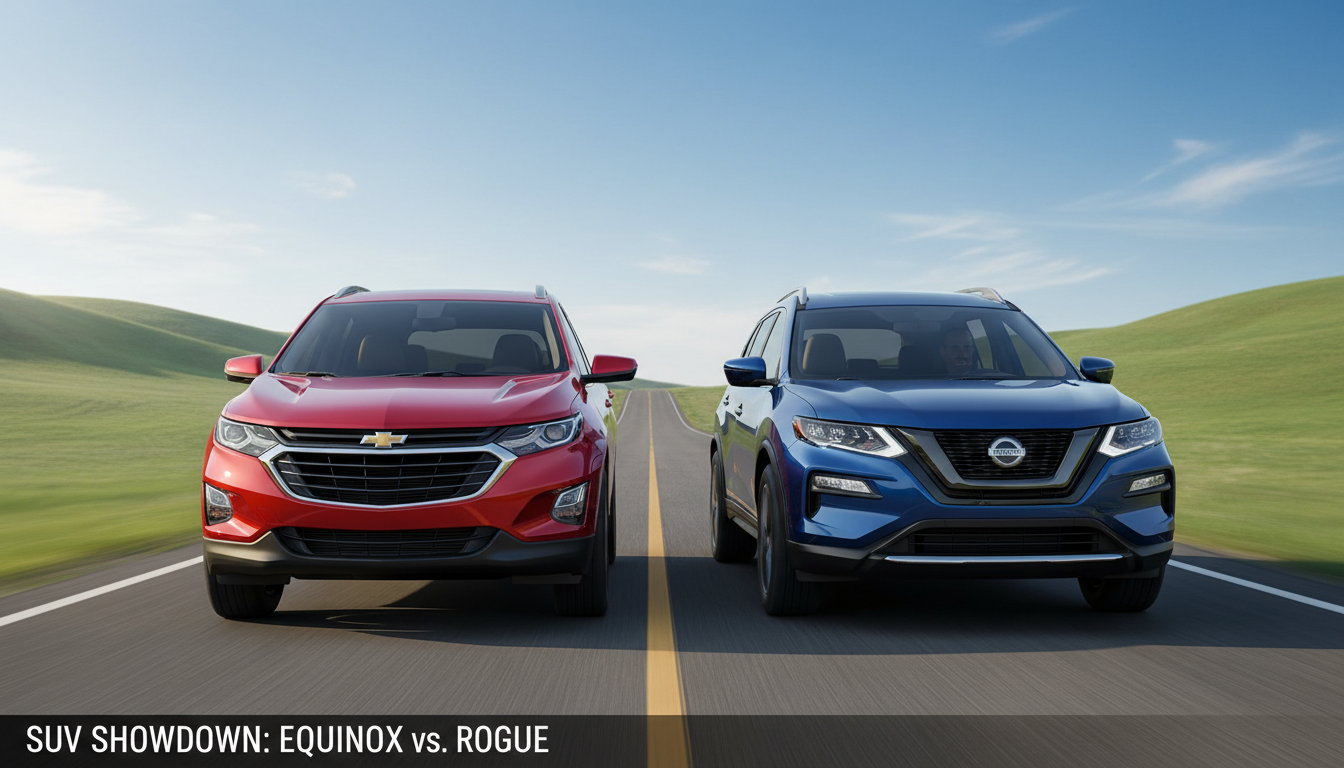
Chevy Equinox vs Nissan Rogue: Which SUV is Right for You?
The compact crossover market in the United States can feel crowded. Shoppers often narrow choices to familiar names when they want reliable daily transport and smart resale value.
This comparison zooms in on what changes day-to-day: cost, fuel economy, features, and safety. The Rogue tends to win at the pump, while the Equinox often delivers more standard tech and better value per trim.
Trim levels are simply package tiers. A base price can look close, but adding options makes costs diverge quickly. Think of trims as starter, mid, and fully loaded versions that stack features and price.
This guide is for commuters tracking MPG, families prioritizing safety systems, and road-trippers who need comfort and connectivity. The decision path starts with budget and ownership costs, moves to performance and drive feel, then tech, then safety and comfort, ending with a clear pick.
Keep expectations realistic: availability and pricing vary by region and inventory. Verify local offers before you commit.
Quick Snapshot for US Shoppers: Price, MPG, and What You Get?
Sticker price, trim spread, and typical highway fuel economy. This helps narrow choices before a purchase.
Starting MSRP and trim realities
| Model | Base MSRP | Notable trims (2025) | MPG (city/highway) |
|---|---|---|---|
| chevy equinox | $30,795 | LT $28,600 / RS $33,000 / ACTIV $33,000 | 26 / 29 |
| nissan rogue | $30,585 | S $28,590 / SV $29,590 / Platinum $38,590 | 29–30 / 36–37 |
Who each compact SUV fits best?
- Commuters: The nissan rogue’s stronger highway numbers matter for long drives and frequent interstate use.
- Budget-conscious tech seekers: The chevy equinox offers solid standard features without climbing to the highest trims.
- Families: Both models suit school runs and errands; later safety details will help with teen-driver concerns.
- Road trips: Highway MPG, cabin tech, and seat comfort usually decide trip satisfaction more than peak power.
Next step: Shortlist two trims that match your must-haves MPG vs tech vs price cap and schedule a test drive at local inventory to compare real-world comfort and economy.
Chevy equinox vs Nissan rogue: Performance, Engine, and Fuel Economy
Practical performance is more about usable torque and transmission behavior than peak horsepower. A quick read of the specs shows both use a 1.5L turbo engine, but output differs on paper.
Engine specs and horsepower
The nissan rogue lists about 201 hp and 225 lb-ft, while the chevy equinox posts roughly 175 hp and 203 lb-ft. That extra torque and horsepower on the Rogue usually helps with merging and passing.
Transmission feel and everyday drive
The Rogue pairs its 1.5L with an Xtronic CVT tuned for efficiency. The Equinox offers a more traditional automatic (8-speed with available AWD and often described as sportier in gear changes).
Fuel, AWD, and towing
Fuel economy favors the Rogue, especially on the highway (roughly high 30s MPG on long runs). The Equinox sits near mid-20s city and high-20s highway in many tests.
Both models offer all-wheel drive availability for better traction in rain and snow. Towing capacity is modest for each: about 1,500 pounds, suitable for small trailers and weekend gear.
| Spec | Equinox | Rogue |
|---|---|---|
| Engine | 1.5L turbo 175 hp / 203 lb-ft | 1.5L turbo 201 hp / 225 lb-ft |
| Transmission | CVT or 8-speed auto | Xtronic CVT |
| MPG (city/highway) | 26 / 28–29 | 29–30 / 36–37 |
| Towing capacity | 1,500 lbs | 1,500 lbs |
Features and Infotainment: Screens, Connectivity, and Tech Value
What you tap and see every day can make or break a drive. The standard screen layout sets the tone for usability and safety while on the road.
Screen setups: One model includes dual 11-inch-class displays as standard, giving a large driver cluster and center touchscreen. The other starts with an 8.0-inch center screen and only offers dual 12.3-inch screens on higher trims. Bigger standard screens mean maps and audio controls are easier to read at a glance.
Smartphone integration: Wireless Apple CarPlay and Android Auto come standard on the higher-value package, while the competitor relies on wired connections unless you move up the trim ladder. If you dislike plugging in for short trips, this matters.
Built-in systems include Google built-in, natural voice recognition, SiriusXM, Wi‑Fi hotspot capability, and front and rear USB ports. One vehicle bundles these features earlier in the lineup, improving out-of-the-lot value.
During a dealership test, pair your phone, start navigation, and try voice commands. That simple test reveals real-world responsiveness and helps decide which model fits daily needs.
| Feature | Standard Value | Upgrade Path |
|---|---|---|
| Center screen | 11.3-inch or 8.0-inch | Up to 12.3-inch dual displays |
| Apple CarPlay / Android Auto | Wireless on value model / Wired on base of rival | Wireless available on higher trims |
| Connectivity | Google built-in, Wi‑Fi, USB ports | Wireless charging on select trims |
Safety and Comfort: Driver Assist, Emergency Braking, and Seating Amenities
Every drive benefits when active safety systems and comfortable seats work together.
Modern compact SUVs include a baseline safety package you should check on the window sticker. Look for automatic emergency braking, forward collision alert, lane-keeping or lane-departure assist, and blind spot detection. These items form the core driver-assist layer that reduces risk in everyday situations.
What automatic emergency braking actually does?
Automatic emergency braking detects imminent collisions and applies braking to reduce impact or stop the vehicle. It helps in slow-speed city crashes and some highway emergencies.
It is not a substitute for attentive driving. Drivers must remain ready to steer and brake.
Rear protection and parking
Rear cross-traffic alert and rear automatic braking are especially useful in crowded lots. They warn of approaching vehicles and can apply brakes if you start reversing into danger.
Family-focused features and seasonal comfort
Equinox-only advantages include a built-in Teen Driver profile for setting limits and an available Safety Alert Seat that gives haptic pulses instead of chimes for some warnings. Those features appeal to families with new drivers.
Both models offer heated front seats and optional heated rear outboard seats. The Equinox also offers ventilated front seats for hot climates, which improves comfort on long summer drives.
| Safety / Comfort Item | Shared | Equinox Advantage |
|---|---|---|
| Automatic emergency braking | Yes | Standard timing and response comparable |
| Forward collision alert | Yes | Driver-configurable alerts (Teen Driver adds limits) |
| Blind spot detection & rear cross-traffic | Yes | Safety Alert Seat available |
| Heated front & rear seats | Available on both | Ventilated front seats available |
If family-oriented controls and unique alerting matter, the model with Teen Driver and the Safety Alert Seat holds an edge. If the shared safety suite meets your needs, decide by fuel economy and tech price. Test seating with child seats and load typical cargo before you buy.
Conclusion
The best pick depends less on badges and more on how the vehicle serves daily life. For shoppers focused on fuel economy, the rival typically wins the tank-to-tank comparison. For buyers who want strong standard tech, family-focused safety options, and clear value, the Chevy Equinox leans ahead.
If you prefer a more traditional automatic feel when you drive, that model’s conventional automatic may suit you better than a CVT. Match the choice to your routine:
Check seating comfort, visibility, cargo and everyday space, and phone pairing in person. Pick two trims that fit your budget, schedule a same-route test drive, and compare ride, acceleration feel, and cabin usability before you decide.
FAQ
Which compact SUV offers better fuel economy for daily driving?
Both models use small turbocharged engines that are efficient in mixed driving. The CVT-equipped compact tends to deliver slightly better highway MPG, while the conventional automatic often feels stronger on acceleration. Expect modest differences at the pump; check EPA labels for current trims to compare city and highway ratings.
How do their infotainment and connectivity options compare?
One crossover offers larger available displays and a dual-screen layout on higher trims, while the other uses a simpler base screen with higher-tier tech upgrades. Both support Apple CarPlay and Android Auto; some trims add wireless connections, embedded Google services, voice recognition, and a Wi‑Fi hotspot. Choose by feature needs rather than nameplate alone.
Are advanced driver-assist systems and automatic emergency braking standard?
Core safety tech—automatic emergency braking, forward collision alert, lane-keeping assist, and blind-spot monitoring—appears across most trim levels from both brands. Availability and whether features are standard or optional vary by trim, so confirm the specific package for the model you want.
Which vehicle feels better on highways and in poor weather?
Both offer available all-wheel drive to improve traction in rain or snow. The one with a firmer automatic transmission can provide a more linear feel on highways; the CVT model delivers smoother, more fuel-efficient cruising. Suspension tuning and tire choices affect ride and stability, so test drive both in conditions similar to your routine.
What are the towing capabilities and cargo capacity differences?
Towing capacity for compact crossovers is modest—suitable for small trailers, bikes, or weekend gear. Cargo volume behind the rear seats and with seats folded varies by model and trim, with liftgate design and underfloor storage influencing usable space. Review spec sheets for precise cubic-foot figures when cargo needs are a priority.
How do seating comfort and climate features compare for all-season use?
Both SUVs offer heated front seats; ventilated front seats are available on higher trims of one model. Rear-seat comfort and headroom are similar, but check seat materials and cushion firmness during a test drive. Climate-control options and heated steering wheels may be trim-dependent.
Which model delivers better value for tech and features at a given price?
Value depends on trim and incentives. One vehicle tends to emphasize upscale tech at higher prices, while the other positions feature-rich lower trims as a value play. Compare feature lists, warranty coverage, and dealer inventory to determine which offers the best equipment-per-dollar for your needs.