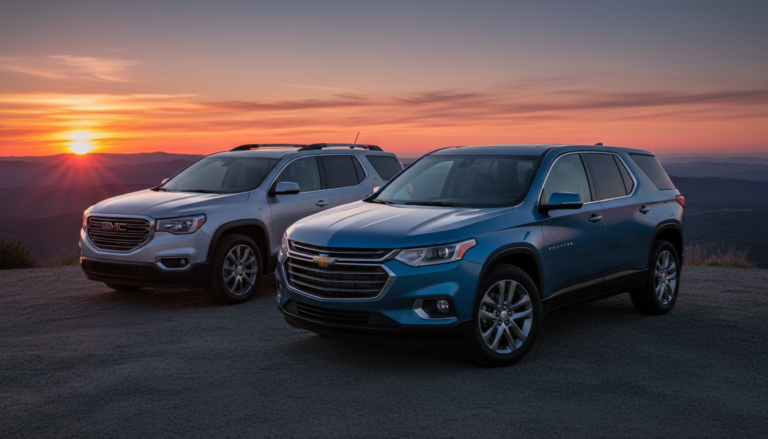
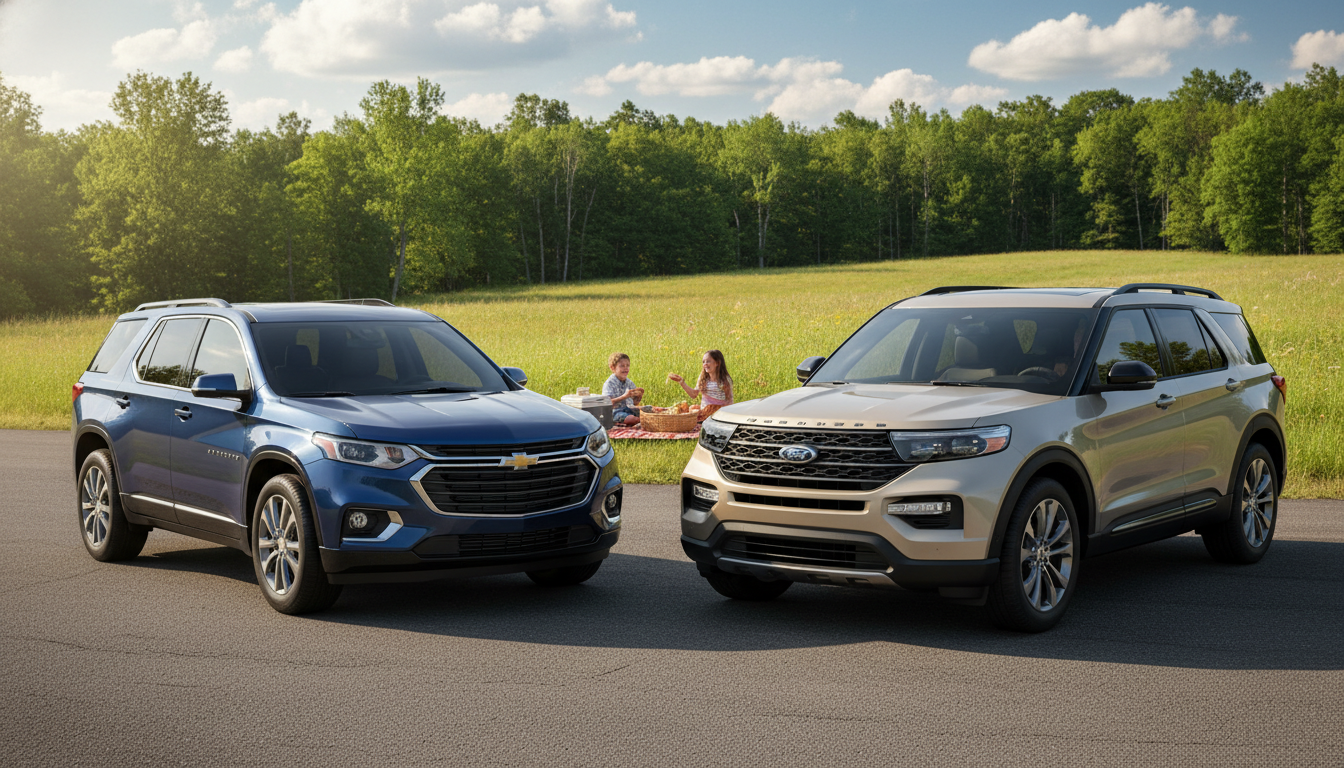
Chevy Traverse vs Ford Explorer: Which Family SUV Reigns Supreme?
The choice between two popular American three-row family suvs comes down to real life needs. Parents juggling school runs, long road trips, and daily commutes want clear answers.
It sets expectations. The chevrolet traverse typically wins on space and seating capacity. The ford explorer often earns higher marks for driving enjoyment, tech polish, and overall balance.
“Family-ready” here means a usable third row, easy access to rear seats, real cargo room behind that row, and strong safety features. Trim levels matter: base pricing can flip the value math, while similarly equipped trims give a fairer match.
Use it by skimming the quick comparison, then jump to sections that match your priorities—third-row comfort, cargo, fuel economy, tech, or hands-free driving. The best pick is the one that fits your family’s seating needs, highway miles, and budget over the next five years.
Quick comparison: price, fuel economy, and what matters most for family SUV shoppers
A quick look at price and efficiency helps families prioritize features they actually use. Below is a clear snapshot of U.S. starting MSRPs and typical fuel numbers so shoppers can compare apples to apples.
Starting MSRP and similarly equipped pricing (U.S.)
Reported starting prices vary by source and model year. One example lists about $42,795 for the larger-seat model and $40,160 for the sportier option. Another comparison shows both near $42,700 with an identical AWD upcharge of +$2,000 on each.
| Trim basis | Price example | AWD upcharge |
|---|---|---|
| Base vs base | $40,160–$42,795 | +$2,000 (both) |
| Similarly equipped | ~$42,280–$42,695 | +$2,000 (both) |
| Why compare trims | Options shift value more than small MSRP gaps | |
Fuel snapshot: city, highway, and mpg combined
EPA city/highway examples include 20/29 for the performance-lean model and 20/26 for the roomier one. Combined estimates vary: one source lists 24 mpg combined (RWD) / 23 (AWD) vs 22 (FWD) / 21 (AWD). Another shows both AWD models near 21 mpg combined.
City numbers matter for short trips; highway mpg guides long commuters. Check the exact trim’s EPA label before buying.
Bottom line upfront: who each SUV fits best?
If the household uses the third row often and needs extra cargo behind it, choose the roomier model. If you value sharper power delivery, tech polish, and a more engaging drive, pick the sportier option.
- Checklist: third-row access, cargo space, safety systems, total running costs, and available standard driver aids.
Chevy traverse vs Ford explorer: key differences at a glance
Two priorities rise above all for most buyers: how many people fit and how the car feels to drive.
These models split those strengths. One prioritizes roomy, flexible seating. The other favors tighter handling and confident steering.
Seating capacity and family flexibility
Seats up to eight vs seven: The roomier model offers an eight-seat layout with a full second-row bench. That gives one extra seat for carpooling or larger families.
Captain’s chairs reduce capacity but improve access to the third row. A bench adds a middle seat and changes daily logistics for child seats and adults.
Space vs driving enjoyment trade-off
The trade-off is simple. Choose more passenger room and easier third-row living when hauling many people.
Or pick the option with sharper steering and steadier emergency handling for long highway miles and more engaging driving.
| Feature | Roomier model | Driver-focused model |
|---|---|---|
| Maximum seats | 8 (bench available) | 7 (often with captain’s chairs) |
| Third-row usability | More legroom for adults and kids | Best for kids or occasional adults |
| Driving feel | Comfort-oriented ride | Sharper steering and emergency stability |
| Best for | Large families, carpooling, grandparents | Smaller families who value long-distance comfort and handling |
Interior space and third row comfort for real-world families
Interior room and seat layout make the biggest day-to-day difference for families. This section focuses on how the 3rd row performs in practice, who can ride back there comfortably, and which cabin features ease busy family life.
Third-row comfort: adults or kids?
The roomier model’s third row often fits adults for short to medium trips. Cushion shape, seating height, and legroom add true comfort on highways.
The other model’s 3rd row is better suited to children or teens on longer drives. It works fine for occasional adult use but feels tighter over hours.
Maximum seating and real scenarios
Maximum seating: one SUV offers eight seats, the other seats seven. An eight-seat layout matters if you regularly need three-across seating in the second row or frequent carpool rotations.
Seven-seat cabins with captain’s chairs improve access and comfort but reduce capacity for larger groups or last-minute rides.
Second-row legroom, access, and car-seat reality
Second-row legroom is noticeably more generous in the roomier model. Slide and tilt functions make reaching the third row easier, even with a child seat installed.
This means parents can access the 3rd row without uninstalling seats—useful during errands or when helping kids buckle up.
Family-friendly touches
Both cabins include rear climate vents, multiple USB ports, and available heated rear seats. These features keep back-seat passengers comfortable on cold mornings and long trips.
| Feature | Roomier model | Driver-focused model |
|---|---|---|
| Third-row adult usability | Good for adults on short/medium trips | Best for kids and teens |
| Maximum seating | 8 (bench option) | 7 (often captain’s chairs) |
| Second-row legroom & access | More legroom; tilt/slide eases access | Tighter legroom; access is narrower |
| Family conveniences | Rear climate controls, multiple USBs, heated rear available | Rear climate vents, USBs, heated rear available |
Cargo capacity and storage: behind the third row and with the row folded
Packing for school, sports, and road trips exposes practical differences in cargo layouts. Families use three main configs: groceries behind the third row, strollers and gear behind the second row, and full max space for big hauls.
Cargo volume comparison:
| Configuration | Roomier model (cu ft) | Driver-focused model (cu ft) |
|---|---|---|
| Behind third row | 22.9 | 16.3 |
| Behind second row | 56.6 | 46.0 |
| Max space (rows folded) | 97.6 | 85.3 |
In real terms, the larger numbers mean extra carry-on suitcases or a folded stroller fit behind the third row. Behind the second row, families can pack several coolers, a set of team bags, or a stroller plus a week’s worth of luggage. Max capacity handles furniture or moving boxes for short moves.
Underfloor and row folded practicality: The driver-focused model adds useful underfloor storage behind the third row. That hidden compartment keeps small items from rolling and frees up the main floor for bulkier cargo.
How flat the floor is when the row folded matters. A flatter load floor makes sliding heavy items in easier. Quick-release latches and low load height speed transitions from kid-hauling to hardware runs.
Cabin storage and daily organization: The roomier model’s center console holds more small goods in demos (about 17 donuts vs 14). That extra front space helps keep phones, snacks, and wipes within reach. Side pockets and passenger cubbies also add everyday convenience.
- Bring your stroller to test fit behind the third row.
- Measure bins and fold a seat to confirm the row folded floor is flat enough for heavy loads.
- Check liftgate opening height and how easy the floor is to reach from the curb.
Technology and infotainment: screens, Google built-in, and smartphone connectivity
Tech choices here split between a massive infotainment display and a tighter, driver-focused layout.
Touchscreen and interface philosophy: One model offers a 17.7-inch touchscreen for a big, clear view. The other uses a 13.2-inch screen but a more compact layout that many find easier to use while driving.
Connectivity and voice features
Both cars include Google Built-in, which gives native Google Maps and Google Assistant for voice navigation and search. This reduces reliance on a phone mount for many trips.
Wireless support: Wireless apple carplay and wireless android auto are standard, so multiple passengers can connect phones without cords. That matters for families juggling navigation and streaming.
Driver displays and premium audio
Digital gauge sizes differ: an 11-inch front cluster in one and a 12.3-inch front display in the other. The larger cluster offers more customization for navigation prompts and driver-assist info.
| Item | Roomy-screen model | Driver-focused model |
|---|---|---|
| Center touchscreen | 17.7-inch | 13.2-inch |
| Digital cluster (front) | 11-inch | 12.3-inch |
| Premium audio | 10-speaker Bose | 14-speaker B&O |
| Notable camera feature | Rear camera mirror available | 360/parking cameras available |
In practice, the larger screen helps families who want big maps and touch targets. The other system may be the practical advantage for drivers who prioritize layout and sound quality.
Safety and driver-assistance features: from blind spot to adaptive cruise control
Families often pick a three-row SUV based on how the safety systems behave on the highway. Core aids like blind spot monitoring, automatic emergency braking, and lane-keep assists form the baseline most buyers expect.
What comes standard matters. One model in recent comparisons adds more lane-centering tech and adaptive cruise control as standard equipment. The other requires higher trims or paid options to match that level.
The adaptive cruise control experience differs in feel. One system centers the vehicle confidently and keeps steady gaps on long highway runs. The other follows traffic smoothly but may require more hands-on correction in tight lanes.
Hands-free highway systems are available on both sides. BlueCruise and Super Cruise map roads and monitor driver attention. Super Cruise generally offers more consistent engagement and automatic lane changes in mapped zones, while BlueCruise remains a solid alternative for many users.
| Feature | Availability | Practical benefit |
|---|---|---|
| Blind spot monitoring | Standard on many trims | Alerts when lane changes risk collision |
| Adaptive cruise control | Standard on one model; optional on the other | Smooth long-distance speed and gap control |
| Hands-free highway system | BlueCruise or Super Cruise available | Hands-off driving on mapped highways |
| Camera tech | 360 camera widely available; rear camera mirror available | Easier parking and rear visibility with cargo loaded |
- Check which features are standard to avoid trim surprises.
- Test adaptive cruise on a highway to feel lane-centering behavior firsthand.
- Try hands-free system demos; mapped coverage and driver monitoring change usability.
Performance and driving feel: engine power, steering, and highway confidence
How an SUV delivers power matters more than the headline horsepower number. Buyers should look at torque curves, transmission gearing, and real-world passing ability, not just peak figures.
Engines and outputs:
| Model side | Engine | Peak power / torque |
|---|---|---|
| Roomier side | 2.5L turbo I-4 | 328 hp / 326 lb-ft |
| Driver-focused side | 3.0L twin-turbo V6 (available) | Up to 400 hp / 415 lb-ft |
In practice, the larger V6 gives more effortless power for towing, mountain grades, and quick merging. The turbo four posts strong numbers but can feel slower when gearing and torque delivery don’t match throttle inputs.
Acceleration, handling, and ride impressions
Test drives show the driver-focused model accelerates quicker and holds better through corners. It feels more secure in sudden maneuvers.
The roomier model can feel firmer and somewhat ponderous in spirited driving. That firmness reduces comfort on rough roads for some families.
Transmission and drivetrain
The roomier model pairs an 8-speed automatic with FWD or available AWD. The driver-focused model uses a 10-speed and a RWD-biased setup with AWD options.
- Advantage: 10-speed gearing helps smoother shifts and better real-world power delivery.
- FWD layouts tend to understeer more; RWD bias gives crisper steering and balance.
Overall, choose the side that matches your daily drives: steady, confident handling reduces fatigue on long trips, while higher available power gives extra margin for towing and mountain routes.
Fuel economy and running costs: city/highway numbers vs mpg combined reality
Fuel costs show up differently in daily life than on paper. Short errands, cold mornings, and long interstate drives all change what you actually see at the pump.
EPA-style figures to expect:
- One model lists 20 city / 29 highway.
- The other lists 20 city / 26 highway.
Combined estimates shift with drivetrain and options. Examples include 24 mpg combined (RWD) or 23 (AWD) for one setup, and 22 mpg (FWD) or 21 (AWD) for the other. Another comparison shows both at about 21 mpg combined when similarly equipped.
How to set expectations for real-world highway driving?
Expect highway miles to approach the higher highway number if you cruise at steady speeds. Add roof racks, larger wheels, or cold weather and that figure falls.
Practical checklist:
- Compare the exact window sticker for the trim and year you plan to buy.
- If you drive mostly highway, favor the trim with the better highway mpg.
- City-heavy drivers should budget for lower tank-to-tank mpg because stop-and-go reduces economy.
Value over time: warranty, reliability, and resale in the U.S.
Warranty promises and resale forecasts shape true ownership cost, not just the purchase price. Think like an owner: maintenance, reliability trends, and resale matter most over five years.
Warranty and maintenance basics
Both SUVs offer the same factory coverage: a 3-year/36,000-mile basic warranty and a 5-year/60,000-mile powertrain warranty.
Practical difference: the traverse includes a complimentary first maintenance visit. The explorer does not. That small perk can save time and a bit of cash in year one.
Reliability and five-year resale outlook
Reliability tools rate the chevrolet traverse above the industry average and the ford explorer below it. Predicted five-year retention shows a noticeable gap: roughly 54.71% for the traverse versus about 48.8% for the explorer.
Finance or lease: how resale affects payments
Higher projected resale helps owners who plan to sell or trade. Better retention also supports lower lease payments because residuals are higher.
Buyers focused on long-term ownership and lower depreciation risk may favor the traverse. Those prioritizing driving feel or specific features might still pick the explorer despite weaker resale.
| Item | chevrolet traverse | ford explorer |
|---|---|---|
| Basic warranty | 3 yr / 36,000 mi | 3 yr / 36,000 mi |
| Powertrain warranty | 5 yr / 60,000 mi | 5 yr / 60,000 mi |
| Complimentary maintenance | First visit included | Not included |
| Estimated 5‑year resale | ~54.71% retention | ~48.8% retention |
- Check local incentives, APR offers, and insurance quotes—these can change which vehicle is the smarter buy in your zip code.
- Test drive both and factor expected depreciation into monthly payment calculations before deciding.
Conclusion
Choosing the right three-row SUV comes down to matching daily habits with vehicle strengths.
Pick this one if you need space: the chevrolet traverse is the better choice for families who use the third row often, want easier access, and value extra cargo behind that row.
Pick the other side if you want driving polish: the ford explorer suits drivers who prioritize confident handling, stronger available power, and a tech experience many testers prefer.
Quick ownership-fit checklist: how many seats do you need? How often is the third row occupied? What cargo do you carry behind the rear row? Is hands-free highway aid a must?
Shopping tip: test third-row access with your car seats installed, load your typical cargo behind the rear row, and drive the same loop in both vehicles to compare steering, ride, and noise. Both can serve as family vehicles; the “supreme” pick depends on whether space or driving feel matters more to your household.
FAQ
Which SUV offers better fuel economy for daily driving and highway trips?
Combined fuel economy depends on engine and drivetrain. The smaller turbo four typically posts higher mpg combined than a big twin‑turbo V6. On highway runs expect the four‑cylinder to be more efficient in real‑world conditions, while the higher‑output V6 sacrifices economy for acceleration and towing capability.
How comfortable is the third row for adults versus children?
Third‑row comfort varies: the third row is best suited for children or shorter adults on longer trips. Taller passengers will find legroom and headroom limited compared with second‑row seats. Folding the row increases cargo flexibility for family gear.
What is the maximum seating capacity and how does second‑row access compare?
Maximum seating ranges from seven to eight depending on configuration. Models with a second‑row bench reach eight seats; captain’s chairs reduce capacity but improve access to the rear and provide easier entry to the third row.
How do cargo volumes compare behind the third row and with seats folded?
Cargo behind the third row is tight for large items but expands substantially when the row is folded. Behind the second row you get near‑SUV or small‑van levels of space. Check published cubic‑ft figures for exact numbers, since measurements vary by trim and drivetrain.
Are Apple CarPlay and Android Auto standard and is wireless connectivity available?
Both Apple CarPlay and Android Auto are generally available; many trims include wireless connectivity as standard or optional. Higher trims add larger touchscreens, premium audio, and wireless charging for convenience.
What driver‑assist systems come standard and how do adaptive cruise systems differ?
Standard safety tech usually includes blind‑spot monitoring, automatic emergency braking, and lane‑keeping aid. Adaptive cruise control capability and lane‑centering vary by package: some offer basic adaptive cruise, while advanced systems include smoother lane‑centering and hands‑free highway modes that require enrollment and map‑matched cameras.
Which vehicle is better for towing and performance needs?
For towing and raw power, the stronger V6 engine option delivers higher horsepower and torque, making it the better choice for regular towing or brisk acceleration. The smaller turbocharged engine balances adequate power with superior fuel economy for everyday driving.
How do infotainment screen sizes and audio systems compare?
Screen sizes vary widely across trims, with options that push into double‑digit inches on the center stack and configurable digital clusters for the driver. Premium audio packages from established brands offer more speakers and improved sound staging; specific speaker counts and branding differ by package.
What should buyers consider about warranty, reliability, and resale value?
Compare factory warranty terms, available complimentary maintenance, and published reliability scores. Predicted resale value depends on trim, optional features, and market demand; vehicles with strong reliability records and popular features retain value better over five years.