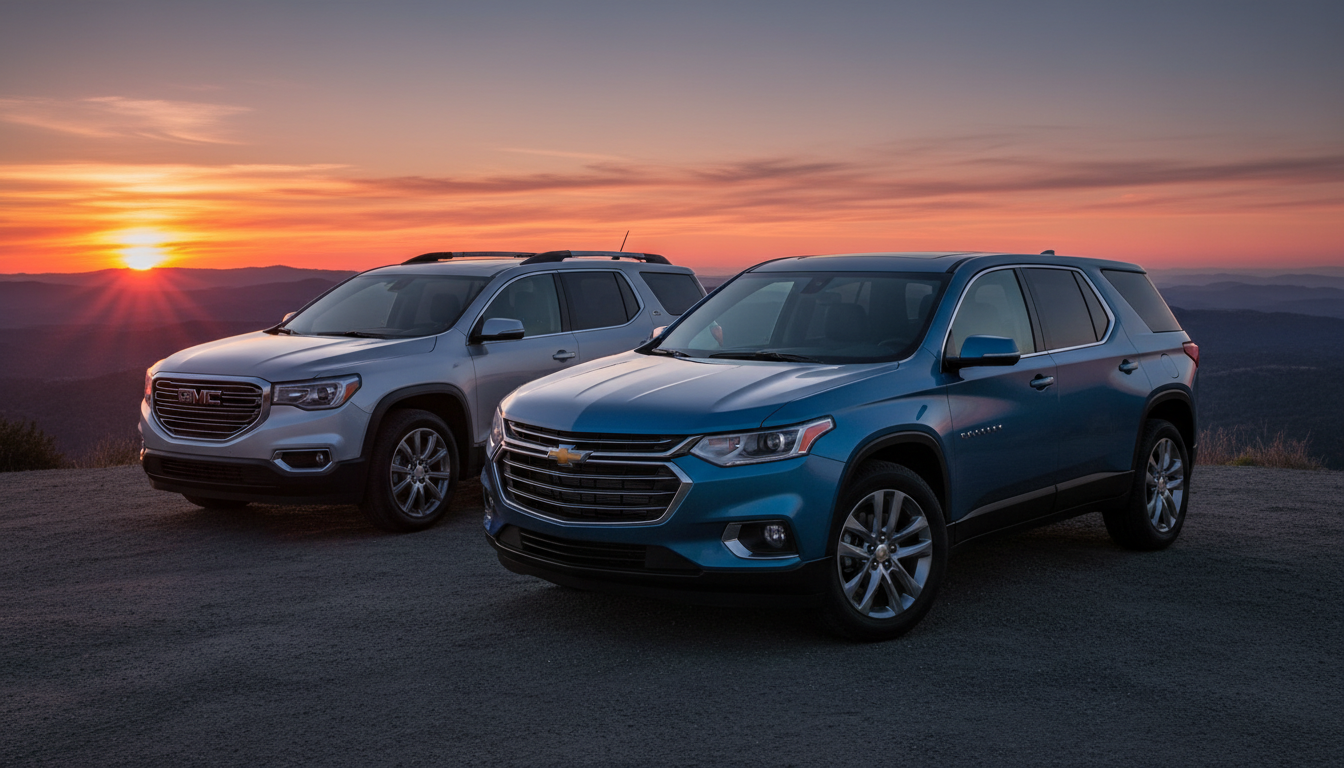
Chevy Traverse vs GMC Acadia: Which SUV Is Right for You?
This shopper-first introduction frames a practical comparison between two closely related three-row midsize suvs. Both share a 2.5L turbo powertrain with about 328 hp and similar towing when properly equipped, so the driving feel and capability are often comparable.
The real decision usually comes down to price, what comes standard, and cabin layout. This piece will examine price/value, performance and mpg, space and cargo, plus tech, safety, and towing confidence. Expect clear notes on MSRP (manufacturer’s suggested retail price), standard versus available features, and what “properly equipped” means for trailering.
You will get a neutral, practical take aimed at helping decide between getting more value up front or more premium features without jumping trims. Use it to pick which model and trim to test drive based on must-haves, budget, and passenger needs. The way forward is to match features to daily priorities, not brand hype.
Chevy Traverse vs GMC Acadia at a glance for today’s midsize SUV shopper
Start with the headlines: price, mpg, and towing capacity in plain terms.
Starting price and value
The chevrolet traverse begins at $42,795 while the gmc acadia starts near $45,795 when similarly equipped. That gap usually means lower monthly payments if price is the priority. Buyers sensitive to upfront cost often start with the lower-MSRP model and add only key options.
Fuel economy snapshot
EPA numbers show both at 20 mpg city. The highway edge goes to the gmc acadia at 27 mpg versus 26 mpg for the traverse. For daily commutes, the identical city rating makes little difference.
Long highway trips can highlight that 1-mpg gap. If most miles are interstate, that small economy advantage adds up over time. If errands and short drives dominate, it won’t move the needle.
Core capability
Both use a 2.5L turbo engine with 328 hp and 326 lb-ft of torque. Each has a max towing capacity near 5,000 lbs when properly equipped, so small campers and utility trailers are within reach.
Keep in mind towing ratings vary by configuration and payload. Verify the exact build and payload to confirm capacity for your trailer.
- Decision cue: start with price if budget-first; start with standard features if convenience/tech-first.
| Item | chevrolet traverse | gmc acadia |
|---|---|---|
| Starting MSRP | $42,795 | $45,795 |
| EPA city / highway | 20 / 26 mpg | 20 / 27 mpg |
| Max towing | ~5,000 lbs | ~5,000 lbs |
Price, trims, and overall value for families
Choosing the right trim is the fastest way for a family to match budget with daily needs. Look at each model’s ladder and map the must-have items to the trim that includes them.
Trim lineups compared
gmc acadia: Elevation, AT4, Denali, Denali Ultimate. These steps add more upscale materials, larger wheels, and premium tech as you move up.
chevrolet traverse: LT, Z71, High Country, RS. The lineup focuses on core value at entry and adds comfort or appearance packs on higher levels.
What trims change day-to-day?
- Appearance: wheels, exterior trim, and seating materials shift by trim.
- Comfort: power seats, heated/ventilated seats, and noise insulation become available higher up.
- Tech: audio upgrades, surround cameras, and driver assists often move from options into standard status on premium trims.
| Positioning | Value-oriented | Premium |
|---|---|---|
| Typical trims | LT / Z71 | Denali / Denali Ultimate |
| Budget effect | Lower MSRP, more options add cost | Higher starting price, fewer must-have options |
| Family must-haves | Available upgrades for audio, cameras, power seats | Often included as standard features |
Shopping tip: List your non-negotiable features first audio, surround-view, power seats then pick the trim that has them with the fewest added options. This keeps surprises out of the final price and aligns monthly payments with real comfort and convenience needs.
Performance, fuel economy, and everyday driving feel
Power numbers tell part of the story, but everyday driving reveals the rest.
Same powertrain, same output: both models share a 2.5L turbo 4-cylinder paired to an 8-speed automatic, rated at 328 hp and 326 lb-ft. That makes straight-line acceleration feel very similar between the two. Expect strong midrange torque for highway merges and passing without the need for a larger V6.
FWD or AWD — what changes?
FWD is simpler and often the better value in mild climates. AWD adds traction for rain and snow but can lower economy slightly.
AWD differences: the gmc acadia AT4 uses Active Torque Control to favor grip and stability. The chevrolet traverse employs a twin-clutch AWD system tuned for sharper cornering balance. Choose based on whether you want stability-first or a more athletic feel.
Fuel economy and real-world notes
EPA estimates list both at 20 mpg city. The highway edge goes to the gmc acadia at 27 mpg versus 26 mpg for the chevrolet traverse. In practice, AWD, big wheels, or an aggressive driving style will reduce those numbers.
- Acceleration: both feel equally quick in most conditions.
- Everyday engine behavior: responsive midrange, minimal turbo lag under light throttle.
- Test-drive checklist: freeway merge, a rough road, and a tight parking maneuver to compare steering, ride, and visibility.
| Item | gmc acadia (AT4) | chevrolet traverse (AWD) |
|---|---|---|
| Engine / transmission | 2.5L turbo, 8-speed auto | 2.5L turbo, 8-speed auto |
| AWD approach | Active Torque Control — stability-focused | Twin-clutch AWD — sportier handling |
| EPA city / highway | 20 / 27 mpg | 20 / 26 mpg |
| Everyday takeaway | Better highway economy, traction focus | Sportier turn-in, slightly lower highway mpg |
With a shared engine and similar outputs, the deciding factors become ride feel, interior comfort, and tech rather than pure speed. Pick the one whose cabin and features match daily needs.
Space, seating, and cargo capacity: third row comfort and room to haul
Count the people you carry most days before you let specs decide which model to test drive. Seating layout matters as much as totals when family routines are the priority.
Standard seating and configuration
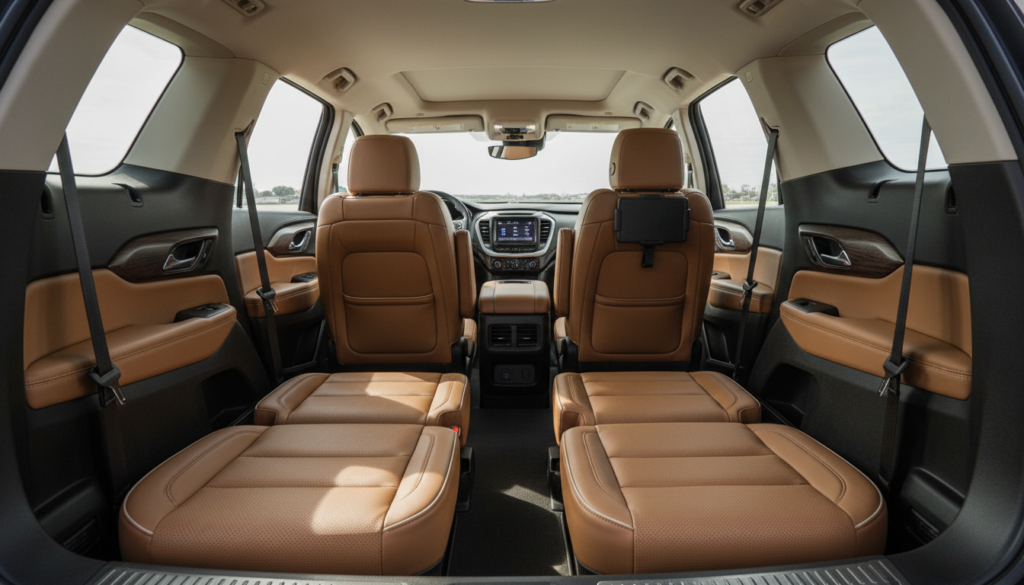
The gmc acadia comes standard with eight seats. The chevrolet traverse seats seven in its common setup, with an eight-seat bench available on some trims.
Why it matters: a standard bench avoids an extra option cost and makes swapping passengers easier for carpools and school runs.
Cargo behind the third row and max volume
Behind the third row the two models are nearly identical: the acadia offers 23.0 cu ft and the traverse 22.9 cu ft. Fold all seats and maximum cargo reaches about 97.5–97.6 cu ft.
- Grocery mode: stroller plus backpacks fits easily behind the third row in either SUV.
- Big-box mode: fold the rows and you can move flat-pack furniture or multiple large boxes.
Interior dimensions and real-world comfort
Legroom is nearly the same across rows: front ~44.29 in, second ~41.46 in, third ~32.13 in. Headroom differences are minimal without a sunroof.
That means adults are happiest up front. Second-row passengers get good stretch; third-row comfort depends on seat shape and how far the second row slides.
| Item | gmc acadia | chevrolet traverse |
|---|---|---|
| Standard seating | 8 passengers | 7 (8 available) |
| Cargo behind 3rd row (cu ft) | 23.0 | 22.9 |
| Max cargo (cu ft) | 97.5 | 97.6 |
Road-trip tip: when all seats are occupied, plan for a roof box or hitch carrier. Choose by seating layout and daily cargo needs first numbers are close enough that personal fit matters most.
Tech, audio, and safety features that separate these three-row SUVs
Screens, speakers, and safety gear are often the deciding factors when engines and space are close. Small differences in displays, camera clarity, and included driver assists shape daily satisfaction.
Infotainment and connectivity
The chevrolet traverse offers a large 17.7-inch touchscreen for big, glanceable controls. The gmc acadia uses a 15-inch Premium GMC Infotainment system tuned for intuitive menus.
Both support wireless smartphone integration and navigation as trim bundles. Check voice recognition and how quickly your phone pairs during a test drive.
Audio and cabin sound
The gmc acadia comes with a 12-speaker Bose premium audio as standard. The chevrolet traverse starts with a simpler 6-speaker setup, with a 12-speaker Bose upgrade as an option.
Buy the better audio up front if sound quality matters. Upgrading later often costs more than selecting a higher trim.
Cameras, safety, and towing aids
High-resolution surround view is standard on the gmc acadia, while the traverse typically requires a higher trim to get HD Surround Vision. That matters in tight lots and when hooking a trailer.
Acadia also bundles more advanced driver assists as standard. Hitch Guidance with Hitch View lowers re-hitching frustration and improves trailering confidence.
- Test-drive checklist: screen brightness, night camera clarity, audio clarity at highway speed, and ease of toggling driver-assist settings.
| Item | chevrolet traverse | gmc acadia |
|---|---|---|
| Infotainment size | 17.7-inch touchscreen | 15-inch Premium system |
| Base audio | 6-speaker (12-speaker option) | 12-speaker Bose standard |
| Surround camera | HD Surround Vision (higher trim) | HD Surround Vision (standard) |
| Driver-assist content | Many features optional | More features included |
Conclusion
When engines and towing match closely, interior features and value do the heavy lifting. Power and core capability are essentially equal, so buyers should focus on cabin comfort, tech, and standard amenities.
Choose the lower-MSRP path if upfront cost matters and you don’t mind picking options to reach desired comfort. Choose the gmc acadia if you want more premium features included without step-up trims.
Before signing, test these vehicles with real-world items: car seats, cargo you carry, and third-row access. Compare trims on paper, then test drive the top two configurations to confirm comfort, visibility, and system usability match expectations.
FAQ
Which midsize SUV offers better value for families on a budget?
Both models target families but take different approaches. One focuses on broad standard content and a lower starting MSRP with straightforward options, while the other positions higher trims with more premium standard features like advanced audio and unique styling. Pick the value-oriented name if you want more cabin space and a lower base price; choose the premium-branded sibling if you prioritize upscale materials and extra tech in upper trims.
How do starting prices and trim lineups compare for today’s midsize shoppers?
The two share overlapping price bands but differ in trim structure. The premium-branded SUV offers Elevation, AT4, Denali and Denali Ultimate levels that layer comfort and off-road options. The mass-market sibling uses LT, Z71, RS and High Country to give sport and luxury choices. Expect the premium trims to cost more but include extras that otherwise require paid packages on the value-oriented model.
Do they use the same engine and what performance can drivers expect?
Both use the same 2.5L turbocharged four-cylinder with about 328 hp and 326 lb-ft of torque. That yields comparable acceleration and a shared 5,000-lb towing capability when properly equipped. Real-world feel differs slightly because of suspension tuning and available all-wheel-drive systems, so test drives reveal the best match for your driving style.
Which all-wheel-drive system should buyers choose for better traction and handling?
One brand offers an AT4 Active Torque Control AWD designed for light off-road tasks and confident traction, while the other provides a twin-clutch AWD that can direct torque quickly between axles for sharper on-road manners. Choose AT4 if you plan occasional dirt roads; pick the twin-clutch setup if you want crisper handling in variable pavement conditions.
What’s the fuel economy difference between the two in city and highway driving?
EPA estimates are very close: roughly 20 MPG city for both and a slight highway advantage to the premium-branded model depending on trim and drivetrain. Expect real-world numbers to vary with load, towing, and wheel size; the difference is minor and unlikely to drive the buying decision alone.
How do seating capacity and third-row comfort compare for passenger families?
The premium-branded SUV comes standard with eight seats, while the mass-market sibling seats seven in most trims with an available eight-seat layout. The value-oriented model generally offers more third-row space and cargo flexibility, making it a stronger choice for families who regularly use the back row.
Which vehicle provides more cargo room behind the third row and with seats folded?
The mass-market model leads in cargo volume both behind the third row and when all rear seats fold, thanks to a longer overall body and more efficient packaging. If you need maximum hauling space for strollers, sports gear or weekend luggage, that model is the practical pick.
What are the key interior dimension differences that affect passenger comfort?
Look at legroom and headroom by row: the value-oriented sibling typically offers more rear legroom and a flatter third-row floor, improving comfort for adults. The premium-branded SUV emphasizes material quality and front-seat amenities, so front passengers get a more upscale feel even if rear dimensions are slightly tighter.
How do infotainment and screen sizes compare between the two SUVs?
One model offers a massive 17.7-inch touchscreen that dominates the dash and supports modern connectivity, while the premium-branded vehicle uses up to a 15-inch GMC Premium Infotainment display. Both support Apple CarPlay, Android Auto and wireless connections, but the larger display gives a more tablet-like user experience.
Which audio system is superior straight from the factory?
The premium-branded three-row SUV typically includes a 12-speaker Bose premium audio system as standard on higher trims, delivering richer sound without extra cost. The mass-market model starts with a simpler base stereo and offers upgraded systems as options or on upper trims.
What camera and visibility technology should buyers expect?
High-end trims on both vehicles offer advanced camera suites. The premium-branded model often includes HD Surround Vision and more comprehensive camera angles as standard or well-equipped options, whereas the value-oriented sibling may require an upgrade package to match that level of visibility tech.
Are advanced safety and driver-assistance features standard or optional?
The premium-branded SUV tends to include more driver-assist technologies as standard on higher trims, such as adaptive cruise and lane-centering aids. The value-minded model provides similar systems but sometimes bundles them in equipment packages. Both score well in safety testing when equipped comparably.
Which vehicle offers better towing assistance and trailering confidence?
The premium-branded trim levels commonly include Hitch Guidance and Hitch View features that make hitching and backing with a trailer easier. The other model offers towing aids too, but some of the camera-assisted trailering tools are reserved for higher packages or trim levels.
How should a buyer choose between more passenger space and more premium features?
Prioritize how you’ll use the SUV. If frequent third-row use and maximum cargo room matter, opt for the roomier, value-oriented model. If you want premium materials, a top-tier audio system and more standard tech without adding packages, choose the premium-branded sibling. A test drive with family and cargo simulates real needs and makes the choice clear.