
P1101 Code Chevy Cruze: Symptoms, PCV Fix & Repair Costs
If your check engine light is on and your scanner reads the P1101 code on a Chevy Cruze, you are dealing with an air intake system performance issue. This is one of the most common fault codes for P1101 Chevrolet models equipped with the 1.4L Turbo Ecotec engine.
Unlike simple sensor failures, the P1101 code often points to a specific design flaw in the PCV (Positive Crankcase Ventilation) system. Ignoring it can lead to blown seals, oil leaks, and eventually, a destroyed engine.
In this guide, we will help you diagnose the P1101 Chevy Cruze code, identify the “hidden” cause that most mechanics miss, and walk you through the exact repair steps to get your car running smoothly again.
⚡ Quick Diagnosis: P1101 Chevy Cruze
- Primary Cause: Ruptured PCV Diaphragm (Valve Cover).
- Hidden Cause: Missing Check Valve in Intake Manifold (MUST CHECK).
- Sound: Hissing noise from engine / rough idle.
- Fix Cost: $70 – $350 depending on manifold status.
- Difficulty: Easy/Intermediate (DIY possible).
P1101 Chevy Cruze: At a Glance
| Category | Details for 1.4L Turbo Ecotec |
| Code Meaning | Intake Airflow System Performance |
| Primary Cause | Ruptured PCV Diaphragm (Valve Cover) |
| Hidden Danger | Missing Orange Check Valve in Intake Manifold |
| Common Symptoms | Hissing noise, rough idle, and “System Too Lean” (P0171) |
| Repair Cost | $70 – $350 (DIY vs. Shop) |
| Critical Tool | E-Torx Sockets and Inch-Pound Torque Wrench |
| Torque Spec | 71 in-lbs (8 Nm) in a center-out spiral pattern |
The Cruze-Specific Reality:
If you drive a Chevy Cruze 1.4 turbo (often badged as the 1.4t), P1101 is almost a rite of passage. It usually isn’t just a dirty sensor; it’s often a symptom of a much larger (and very common) PCV system failure.
Look for these Red Flags:
- The Whistle: A high-pitched whistling or chirping sound from the engine at idle.
- Rough Idle: The car feels like it wants to stall at stoplights.
- The Culprit: A ruptured PCV diaphragm inside the valve cover or a missing ‘orange nipple’ inside the intake manifold.
Whether you’re dealing with a simple dirty MAF sensor or the dreaded valve cover replacement, this guide breaks down the symptoms, the DIY tests, and the real-world repair costs to get your Cruze running smoothly again.
What Does the P1101 Code Mean on a Chevy Cruze?
Technically, the P1101 Chevy Cruze intake air flow system performance error indicates that the ECM runs a self-test.:
- Mass Air Flow (MAF) sensor readings
- Throttle position
- Manifold pressure / barometric pressure
On advanced scanners, you might see this displayed as P1101-00 Chevy Cruze, where the ‘-00’ extension confirms the specific airflow performance failure.
Whether your diagnostic tool displays the correct format or you accidentally search for a po1101 code Chevy or p01101 Chevy Cruze error, the root issue remains the same: the ECM has detected an intake airflow system performance failure.
If the measured airflow is outside the expected range during this test, the P1101 error code is stored.
On the Cruze, P1101 often appears with P0171 (System Too Lean), which reinforces that unmetered air or incorrect airflow measurements are involved.
Since the 1.4L Ecotec is an inline-4 engine, this airflow discrepancy is technically registered on Bank 1 (the only bank), often triggering alongside lean codes.
In simple terms, the computer thinks the engine is breathing more or less air than it should, given throttle and RPM.
Common Symptoms of the P1101 Code
When the P1101 code triggers, your car’s computer (ECU) is detecting that the actual airflow into the engine does not match what it expects. While the check engine light is the most obvious sign, you will likely experience other driveability issues.
Here are the most common signs of a P1101 issue on the Chevy Cruze:
- Check Engine Light (CEL): The light may stay solid or flash intermittently.
- Rough Idle: The engine may shake or stumble when stopped at a red light.
- Hissing Noise: A distinct whistling or hissing sound coming from the engine bay (often caused by a vacuum leak).
- Oil Leaks: You may notice oil seeping around the valve cover or oil filler cap due to excess pressure.
- Reduced Power: The turbo may feel sluggish, or the car may hesitate during acceleration.
- Lean Codes: You might see accompanying codes like P0171 (System Too Lean) along with the P1101.
Related Code: P0106 (MAP Sensor Performance) You may frequently see the P0106 code pop up alongside P1101.
- The Connection: While P1101 is a general “system performance” error, P0106 specifically flags the Manifold Absolute Pressure (MAP) sensor.
- What it Means: The car’s computer compares the reading from the MAP sensor against the MAF sensor and Throttle Position. If the pressure inside the intake manifold doesn’t match the physics of the other sensors (often due to the vacuum leaks mentioned above), both codes will trigger. Solving the vacuum leak usually clears both.
Typical Symptoms When P1101 Appears?
Depending on how bad the issue is, the engine code P1101 might trigger just a check engine light or cause severe drivability problems..
Common symptoms of the P1101 code on your Chevy Cruze include
- Check engine light on (sometimes with P0171 or other codes)
- Rough or unstable idle
- Hesitation when accelerating, especially from a stop
- Reduced power or sluggish performance
- Poor fuel economy
- Whistling or howling noise from the valve cover (PCV failure)
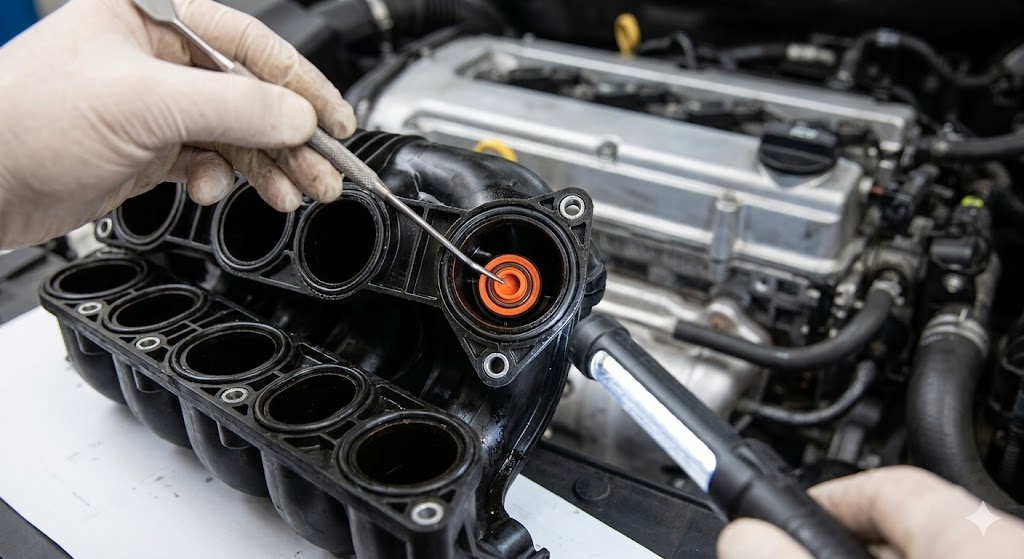
⚠ CRITICAL WARNING: Check the Intake Manifold First! Before you buy a new valve cover, you must check the intake manifold. On the 1.4L Turbo engine, the PCV valve cover usually fails because a tiny orange non-return valve (check valve) inside the intake manifold has disappeared.
The Test: Remove the corrugated plastic hose from the top of the intake manifold. Look inside the hole on the manifold.
If you see an orange nipple: You are safe. Just replace the valve cover.
If you see nothing (just a dark hole): The check valve is gone. You must replace the intake manifold or install an external PCV fix kit. If you don’t, boost pressure will blow out your new valve cover gasket within days. - Occasional stalling at idle
If you only notice the light and the car seems to drive normally, the problem may be early-stage (small leak, mild sensor contamination). Symptoms usually worsen over time if ignored.
What Causes the P1101 Code on a Chevy Cruze?
While we focus on the Cruze, general P1101 code GM errors are also prevalent in the Sonic and Trax, and occasionally present as a P1101 Chevy Malibu or P1101 Chevy Equinox issue depending on the specific Ecotec engine equipped.
DTC P1101 Chevrolet errors are also prevalent in the Sonic and Trax due to the shared Ecotec engine design.
A dirty Mass Air Flow (MAF) sensor can trigger this code, the root cause is almost always mechanical. On the 1.4L Turbo engine, the P1101 code is notoriously caused by a failure in the PCV system.
The three main culprits are:
1. Valve Cover Diaphragm Rupture The most frequent cause is a burst pressure diaphragm built into the valve cover. When this rubber disc tears, unmetered air is sucked into the engine, throwing off the air/fuel mixture and triggering the code. This diaphragm failure is highly prevalent across the entire first generation; you will frequently see a 2011 Chevy Cruze P1101 or 2013 Chevy Cruze P1101 error trigger as these plastic components age, right up through the 2014 and 2015 Chevy Cruze P1101 code. It also frequently triggers the 2016 Chevy Cruze P1101 code, specifically on ‘Cruze Limited’ models that carried over the Gen 1 engine.
2. Intake Manifold Check Valve (The “Hidden” Killer) [CRITICAL WARNING] This is the part most DIYers miss. Inside the intake manifold, there is a small orange check valve (nipple). If this valve goes missing or gets stuck, boost pressure enters the crankcase and blows out the valve cover diaphragm. If you replace the valve cover without fixing this manifold issue, the new cover will fail within days.
3. Dirty or Faulty MAF Sensor Occasionally, the Mass Air Flow sensor itself is dirty or failing, sending incorrect data to the computer. However, on the Chevy Cruze, this is less common than the PCV issues mentioned above.
4. Throttle Body Carbon Buildup
Even if your MAF sensor is working perfectly, a dirty throttle body can trigger code P1101. Over time, carbon deposits and oil residue (from the PCV system) build up around the butterfly valve plate.
The Fix: A simple throttle body cleaning service is often good maintenance to pair with MAF cleaning.
The Issue: This sticky residue prevents the throttle plate from closing or opening to the exact angle the computer (ECM) commands.
The Result: The ECM expects a specific amount of airflow for that throttle angle. When the carbon buildup changes the actual airflow, the “calculated” vs “actual” numbers don’t match, setting the P1101 code.
Does P1101 Apply to the 1.8L Engine (Non-Turbo)?
While the P1101 code on the 1.8L Chevy Cruze (LS models) also indicates an intake airflow performance issue, the causes are different from the 1.4L Turbo models.
- No Turbo or “Orange Nipple”: The 1.8L engine is naturally aspirated, meaning it does not have a turbocharger or the problematic intake manifold check valve (orange nipple) that plagues the 1.4L engine.
- Dirty MAF Sensor: On the 1.8L, the P1101 code is most frequently caused by a dirty or failing Mass Air Flow (MAF) sensor. Cleaning it is your first step.
- Intake Tube Cracks: Inspect the rubber intake hose connecting the air box to the throttle body. The 1.8L intake tube is prone to cracking in the accordion (ribbed) sections, causing unmetered air to enter.
- Vacuum Leaks: Check the vacuum lines running to the throttle body and valve cover. A small vacuum leak here will trigger the P1101 and P0171 codes just like on the turbo models.
Does P1101 Affect Newer Models? (2017-2019)
While the P1101 Chevy Cruze 2018 and newer Gen 2 models can triggers this code, the PCV system is designed differently. On these newer models, focus more on the MAF sensor and dirty throttle body rather than the intake manifold check valve.
Tools and Parts Required for Repair
Before you begin diagnosing the P1101 code on your Chevy Cruze, ensure you have the following tools handy. The 1.4L Turbo engine requires specific Torx bits common in GM vehicles.
Essential Tools:
- OBD2 Scanner: To clear the code after the fix.
- E-Torx Sockets (E10, E12): Crucial for removing the valve cover bolts on the 1.4L Ecotec engine.
- Torx Bits (T30): For removing the coil pack.
- Flathead Screwdriver: For loosening the intake air duct clamps.
- Pliers: For removing spring clamps on PCV hoses.
- Flashlight: To inspect the intake manifold check valve (orange nipple).
- 1/4″ Drive Torque Wrench: The Chevy Cruze valve cover is made of plastic and is extremely sensitive to over-tightening. You must use a torque wrench capable of measuring low torque (inch-pounds) to hit the required 71 in-lbs (8 Nm). Do not guess—if you crack the cover, you have to buy a new one.
Potential Parts Needed:
- OEM Valve Cover (GM Part #55573746): Avoid cheap aftermarket covers; they often fail quickly.
- Intake Manifold (or Fix Kit): If the internal check valve is missing.
How to Fix P1101 Code on Chevy Cruze (Diagnosis Steps)
Don’t just throw parts at your Chevy Cruze. Follow this logical workflow to pinpoint the exact failure.
1. Listen for the “Hiss” Pop the hood and start the engine. Lean in close to the engine cover. Do you hear a loud hissing or sucking sound?
- Yes: You likely have a vacuum leak.
- No: The issue might be internal or sensor-related.
2. The Finger Test (PCV Diaphragm) Locate the round diaphragm on the top right corner of the valve cover. While the engine is idling, place your finger over the small vent hole on the cap.
- The Test: Does it suck your finger in?
- The Verdict: If you feel strong suction, the internal diaphragm is ruptured. You must replace the valve cover.
3. Inspect the Intake Manifold (The “Orange Nipple”) This is the most critical step. Disconnect the corrugated air hose from the intake manifold. Shine a flashlight inside the manifold port.
- Look For: A small orange rubber check valve (nipple).
- Missing? If you see a hole but no orange valve, your intake manifold is trash. The check valve has been sucked into the engine.
- Warning: If you replace the valve cover without fixing this missing valve, the new cover will blow out again immediately.
4. Check Fuel Trims (Advanced) If you have an OBD2 scanner with live data, look at your Long Term Fuel Trims (LTFT) at idle.
- High Positive % (e.g., +15% to +25%): Confirms a vacuum leak (unmetered air entering).
- Normal (approx 0%): The leak might be intermittent, or the MAF sensor is dirty.
Crucial Step: The Tightening Sequence
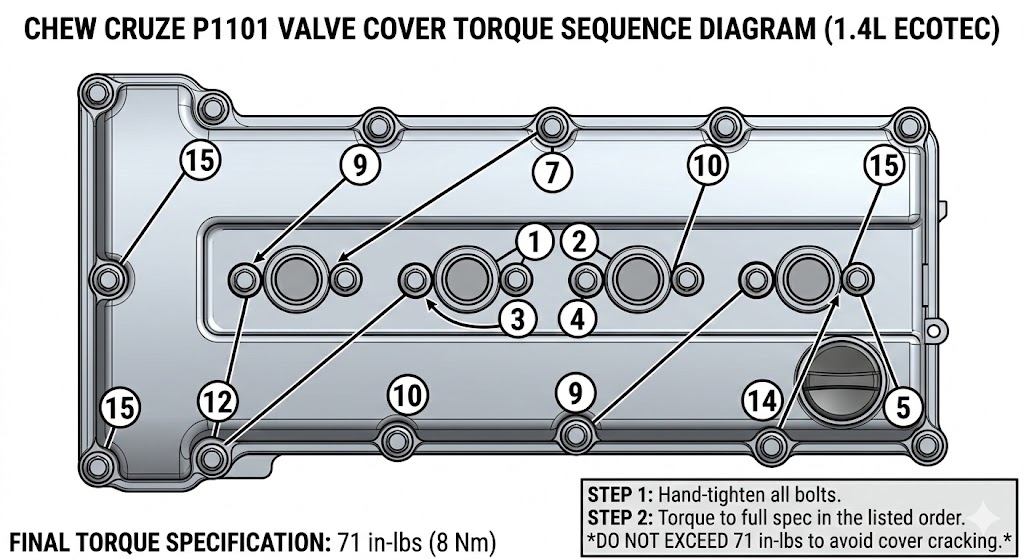
Never tighten the valve cover bolts in a random order. To prevent cracking the plastic cover or pinching the gasket, you must follow a specific Center-Out pattern.
- Hand Tighten First: Spin all bolts down by hand until they just touch the cover.
- The Pattern: Start with the two bolts in the very center of the cover (near the spark plugs).
- Spiral Out: Move to the bolts directly surrounding the center, then work your way to the outer perimeter, alternating sides (criss-cross) as you go.
- Final Torque: Once all bolts are snug, do a final pass with your torque wrench to 71 in-lbs (8 Nm). Note: You may need to do two passes, as the gasket compresses and loosens the bolts slightly.
Chevy Trax 1.4 Turbo Ecotec Valve Cover BOLT SEQUENCE And TORQUE SPECS
This video is visualizes the specific bolt tightening sequence for the 1.4L Ecotec engine.
Repair Options and Typical Costs
If you are wondering exactly how much does it cost to fix a P1101 code, the answer varies largely based on whether the intake manifold check valve is salvageable or if you simply need a new vacuum hose.
Here’s a cost and difficulty comparison for the most common P1101 Code Chevy Cruze fixes:
| Repair / Component | Parts Cost (USD) | Labor Time (hrs) | Typical Shop Total* | DIY Difficulty | Notes |
|---|---|---|---|---|---|
| Valve cover (PCV integrated) | $80–$200 | 1.5–3.0 | $250–$500 | Medium–Hard | Requires careful torque pattern and gasket seating |
| PCV / vacuum hose replacement | $10–$60 | 0.5–1.0 | $80–$180 | Easy–Medium | Often the cheapest fix if hose is visibly damaged |
| Intake boot / charge pipe replacement | $40–$150 | 0.5–1.5 | $120–$300 | Medium | Look for splits near clamps and bends |
| MAF sensor replacement | $70–$200 | 0.3–0.5 | $100–$260 | Easy | Try cleaning before replacing |
| Throttle body cleaning (shop) | Included / $20–$50 | 0.5–1.0 | $80–$150 | Easy–Medium | Good maintenance to pair with MAF cleaning |
| Evap purge valve replacement | $40–$100 | 0.5–1.0 | $120–$220 | Medium | Can cause rough idle and lean issues |
*Typical total varies by region, shop rates, and parts choice (OEM vs aftermarket).
How to Prevent P1101 from Returning?
Once you’ve fixed the cause of the P1101 Code Chevy Cruze, a few habits can reduce the chance of seeing it again.
Preventive tips:
- Replace the engine air filter on schedule.
- Avoid over‑oiled aftermarket filters that can contaminate the MAF.
- Periodically inspect hoses and intake ducting for early signs of cracking.
- Use quality oil and change it on time to limit PCV system contamination.
- Clean the throttle body and MAF before problems get severe (every 40–60k miles).
- Address any new rough idle, whistling, or lean codes quickly rather than driving for months.
How to Prevent the P1101 Code from Returning
To avoid expensive repairs and recurring check engine lights, follow this routine maintenance schedule specifically for the Chevy 1.4L Ecotec engine:
- Inspect the “Orange Nipple” Every Oil Change: Periodically remove the corrugated PCV hose to ensure the orange check valve is still present inside the intake manifold.
- Keep the MAF Sensor Clean: Use a dedicated MAF sensor cleaner every 30,000 to 40,000 miles to prevent oil and dust buildup from skewing airflow readings.
- Replace the Engine Air Filter Annually: A clogged filter stresses the turbo and can lead to incorrect pressure readings that trigger airflow performance codes.
- Clean the Throttle Body: Use a throttle body cleaner every 50,000 miles to remove carbon buildup around the butterfly valve, ensuring smooth airflow at idle.
- Monitor for Hissing Sounds: Listen for a “whistling” or “chirping” noise at idle; catching a failing PCV diaphragm early can prevent blown engine seals from excessive crankcase pressure.
- Use High-Quality Full Synthetic Oil: Changing your oil on schedule reduces the amount of oil vapor entering the PCV system, which protects the intake manifold check valve from getting stuck or damaged.
- Check Intake Boot Clamps: Ensure the clamps on the intake air ducting are tight; loose clamps allow “unmetered air” to enter, which is a common trigger for P1101.
DIY vs Mechanic: Pros and Cons
Pros of DIY P1101 Diagnosis/Repair
- Save money on labor, especially for simple tasks like cleaning the MAF or tightening clamps.
- Learn more about your vehicle and spot future problems early.
- Many common causes (intake leaks, simple hose replacements) are low-risk for a careful DIYer.
Cons of DIY P1101 Diagnosis/Repair
- Misdiagnosis can lead to unnecessary parts and wasted time.
- Some fixes (valve cover replacement) require correct torque patterns and gasket handling.
- Without a scan tool and data reading, you may miss less obvious issues.
- If you’re not comfortable, you risk damaging connectors, sensors, or plastic components.
If you try the basic checks and the P1101 Code Chevy Cruze keeps returning, it’s wise to have a trusted shop perform a smoke test for leaks and read live data.
Actionable Checklist
Use this checklist to tackle a P1101 code methodically:
- Scan for additional codes (especially P0171) and record them.
- Inspect intake ducting from airbox to turbo/throttle for cracks and loose clamps.
- Check PCV and vacuum hoses for splits, oil saturation, or collapse.
- Listen for whistling or strong vacuum at the valve cover (suspect PCV/valve cover).
- Clean the MAF sensor using proper MAF cleaner and reinspect.
- Clean the throttle body if visibly dirty, as severe carbon buildup in the throttle body causes P1101 errors by restricting the expected airflow at idle.
- Clear codes and perform a test drive (mixed city/highway) to see if P1101 returns.
- If the code persists, consider smoke test, MAF replacement, or valve cover replacement.
- Document what you’ve done to help a mechanic if you decide to go to a shop.
Conclusion
Solving the Chevy Cruze P1101 issue usually requires a systematic check of the PCV system and intake airflow sensors. Most often from PCV/valve cover failures, intake leaks, or MAF/throttle body issues. A systematic check of hoses, the PCV system, and sensors will usually pinpoint the cause without guesswork.
If you’re not comfortable diagnosing it yourself, schedule a visit with a trusted mechanic and share the symptoms and steps you’ve already taken.
FAQs
1. Is it safe to drive my Chevy Cruze with a P1101 code?
Usually you can drive short distances if the car runs reasonably well, but it’s not ideal long term. A persistent airflow or lean condition can stress the catalytic converter and engine. Treat it as “drive to diagnose and repair soon,” not “ignore for months.”
2. What does P1101 mean specifically on a Chevy Cruze?
On a Cruze, P1101 means the ECM detected abnormal intake airflow during a self‑test. It compares MAF, throttle position, and manifold pressure; if readings don’t match what’s expected, the code sets. It’s often linked to intake leaks, MAF issues, or PCV/valve cover problems.
3. Why is my StabiliTrak light on with the P1101 code?
When a P1101 Chevy Cruze StabiliTrak warning appears simultaneously with your check engine light, don’t panic. The engine computer automatically disables the traction control system as a safety precaution whenever it detects abnormal airflow or a rough idle.
4. Can code P1101 cause a loss of power?
Yes. If you are experiencing a P1101 code Chevy Cruze loss of power scenario, it is usually because a severe vacuum leak (like a blown PCV diaphragm) prevents the turbocharger from building adequate boost, making the car feel sluggish during acceleration.
5. What is the most common cause of a P1101 code?
While dirty MAF sensors happen, the absolute most common cause of P1101 Chevy Cruze errors on the 1.4L Turbo engine is a ruptured PCV diaphragm inside the plastic valve cover, usually triggered by a missing intake manifold check valve.
6. Can a dirty air filter cause P1101?
An extremely clogged air filter can affect airflow, but it’s not the most common cause on a Cruze. More often, P1101 comes from leaks, PCV issues, or a dirty or failing MAF sensor. Checking and replacing a dirty filter is still an easy first step.
7. Do I need a smoke test to find the leak?
A smoke test isn’t mandatory, but it’s very effective at revealing hidden intake or vacuum leaks. If basic visual checks fail to find the problem and P1101 persists, a professional smoke test is often worth the cost.
8. Can low-quality fuel trigger P1101?
Low-quality fuel can cause drivability issues, but P1101 is primarily about airflow, not fuel quality. Bad fuel might set misfire or knock-related codes before it would be associated with P1101. Focus diagnostics first on air leaks, the PCV system, and the MAF sensor.
9. Will clearing the code without repair fix the problem?
Clearing the code will turn the light off temporarily, but if the underlying airflow issue remains, P1101 will usually return after a few drive cycles. Code clearing should be used as a test step after repairs, not as the repair itself.
10. How long does it take to fix P1101 on a Cruze?
Simple fixes such as tightening clamps, replacing a hose, or cleaning the MAF can be done in under an hour. Valve cover replacement or deeper diagnostics may take a few hours. The main time factor is correctly identifying the root cause before replacing parts.