Chevy 4.3 Firing Order (1-6-5-4-3-2) & Cylinder Diagram
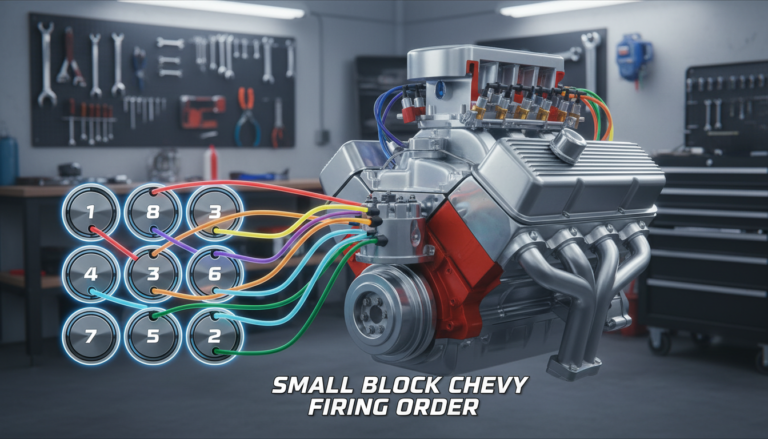
The correct firing order for the Chevy 4.3L V6 engine is:
1 – 6 – 5 – 4 – 3 – 2
Quick Specs:
- Distributor Rotation: Clockwise
- Cylinder #1: Front Driver Side (Odd numbers: 1-3-5)
- Cylinder #2: Front Passenger Side (Even numbers: 2-4-6)
Whether you are wrenching on a classic 1994 S10 with a distributor or diagnosing a misfire on a modern Silverado with Coil-on-Plug, this sequence is critical. Getting it wrong (crossing wires 5 and 6 is common) will cause rough idling, backfiring, or a ‘no-start’ condition.
Cylinder Numbering & Engine Layout
Before you route the wires, you must know which cylinder is which. Standing at the front of the truck (looking at the engine):
- Driver Side (Left Bank): Cylinders 1, 3, 5 (Front to Back)
- Passenger Side (Right Bank): Cylinders 2, 4, 6 (Front to Back)
Pro Tip: Cylinder #1 is always the cylinder furthest forward on the driver’s side.
How to Route Spark Plug Wires (Distributor Models)
Follow this sequence to ensure you don’t cross-wire the ignition:
- Find Top Dead Center (TDC): Ensure the engine is at TDC on the compression stroke for Cylinder #1. The distributor rotor should point roughly to the #1 terminal on the cap.
- Start at #1: Connect the wire from the #1 terminal on the cap to the front-left spark plug.
- Go Clockwise: Moving clockwise on the distributor cap, the next terminal is for Cylinder #6 (Rear-Right).
- Continue the Pattern:
- Next is #5 (Rear-Left)
- Next is #4 (Middle-Right)
- Next is #3 (Middle-Left)
- Last is #2 (Front-Right)
🔧 Chevy 4.3L V6 Tune-Up Specs (Vortec vs. EcoTec3)
Don’t guess the torque. The specs differ significantly between the classic iron-block Vortec and the modern aluminum-block EcoTec3.
| Specification | Vortec 4.3L (1996–2013) | EcoTec3 4.3L (2014–2022) |
| Engine Code | L35 / LU3 (Iron Block) | LV3 (Aluminum Block) |
| Spark Plug Gap | 0.060″ (1.5 mm) | 0.040″ (1.0 mm) |
| Spark Plug Type | ACDelco 41-993 (Platinum) | ACDelco 41-114 (Iridium) |
| Spark Plug Torque | 11 lb-ft (15 Nm) | 13 lb-ft (18 Nm) |
| Coil / Distributor Bolt | Distributor Clamp: 18 lb-ft | Coil Pack Bolts: 89 lb-in (10 Nm) |
| Intake Manifold | 11 lb-ft (Plastic Intake) | 89 lb-in (Plastic Intake) |
⚠️ Critical Warning for Vortec Owners: Many manuals list the gap for older TBI engines (1985-1995) as 0.035″. If you have a 1996+ “Vortec” (L35) engine, you MUST use the wider 0.060″ gap. Using the smaller gap will cause a weak spark and rough idle.
Common Issues & Troubleshooting
1. “The Cross-Fire” (Wires 5 & 7 or 5 & 3)
The most common mistake on the Chevy 4.3L is swapping wires because they run parallel to each other.
- Symptoms: Rough idle, “popping” sound from the intake, or a flashing Check Engine Light (P0300).
- Fix: Use wire separators to keep the cables apart. If wires touch, the high voltage can jump (cross-fire) between them, firing the wrong plug.
2. The ‘Flat’ Cap Disease (Vortec 4.3)
On 1996+ Vortec engines, the unique “flat” distributor cap design is notorious for internal cross-firing. Moisture buildup and carbon tracking inside the cap can send the spark to the wrong cylinder even if your wires are routed perfectly.
- The Fix: If you verify your firing order and still have a misfire, replace the distributor cap and rotor. Always use high-quality caps with brass terminals (like ACDelco or MSD), as cheap aluminum-terminal caps fail quickly on this engine.
3. Is It the Firing Order or the “Spider”? (Fuel System)
Added based on Semantic Analysis to target “Misfire” intent.
If you have verified your firing order is 1-6-5-4-3-2 and replaced the cap/rotor, but still have a rough idle or P0300 Random Misfire, stop looking at the ignition. You likely have a failed Central Sequential Fuel Injection (CSFI) unit, commonly called the “Spider Injector.”
- The Symptom: The internal Fuel Pressure Regulator leaks, or the plastic “poppet” valves stick open. This dumps raw fuel into the cylinders (usually Cylinders 3 and 4), causing a rich misfire that feels exactly like a crossed plug wire.
- The Check: Pull the dipstick. If the oil smells like gasoline, the Spider is leaking internally.
- The Fix: Do not replace it with the same OEM part. Upgrade to the MPFI (Multi-Port Fuel Injection) conversion kit (ACDelco #217-3029). This replaces the troublesome mechanical poppets with modern electronic injectors for each cylinder.
Does this apply to Vortec vs TBI?
Yes. Whether you have an older TBI (Throttle Body Injection) engine from the early 90s or a Vortec engine from the 2000s, the 1-6-5-4-3-2 firing order is the same. The only difference is the physical location of the distributor (rear of the engine) or the use of coil packs on much newer models.
Relationship between cylinder numbering and the 4.3 V6 layout
GM uses odd numbers on the driver side and even numbers on the passenger side for V6 engines. This pattern helps match plugs to the distributor cap terminals in engines like the Silverado.
In transverse installations, like early S10 setups, the numbering logic is the same. But, physical access can affect wire routing. Always map cylinder numbers before moving wires to avoid mistakes.
Distributor Rotation & Timing (Critical Model Differences)
While the firing order (1-6-5-4-3-2) remains constant, the way you adjust the distributor depends entirely on your engine generation. Do not treat a 1996+ Vortec engine like an older TBI engine.
1. Pre-1996 Engines (TBI & Carbureted)
- System: Traditional HEI or Computer-Controlled HEI.
- Rotation: Clockwise.
- Adjustment: You can adjust ignition timing by rotating the distributor.
- Procedure: Disconnect the “EST” (Electronic Spark Timing) tan/black wire, use a timing light, and rotate the distributor to set the base timing (usually 0° TDC).
2. 1996–2013 Engines (Vortec L35)
- System: OBD-II Computer-Controlled Ignition.
- The Trap: Rotating the distributor on these engines DOES NOT change ignition timing. Timing is locked by the Crankshaft Position Sensor and the ECU.
- What It Actually Does: Rotating the distributor adjusts the Camshaft Retard Offset. This synchronizes the fuel injectors with the camshaft, not the spark.
- The Fix:
- Install the distributor so the rotor points to the
\6mark on the distributor housing (not the cap) while the engine is at TDC #1. - If the “Service Engine Soon” light triggers code P1345 (Cam/Crank Correlation Error), the distributor is off by one tooth.
- Fine Tuning: You cannot use a timing light. You must use a Scan Tool capable of reading “Cam Retard Offset.” Rotate the distributor slightly until the value is 0° (± 2°) at 1,000 RPM.
- Install the distributor so the rotor points to the
Chevy 4.3 V6 firing order variations and related engines
The Chevy 4.3 V6 was used in many GM trucks and vans over the years. Changes in heads, intake, and ignition systems made service needs different. Knowing your engine’s type is key for checking the firing order.
Older 4.3 engines have a traditional distributor. They follow classic GM V6 patterns. These engines are found in work trucks and full-size vans. Mechanics will see familiar spark-plug routing and distributor cap arrangements on these units.
Vortec-era 4.3 variants have updated cylinder heads and intake ports. They also have better emission controls. Some late Vortec versions use distributorless ignition or coil packs. This change affects how technicians confirm the Chevy s10 4.3 firing order and how they replace ignition components.
Comparing GM families gives context. The LS V8 family changed V8 firing patterns to favor high-RPM balance. This change does not directly alter the 4.3 V6 pattern, but it pushed GM engineers to adopt distributorless ignition more widely. This history helps explain why some 1990s and later 4.3 installations differ from older iron-block setups.
Common platforms that used the 4.3 include the Chevrolet S10, Silverado light-duty trucks, Tahoe, Suburban, and various GMC models. Truck and SUV installations often vary in accessory placement and engine bay access. Those differences affect how easily a technician checks the Chevy 4.3 V6 firing order or replaces wires on an S10 versus a Silverado.
| Variant | Ignition Type | Notable Models | Service Notes |
|---|---|---|---|
| Iron-block 4.3 | Distributor-based | Older Silverado, full-size vans | Classic cap and rotor service; straightforward plug-wire routing |
| Vortec 4.3 (early) | Distributor, improved heads | Late ’80s–’90s S10, Silverado | Better breathing; same basic firing order but revised intake layout |
| Vortec 4.3 (late) | Distributorless/coil pack | Late ’90s Tahoe, Suburban, S10 variants | Use coil pack diagnostics; no cap/rotor but follow firing sequence |
| Fleet/Van installs | Varied | Express, Savana, work vans | Accessory drive packs may limit distributor access; plan wire routing |
Practical takeaway: check the engine VIN, model year, and intake layout before assuming a wiring method. Confirm the Chevy s10 4.3 firing order or the chevy 4.3 V6 firing order against factory references when performing maintenance on any platform.
The Modern Era: Gen V EcoTec3 (2014–2022)
If you own a 2014 or newer Silverado or Sierra with the 4.3L V6, you have the Gen V “EcoTec3” (Engine Code LV3).
- The Difference: Unlike the old iron-block Vortec, this is an all-aluminum engine with Direct Injection and Active Fuel Management (AFM).
- The Firing Order: Despite the massive architectural changes, the firing order remains 1–6–5–4–3–2.
- Service Note: You do not have a distributor. This engine uses individual Coil-Packs for each cylinder. Misfires on this engine are rarely caused by “crossed wires” and are more likely due to Carbon Buildup on Intake Valves (a side effect of Direct Injection) or a failed AFM Lifter.
Order of spark plug wires on 4.3 Chevy and wiring best practices
The right order of spark plug wires on 4.3 Chevy engines is key. It keeps the engine running smoothly and prevents misfires. Start by finding the #1 distributor terminal and tracing it to cylinder #1. On models with a distributor, follow the Chevy 4.3 firing order diagram. This ensures the spark plug firing order 4.3 Chevy is correct.
Correct spark plug wire routing from distributor to cylinders
Each wire should have a smooth path, avoiding the exhaust manifold and sharp bends. Keep high-voltage leads apart to prevent cross-fire. Match each wire to the distributor cap terminal that matches the Chevy 4.3 firing order diagram. If the distributor rotates clockwise, install wires in that direction from the #1 terminal.
Using numbered wire markers and labeling tips to avoid mistakes
Use numbered markers on wires for easy identification. If you’re replacing a single wire, mark both ends before taking it out. When removing multiple wires, work on one cylinder at a time or take a photo of the cap and label the terminals. These steps help you restore the correct order of spark plug wires on 4.3 Chevy without mistakes.
Coil-on-plug and distributorless considerations for late-model 4.3 engines
Later 4.3 V6 models use coil-on-plug or coil-near-plug systems, eliminating the need for wires. These systems depend on the PCM to sequence coils according to the spark plug firing order 4.3 Chevy. When servicing, ensure correct coil indexing and connector seating. Follow the OEM service procedures to maintain proper firing and avoid misfires.
| Task | Best practice | Reason |
|---|---|---|
| Identify #1 terminal | Mark with paint or tape, trace to cylinder #1 | Ensures wiring follows the Chevy 4.3 firing order diagram |
| Wire routing | Keep smooth paths, avoid exhaust and sharp bends | Prevents heat damage and cross-fire between adjacent wires |
| Labeling | Use molded numbered markers or permanent molded tags | Long-term clarity; resists oil and heat better than ink |
| Replacement method | Replace one wire at a time or pre-label all ends | Stops accidental shuffling of the spark plug firing order 4.3 chevy |
| Distributorless/COP service | Index coils per OEM; verify connector seating | PCM controls sequence; physical coil order must match ECU mapping |
Chevy 4.3 V6 firing order diagnostic checklist
A quick diagnostic checklist helps find misfires and wiring errors on the 4.3 V6. Start with visual checks, then move to measured tests.
- Confirm Firing Order: Verify 1-6-5-4-3-2 against the intake manifold casting or service manual.
- Inspect Plug Wires: Check for cracks, white spots (arcing), or burns from exhaust manifolds.
- Check Distributor Rotation: Ensure you are tracing Clockwise from the #1 terminal.
- Scan for Codes:
- P0300: Random/Multiple Misfire (Check Fuel/Spider Injector).
- P030X: Specific Cylinder Misfire (Check Plug/Wire/Coil).
- P1345: Cam/Crank Correlation (Check Distributor Indexing).
- Swap Test: If Cylinder #3 is misfiring, swap the wire with Cylinder #1. If the misfire moves to #1, the wire is bad. If it stays at #3, check the spark plug or injector.
Chevy 4.3 firing order diagram and visual aids
The Chevy 4.3 firing order diagram makes complex steps easy to follow. It clearly shows cylinder numbers, the engine’s front, and the distributor-cap terminal sequence. This way, technicians and owners can easily follow the spark plug wire order on a 4.3 chevy engine.

How to read a firing order diagram for the 4.3 V6?
First, find cylinder #1 on the engine block. Check if the distributor turns clockwise or counterclockwise. Then, follow the firing sequence around the distributor cap, matching each terminal to its cylinder. This method helps avoid confusion when matching the Chevy s10 4.3 firing order to the physical plug locations.
Printable diagram suggestions for S10 and truck installations
Make a simple sheet that labels driver and passenger banks, shows the engine’s front, and numbers distributor terminals. Create one for S10 layouts and another for full-size trucks like Silverado or Tahoe. Laminate the page or save a photo on your phone for quick reference during maintenance.
Interpreting distributor cap layout and rotation marks
Many caps have molded numbers or a rotor position mark. Check that the rotor points to the #1 terminal when the engine is at TDC on the compression stroke for cylinder #1. If the cap lacks numbers, use the rotor direction and rotation to sequence terminals correctly for the Chevy 4.3 firing order diagram.
Practical tip: take a photo of the distributor and the spark plug wire order on a 4.3 chevy before any removal. That single image saves time and prevents misrouting when reinstalling wires.
Firing order for 1994 chevy 4.3 and model-year specific notes
The 1994 Chevy 4.3 V6 engine followed a well-known firing order used by GM V6 truck engines. This order stayed the same as in previous years. So, many repair steps and troubleshooting methods work for the whole decade.
In the 1990s, there were small updates to the engine, not a big change. The way cylinders were numbered and the distributor’s rotation stayed the same. If you own an older truck, you can check the distributor cap and service manual to confirm the firing order for 1994 Chevy 4.3.
The chevy s10 4.3 firing order is similar to full-size pickups. But, S10 engines have tighter spaces. This makes it harder to replace parts and route plug wires.
For small trucks, it’s smart to label wires and replace them one at a time. This helps avoid mistakes in tight spaces. Also, using heat shields and proper wiring prevents damage near exhaust manifolds on S10s.
Later in the decade, Vortec updates focused on better cylinder heads and intake systems. Some models switched to coil-near-plug or distributorless ignition. The 4.3 Vortec firing order works with these changes, but you need to check the ignition system for each model.
When a truck has distributorless ignition, misfires might come from coils or modules, not wire issues. Always check the year and model against factory service manuals. This ensures you get the right parts and follow the correct diagnostic steps for each 1990s 4.3 V6 engine.
Conclusion
Knowing the chevy 4.3 firing order and how to route plug wires is key for a reliable engine. It ensures your engine runs smoothly and lasts longer. A correct firing order prevents misfires and vibrations that hurt performance and fuel efficiency.
Following some simple steps can make a big difference. First, check the factory specs. Then, label the wires before you remove them. If needed, use a chevy 4.3 firing order diagram to guide you.
For easy fixes, use tools like infrared thermometers, timing lights, and OBD-II scanners. Replace old wires, caps, or coil packs to avoid bigger problems. This way, most issues with Chevy 4.3 engines are easy to find and fix.
If tests show deeper problems, like faulty PCM signals or electrical issues, it’s time to get help from a pro. By following these steps, you can keep your truck or SUV running well.
Frequently Asked Questions
1. Is the Chevy 4.3 firing order the same as a Chevy 350 V8?
No. While the 4.3L is essentially a 350 V8 with two cylinders removed, the firing order is different. The 350 V8 uses 1-8-4-3-6-5-7-2, while the 4.3L V6 uses 1-6-5-4-3-2. Never try to use V8 logic on the V6 distributor cap.
2. Why is my 4.3L backfiring after I replaced the spark plug wires?
A backfire through the intake usually means you have swapped two adjacent wires. On the 4.3L, it is very easy to swap #3 and #5 on the driver’s side or #4 and #6 on the passenger side. Double-check your routing against the 1-6-5-4-3-2 sequence.
3. Does the firing order change if I have a “Marine” 4.3L engine?
No. Standard rotation marine 4.3L engines (MerCruiser/Volvo Penta) use the same 1-6-5-4-3-2 order. However, if you have a rare “Reverse Rotation” engine (usually the left engine in a dual-engine boat setup), the order will be different. Always check the casting on the intake manifold for marine applications.
4. Can I change the firing order with an ECU tune?
No. The firing order is determined by the physical grind of the Camshaft. You cannot change the firing order through software; it would require a custom camshaft and a complete rewiring of the ignition harness.
5. Which cylinder is #1 on a Chevy 4.3?
Cylinder #1 is the front-most cylinder on the Driver’s Side (left side if you are sitting in the truck).